Stretch Developer

Taking urban development into our own hands

  • Home
  • About
  • The Project
    • Finding a Property
    • Design
    • Approvals
    • Financing
    • Construction
    • Performance
  • Blog
  • Contact
  • Rental Suite

Financing 101

June 26, 2015 by clove Leave a Comment

So I don’t actually know yet how we are going to pay for our project. I know, right? The trick is that if you haven’t done it before and just “know”, you don’t really know until you have a designed and appraised project. This is what the many lenders/brokers I talked with asked: do you have a design? Do you have an appraisal? Well, no, I was hoping to get some answers before we committed. But it seems to be one of those things we will only really learn by doing and bumbling through.

Here’s what I do know, and the basis for my high level confidence that our project makes financial sense:

We bought the house for $565,000. We can build the attached or detached new house for $300,000-$400,000, and we can renovate the existing house for around $200,000. If we built an attached addition, we could sell it for $500,000 – $600,000, which covers the cost of the new build and the renovation. We are then left with a renovated house with a suite for the same cost as the original house, but with the added rental income. So overall, our project makes financial sense. If we go the detached route, the construction cost numbers don’t really change, but the sales price is likely closer to $700,000.

But wait! There’s a piece in between: regardless of how good the end picture looks, a lender is not going to lend based on future potential alone. And! The lending scenario looks different if we go with the attached/strata option versus subdividing and building a separate dwelling on its own titled lot.

Here’s what I learned from our mortgage broker Scott Travelbea, who did his own lot subdivision development project a couple of years ago:

For both the subdivision and attached dwelling options, we need to self fund the project to the point where we have approval for the subdivision/rezoning and/or development permit application. However, for the subdivision option, once we have that new lot serviced and titled, it now has real value to a lender, and they are willing to lend against that serviced lot. If the project fails, they have something of value that they can turn around and sell to recover their costs.

In order to be approved for a loan on top of our existing mortgage, we also need to have 20% equity in the existing house, and some money to get the construction started.

In an attached duplex/strata scenario, we need to be much further along in the construction before a lender will be comfortable throwing money at us. If we screw up the project and don’t finish, there isn’t much of value for the lender to recover, given shared land, shared walls etc.

So let’s look at our numbers for the detached option:

  • We have $80,000 down on the existing house on a purchase price of $565,000 (14%).
  • We currently have $100,000 and change in the bank to fund the rest of the project.
  • Say we can limit upfront design and rezoning application costs to $20,000.
  • Once the project is approved, both houses will be re-appraised and we may need to put in some extra cash to bump us up to 20% equity in the existing house – let’s assume another $30,000 (based on the purchase price).
  • Then we need some cash to get us through to the first construction phase draw – if $50,000 is enough to get started here, we are in business.

My current feeling is that if we do, in fact, have enough money now, we barely have enough money now.

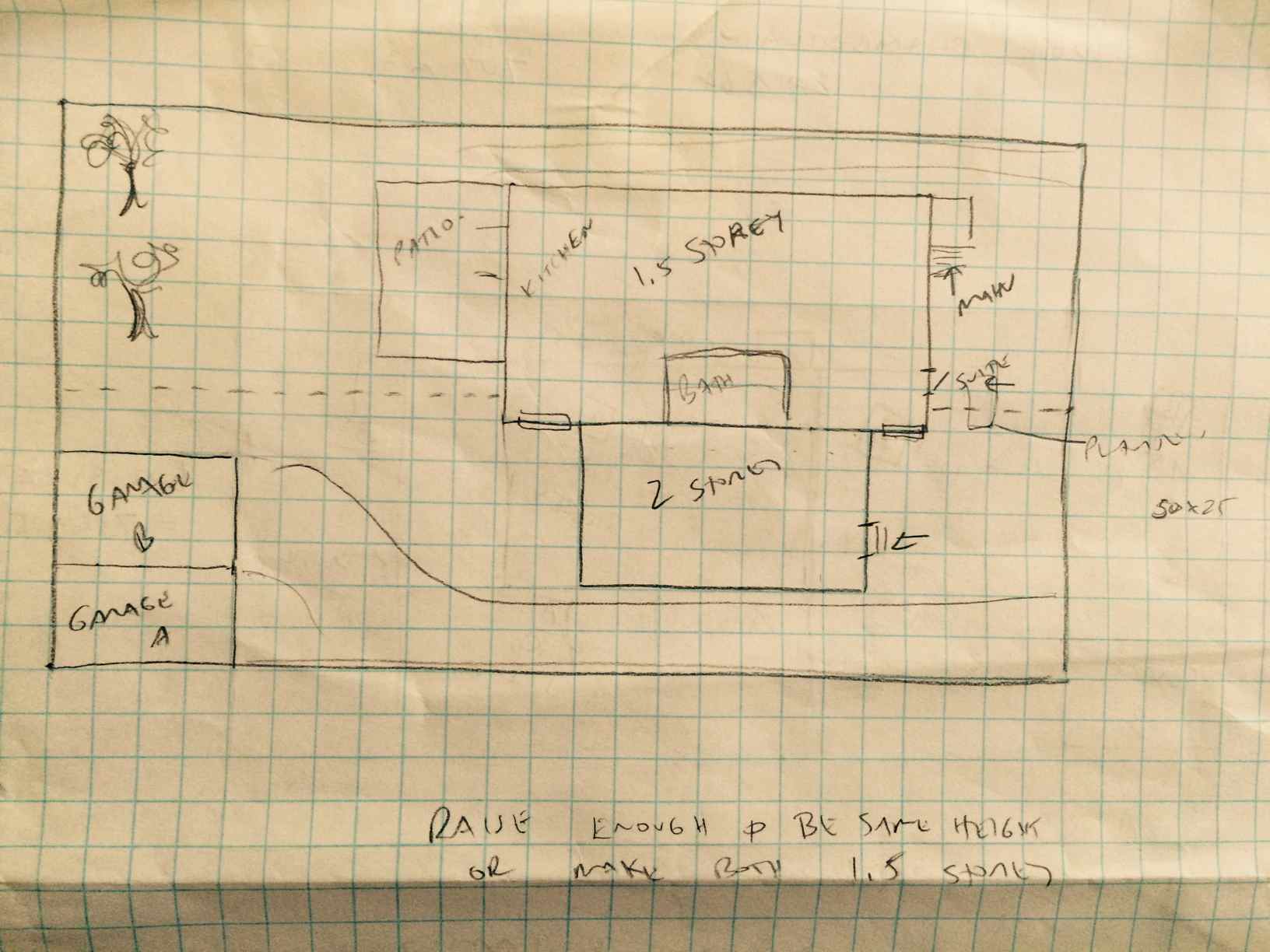
The downside to doing a detached option is that we do not get the additional passive benefit of the combined building volume (minimizing our exterior surface area to internal volume ratio). However, we can sell a detached house for more than an attached strata duplex, at roughly the same cost to build. The detached option is easier to manage long-term since there is no common property. We may not meet Passive House standard, but ultra low energy/net zero is still feasible with a simple smart design and a good enclosure.

Filed Under: Featured, Financing Tagged With: financing, pro forma

How we got our property

June 20, 2015 by clove Leave a Comment


May 1_15 House viewing with advisors_MA

Site walk with our “team” soon after conditions were removed

The house sat on the market for 6 months last year and I didn’t see the listing because it was out of our listing price range at the time ($600,000 or less). It was re-listed this year at $599,000 and got no early bites. I barely noticed it the first time I saw it, but eventually circled back. I found that I only saw the houses with good curb appeal the first time around, so I would later comb through older listings to see if I’d missed something with potential. This was one of those properties.

We visited the property in late March 2015. It was a stinky smoker house that was old but with good bones, reasonably cared for and livable. It had a low 6’ basement with a finished room and bathroom added, which was laughably called the “master suite” in the listing- so long as this “master” is 5′ tall with no sense of smell. The location was great and the lot big (~7600 sqft /700 sm).

At this time, though, my American Matt had only just received his Canadian permanent residency and had started working 2 days a week. We couldn’t afford anything near $599,000, which we felt was overpriced anyway. So we tried a low-ball offer at about the land value: $500,000. They countered by dropping the price to $595,000. Ha! I talked to our lender – what was the most we could afford? $540,000 if we really stretched it. OK, let’s try that. No dice. They still wanted more and the offer died.

I kept thinking about the property. I drew more sketches, crunched more numbers, and felt more convinced that this was a good one.

Meanwhile, the house had now been on the market for 30 days, which is an eternity for a house in this location and in this market. It was clearly overpriced. I thought about approaching the owners without an agent as a way to lower the sales price with less impact on the funds going to the sellers. Ultimately, I wasn’t confident enough about how to write an offer to go this route.

A couple of weeks later, they dropped the price to $575,000 and they suddenly generated a bunch of interest. At the same time, Matt had picked up another day of work and was approaching the end of his 3 month probationary period (typically a requirement of the lender). They would be accepting offers until 5PM the next day. I ran the numbers with our mortgage broker again using Matt’s new income. We could now purchase up to $580,000 with $80,000 down and an uncomfortably high monthly payment.

We took another shot: $551,000, and made it only subject to financing but not inspection in an attempt to sweeten our offer. We were one of three offers and they accepted the highest, at $565,000. Lost it again, and this time it hurt a little more. I counseled myself that if it was meant to be, it would be. There is always another house! But I was still bummed. We found ourselves wondering – if the numbers and the project and the location all look so good, would it have been worth the extra $15,000 up front to get the damned thing?

6 days later, our agent Christina called us to say the other deal fell through and would we like to put in another offer (this would be our fourth kick at the can!)? Ok! Let’s do this! We offered $560,000, same conditions as last time. They had also reached out to the other buyers who had lost out on the last round, so again they had multiple offers to consider. They came back to us and said that the other party offered $565,000 but they liked our conditions better, so if we could match their price, the house was ours. So we went for it. The extra money spent did not mean our project would no longer be viable, so it seemed silly to pass this one up. And with four chances, it was clearly meant to be!

After some hiccups around Matt’s employment history in Canada, the conditions were removed on May 8, 2015 with a closing date of July 2. Phew.


Filed Under: Featured, Finding Land Tagged With: finding land

The Chase

June 15, 2015 by clove Leave a Comment

I had several RMLS searches set up through a local realtor (thanks Christina!), which I poured over obsessively: one for houses less than $400,000 (“land value” houses); one for houses up to $700,000 (this gave me a good picture of the local market); one for bare lots less than $400,000 (almost nothing came up, ever, but the occasional $1.5M waterfront lot slipped through my search filters and gave me a good jolt -yep, that one’s nice…).

When I saw something in a good location that seemed to have potential, I looked it up on the local GPS map (in Victoria, vicmap), to check the current zoning, the assessed and land values (and compare these to the asking price), and to take site measurements on the aerial map. If promising, we went to see the property; I drew up one or more rough to-scale schemes that might work, and did a very high level financial analysis (cost of land + cost to build – likely sales price – cost of ownership).

Chamberlain Sketch

Basic ‘to scale’ sketch

If still looking good at this point, I then emailed the local area planner to ask about rezoning potential for a specific lot (most of my schemes involved increasing density on a single family or duplex lot, which kicks it into a rezoning process). I saw the potential in many sites and filled pages and pages of potential schemes – each a little different to suit the property. Many were unrealistic given the likelihood of getting the project approved, but this was all good learning.

I also sought input for any potentials from my “team”. Since beginning my search, I’ve been building relationships and picking the brains of those with more experience, with the intent of hiring them when we have a real project. People like Rob and Mark Bernhardt of Bernhardt Contracting, who built the first two certified Passive Houses in Victoria. And Ian Scott, who is a former City of Victoria planner and now consults on his own. And my architect friend Mark Ashby, of Mark Ashby Architecture, who will ultimately design our project for us.

If we were excited about the property, and neither the area planner nor any of our advisors raised any major red flags, Matt and I talked seriously about putting in an offer. Before we got our property, we talked seriously about two or three properties and made one other (losing) offer.

In a hot market, doing this due diligence up front can be tough, so there is also an element of instinct. After scanning properties for over a year, and drawing up dozens of schemes, I learned what to look for and had a pretty good sense when was a good time to jump. Patience is advised, as it does take time to learn what to look for.

Pile of sketches

my pile of sketches


Filed Under: Featured, Finding Land Tagged With: finding land, property search tips

In the Meantime…

June 9, 2015 by clove Leave a Comment

An important element to consider is what you will do with the property between the time that you buy it and realize your project. I imagine this is less important for a larger developer who has Capital. But for regular people like us, these details can make a big difference. What you will do with the property in the meantime will inform what type of property you can buy.

If the property is already zoned for what you need, then you are looking at the amount of time to design the project and get permits in place – 3 to 6 months if you’re on it and you can do some of the design work before the sale closes. If the property has to be rezoned, plan on a year before you break ground.

Let’s consider some options:

  • Bare land
  • Property with a tear down
  • Property with a habitable residence

Bare land: Good luck finding anything in the walkable urban core, and if you do, it will be expensive (unless you are in a city recovering from urban flight/blight). In Victoria, unless you have a lot of cash, build higher density, or build very cheaply, the project is unlikely to be financially viable. When I first started my property search, I looked for any bare land lots that were below $400,000, but really the land would have to be less than $300,000 to be even remotely viable, assuming $200/SF build cost for 2000 SF (house + rental suite). If you get into higher density options, like a row house, the financial picture starts to look better, but you have to carry the cost of owning the bare land while you go through the design, rezoning, and/or permitting process, and the overall project costs are higher.

Property with a tear down: We looked at a couple of properties that fit this description (whether or not the seller agreed). One house we looked at was in very poor shape, but on a nice lot in a good location. It had elevated exterior doors with no stairs, rotting wood, a sagging, moss covered roof. The property was zoned for duplex, but was not currently a duplex. To make the property habitable while we went through design, we would have to do a lot of work.

Insurance can be an issue with these properties – don’t count on being able to get insurance without a lot of work/investment to rent it out in the short term. The most viable option if purchasing a property with a teardown is to purchase it with enough of a down payment that you can hold it without living in it or renting it out. If you can buy the land outright with cash, even better, although that was not an option for us. You will still need some kind of insurance on the property, though, and I’d recommend researching the cost of vacant house/uninhabited house insurance before plunging in.

Property with a habitable residence: If you plan to retain the existing residence, you have two key issues to consider: renting in the short term vs. moving in. Mortgage options differ if you are renting a house vs. using it as your primary residence. We were able to purchase our house with 14% down through a CMHC insured mortgage, and keep more cash on hand to fund the development (although we took a hit by adding the cost of CMHC mortgage insurance to our total mortgage). If we had financed with the intent of renting the house in the short term, we would have needed 20% down, and may not have gotten as favourable a lending rate. People sometimes bend the rules by “intending” to use the property as their primary residence, but then changing their intentions a month later.

If it’s a habitable house and you want to tear it down and start fresh, you are then faced with making a case that either the house is not worth saving, or potentially moving the house to another site.

Either way, you may be faced with some short term costs to meet the insurance providers’ requirements, which is why I recommend getting a house inspection done regardless of whether it is part of the sale conditions.

Filed Under: Featured, Finding Land Tagged With: bare land, finding land, property search

Cultivating Patience

June 2, 2015 by clove Leave a Comment

I have two words of advice around finding a suitable property for a development: be patient! I have to remind myself all the time. In fact, it’s a critical practice for the entire development process.

Spend some time getting to know your local market, as well as the city’s Official Community Plan and/or Neighbourhood Plans. My development ideas evolved as I got to know the local market. I started out thinking we would find a piece of bare land, build a duplex, live in one half and sell or rent the other half. When I came to terms with how expensive land is here, I had to think bigger to make the numbers work: maybe we could do a triplex or a row house? Certainly, the more sellable or rentable units you can fit on a piece of land, the more financially viable the project. But then you start butting up against rezoning challenges. You can’t just add density anywhere. To add significantly more density to a given lot, you’d better choose a spot that’s already bustling. The City of Victoria planners I spoke to encouraged me to look at busy corner lots for my higher density schemes. The trouble was, we didn’t want to live on a busy corner and didn’t know many other families who would want to either, given the choice.

The higher density options also meant a higher build cost and more money up front, which for us, would necessitate working with one or more partners. The project was getting bigger and more complex than we were likely ready for.

So we scaled back. What if we just built our own home with a suite? Nope, also not financially viable. We didn’t have $700,000, which is the minimum price tag given the cost of land (best case $300,000 for a small lot in an ok spot) and build cost (assuming $200/SF and 2000 SF) for a high performing house.

In a way, the property we eventually found dictated the project, but working out some schemes with round numbers was a good way to both learn what the viable options are, and to hone in on what was most important to us.

Filed Under: Featured, Finding Land Tagged With: finding a property, finding land, property search tips

  • « Previous Page
  • 1
  • …
  • 5
  • 6
  • 7

Who is Stretch Developer?

Stretch Developer is written by Christy Love. In partnership with my husband Matt, we are challenging ourselves to create the kind of homes we want to live in and see more of in our community. Home is the incredible Victoria, BC, Canada.

Sign up!

Sign up to receive email notifications of new posts.

Recent Posts

  • New Uses for Old Wood Part 2 September 26, 2021
  • Ongoing Preparations for the Apocalypse August 13, 2021
  • Things We’ve Noticed – Energy Edition May 29, 2021
  • Passive House Suite for Rent April 17, 2021
  • Things We’ve Noticed – Comfort Edition March 14, 2021

Blogs We Like

Green Building Advisor Blogs

Musings of an Energy Nerd

Treehugger

Talk to ARYZE

Recent Posts

  • New Uses for Old Wood Part 2
  • Ongoing Preparations for the Apocalypse
  • Things We’ve Noticed – Energy Edition
  • Passive House Suite for Rent
  • Things We’ve Noticed – Comfort Edition
  • New Uses for Old Wood Part 1

Tags

budget building permit cabinet construction climate action climate change community engagement construction deep energy retrofit design design progress development permit duplex duplex + suite energy consumption energy efficient design financing financing passive house finding land food security home inspections infill low energy design neighbourhood engagement net zero passive house Passive House comfort Passive House construction Passive House construction costs passive house for sale Passive House performance Passive House performance; Sanden CO2 heat pump Passive House rental Passive House systems passive house testing performance pro forma property search tips reclaimed wood reclaimed wood construction rezoning roof row house small lot development small lot subdivision ultra low energy

Copyright © 2026 · Metro Pro Theme on Genesis Framework · WordPress · Log in


Loading Comments...