Stretch Developer

Taking urban development into our own hands

  • Home
  • About
  • The Project
    • Finding a Property
    • Design
    • Approvals
    • Financing
    • Construction
    • Performance
  • Blog
  • Contact
  • Rental Suite

Master Class in Construction Sequencing

November 1, 2018 by clove 2 Comments

Things are really zipping along on-site, thanks to some ingenious sequencing work by our Project Manager, Mike.

Here is the progress update in photos and a video.

Insulated Concrete Form (ICF) foundation walls are wrapped with self-adhered waterproofing membrane. 4″ of additional rigid foam insulation is being installed on the outside of the ICFs for a total of just over 6″ insulation on the exterior side:
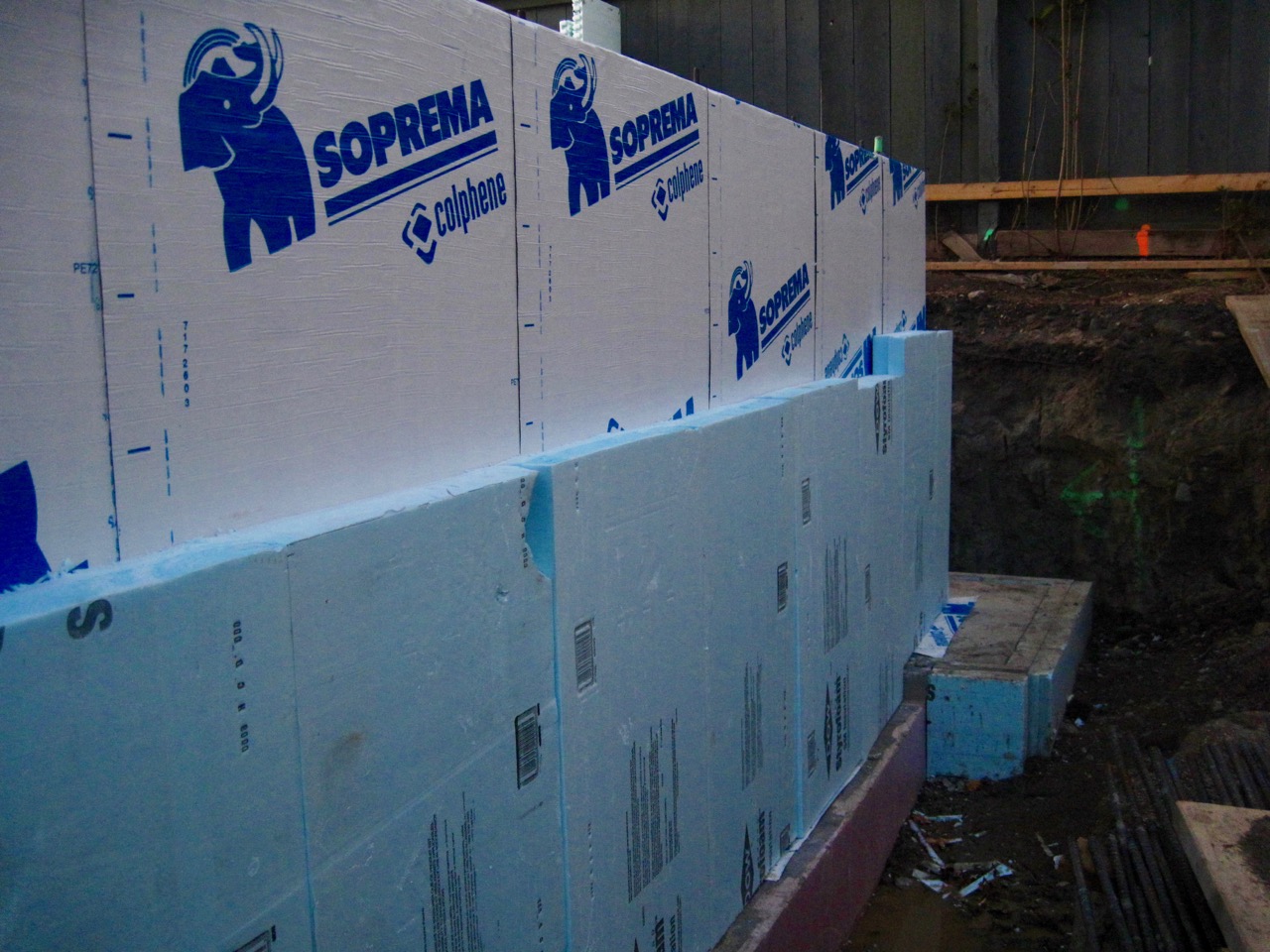
Here we can see the exterior rigid insulation on the foundation walls and 6″ of rigid insulation topping off (and surrounding) the footings:
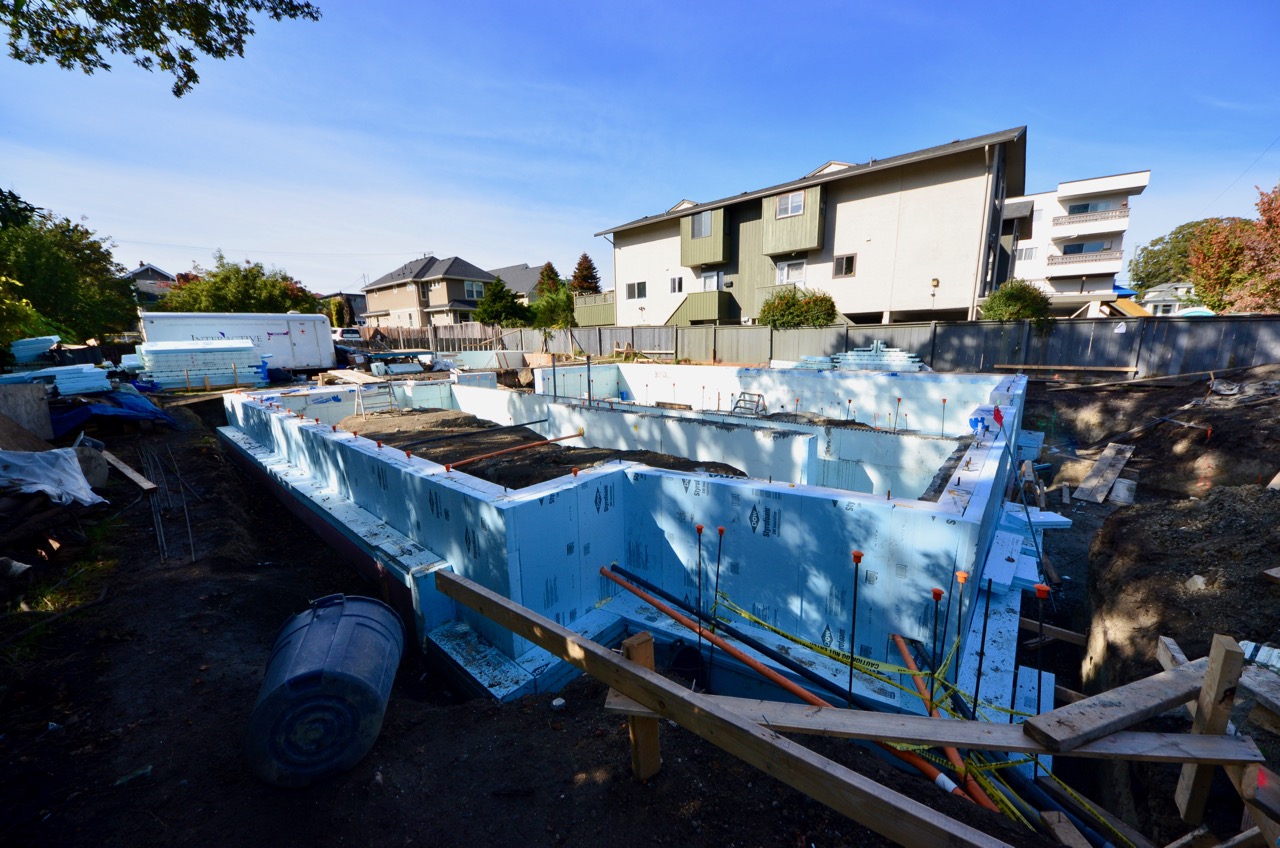
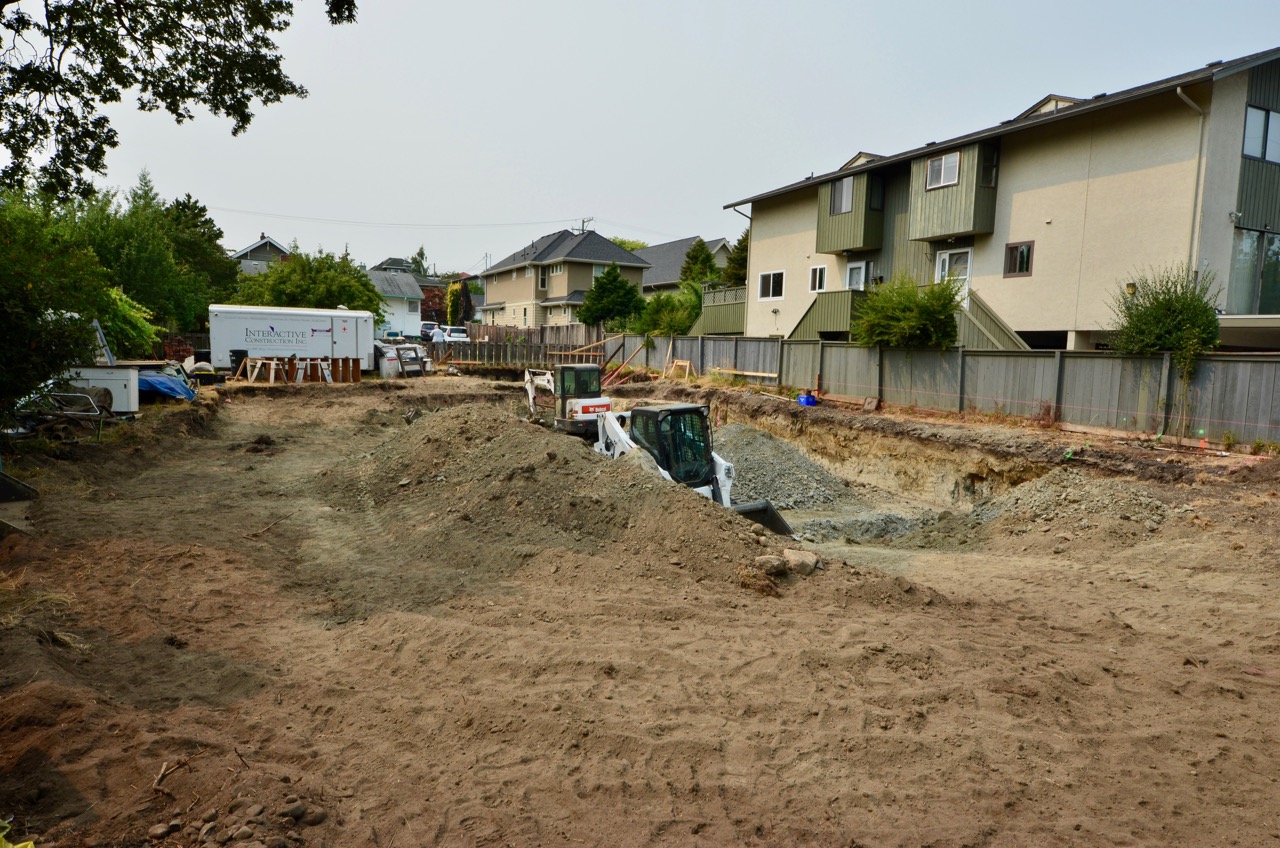
View from the back yard:
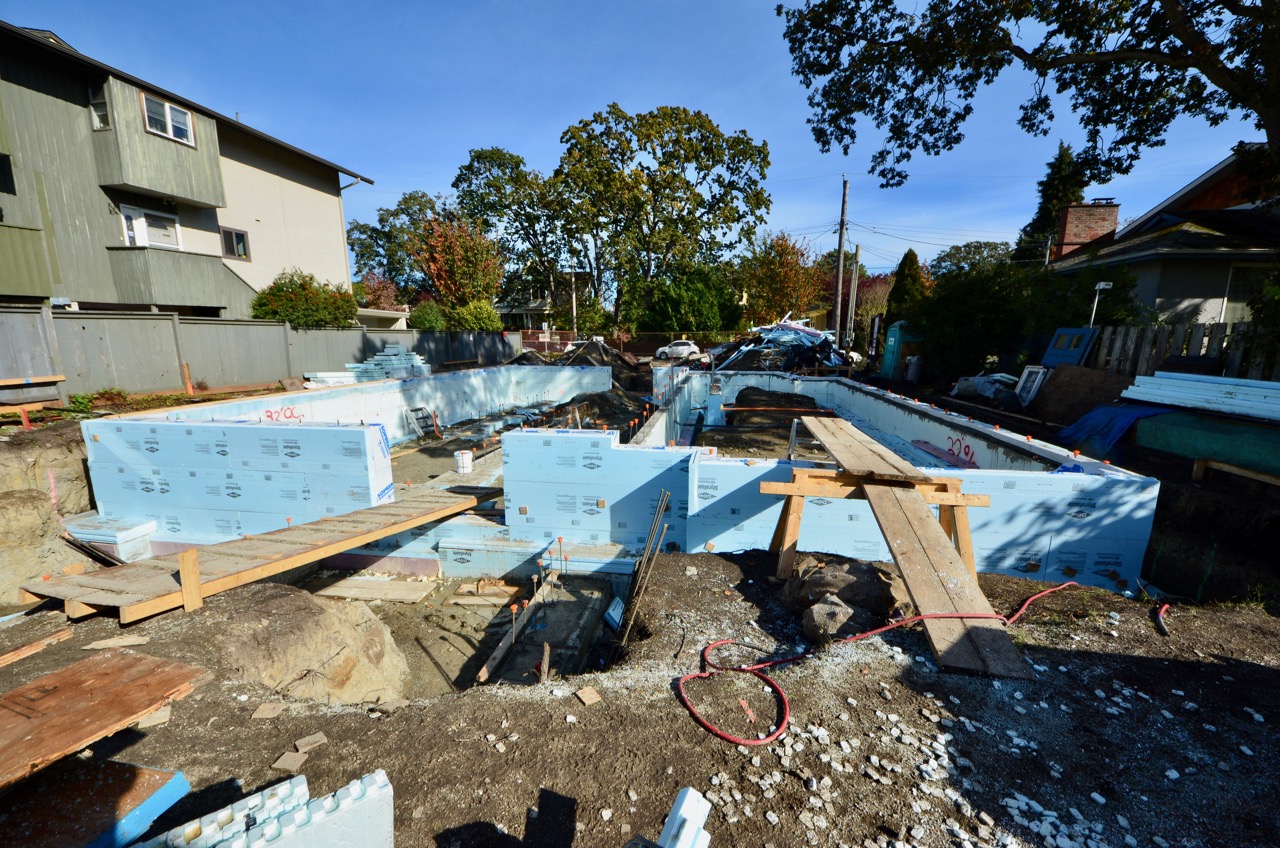
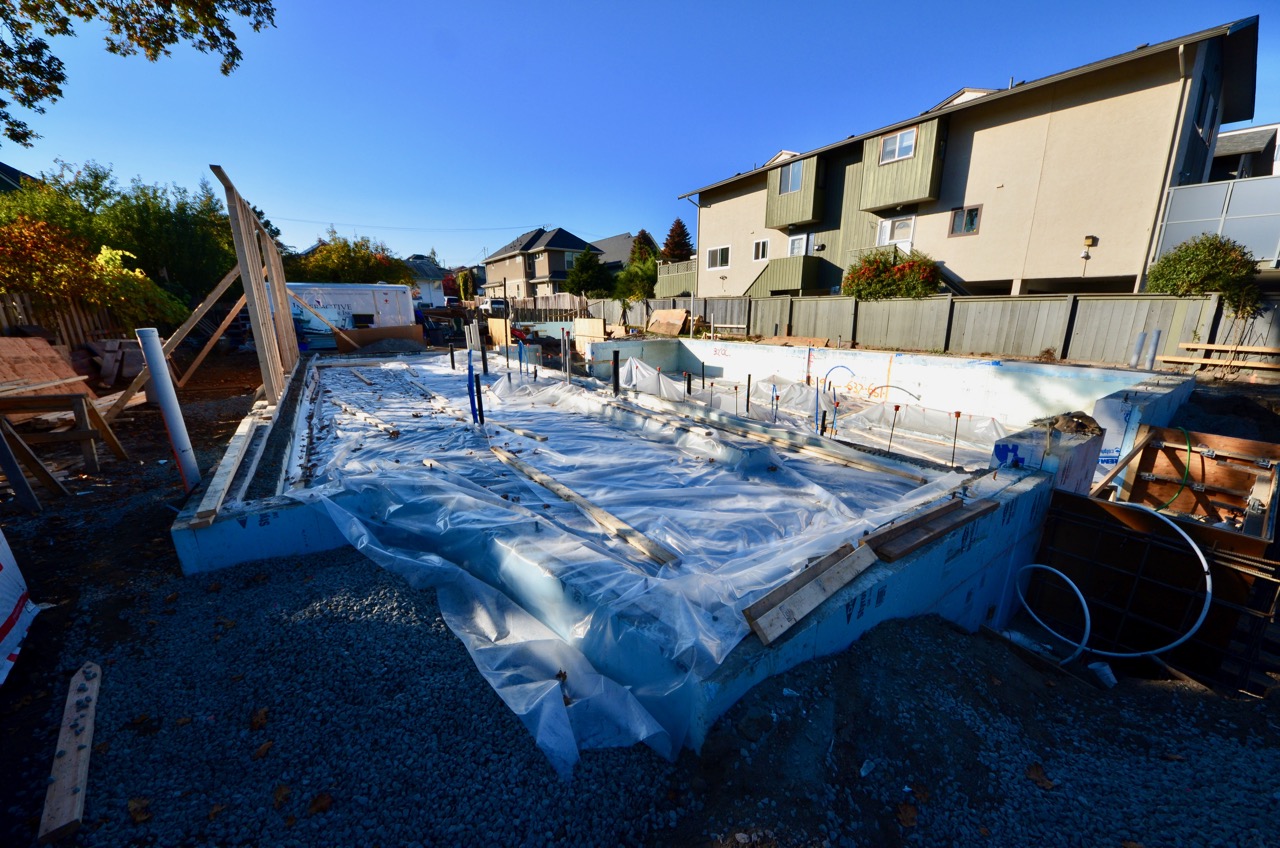
Below grade plumbing is installed; gravel is laid and protected with poly in preparation for pouring the below slab spray foam:
Spray foam was applied on Monday and Tuesday of last week (in four “lifts”, or separate applications):
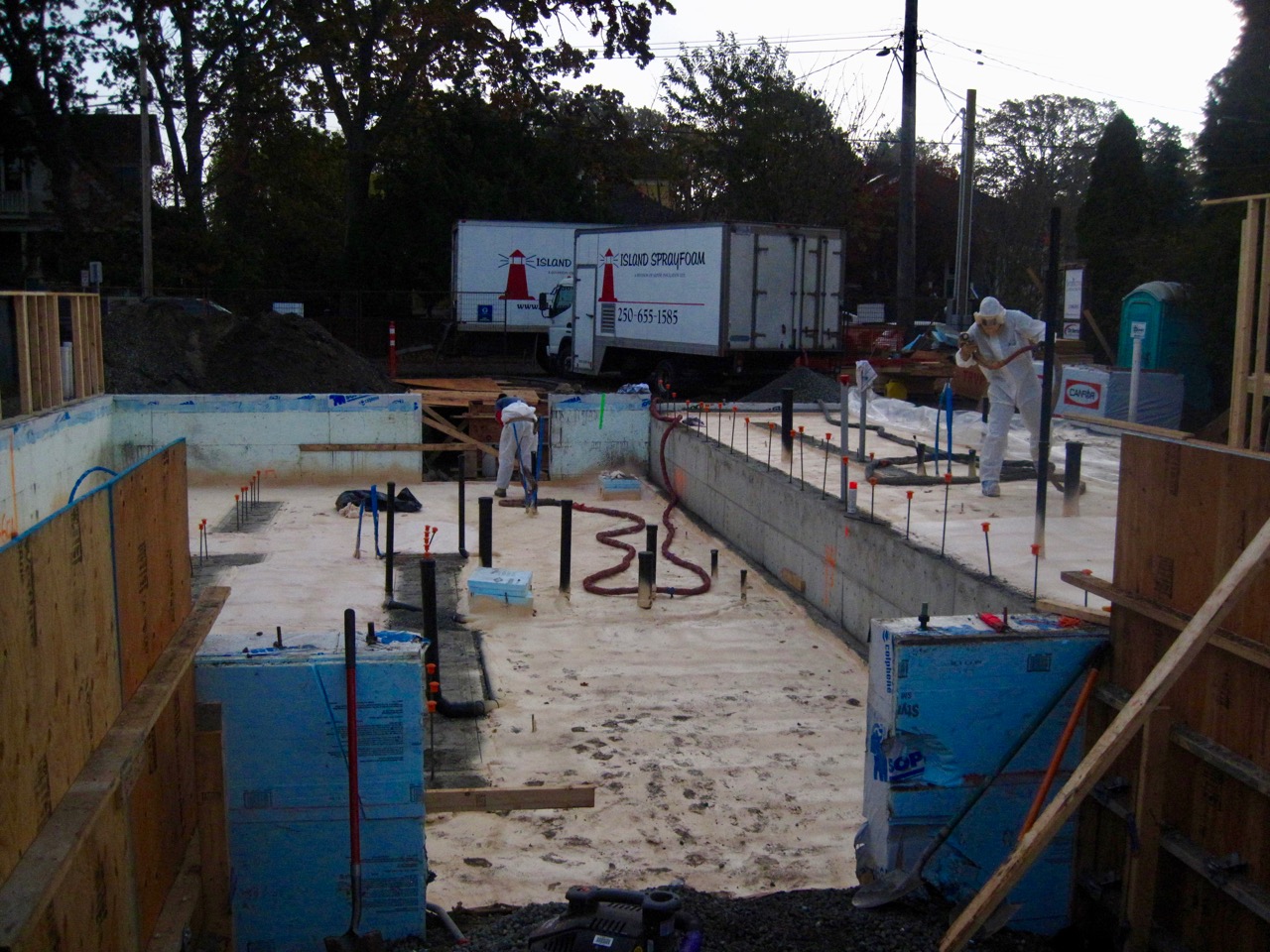
We added 6.75″ total for R-40 below slab. The product is Heatlok Soya, which claims a more environmentally friendly blowing agent than previous generation products. It’s very sensitive to weather during application and curing, but the weather gods shined their temperate, dry smiles on us this week.
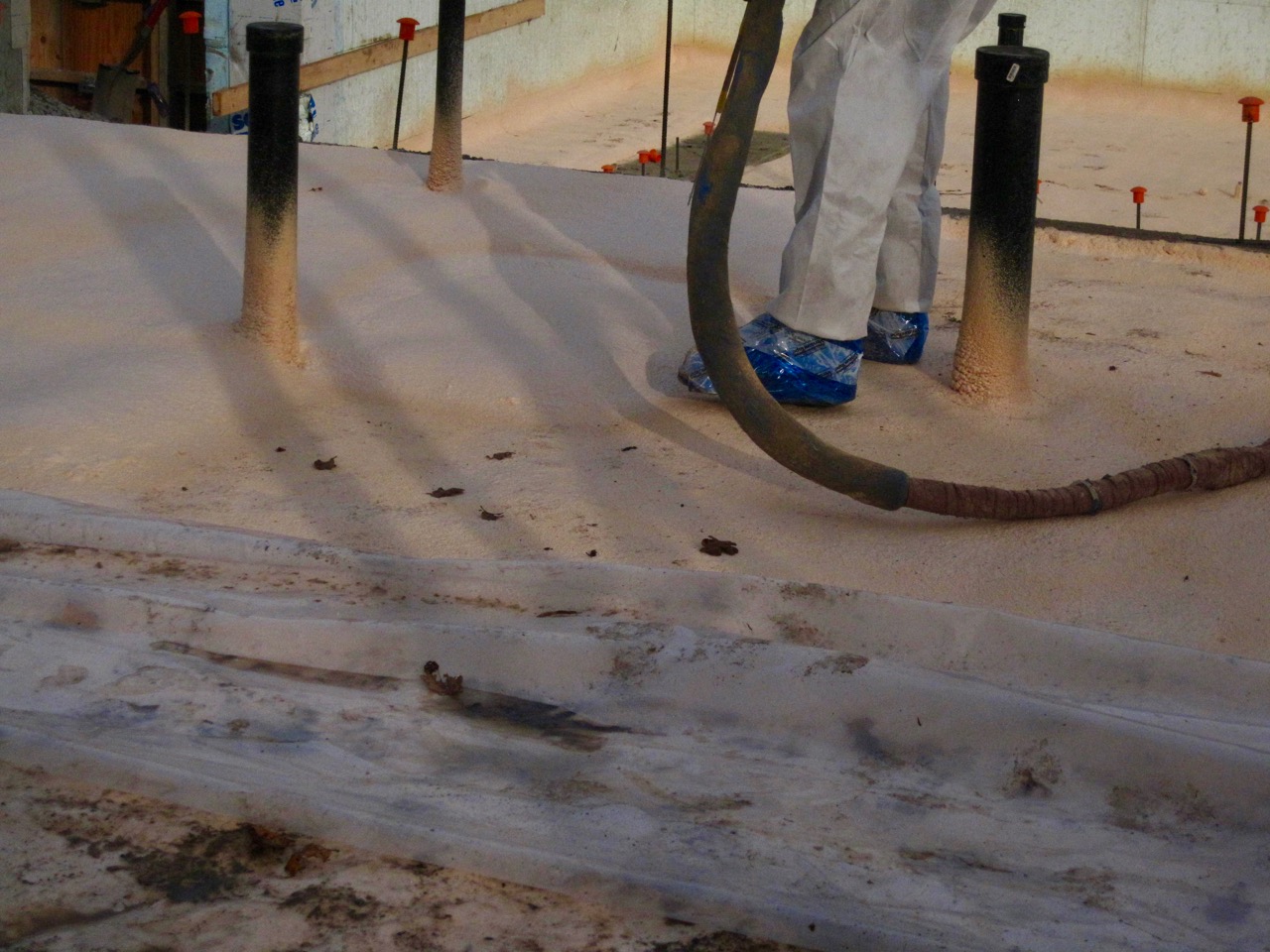
Spot checking the total thickness:
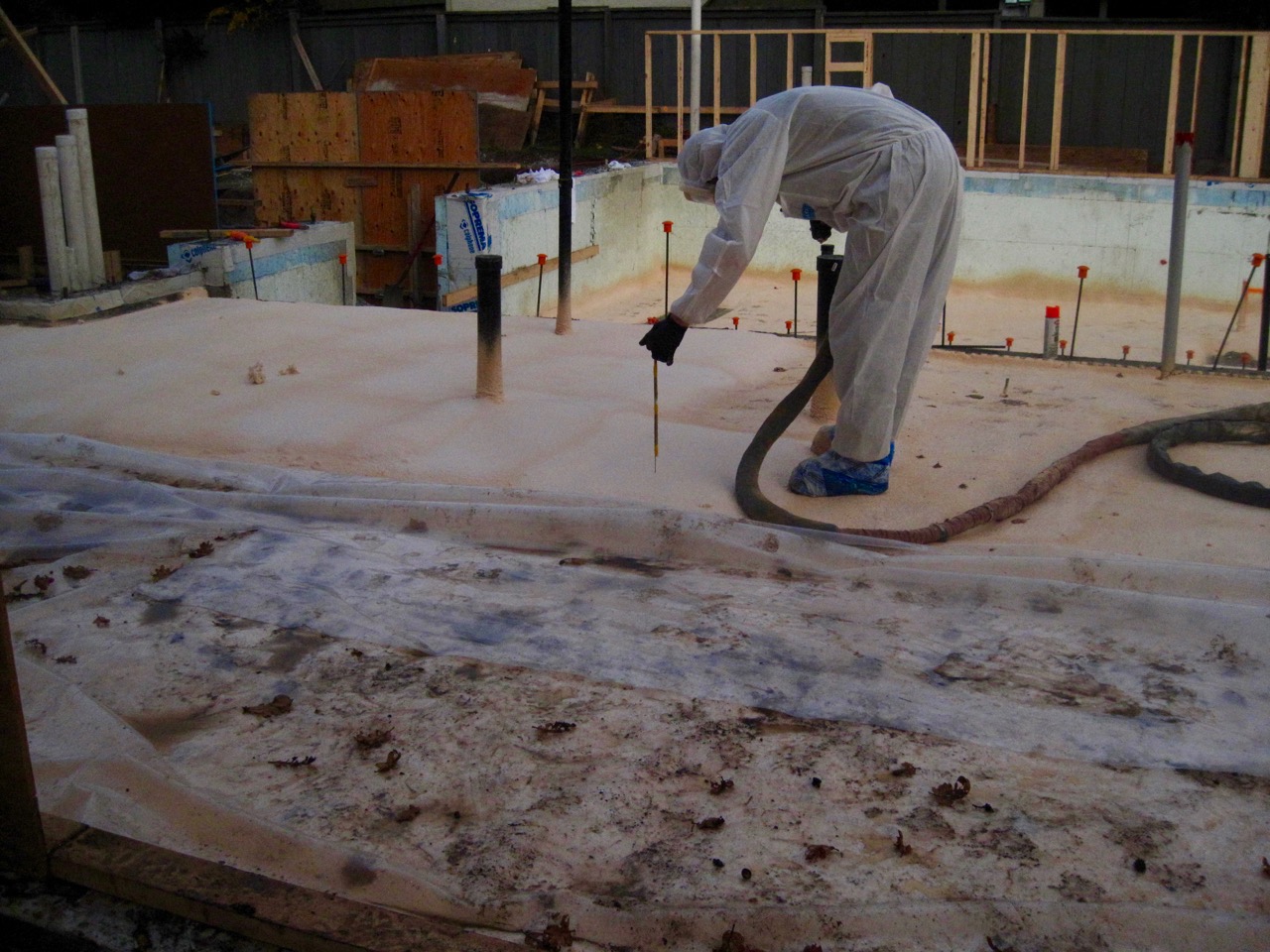
Here’s a short video of the application process:


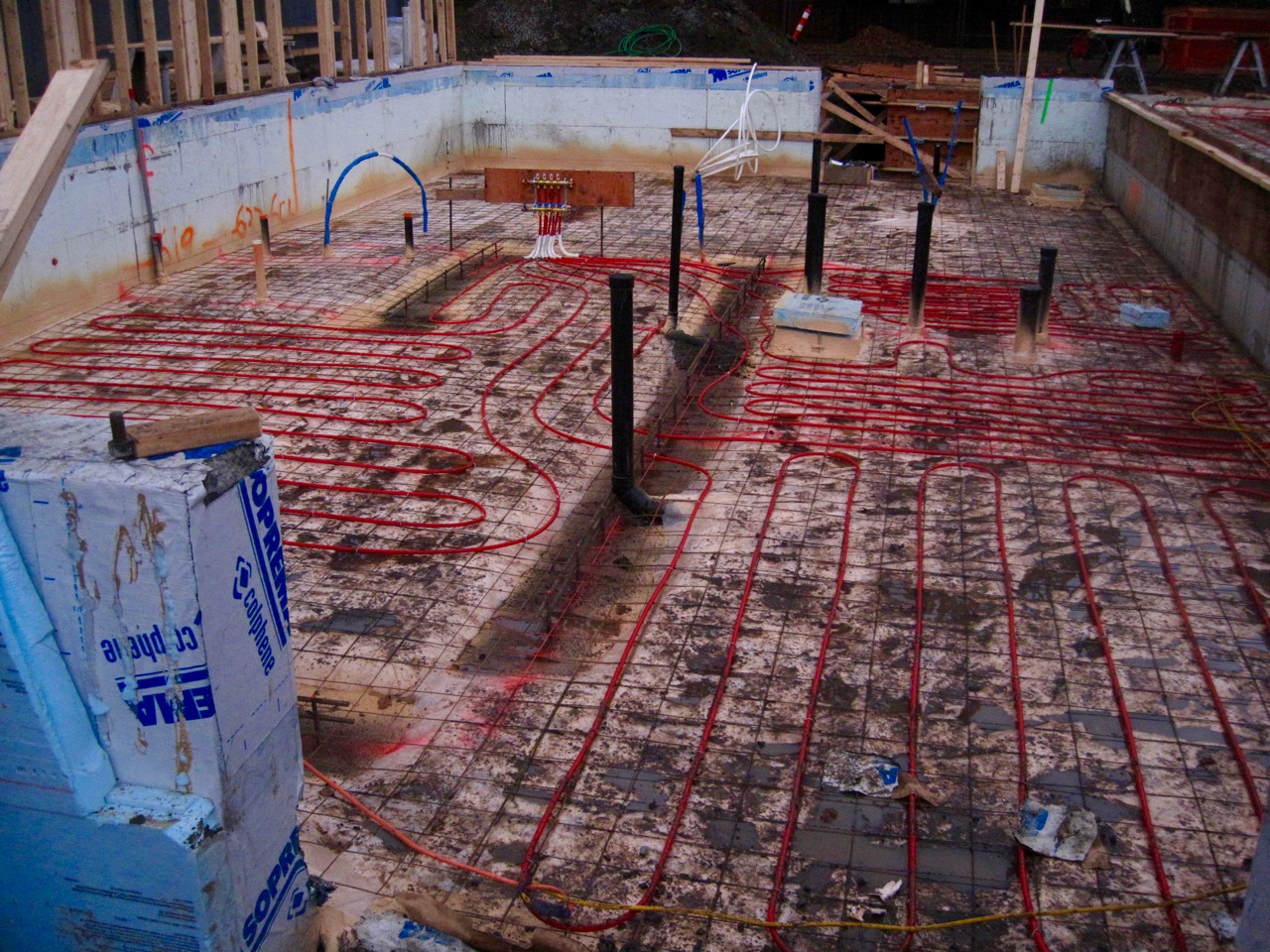
Tubing was then installed for the in-slab hydronic radiant heating system. This was Thursday:
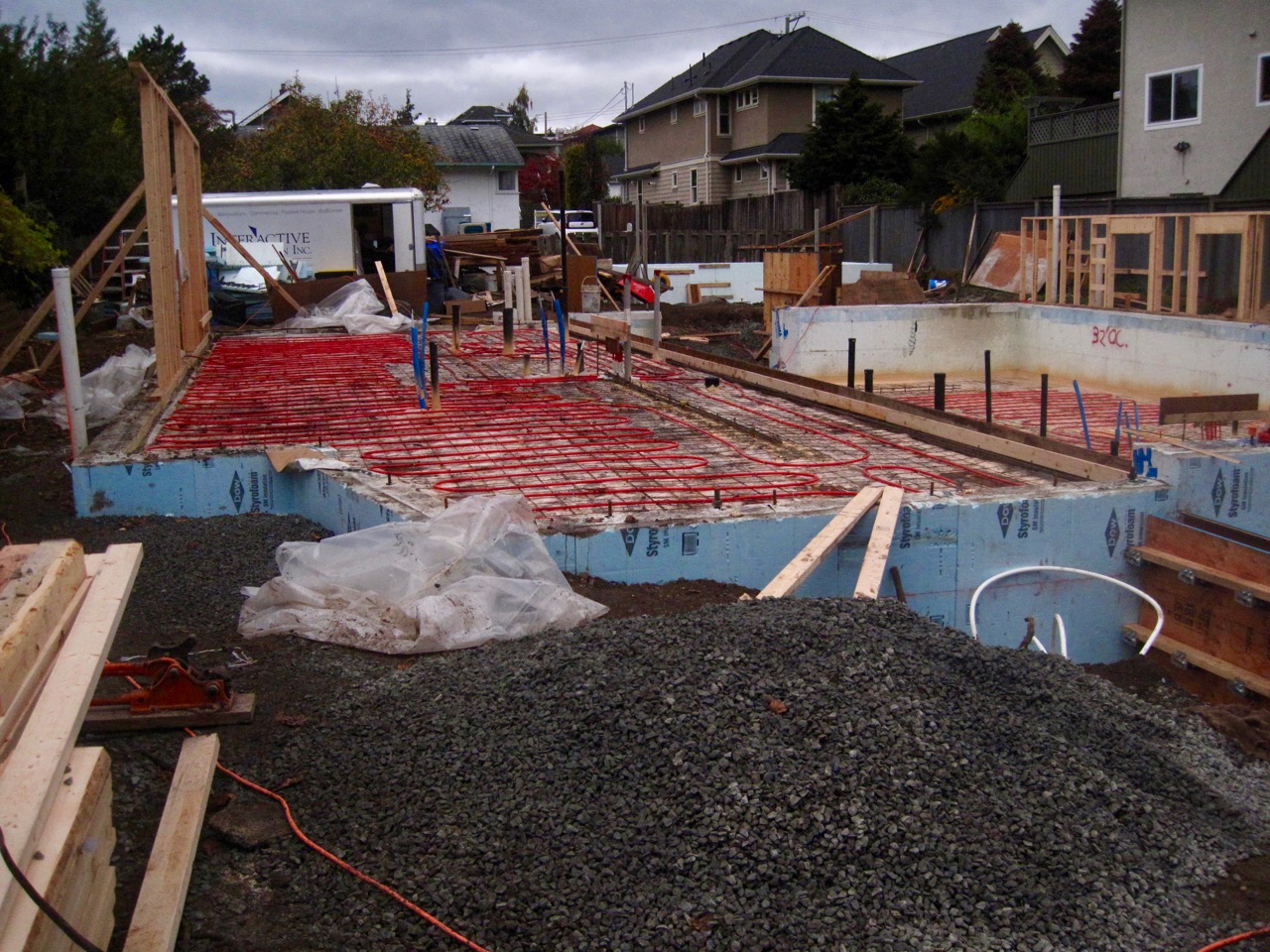
Tubing spacing is ~12″ in most areas; tighter in the baths, and generally more widely spaced than in a non-Passive House due to the low heating load.
And by Friday we had a poured slab – two slabs, in fact; one for each side:
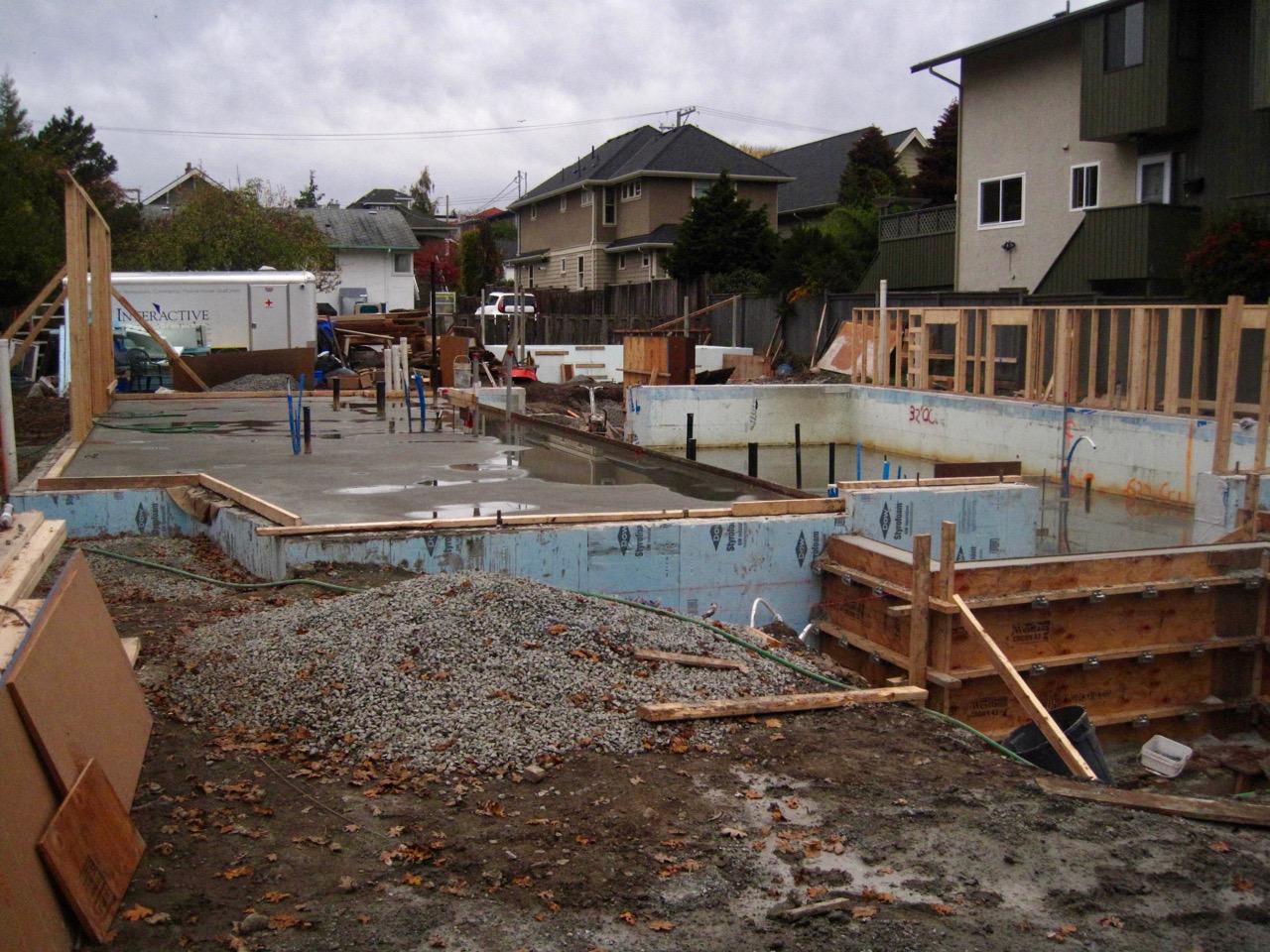
We kept it watered between weekend rain showers to encourage an even cure:
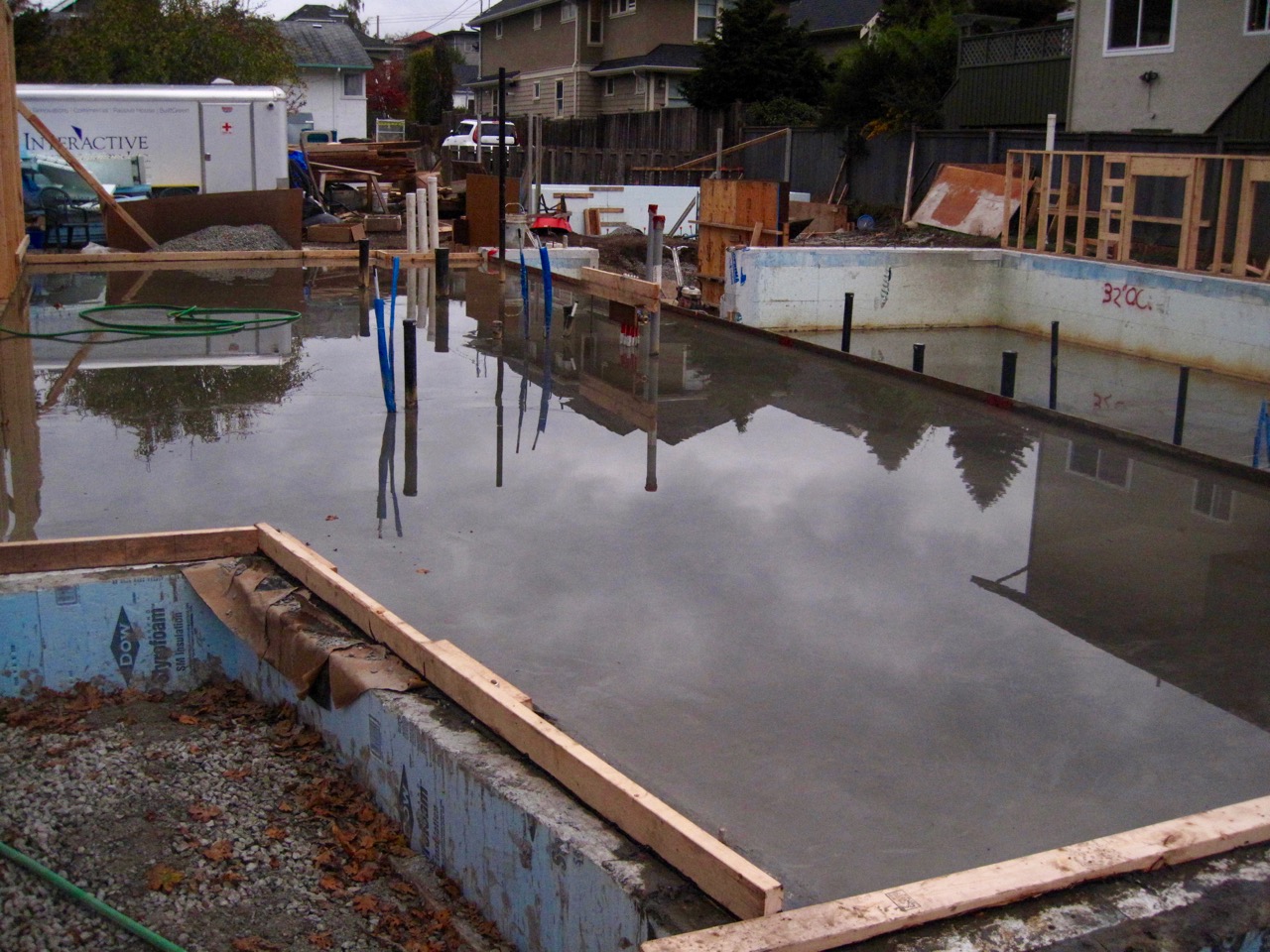
I think this means we can no longer call our project “the hole”. If we aren’t careful, pretty soon we’ll be calling it a house.
 

Filed Under: Construction, Featured Tagged With: construction, Passive House construction

She’s Coming Down…and Woah, Progress!

August 24, 2018 by clove 2 Comments

After hearing from our structural engineer that we can’t keep our existing roof, and that we need to make significant modifications to the existing floor joists and structure to meet current seismic code; after being put on hold indefinitely by the company scheduled to do the house lift, and after considering other related complications, Matt and I made the difficult choice to disassemble what remains and reuse it for other purposes.

Not how we had imagined or hoped things would go, but given where we are, we are confident this is the most practical choice to keep the project moving and manage our costs. Learning has been a big part of this process, and we likely would have taken a few different turns along the way knowing what we know now.

A number of considerations tipped the balance:

  • The cost of the house lift and modifications to the existing structure is considerably more than building new. And that’s not accounting for all the weird little things that will crop up along the way when working with an existing building, like, say, the walls being crooked and not fitting on the new foundation and below grade walls. And there just isn’t much left to lift! We would be spending a lot of effort and cost to move around four walls and a floor.
  • Disassembly allows us to keep moving. With no lift/move required, the excavation company can come in with their bigger/faster/more available excavation equipment and start right away.
  • Disassembly allows us to use the beautiful old growth fir floor joists, planks, and framing for any number of visible features, like interior doors, cabinets, shading features, soffit, and other wood accents. Matt can also likely build his entire workshop using this material. If kept in place, the wood would have been 1) drastically modified by new structure and 2) covered in drywall.

In short, it was a move toward simplicity. Sometimes you have to make the most practical choice, emotions aside. And Matt and I are heartened by the fun possibilities in re-using the old wood in new ways. We intend to keep the same design, although we are considering the possibility of switching from the current hip roof on the ‘existing’ half to a gable roof, also for simplicity.

And…Progress!

Wow, it’s amazing how quickly things can happen when you remove a barrier! This thing might get built yet.

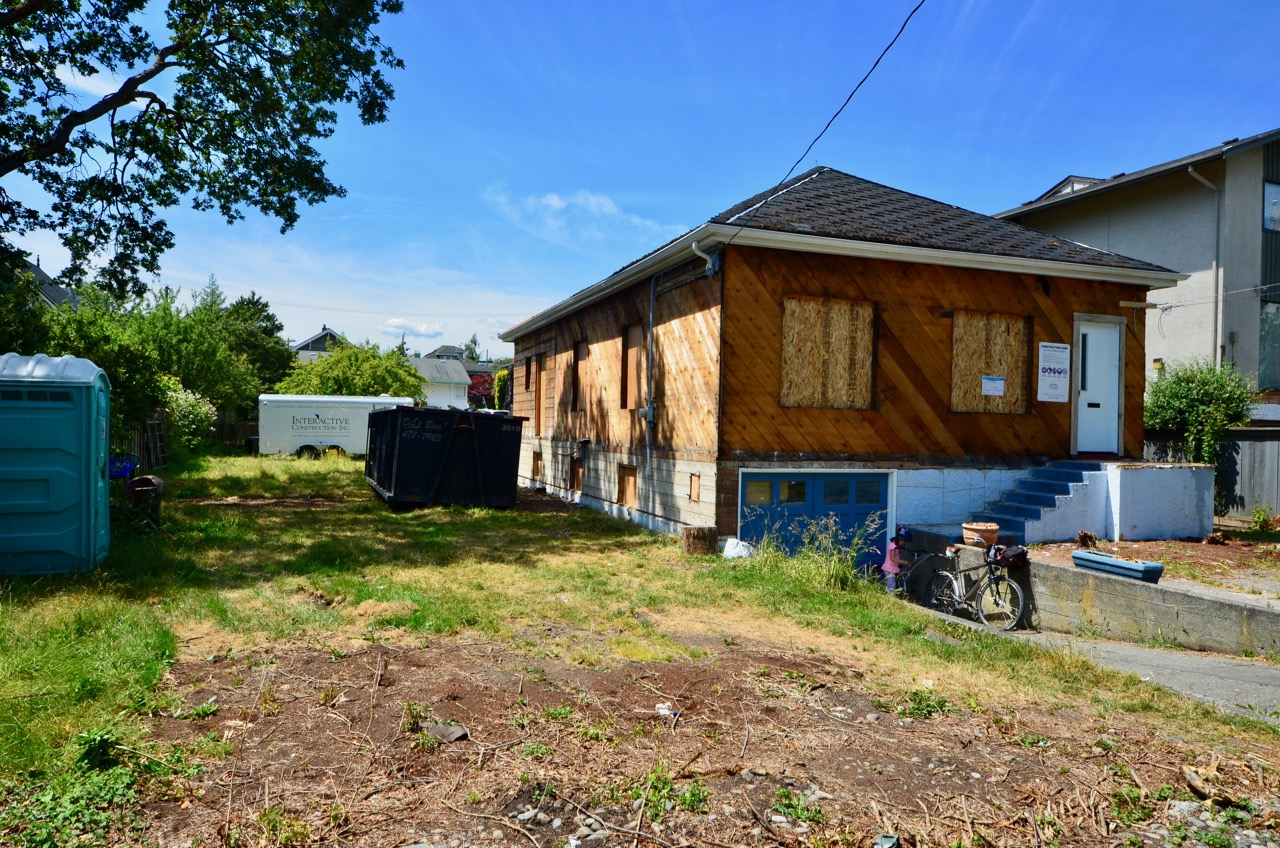
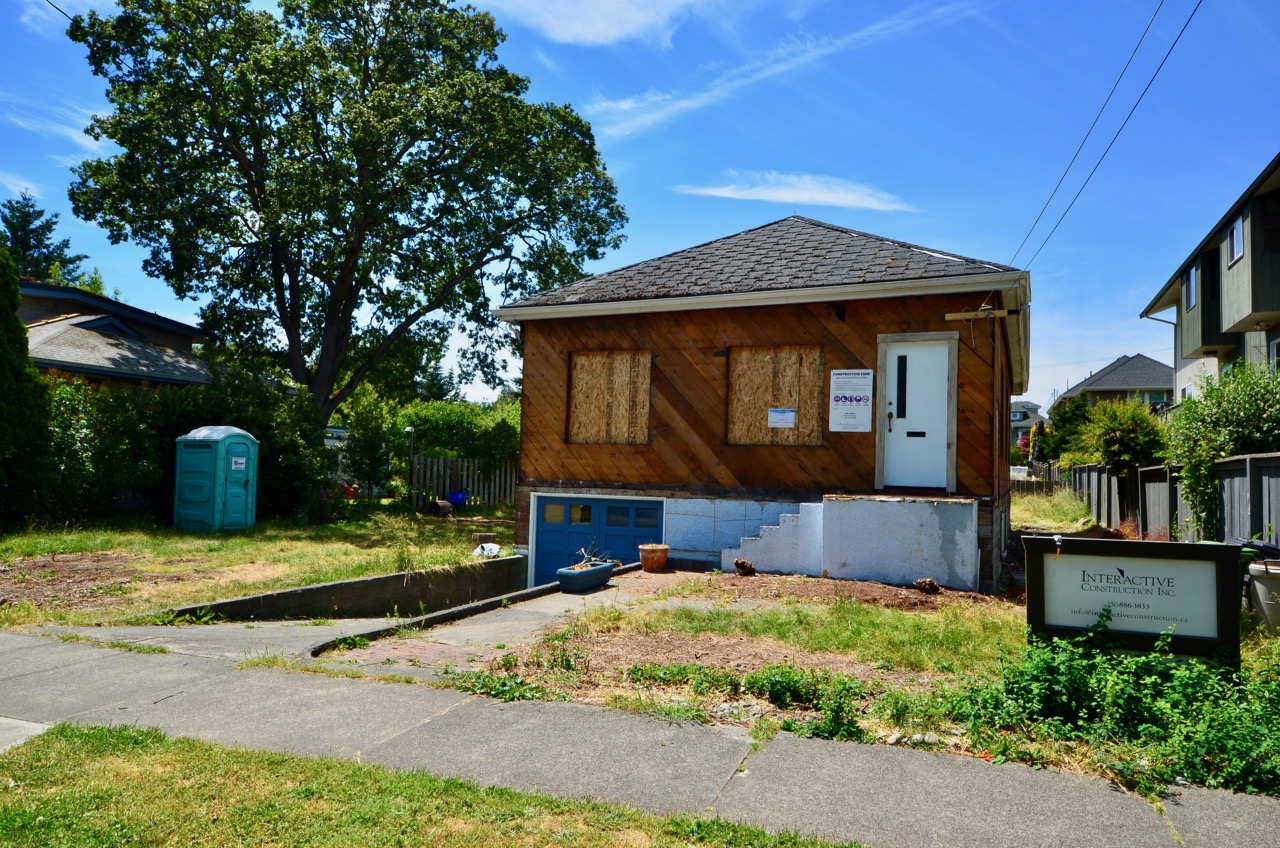
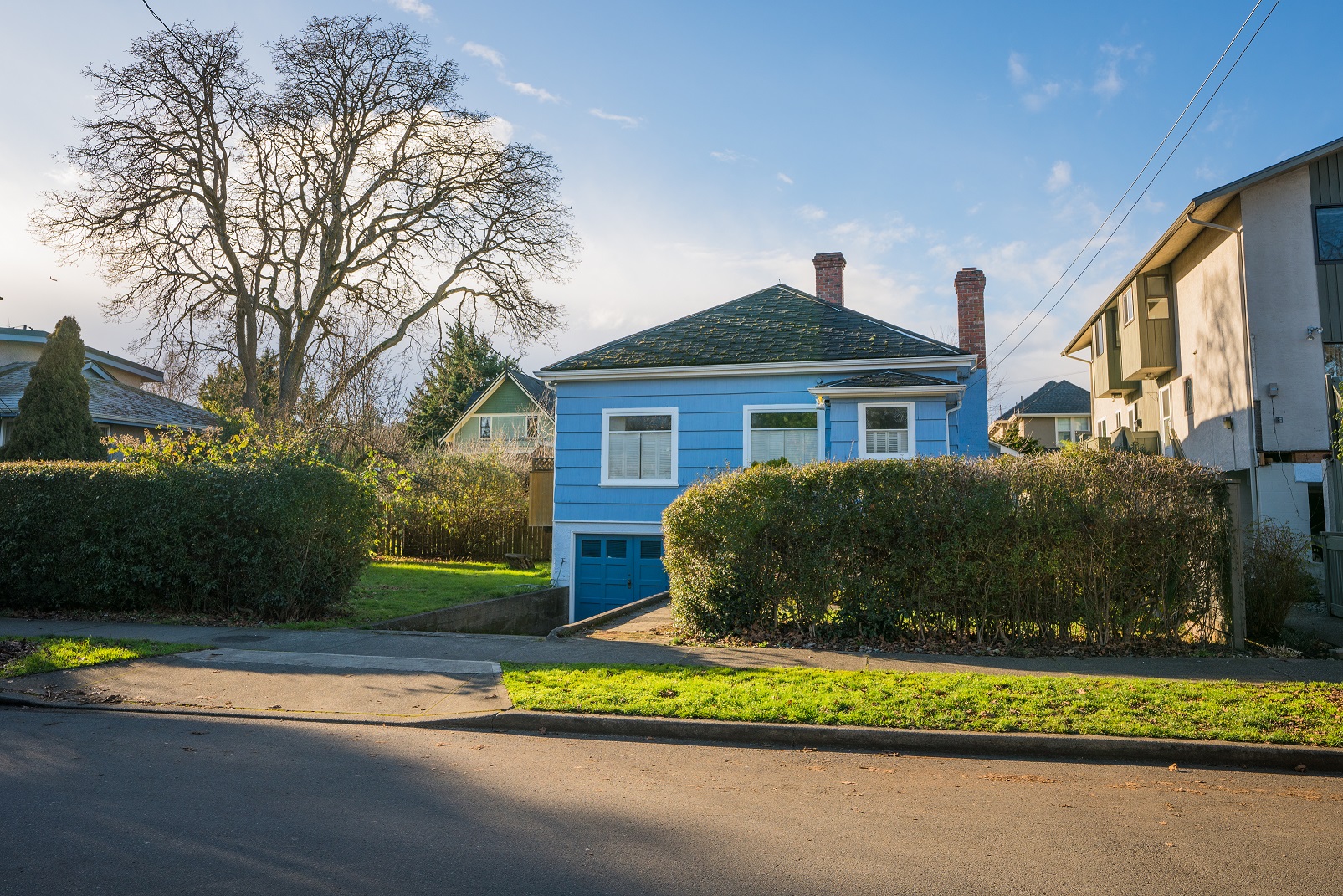
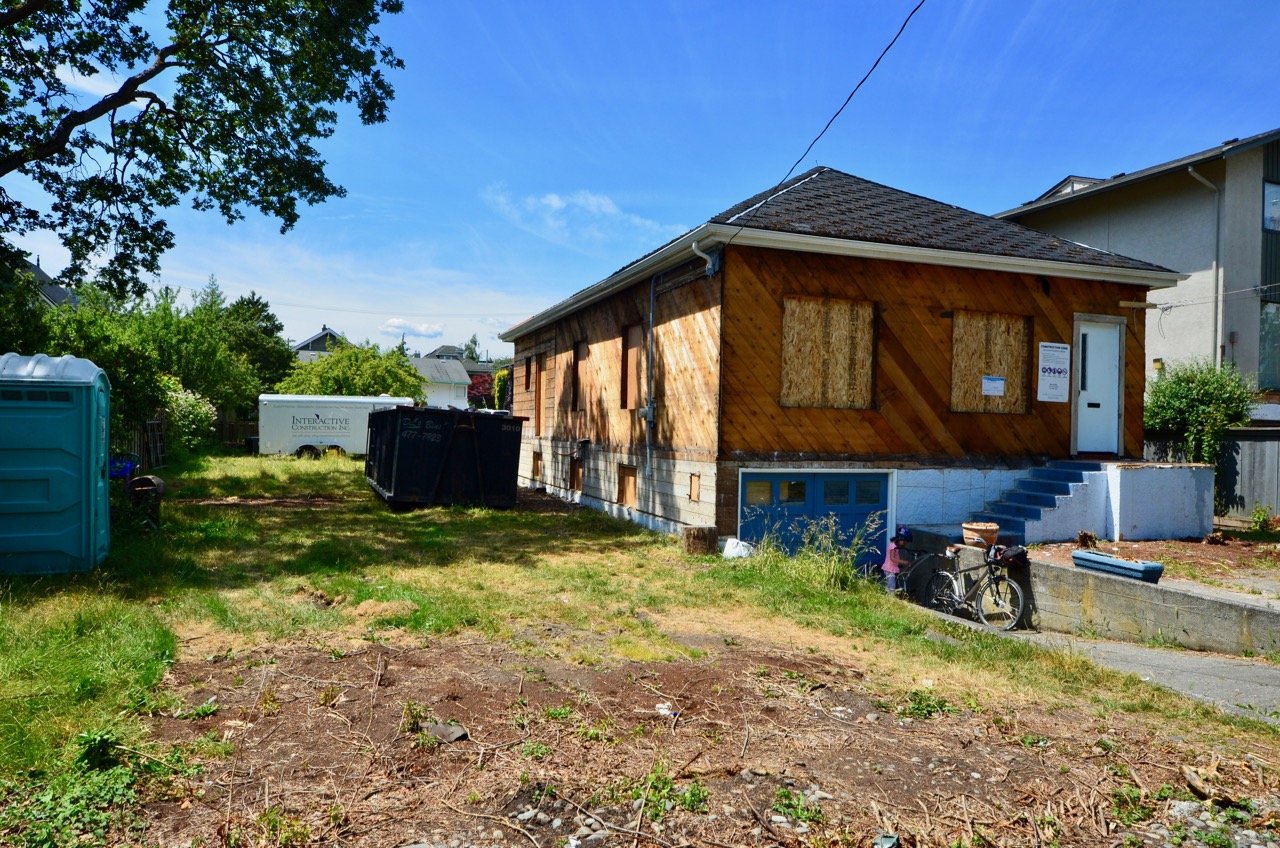
Here was our house just before we made the call:

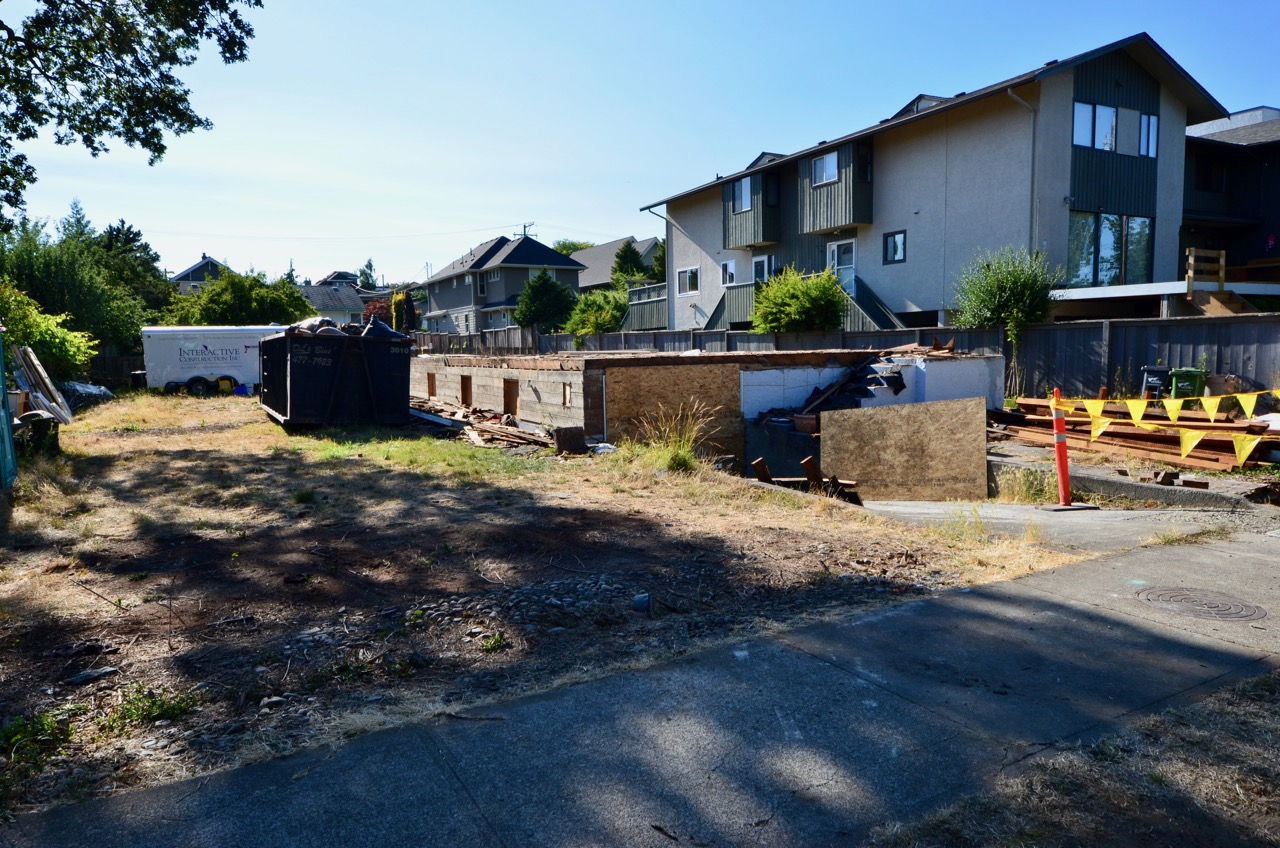
Then we had our meeting with Interactive and they got right to work, spending two days removing the roof and walls carefully enough to keep and stack the good wood, leaving us with just the basement:

And by the end of the week, we were down to this:

Then Level Lift came in with their machines to remove the rest and prepare the ground for the new foundation:

I have to say, progress feels good.

And in the spirit of Konmari, we wish to thank our old house for its service and acknowledge its time on the block and in our lives. We are grateful to have landed here and to have lived in this house before its transformation into something new.

Filed Under: Construction, Featured Tagged With: construction, passive house

Is it Worth It?

July 13, 2018 by clove 1 Comment

We stopped by to check on things the other day, and arrived as our neighbour Patrick stood contemplating our house, his pair of pugs snuffling in the grass.

“Is it worth it?” he asked.

Was it worth keeping the existing house? His question hit squarely on the low-level malaise I had lately been nursing about the amount of our house that was left and would be left when all was said and done. Much less than I had expected or had wanted to believe.

All the Little Things

If we could ignore all the steps that led to this moment, the answer might be no, it’s not worth it. Recall, though, that our original plan was a small lot subdivision. In this scenario, we wouldn’t have even touched our existing house until the new one was built and sold. We would then have had numerous options for improving our house incrementally. Melding the two together appeased some of our neighbours and led to a more interesting design, but it also required a more complex and immediate transformation to the existing house.

Our structural engineer came on board late in the process and said we can’t keep the existing roof. We don’t know a lot about structural engineering, but now that the roof’s underside is fully exposed, we see surprisingly little wood up there. So we will now be building a new roof to match the shape of the old roof.

The framing of several interior walls – the location of which dictated our new layout – was also removed during the strip out process. After peeling off the drywall and the wallpaper and the planking, there just wasn’t much left.

$$$

Similarly, if we were to consider only the cost of keeping an old house like this and carefully rebuilding around it, the answer to Patrick’s question would most certainly be no. Two of the three builders who bid on our project more or less bluntly told us that it would be easier (read: cheaper) to build new. The careful deconstruction to save parts of the building, or even to thoroughly salvage a house being demolished, takes time (read: money). Granted, Matt has done a sizable chunk of the manual labour, and even with a full demo and new build, we would still pay hazmat and some demolition costs.

Our next step is to lift and shift the shell of our former house, which is now delaying the project as we wait on the sub-contractor who will do this work. Again, more time and more money we would not be putting out if we just built from scratch.

And Still…

Call it sentimentality if you like, but our house has become more than an “it” now that we’ve lived in it for a few years and have painstakingly peeled away the layers to reveal its bones. It (she?) is more like a person with a history etched by many hands over the years.

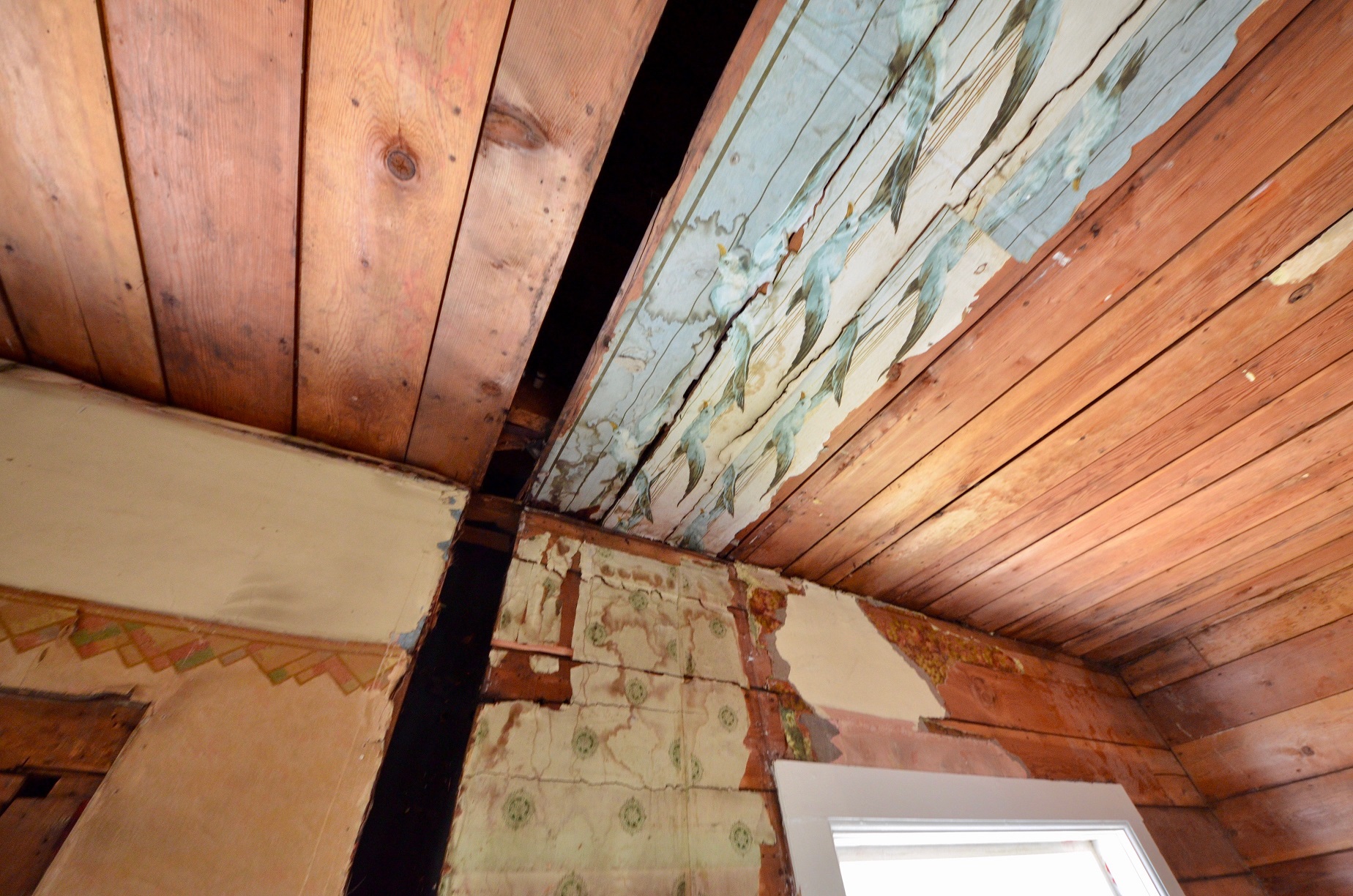
This house has stood in this place for over a hundred years. The sun has passed over it tens of thousands of times. Generations of people have walked their dogs past its front yard. Early owners added on the kitchen and bathroom, extended the roof, and shingled over the original lapped siding. Someone added bird wallpaper to the ceiling. Someone else painted over it.

Therefore…

In answer to Patrick’s question, I say no…and yes. We remind ourselves that our decisions are not informed purely by cost, as painful as that can be to our bottom line. It feels right to us to keep everything we can. I only wish we could have kept more of it. And I think what it comes down to is that, by the time you strip all the guts out, there actually isn’t much to a house.

If we’d found rot, the situation would have been even worse. But what is there is in great shape and we can be thankful for that. We can leave much of the exterior sheathing, walls and floor in place.

And so, here we are, our house waiting to be lifted, shifted, and placed back down on her new super-insulated, seismically resistant foundation.

We’ll keep and reuse many of the materials that we did remove, like:

  • good wood planking that Matt can use to build us a kitchen worth of cabinets and probably a kitchen table to boot
  • brick for outdoor landscaping
  • fir flooring that we can relay in the downstairs suite

We found new homes for many other things:

  • Our neighbour, Peter, spent a painstaking couple of weekends carefully prying off enough of our cedar shingle siding to patch the hole left when he removes his own chimney.
  • Another neighbour, Mike, left a note requesting the basement garage door when it’s ready for removal.
  • Someone we found through usedvictoria took the old oil furnace to replace his broken down one.
  • Another friend took our hot water tank for his reno project.
  • Any scrap wood put to the curb was scooped up almost instantly. Even the old built-in dishwasher was eventually picked up.
  • Interactive donated all the wiring and copper plumbing to Power to Be, to fund programs bringing people with barriers into nature.
  • We’ll donate the older but still functional appliances.

These parts and pieces of our original house will live on, their histories morphing as they are re-used by us or usefully absorbed or into other people’s homes. That is worth something too, right?


Filed Under: Construction, Featured Tagged With: construction, infill, Passive House construction

After Hazmat, There is Wallpaper (Lots)

June 20, 2018 by clove Leave a Comment

We spent three winters in our existing house before starting construction. Even during the strongest wind storms, our house stood surprisingly firm – nary a shudder or creak – and now we know why!

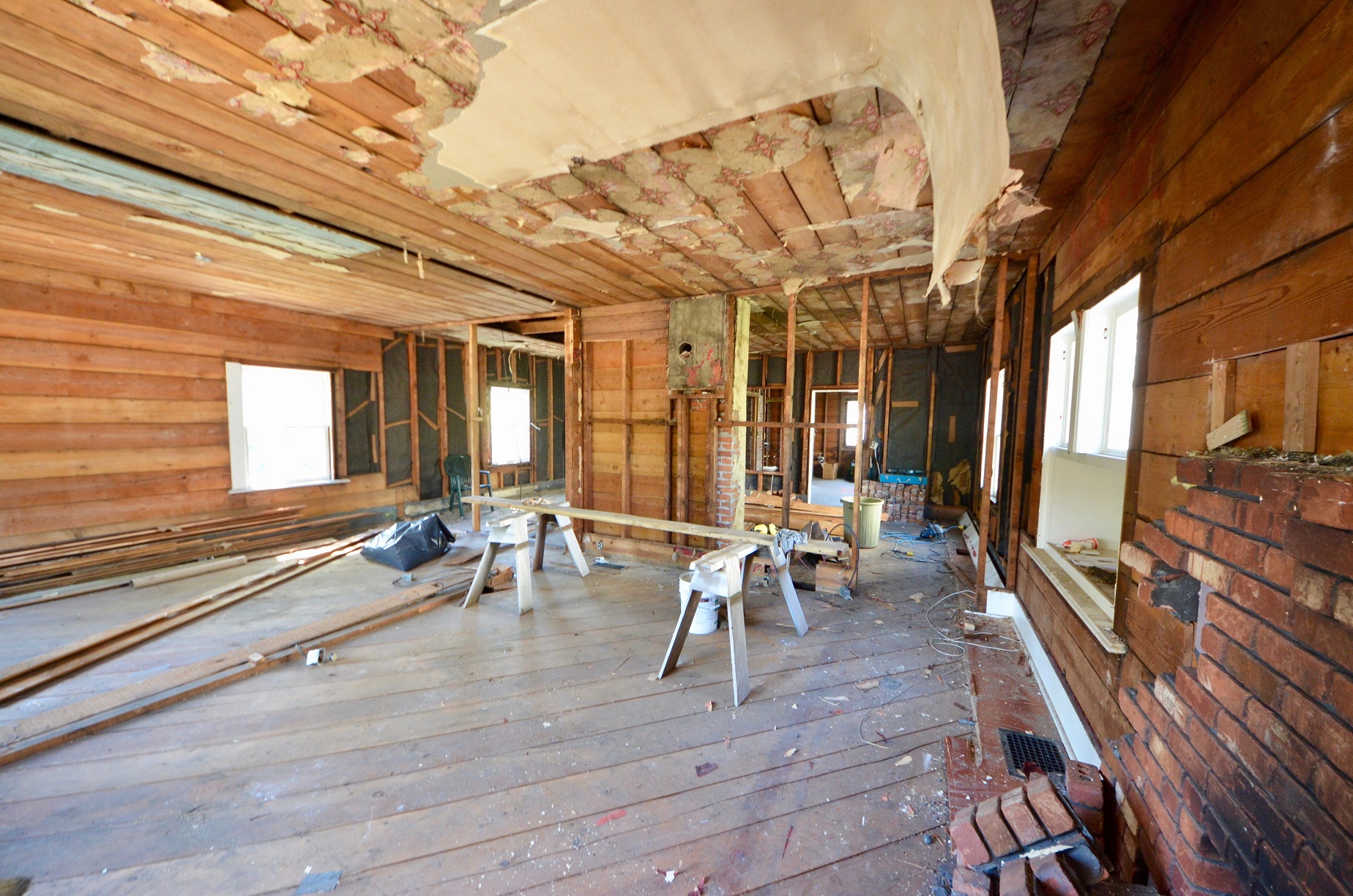
After the hazmat crew stripped out the asbestos and lead containing materials (found in paint, drywall, duct sealant tape, and vinyl flooring), Ty and Brittany from Interactive and Matt have been peeling back the layers to prep the house for its lift and rebuild.

Underneath the drywall, we uncovered up to five layers of wallpaper –  even on the ceiling! Under that was some sort of wallpaper fabric, then fir planking. We even discovered a second roof – left in place when the house was extended out the back – and the original exterior lapped siding behind the kitchen wall.

Here are some shots of the work in progress from the inside.

bird wallpaper  – on the ceiling!

looking into the house from the front doorway

original exterior siding from before the kitchen and bath were added out the back

look at all that beautiful wood!

Filed Under: Construction, Featured Tagged With: construction

Hooray for our Building Permit*

June 12, 2018 by clove 4 Comments

I was joking with a friend that every milestone we reach on our project comes with an asterisk. Like when we finally got our financing approval, which was an incredible relief, right? Except…the financing isn’t actually enough, and we’ve immediately had to get to work on other ideas to cut cost and access more capital.

So here’s today’s version.

We finally got our Building Permit- hooray! Bring out the confetti and chocolate cake!

But*

First of all, it took a really long time and, second, I’m still getting over the sticker shock of what it cost us. Confetti doesn’t quite capture the mood, and we probably can’t afford that chocolate cake anymore.

how long it took

The City strives for a 20-day turnaround on permit reviews, although I was warned when I submitted that City staff are slammed.

The day I actually submitted in early March was already my second attempt. I had been turned away by an initial scan in mid-February that revealed a few obvious inconsistencies with how the City wants things presented. So the permit process actually began for us nearly 4 months ago.

After officially submitting, City staff took 30 business days to review. So 6 weeks in real life. Every application wends its way from pile to pile and desk to desk. Engineering looks at it, parks looks at it, plumbing looks at it, and so on; each person adding their comments. Reviewers in two departments- Building Inspection and Plumbing Inspection- asked for a few changes, which took us 6 business days to turn around. The City then took another 24 business days to review those changes, our application once again passing across every desk. All told, it took 54 days of City review time to get our Building Permit, and 3 1/2 months in total time, including revisions on our end, since our first attempt to submit.

We do have to appreciate that the current level of construction activity in our fair city is unprecedented. Those who have worked in the industry here for decades say they’ve never seen it this busy. All you have to do is look around at all the cranes and holes in the ground to sympathize. City staff are working really hard with a daunting workload.

Still, it’s hard to not get frustrated by all the little details that have slowed things down and ultimately cost us money (our first construction loan advance is charging interest as I type!).

Here is one of the main details leading to the request to resubmit:

Our new neighbourhood plan specifically calls out ‘duplexes with suites’ as a desirable building form, meaning that the two main halves of the duplex can be titled separately, but the suite will always be a rental within one half. However, this building form does not exist in a code official’s mind because the building code does not specifically address it. As a result, while we intentionally designed it as a duplex + suite, the permit folks felt compelled to reclassify it as a “triplex”. This then required us to remove reference to certain parts of the building code, add extra fire separations, and change a few other details on our drawings. It is also likely to mean all manner of headache around shared ventilation and hot water systems further down the road – i.e. more cost to us.

Which leads us to…

how much it cost

The real asterisk dampening our ‘hooray’ moment is how much it cost to get our permit. We’re now pretty used to everything taking longer than hoped or expected. I suppose we’ve now also reached a point where we might as well get used to everything costing more than hoped or expected.

I had anticipated $10k for the permit itself (1.4% of construction cost, less plumbing and electrical, which are separate permits), plus ~$7,500 for a landscape deposit. This deposit is to ensure we actually do the landscaping work we promised as part of our Development Permit application. I’m not thrilled about this deposit, but it is described on the City’s website, so I’ve had a couple of months to get over it.

So how the heck did I end up writing a check for $50,784?!

There were two surprises that cha-chinged us up to this unpleasant total:

  1. We pay for new city services up front in order to get in the queue for the City to do the installation (three to four months behind, by the way). So, $24,600 for new storm, sanitary and domestic water connections for each half of the duplex. We had expected to pay for this, but hadn’t realized it would be up front.
  2. They took an $8,000 deposit for ‘new engineering works’. I had to call someone to learn what this was, because the staffer who initially helped me didn’t know, and neither did the staffer she called over who knew more than she did. This one is to make sure we build the new driveway and sidewalk to City specs. OK…but isn’t that the whole point of the Building Permit itself – granting permission to build something with the expectation and promise that we build it as shown in the drawings?

I’m frankly a little enraged about that one. Are we getting paid back with interest? Don’t know. And because there is no paperwork beyond a line item on my receipt, I fear we will have to fight to get our deposit back.

So there you have it:

  • $16,184 for ‘refundable’ deposits;
  • $10,000 for our Permit proper, and
  • $24,600 for new City services.

I can see why some developers raise the white flag and go to Langford where you can get a building permit in 48 hours for a fraction the cost!

Hey, I have an idea! How about permit rebates or waived deposits for people building ultra low energy projects? We are helping the City meet its climate goals after all, and leapfrogging all the way to the 2030 end of our new BC Energy Step Code. And so far, we’re just another folder on a pile of endless, helpless applications.

Alright, enough complaining.

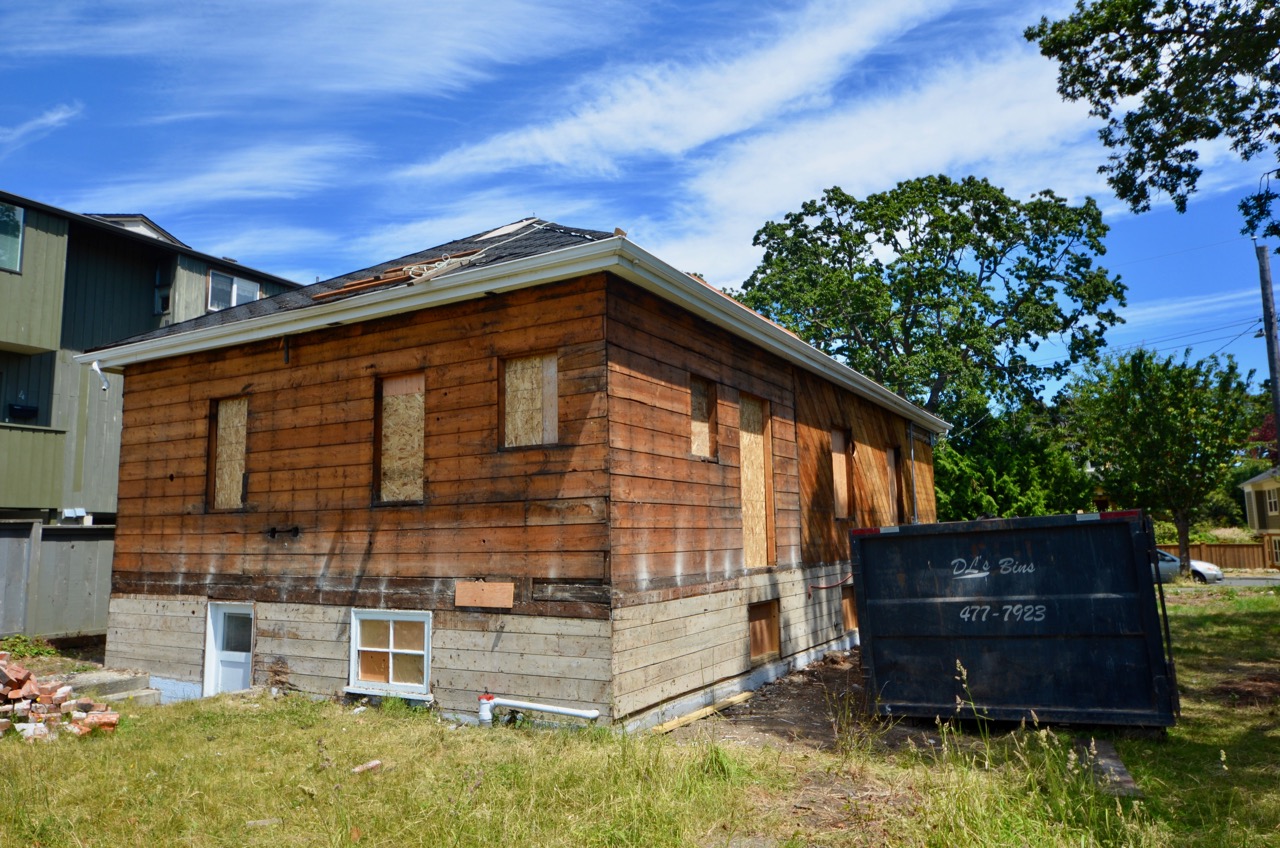
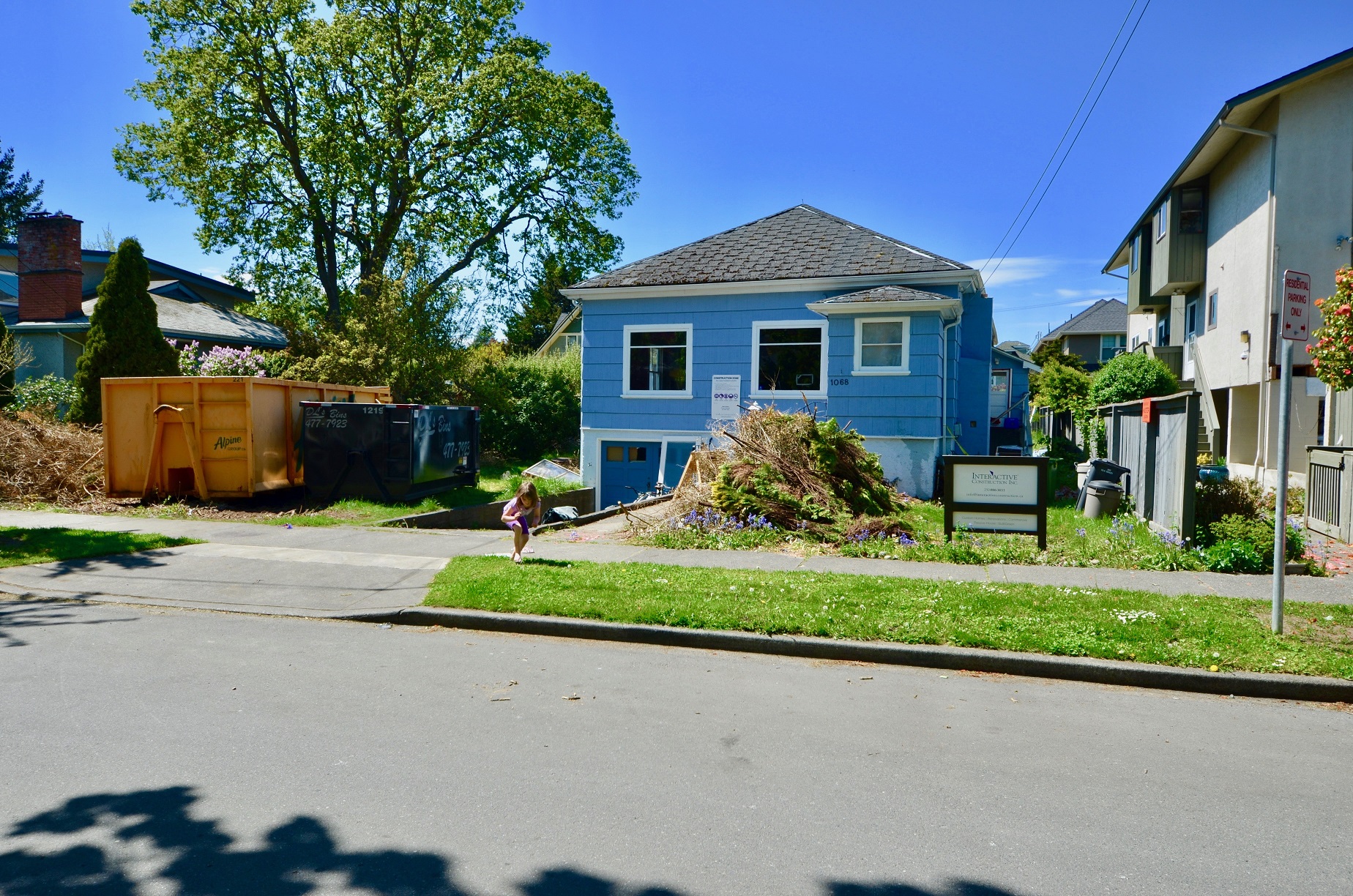
I’ll close out today’s post with a puzzle. Spot what’s different about our house in these two photos. Winner gets a pile of early 20th century bricks!

Filed Under: Construction, Featured Tagged With: building permit, construction, duplex + suite, ultra low energy

House Prep

April 11, 2018 by clove Leave a Comment

As we line up final details to get construction underway, Matt has blasted through several house prep tasks that will save us time and money once our builder is on-site. Matt’s work reminds me what a good team we are. I am the planner and executor of the mostly invisible things that have made our project happen. Matt is a master planner and executor of the visible stuff. I continue to be amazed at how efficiently and thoroughly he gets this type of work done.

While I wrestled with insurance providers, equipment suppliers, banks and schedules, here is what Matt accomplished over 5 days spread over the past couple of weeks:

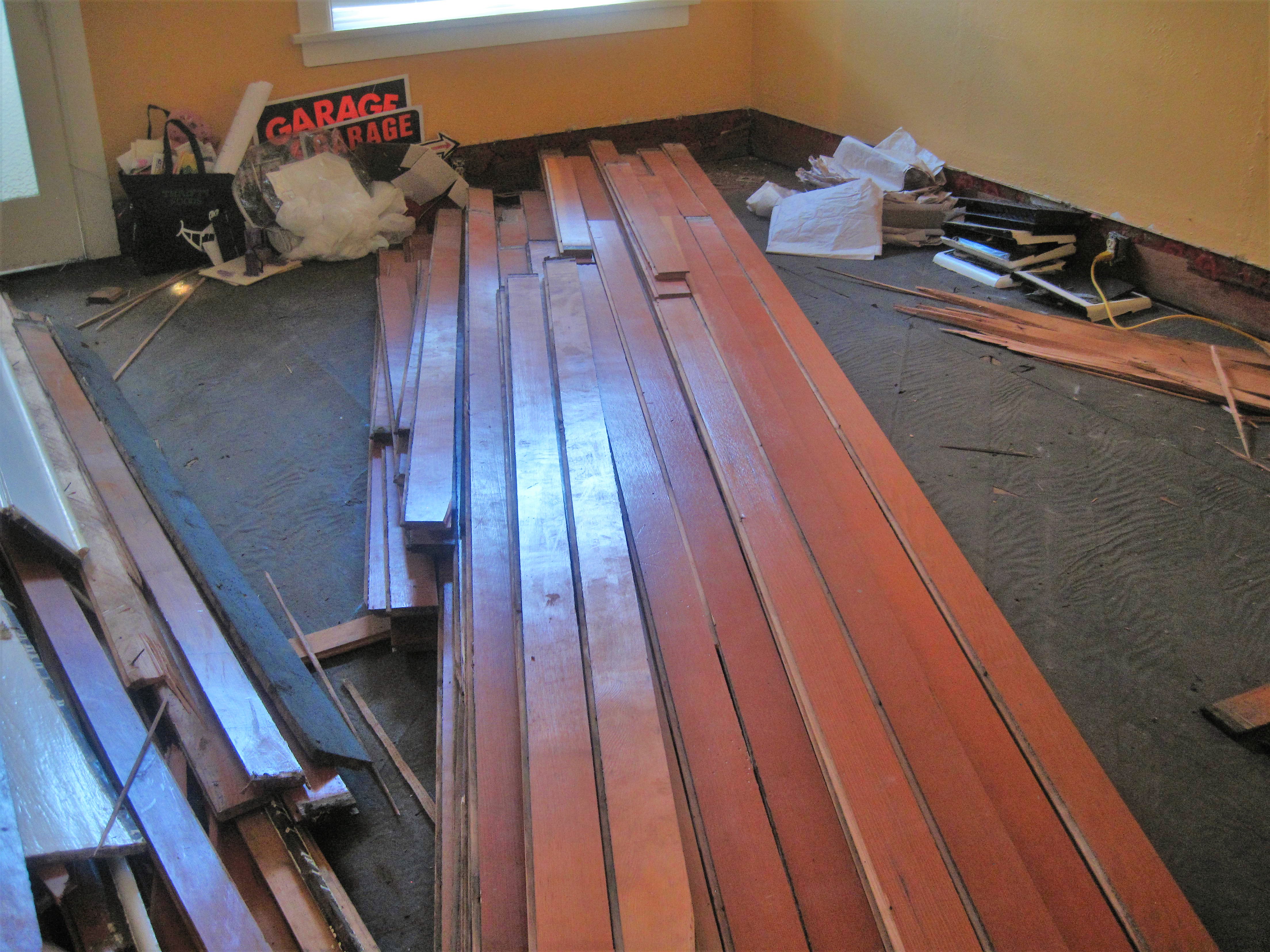
He pulled up about 1000 square feet of fir floor in 4 rooms, which we intend to re-lay in the downstairs suite. This job took a solid three days of bending over, prying and pulling. The great news is that we have mostly room length pieces for relaying. The challenge will be finding a place to store it and keep it stable until we’re ready for it.

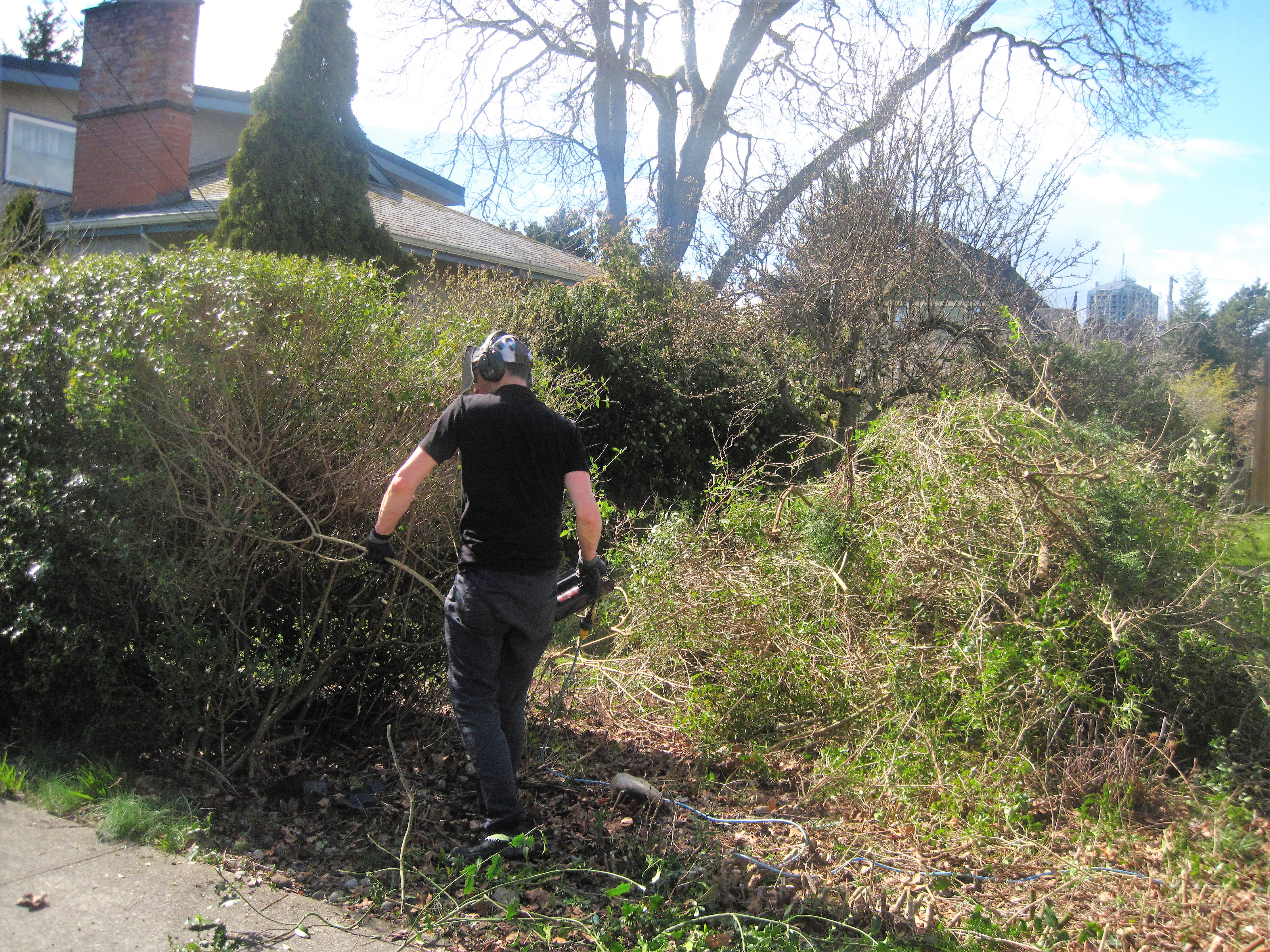
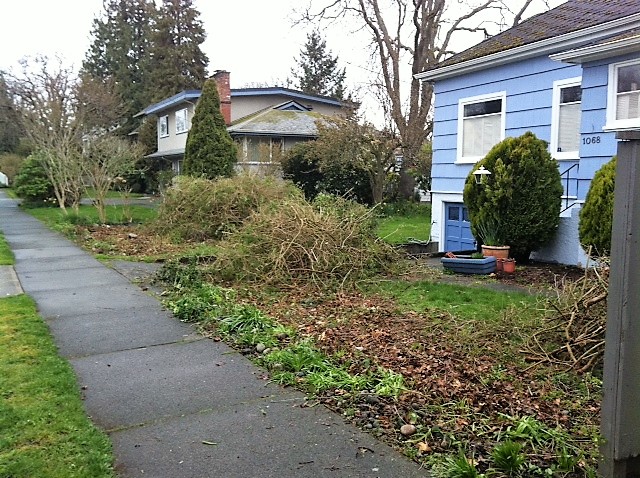
Then Matt cleared out the front hedge using an electric saw. The front landscaping needs to be clear to make space for the house lift equipment (our next big step after interior hazardous material removal).

post- hedge removal

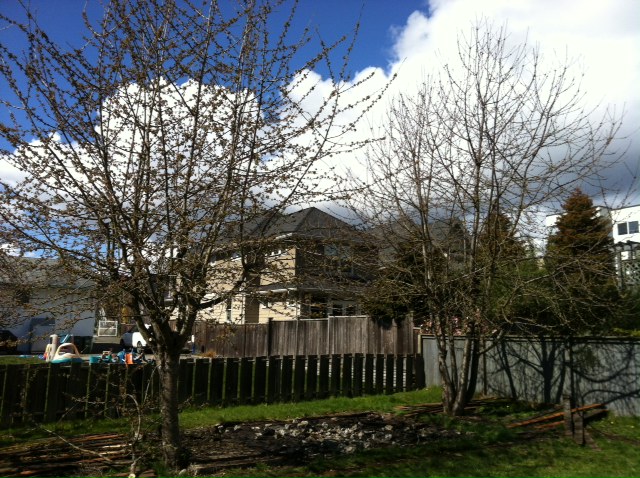
Then he pulled up the weird deck thing (which appears to have been built to cover up a bunch of broken concrete and other junk) and chopped down the two cherry trees in the back yard, where the workshop will go. He borrowed a bigger chainsaw for this job, and did his requisite youtube research to be sure he did it safely. He’ll save the bigger pieces of cherry wood for future wood-working projects. The smaller pieces were scooped up from the curb nearly as fast as we were able to type the words FREE on UsedVictoria. On that note, drop us a line if you are interested in any salvaged materials (wood, cedar siding, old wood windows, bricks from chimneys etc) and we’ll keep you posted as they become available. Will consider trades for labour and truck use!

back yard view pre-tree removal

back yard view post-tree removal

our littlest helper

Filed Under: Construction, Featured Tagged With: construction, deep energy retrofit, passive house

We’re Moving!

January 19, 2018 by clove 2 Comments

We have neither our Building Permit nor secured financing, but we are moving February 1!

Because we are raising our existing house and renovating most of the interior, we have to vacate during construction. Plan A was to move to the end of our block and rent our neighbours’ newly created garden suite for a 10-12 month experiment in tiny house living. We were actually very excited about this idea, as well as the fact that we would be a short walk away from our house during construction. But given that our neighbours are also rebuilding their entire house, they’ve encountered enough of their own roadblocks and schedule extensions that our timing no longer aligns.

Plan B, which is really a bit of a miracle given the 0.7% rental vacancy rate in Victoria right now, is to move back into the house we rented when we first returned to Victoria almost 4 years ago. It’s currently empty because it’s part of a whole-block redevelopment proposal inching its way through the public process. It’s a great little house that will fit all our things and it’s literally around the corner from my mom. We also got a discounted rate on rent in exchange for the risk inherent in only being guaranteed tenancy through May 31. I am pretty certain we’ll be able to stay beyond May, but it is possible that we’ll have to move again before moving back into our completed home. Better to not think too much about the prospect of moving 3 times in one year, though. Willful denial can be a very useful strategy to keep us progressing from one step to the next!

Our Building Permit application is ready to be submitted, save for structural drawings that are now being drafted (our structural engineer was sadly delayed due to a personal emergency). I’ve been down to the city a couple of times to check that we’ve included what they want to see, with the intent that once the application is submitted, it will quickly pass through the various departmental reviews. And since we’ve already been through rezoning, I am confident that the Building Permit is a formality. It will happen, it’s the when that could throw things off. The city aims to respond within 4 weeks to a building permit application, but if there is any back and forth over the details, this could stretch out. There is some prep work we can do on the existing house and site in the meantime, though, so I remain optimistic on that front.

The financing is the last big piece of the puzzle that still has me nervous, as it’s really the last point at which someone outside the project can say No and delay it until we find someone else who says Yes. It’s only coming together now because, in order to get financing, the credit union needed an appraisal of the existing house and proposed project. To do the appraisal, they needed a construction budget. For Russ to give us a reasonably accurate construction budget, we needed close to complete drawings. We have all of those things now, and the appraiser has what she needs. All we can do for the moment is pack up our house and have faith that the stars will align!

Filed Under: Financing, Uncategorized Tagged With: building permit, construction, financing, passive house

Choosing a Builder

June 24, 2017 by clove 1 Comment

For a successful Passive House or ultra low energy project, it’s important to bring your builder on board early – especially if you want one for a reasonable budget. Material, assembly, and detailing choices will all impact cost, and your builder will have the best insight on these impacts. On top of this, the local construction market is hot right now and some builders are booking a couple of years out. Planning ahead in any case is a necessity.

While a year or two ago, there was only one builder in town who had built a Passive House (shout out to Mark Bernhardt!), we now find ourselves in the enviable position of having several excellent choices.

We narrowed our search to three builders: NZ Builders, Bernhardt Contracting, and Interactive Construction. I have gotten to know all three through the Passive House community and my work at RDH, and all three are passionate about building ultra low energy homes. I mention them all because any one would be an excellent choice depending on the needs of your project. All three builders have at least one Passive House as well as other net zero/ultra low energy homes under their belts.

The downside to having these choices was that we’d have to say no to two of them – something I was not looking forward to. Matt and I took a similar approach we’ve taken when buying a house: establish our criteria, do our best to keep emotions out of it, and make the most rationale decision. Hiring a builder does add another layer of complexity over buying a house, though, because you are choosing not just the end product you think you will get, but also the person you will work closely with over the next year or more.

So what did our choice come down to? Prior experience was a prerequisite, but here are the other criteria we considered:

  • Enthusiasm and experience working with the existing house and materials:

How keen were they to work with the existing 100-year-old structure (framing, walls, roof) and existing materials (like our fir floors, solid wood doors, and bricks from our three chimneys)? Yes, it may ultimately be easier (and cheaper) to tear down and build new, but that is not what our design is about. Our existing house has a lot of good material in it. It shows none of the telltale signs of rot or other structural damage, and our design was specifically intended to preserve as much of the existing house form and materials as possible – and to look that way. If we were going to tear down and rebuild, the design would have been completely different.

The marriage of old with new. Rendering Mark Ashby Architecture


  • Crew size and proposed construction duration:

The ability to build as quickly as is reasonable will save us financing costs, as well as the amount of time we need to live/rent somewhere else. Available crew size varied and estimated construction ranged from 7 to 12 months.

  • Budget input:

We didn’t ask for a budget, but did ask for their input on whether they thought our budget was feasible. They all said No! The cost of materials has skyrocketed in the past year, and there is a severe skilled labor shortage locally. Our original construction budget of $600-650k, which seemed entirely reasonable a year or two ago, is now laughably low. Let’s all have a good laugh (cry) and move on, because we’re now likely to be pushing the $1M mark. On the plus side, the value of real estate has gone up significantly as well. Such is the inherent risk in development.

Budget projections from all three builders were in the same range for a new build, although a builder won’t do a detailed budget until you have signed on the dotted line. The number can vary widely depending on interior finishing choices that are largely up to us. Renovation costs are also more variable and depend heavily on what we find behind the walls and what we want to do with the interiors.

Hourly labour costs did vary between the builders and this was a factor in our decision-making. But again, difficult to judge whether that automatically leads to a more expensive project – especially if one builder places a heavy emphasis on upfront planning and another flies by the seat of their pants.

As one of our project goals is to reduce our cost of living, we will have to keep a close eye on budget and likely make some difficult decisions to keep costs within a range we are comfortable with.

  • Fit:

Fit was the toughest criteria for us to evaluate objectively. Is there a fit with our values, as well as how we think and work? Do they approach their work the way we do in terms of problem solving and attention to detail? How do they respond to our ideas?

I recommend spending a good amount of time talking with any builder you are considering, because this one comes down to intuition more than any other criteria. We also talked to people who have had homes built or renovated by each builder, and toured works in progress. In this exercise, we were looking at attention to detail and quality of finish work (but not necessarily the actual finishes, which reflect owner’s preference not builder’s skill). We were also listening for how the crew communicated with us and with each other.

In the end, our evaluation against our criteria led us to sign on the dotted line with Russ Barry at Interactive. Our signed letter of engagement allows Russ to slot us into his project schedule (likely for late this year, depending on our rezoning timeline).

Now what? Next month, we will meet with Russ and Mark A to hash through assembly details – from a Passive House performance, buildability and cost perspective – and firm up those pieces. This will allow Russ to develop a more detailed budget, and will allow me to refine the Passive House model. Closer to the start of construction, and before he starts ordering materials and otherwise committing financially to our project, we will need to give Russ a deposit to the tune of $30,000.

And of course, we are still waiting on rezoning, so we won’t get too far ahead of ourselves until we clear that hurdle. Stay tuned and enjoy our beautiful summer weather in the meantime!


Filed Under: Construction, Featured Tagged With: construction, passive house, ultra low energy

Who is Stretch Developer?

Stretch Developer is written by Christy Love. In partnership with my husband Matt, we are challenging ourselves to create the kind of homes we want to live in and see more of in our community. Home is the incredible Victoria, BC, Canada.

Sign up!

Sign up to receive email notifications of new posts.

Recent Posts

  • New Uses for Old Wood Part 2 September 26, 2021
  • Ongoing Preparations for the Apocalypse August 13, 2021
  • Things We’ve Noticed – Energy Edition May 29, 2021
  • Passive House Suite for Rent April 17, 2021
  • Things We’ve Noticed – Comfort Edition March 14, 2021

Blogs We Like

Green Building Advisor Blogs

Musings of an Energy Nerd

Treehugger

Talk to ARYZE

Recent Posts

  • New Uses for Old Wood Part 2
  • Ongoing Preparations for the Apocalypse
  • Things We’ve Noticed – Energy Edition
  • Passive House Suite for Rent
  • Things We’ve Noticed – Comfort Edition
  • New Uses for Old Wood Part 1

Tags

budget building permit cabinet construction climate action climate change community engagement construction deep energy retrofit design design progress development permit duplex duplex + suite energy consumption energy efficient design financing financing passive house finding land food security home inspections infill low energy design neighbourhood engagement net zero passive house Passive House comfort Passive House construction Passive House construction costs passive house for sale Passive House performance Passive House performance; Sanden CO2 heat pump Passive House rental Passive House systems passive house testing performance pro forma property search tips reclaimed wood reclaimed wood construction rezoning roof row house small lot development small lot subdivision ultra low energy

Copyright © 2026 · Metro Pro Theme on Genesis Framework · WordPress · Log in


Loading Comments...