Stretch Developer

Taking urban development into our own hands

  • Home
  • About
  • The Project
    • Finding a Property
    • Design
    • Approvals
    • Financing
    • Construction
    • Performance
  • Blog
  • Contact
  • Rental Suite

The Quest for Simplicity

September 29, 2018 by clove Leave a Comment

As our beloved hole continues to take shape, the more technical among our readers may be wondering how things are looking on the Passive House modeling side.

As currently modeled in the Passive House Planning Package (PHPP), we are just squeaking by on the certification requirements. We had a Design Stage Review done by our certifier, Brittany, around the time we submitted for our Building Permit in the spring. The Design Stage Review is meant to be done before we start digging a big hole; and ideally, to give us some assurance that if things go according to plan, we are likely to achieve certification. Or, conversely, we would know early enough if any bigger changes were required. The review left me feeling confident in our design but with a long list of comments to respond to. Many of these comments involved refining conservative placeholder values for things like thermal bridging.

If I’m perfectly frank, I’d rather have a tooth pulled than spend a whole Saturday on PHPP updates. But there’s also the fact that things are still in flux, and while I want to know the energy impact of design changes, I am resistant to the notion that PHPP is our ultimate decision maker. There are design questions that absolutely impact the passive house model (and its predicted energy use), but are also influenced by other factors like practicality, cost, and aesthetics. PHPP doesn’t care about any of these things.

One thing that the model and I both care a lot about is simplicity. My strong inclination is to remove design complications, which by extension, tend to also remove modeling complications.

Here are the design questions we have been working through over the last while. We’re tackling each in the priority that Interactive needs answers to keep the project on schedule. I will tweak values in PHPP to test the impact, but will officially update them when we are satisfied that we have made good choices based on all of our criteria. With a bit of synergistic karma, our quest for simplicity will also lead to a certifiable passive house.

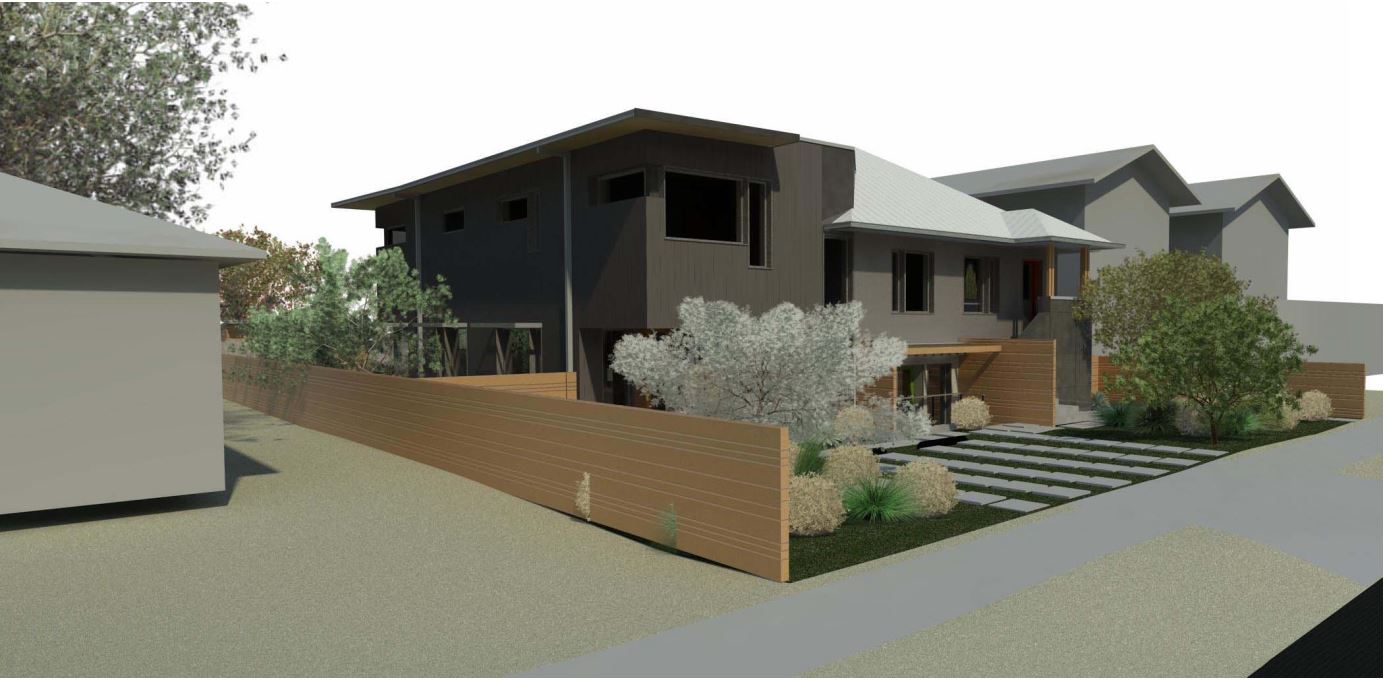
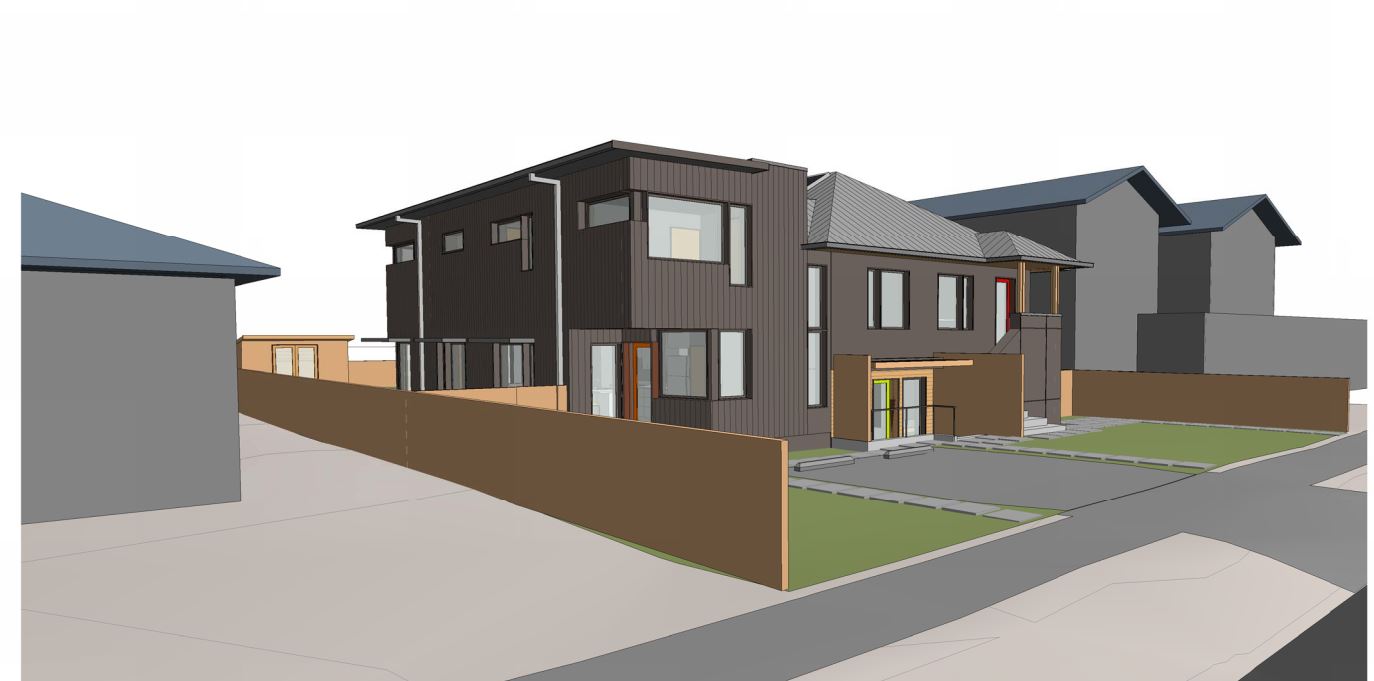
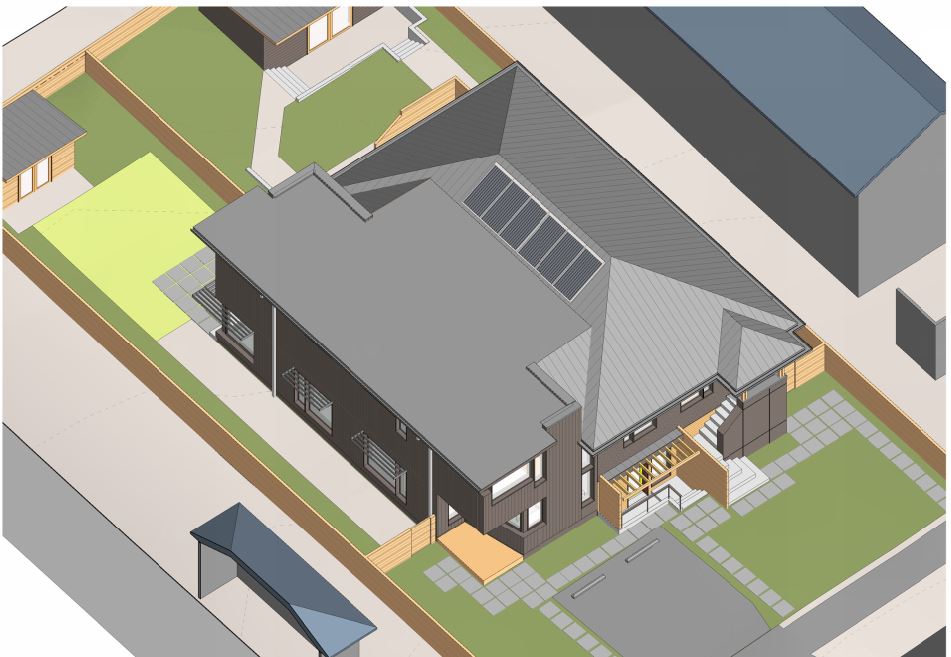
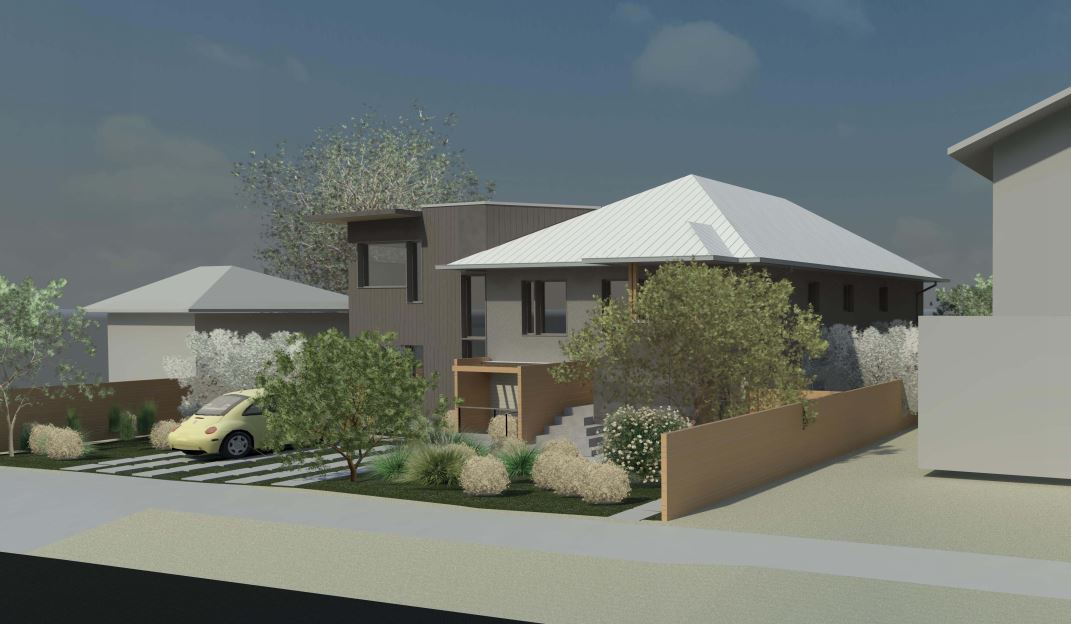
Roof Shape: Since we have to rebuild it anyway, we’ve chosen to do away with the hip roof on the ‘existing’ half. It’s a dramatic aesthetic improvement in my opinion but also a major simplification.

new gable roof (with the same floor plan)

old hip roof

Modeling the original hip roof was a less than satisfying experience. I could not completely capture the intersection of multiple hip roof slopes with the low slope roof of the new half using simple geometry and the dimensions provided on the drawings. And Interactive would have to build this! A gable roof is so much simpler to model and build.

The downside of this change is that the City needs to approve it. We are told it will only take a few weeks, but we have to submit a modified Development Permit package for the planning department’s review AND a revised Building Permit Package for the code inspection side. Good times.

Windows and Doors: We’re confirming final details of our Cascadia Universal Series fiberglass window and door order, which includes committing to the Solar Heat Gain Coefficient (SHGC) for the glazing. This is the value that determines how much heat is allowed through the windows versus reflected away. Higher is better in the model because it allows in more ‘free heat’, but lower is better to prevent overheating, and I think lower is ultimately the better way to go given our climate trends. I’m leaning toward using the lower value (Cardinal 360/180) on the south and west windows and the higher (Cardinal 270/180) on the north and east.

Much more fun than picking a SHGC for glazing is picking custom colours for our front entry doors. Thanks to our kindergartener’s astute design sense, there will be a purple door!

Ventilation: Each half of the duplex will have distinct heat recovery ventilation systems. We had been mulling over whether to pay for the more expensive Paul Novus units that have better heat recovery than the Zehnder units. This makes a difference of about 1 kWh/m2 heating demand, which is not insignificant when the maximum allowable is 15. I’ve got the less efficient Zehnder units in the model now, but this dilemma is likely to resolve itself even more favorably when the new Zehnder Q-series units become available in early 2019. They have vastly improved efficiency at much lower cost than the Paul units. Whoopee.

Heating and Domestic Hot Water Heating:  We have chosen to go with Sanden CO2 heat pumps for domestic hot water heating and in-slab radiant hydronic heating on the ground floors. These are air-to-water heat pumps that use CO2 as the heat transfer medium instead of something like R410-A. This technology has so much potential because most other refrigerants have several hundred to several thousand times the global warming potential of CO2. And the thing that doesn’t get talked about (and as far as I can tell has not been studied) is that typical refrigerant-based systems leak refrigerant like crazy. Anecdotal evidence suggests that 80% of the refrigerant that gets added to a system leaks out into the atmosphere.

The limitation of CO2-based systems is that they can only do heating, whereas other refrigerant based systems can provide both heating and cooling. We’re not currently planning to add mechanical cooling and we’re hoping that by the time the climate here becomes California, we’ll have sufficient shade trees to limit our exposure.

I’ve chatted with a few people who have experience with a Sanden “combi” system, including Peter J from Cascadia Architects. He has a functioning system in his Passive House home and shared a few tips for making sure it works properly without overheating the house – like heating the slab overnight and then shutting it off during the day and having a couple of supplemental heat sources for the few very cold days.

And further to the simplicity theme: by using polished concrete floors on the ground floors, we can embed the hydronic tubing; do one concrete pour and save on other floor finishes. It also makes for a clean modern look that we quite like.

And a Bunch of Little Things: I’m keeping a running markup of all the little things that occur to us the more we stare at the drawings – like moving a toilet location; combining the laundry and mechanical rooms to remove a wall and a door; shifting a window so there is room for a single bed along one wall. So basically thinking carefully about what it will be like to live in the space and making sure it works.

We’re quickly approaching the point where we’ve firmed up the bigger system choices. I will then do another update of PHPP, after which we’ll have a very good idea how the numbers will work out. Our decision-making will then shift toward things like kitchen cabinets and countertops and away from things with an appreciable impact on energy demand.
Filed Under: Design, Featured, Performance Tagged With: passive house, Passive House construction, Passive House performance, Passive House systems, ultra low energy

Hooray for our Building Permit*

June 12, 2018 by clove 4 Comments

I was joking with a friend that every milestone we reach on our project comes with an asterisk. Like when we finally got our financing approval, which was an incredible relief, right? Except…the financing isn’t actually enough, and we’ve immediately had to get to work on other ideas to cut cost and access more capital.

So here’s today’s version.

We finally got our Building Permit- hooray! Bring out the confetti and chocolate cake!

But*

First of all, it took a really long time and, second, I’m still getting over the sticker shock of what it cost us. Confetti doesn’t quite capture the mood, and we probably can’t afford that chocolate cake anymore.

how long it took

The City strives for a 20-day turnaround on permit reviews, although I was warned when I submitted that City staff are slammed.

The day I actually submitted in early March was already my second attempt. I had been turned away by an initial scan in mid-February that revealed a few obvious inconsistencies with how the City wants things presented. So the permit process actually began for us nearly 4 months ago.

After officially submitting, City staff took 30 business days to review. So 6 weeks in real life. Every application wends its way from pile to pile and desk to desk. Engineering looks at it, parks looks at it, plumbing looks at it, and so on; each person adding their comments. Reviewers in two departments- Building Inspection and Plumbing Inspection- asked for a few changes, which took us 6 business days to turn around. The City then took another 24 business days to review those changes, our application once again passing across every desk. All told, it took 54 days of City review time to get our Building Permit, and 3 1/2 months in total time, including revisions on our end, since our first attempt to submit.

We do have to appreciate that the current level of construction activity in our fair city is unprecedented. Those who have worked in the industry here for decades say they’ve never seen it this busy. All you have to do is look around at all the cranes and holes in the ground to sympathize. City staff are working really hard with a daunting workload.

Still, it’s hard to not get frustrated by all the little details that have slowed things down and ultimately cost us money (our first construction loan advance is charging interest as I type!).

Here is one of the main details leading to the request to resubmit:

Our new neighbourhood plan specifically calls out ‘duplexes with suites’ as a desirable building form, meaning that the two main halves of the duplex can be titled separately, but the suite will always be a rental within one half. However, this building form does not exist in a code official’s mind because the building code does not specifically address it. As a result, while we intentionally designed it as a duplex + suite, the permit folks felt compelled to reclassify it as a “triplex”. This then required us to remove reference to certain parts of the building code, add extra fire separations, and change a few other details on our drawings. It is also likely to mean all manner of headache around shared ventilation and hot water systems further down the road – i.e. more cost to us.

Which leads us to…

how much it cost

The real asterisk dampening our ‘hooray’ moment is how much it cost to get our permit. We’re now pretty used to everything taking longer than hoped or expected. I suppose we’ve now also reached a point where we might as well get used to everything costing more than hoped or expected.

I had anticipated $10k for the permit itself (1.4% of construction cost, less plumbing and electrical, which are separate permits), plus ~$7,500 for a landscape deposit. This deposit is to ensure we actually do the landscaping work we promised as part of our Development Permit application. I’m not thrilled about this deposit, but it is described on the City’s website, so I’ve had a couple of months to get over it.

So how the heck did I end up writing a check for $50,784?!

There were two surprises that cha-chinged us up to this unpleasant total:

  1. We pay for new city services up front in order to get in the queue for the City to do the installation (three to four months behind, by the way). So, $24,600 for new storm, sanitary and domestic water connections for each half of the duplex. We had expected to pay for this, but hadn’t realized it would be up front.
  2. They took an $8,000 deposit for ‘new engineering works’. I had to call someone to learn what this was, because the staffer who initially helped me didn’t know, and neither did the staffer she called over who knew more than she did. This one is to make sure we build the new driveway and sidewalk to City specs. OK…but isn’t that the whole point of the Building Permit itself – granting permission to build something with the expectation and promise that we build it as shown in the drawings?

I’m frankly a little enraged about that one. Are we getting paid back with interest? Don’t know. And because there is no paperwork beyond a line item on my receipt, I fear we will have to fight to get our deposit back.

So there you have it:

  • $16,184 for ‘refundable’ deposits;
  • $10,000 for our Permit proper, and
  • $24,600 for new City services.

I can see why some developers raise the white flag and go to Langford where you can get a building permit in 48 hours for a fraction the cost!

Hey, I have an idea! How about permit rebates or waived deposits for people building ultra low energy projects? We are helping the City meet its climate goals after all, and leapfrogging all the way to the 2030 end of our new BC Energy Step Code. And so far, we’re just another folder on a pile of endless, helpless applications.

Alright, enough complaining.

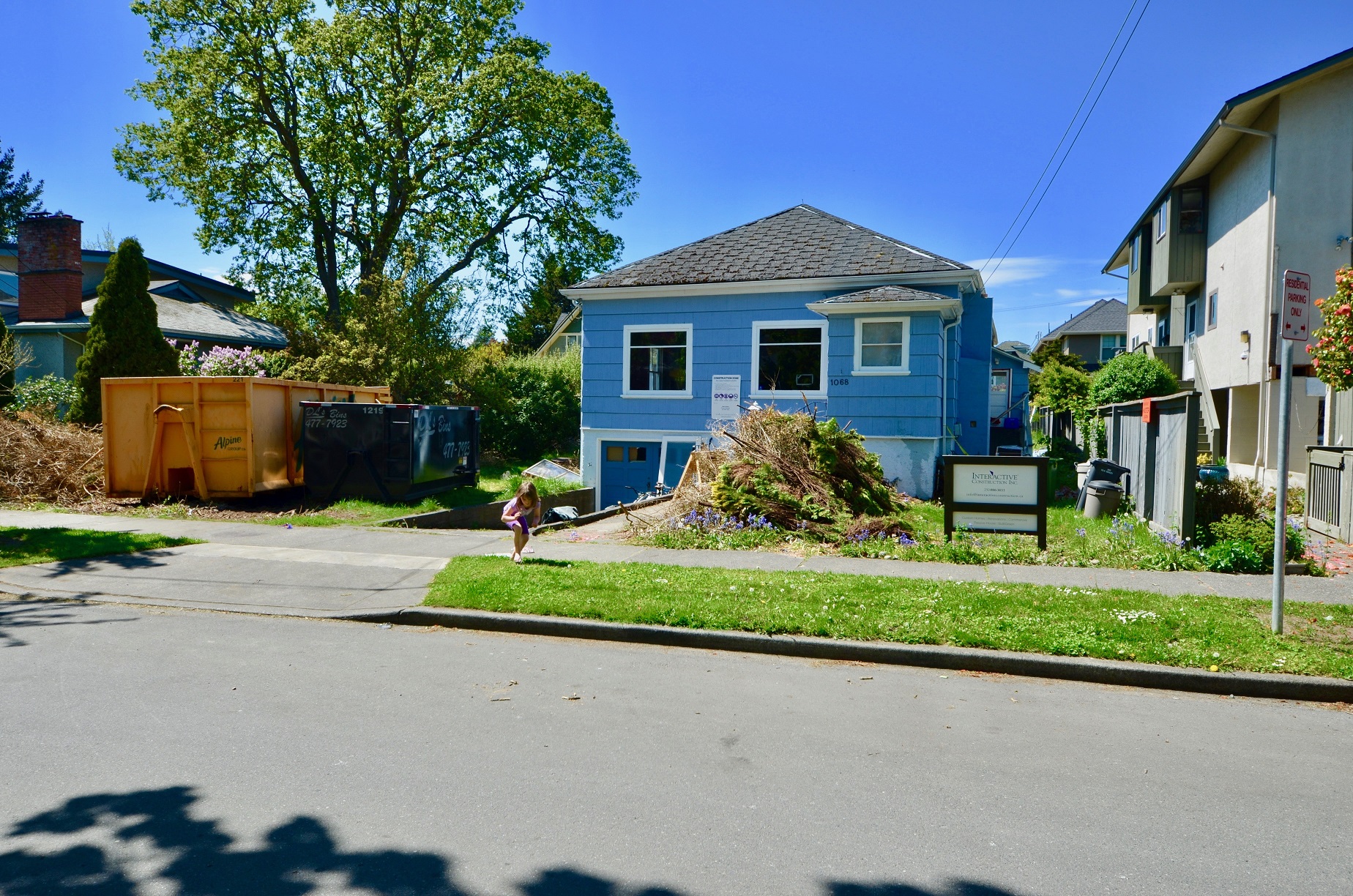
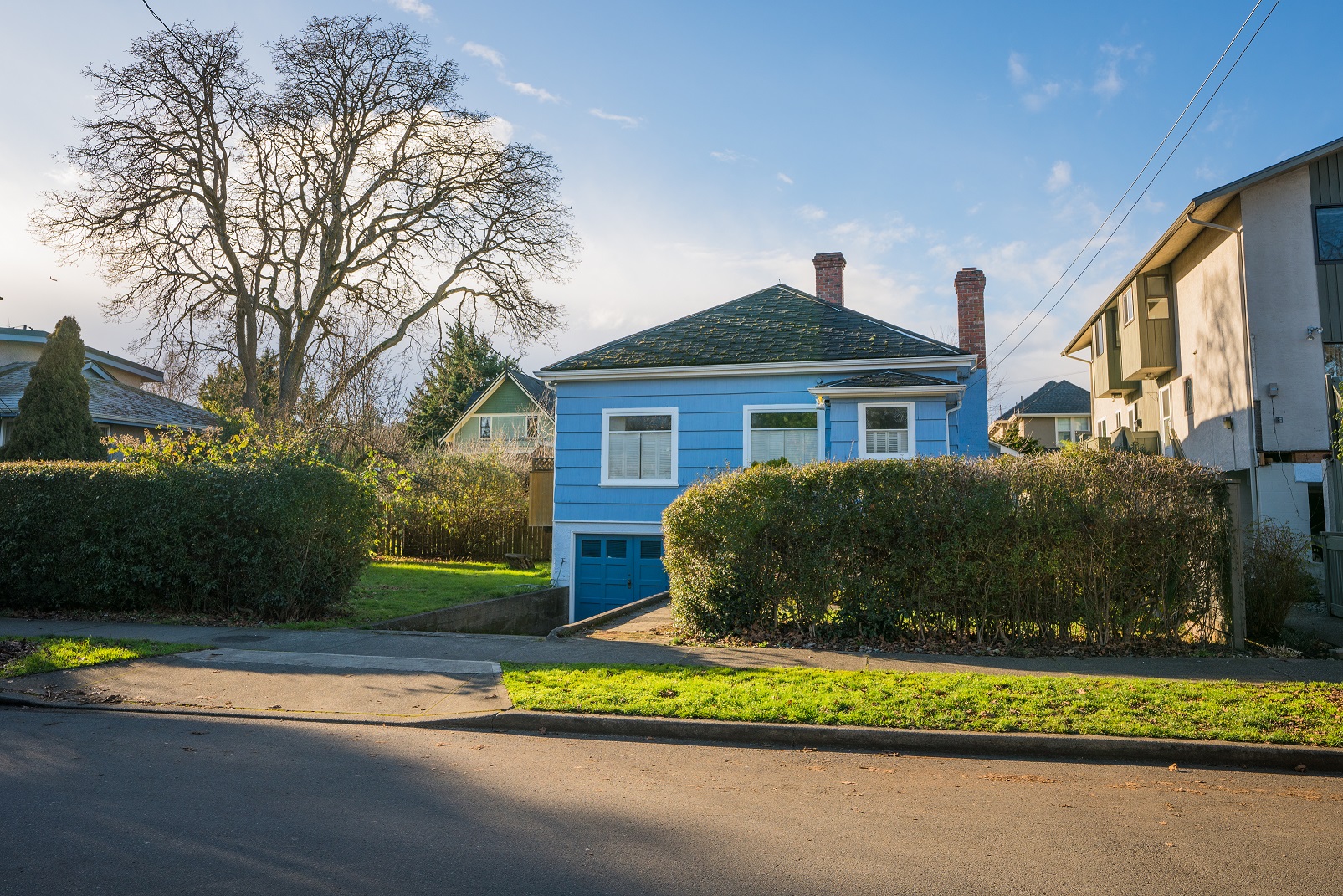
I’ll close out today’s post with a puzzle. Spot what’s different about our house in these two photos. Winner gets a pile of early 20th century bricks!

Filed Under: Construction, Featured Tagged With: building permit, construction, duplex + suite, ultra low energy

You’re Invited!

November 3, 2017 by clove 4 Comments

Dear Readers, Friends, Neighbours,

Well here we are, finally approaching the moment when City Council will vote yes or no to our rezoning application. The rezoning is what will change the use of our property from single family to two-family + suite. If we get through this, all that is left in terms of the City’s process is to apply for the building permit to begin construction. 

First: We want to thank each of you who shared ideas for making our project better, for offering support, and even just for showing interest in what we are doing. Our project is better because of you! We have made many friends through this process and continue to be amazed by this incredible community we call home.

Second: We officially invite you all to join us at our public hearing next Thursday, November 9 at City Hall! The meeting starts at 6:30 and we are third on the agenda. The format is that we present for 10 to 15 minutes and then Council hears comments from any member of the public who wishes to speak.

If you can’t make the hearing, or speaking in public isn’t your thing, feel free to send a letter or email. These do get read and considered. Here are the City’s instructions for doing this:

For those who are unable to attend, your input can be via mail, an email to publichearings@victoria.ca, or you can drop off your written feedback at Victoria City Hall to the City Hall Ambassador located to the left of the main entrance. Correspondence should be received by 11 a.m. the day before the Council meeting.

Please note that all correspondence submitted will form part of the public record and will be published in the meeting agenda. Your address is relevant to Council’s consideration of this matter and will be included as part of the public record. If you choose to share your phone number and email address with us and wish that it not be disclosed, please let us know and we will ensure it remains confidential.

Thank you again and see you out there!


Filed Under: Featured, Rezoning Tagged With: community engagement, infill, neighbourhood engagement, passive house, rezoning, ultra low energy

Public Hearing, Here We Come

September 29, 2017 by clove 2 Comments

On one hand, this project feels like it’s taking forever (2 years and counting since we first shared our concept with our neighbours), but on the other, I’m not sure we’d be able to handle it if it moved any faster, what with the rest of life and all. We’re currently looking at a construction start of early 2018 and there’s a lot that has to happen before then!

At the Committee of the Whole meeting in August, Council voted 7 to 1 that our project was ready to go to public hearing. So mark your calendars for November 9, folks! This is the day we present to Council and the public, and anyone with an opinion is welcome to speak. After that, council weighs in and then votes yes or no to our application. If they vote yes, then we’re done with the rezoning part and can focus on getting to construction. If they vote no, it’s back to the drawing board.

Our general plan is that we be ready to submit for building permit as soon after the public hearing as possible. Once we have our building permit, we can start construction.

Here’s the “lot” that has to happen next:

  • Finish the passive house model to a point that our certifier can review it and flag anything big before we apply for our building permit.
  • Find a structural engineer to look at our renovation plans, as well as any strange lateral loads we are introducing by attaching a second house to the side of our current house. Last time I called around, half my calls went unanswered, and the other half said they were too busy to take on any more work. This input will be a requirement for our building permit.
  • Meet with Mark A (our architect) and Russ (our builder) to firm up our assemblies and talk about cost and constructability issues. The big one currently on my mind is how we will insulate a hip roof transitioning to a flat roof. We’d like to do exterior insulation, but how realistic/affordable/buildable will this be?
  • This meeting should give Russ what he needs to work up a construction budget, which we can then use to secure financing (another big looming question that I look forward to resolving very soon!).
  • Prepare for and present at the public hearing.
  • Prepare building permit drawings and apply for building permit.
  • Find a place to live during construction, pack up and move there!
  • Clear out as much of our existing house as we can before Russ takes over.

As for the rest of life, there’s work, hosting Thanksgiving dinner, celebrating our anniversary, visiting friends in Toronto, watching a few movies, hanging out with family and friends, riding bikes, sleeping, eating, reading, being healthy…no big deal, right?


Filed Under: Rezoning Tagged With: community engagement, infill, rezoning, ultra low energy

A Sign of Progress

July 29, 2017 by clove Leave a Comment

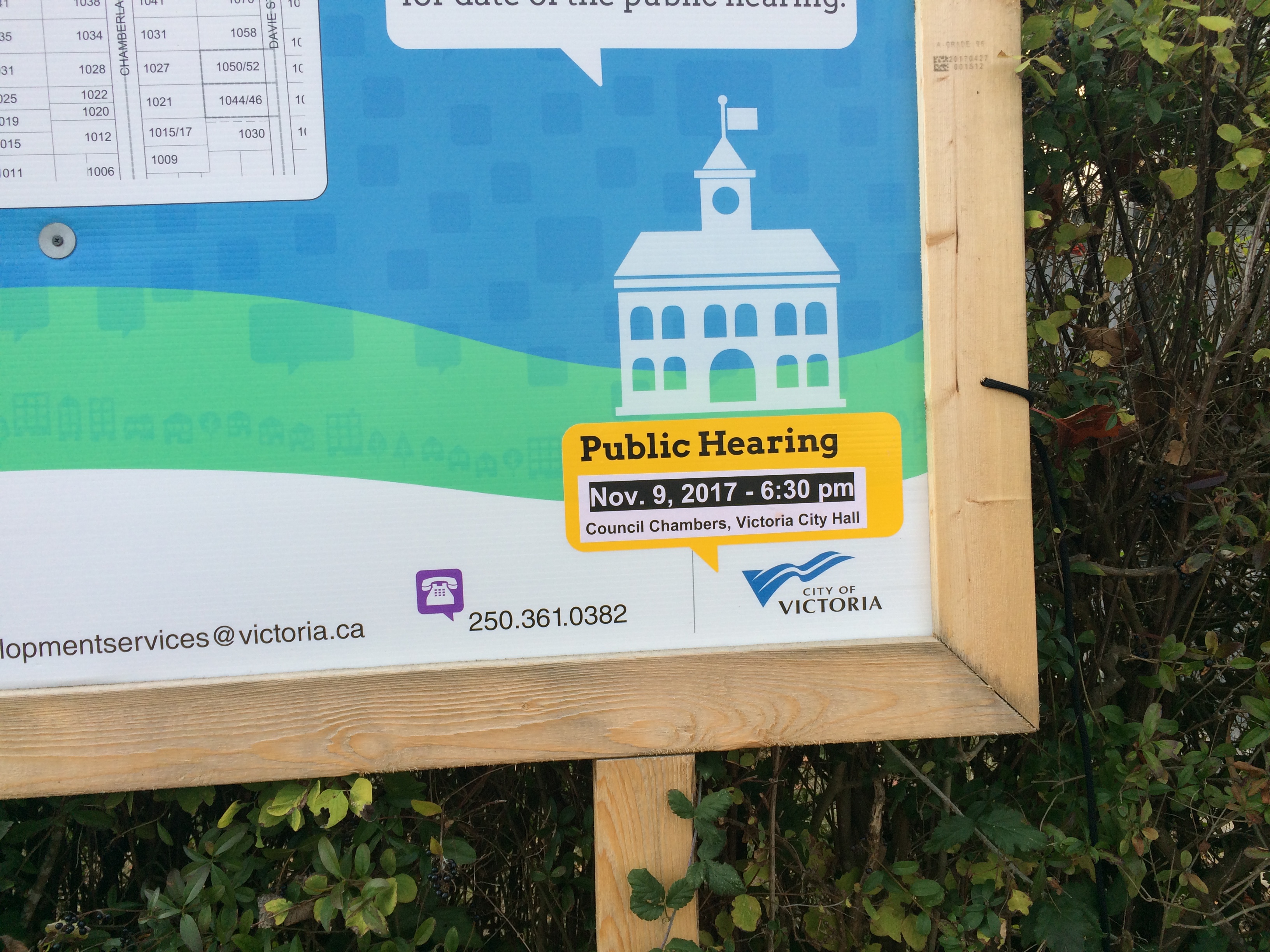
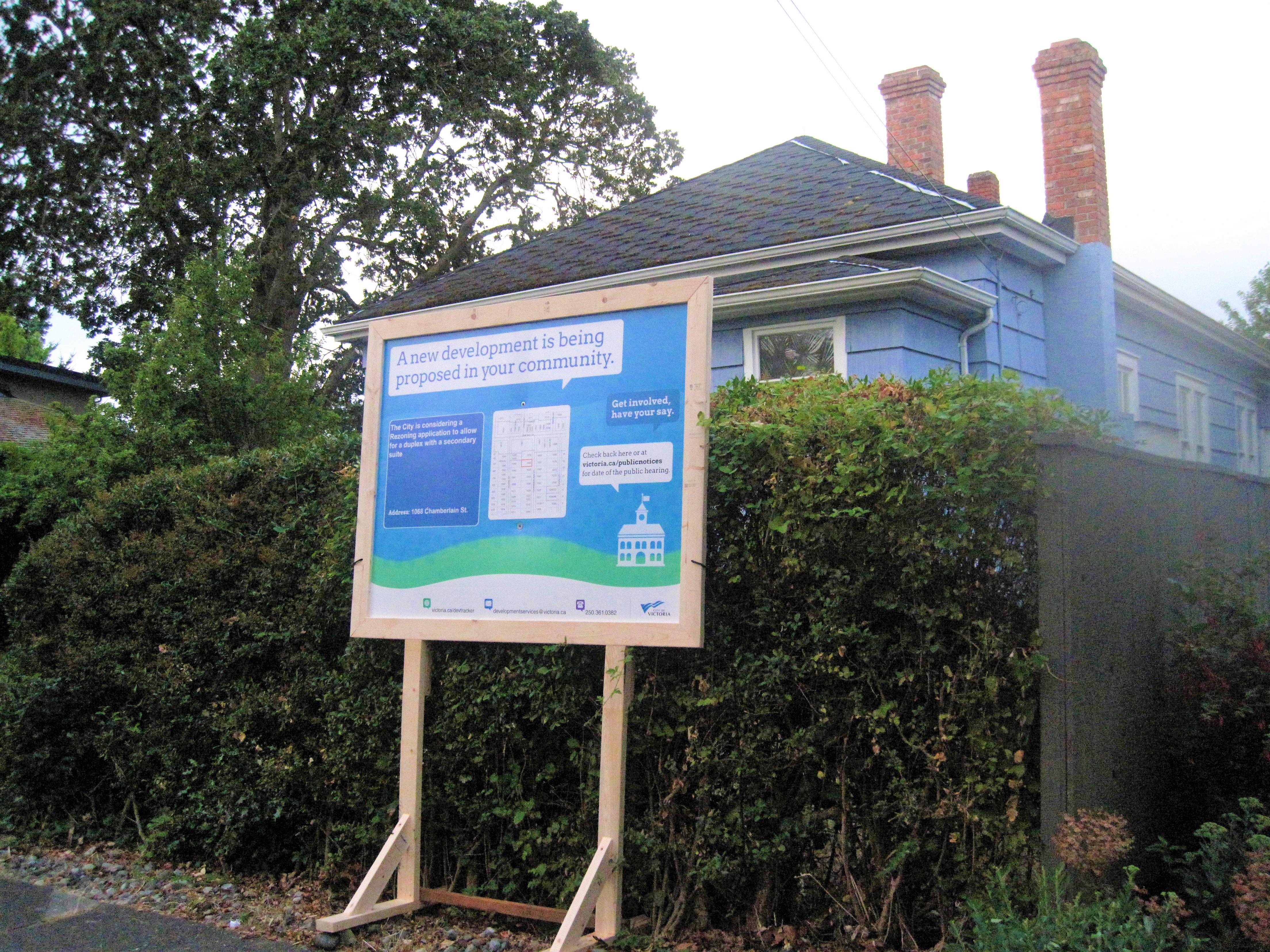
We posted this enormous sign in front of our house last weekend:

This sign means that we are on the agenda of an early August meeting of the Committee of the Whole, and it will stay up until the Public Hearing. The meeting of the Committee of the Whole is attended by both City Council and city staff, and it’s when they discuss staff’s recommendations for a given project application in advance of the Public Hearing. The meeting is open to all (you can view them in person or remotely here), but we are only allowed to listen in, not participate.

This is the last step toward rezoning approval before the public hearing. We would not expect any further comments from city staff, but it’s possible that Council may raise something major.

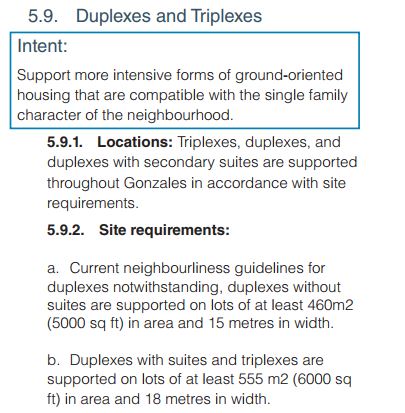
In other related news, I also recently reviewed our neighbourhood’s new draft Community Plan – the first update since 2002. Hey, get a load of this:

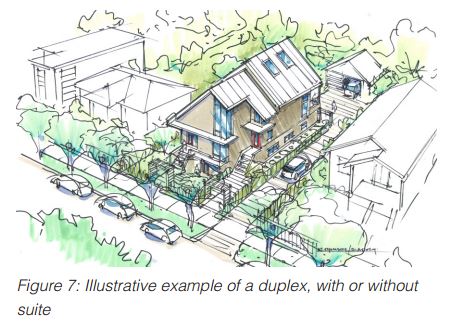
Duplexes + suites are specifically called out! This was the riskiest part of our rezoning application – that we were asking for a custom zoning because the existing two-family/duplex zoning does not allow suites within the duplex.

While we’ve heard in principle that the city wants more of this type of infill, and the Official Community Plan refers more generally to it, there is currently no zoning to support it. So having a nearly official document explicitly name what we are proposing is very encouraging.

Thanks to all of you who have followed along and supported the project so far!


Filed Under: Featured, Rezoning Tagged With: duplex + suite, infill, rezoning, ultra low energy

Choosing a Builder

June 24, 2017 by clove 1 Comment

For a successful Passive House or ultra low energy project, it’s important to bring your builder on board early – especially if you want one for a reasonable budget. Material, assembly, and detailing choices will all impact cost, and your builder will have the best insight on these impacts. On top of this, the local construction market is hot right now and some builders are booking a couple of years out. Planning ahead in any case is a necessity.

While a year or two ago, there was only one builder in town who had built a Passive House (shout out to Mark Bernhardt!), we now find ourselves in the enviable position of having several excellent choices.

We narrowed our search to three builders: NZ Builders, Bernhardt Contracting, and Interactive Construction. I have gotten to know all three through the Passive House community and my work at RDH, and all three are passionate about building ultra low energy homes. I mention them all because any one would be an excellent choice depending on the needs of your project. All three builders have at least one Passive House as well as other net zero/ultra low energy homes under their belts.

The downside to having these choices was that we’d have to say no to two of them – something I was not looking forward to. Matt and I took a similar approach we’ve taken when buying a house: establish our criteria, do our best to keep emotions out of it, and make the most rationale decision. Hiring a builder does add another layer of complexity over buying a house, though, because you are choosing not just the end product you think you will get, but also the person you will work closely with over the next year or more.

So what did our choice come down to? Prior experience was a prerequisite, but here are the other criteria we considered:

  • Enthusiasm and experience working with the existing house and materials:

How keen were they to work with the existing 100-year-old structure (framing, walls, roof) and existing materials (like our fir floors, solid wood doors, and bricks from our three chimneys)? Yes, it may ultimately be easier (and cheaper) to tear down and build new, but that is not what our design is about. Our existing house has a lot of good material in it. It shows none of the telltale signs of rot or other structural damage, and our design was specifically intended to preserve as much of the existing house form and materials as possible – and to look that way. If we were going to tear down and rebuild, the design would have been completely different.

The marriage of old with new. Rendering Mark Ashby Architecture


  • Crew size and proposed construction duration:

The ability to build as quickly as is reasonable will save us financing costs, as well as the amount of time we need to live/rent somewhere else. Available crew size varied and estimated construction ranged from 7 to 12 months.

  • Budget input:

We didn’t ask for a budget, but did ask for their input on whether they thought our budget was feasible. They all said No! The cost of materials has skyrocketed in the past year, and there is a severe skilled labor shortage locally. Our original construction budget of $600-650k, which seemed entirely reasonable a year or two ago, is now laughably low. Let’s all have a good laugh (cry) and move on, because we’re now likely to be pushing the $1M mark. On the plus side, the value of real estate has gone up significantly as well. Such is the inherent risk in development.

Budget projections from all three builders were in the same range for a new build, although a builder won’t do a detailed budget until you have signed on the dotted line. The number can vary widely depending on interior finishing choices that are largely up to us. Renovation costs are also more variable and depend heavily on what we find behind the walls and what we want to do with the interiors.

Hourly labour costs did vary between the builders and this was a factor in our decision-making. But again, difficult to judge whether that automatically leads to a more expensive project – especially if one builder places a heavy emphasis on upfront planning and another flies by the seat of their pants.

As one of our project goals is to reduce our cost of living, we will have to keep a close eye on budget and likely make some difficult decisions to keep costs within a range we are comfortable with.

  • Fit:

Fit was the toughest criteria for us to evaluate objectively. Is there a fit with our values, as well as how we think and work? Do they approach their work the way we do in terms of problem solving and attention to detail? How do they respond to our ideas?

I recommend spending a good amount of time talking with any builder you are considering, because this one comes down to intuition more than any other criteria. We also talked to people who have had homes built or renovated by each builder, and toured works in progress. In this exercise, we were looking at attention to detail and quality of finish work (but not necessarily the actual finishes, which reflect owner’s preference not builder’s skill). We were also listening for how the crew communicated with us and with each other.

In the end, our evaluation against our criteria led us to sign on the dotted line with Russ Barry at Interactive. Our signed letter of engagement allows Russ to slot us into his project schedule (likely for late this year, depending on our rezoning timeline).

Now what? Next month, we will meet with Russ and Mark A to hash through assembly details – from a Passive House performance, buildability and cost perspective – and firm up those pieces. This will allow Russ to develop a more detailed budget, and will allow me to refine the Passive House model. Closer to the start of construction, and before he starts ordering materials and otherwise committing financially to our project, we will need to give Russ a deposit to the tune of $30,000.

And of course, we are still waiting on rezoning, so we won’t get too far ahead of ourselves until we clear that hurdle. Stay tuned and enjoy our beautiful summer weather in the meantime!


Filed Under: Construction, Featured Tagged With: construction, passive house, ultra low energy

To Passive House or Not to Passive House (Responding to City Comments Part 2)

February 17, 2017 by clove Leave a Comment

The city asked in their first rezoning review if we were willing to sign a covenant to seek Passive House certification. Good question and the time has come to answer it!

(Read more about Passive House and other approaches we considered.)

There are a couple of good reasons to pursue Passive House certification:

  • Understanding the nuances of the process by going through it.
  • Marketability – it’s becoming increasingly recognized and sought out by savvy buyers around here.

Because of what I do for a living, though, I am inclined to remain certification-system-agnostic. If we go for Passive House, it’s because I want to test it out. We’re not doing it because we think it’s the only way to a good building and to a sustainable future. It is a way. Focusing on passive principles, like airtightness, well insulated walls, no thermal bridging, and effective ventilation – is a very straightforward way to dramatically reduce our energy consumption and greenhouse gas emissions, and I do believe this is a critical approach to building better buildings. A house that consumes 20 kWh/m2/yr instead of the 15 required by Passive House at the end of the day is still miles ahead of a typical one that consumes 100.

I’m also very curious about the impact of occupant behavior. Could we build something slightly less than a passive house and use as little energy through conscious consumption? Would we be more uncomfortable? Is there an ideal balance that is something less than Passive House but right in our mild west coast climate? These are difficult questions to answer on a single project, but interesting all the same.

I’ve had in my mind from the beginning what I believed to be a reasonable but very high performing wall assembly: 2×4 wood frame cavity with batt insulation; plywood sheathing, weather barrier, 6” of mineral fibre insulation; rainscreen and cladding. We’re on board for a high-efficiency heat recovery ventilator (Zehnder, Paul or similar) and we’re set on good triple pane windows. We’re committed to renewables with a goal of net zero energy consumption and zero greenhouse gas emissions.

But I was not sure about other pieces like the amount of roof and below slab insulation. And I wasn’t sure how this would all add up in the eyes of Passive House. There was no way of getting around it – I had to model it in PHPP, the Passive House (giant) spreadsheet software.

In early January, I took the 3-day Passive House modeling course as a follow-up to the 5-day design course I took three years ago. I’ve since been chipping away at the model to give us more confidence about what we are prepared to commit to in our re-submission to the city.

I’m relieved to report that I am *almost* finished the model.

The first time going through a whole model for a smaller house takes at least 3 days, assuming you’ve had some training. I’m 24 hours in so far, and this includes a fair bit of head scratching, learning, looking at other examples, going back and fixing mistakes.

I would recommend to anyone who has the luxury to devote 3 whole days in a row to get your head into it; even half days are wonderful. I found two hours at a time is about the minimum to feel productive. And keep moving – if I got stuck and bogged down by something, I moved on to make progress elsewhere, then looped back after I’d had a bit of time to digest the issues, or could ask someone for guidance.

The modeling tool itself is not difficult provided you are comfortable using Excel, but it does take time to understand the intent of each entry and to follow the protocols where they exist. The most frustrating part of the modeling for me was that there are several key entries that require significant work in the background – for example, calculating total floor area, heat loss area, and domestic hot water pipe lengths – but lead to a single number entered into a single excel cell. The progress is significant but can feel small.

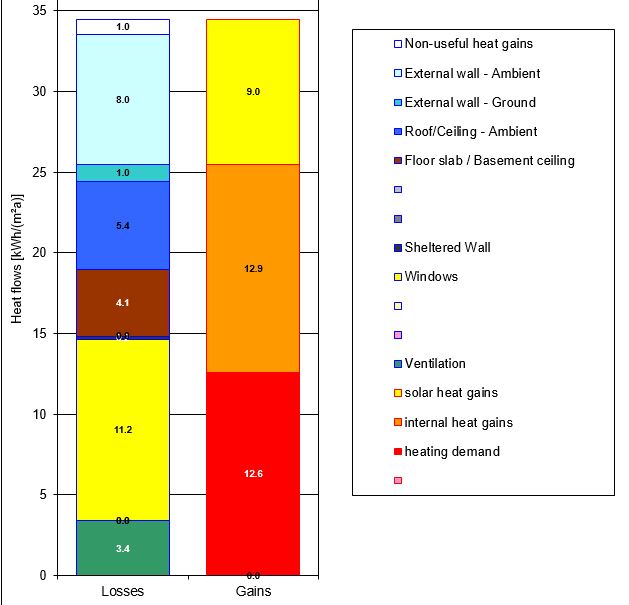
Here is the heart of what you get out of the model:

The software is really an energy balancing tool in which your goal is to moderate heat losses (e.g. through your walls and windows), and then balance them with gains (e.g. through people, light bulbs, appliances, as well as solar gains through windows). The remaining imbalance is your heating demand, represented by the red chunk in the ‘gains’ bar above – this is what you have to add to the space, and this is the number that Passive House requires you to keep less than or equal to 15 kWh/m2/year.

I still have a few key inputs to add, but am feeling confident that this is within reach for our project and we are likely to go for it. In the meantime, time to reclaim my personal wellness time and get outside for some fresh pre-spring air! Thanks for reading!


Filed Under: Performance, Rezoning Tagged With: energy efficient design, passive house, performance, ultra low energy

Argh, Parking! (Responding to City Comments Part 1)

February 17, 2017 by clove Leave a Comment

Lest you surmise I’ve been idly twiddling my thumbs for the past 3 months, I’m overdue to lift my head and share an update.

Besides shivering through Victoria’s longest cold snap in over 30 years, we’ve been working on 2 big things:

  1. Responding to the first round of city comments on our rezoning application.
  2. Completing the Passive House PHPP model.

I’ll cover the first item here. See this post for the Passive House model update.

We received our first round of comments back from the city on December 22 –  four weeks after we’d officially submitted. When I first reviewed the comments, I felt discouraged, as there appeared to be a long list of issues. But Ian, our planning consultant, pointed out this key sentence at the beginning of the letter:

The application as submitted can be considered with the land use policies relevant to the property.

Ian thought this was an excellent response. It is saying, albeit obliquely, that the city is likely to support our application, provided we address their comments. Great!

Ian and I met with the planner responsible for our project to clarify some of the comments. Nothing earth shattering resulted from this meeting, but it was good to have the face time and confirm that we understood their intent.

There were two major comments that affect our design: parking and roof lines.

Parking:

I long for the day when the level of consideration, money and space we devote to places to put our cars do not vastly overshadow the resources we devote toward places for people to actually live. Alas.

The rules around parking are largely inflexible and at odds with our desire to preserve green space on our urban lot. At the same time, the more we push the rules, the longer the timeline drags out and the less certain our outcome becomes, so we’re working toward a reasonable solution that satisfies city engineering but does not compromise our project goals.

We’re required to provide 2 off street parking spots for a duplex (the secondary suite does not require a third spot thankfully). Our neighbourhood has a precedent to allow for front yard parking, which we are invoking to preserve as much back yard space as possible.

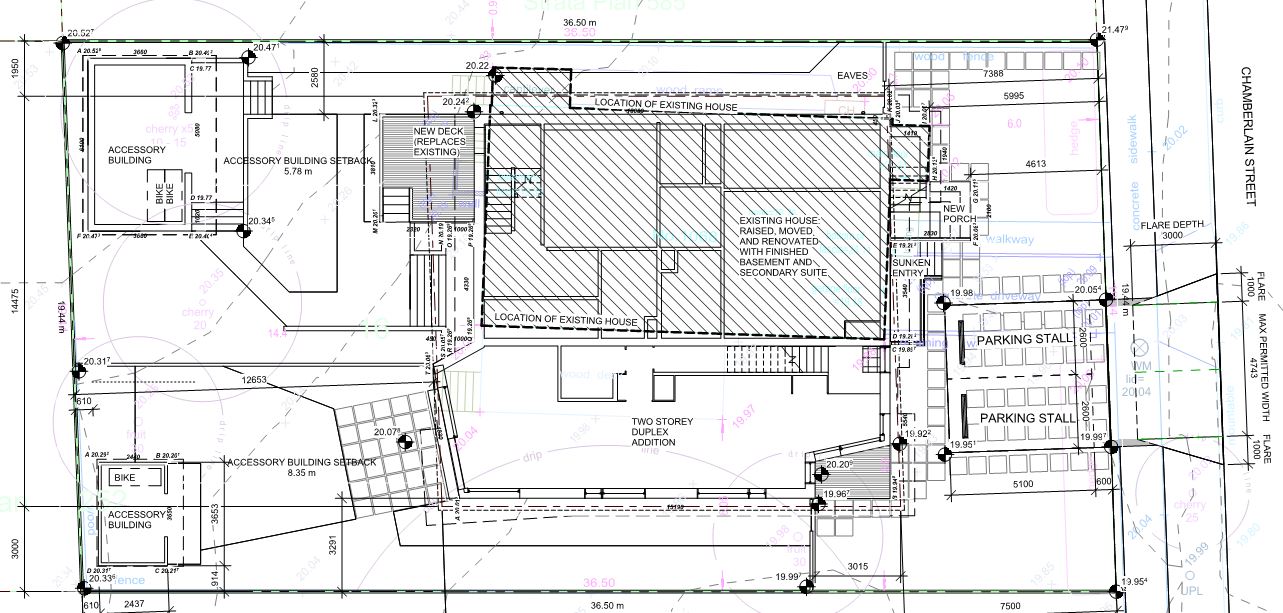
One of the unbendable requirements is a 1.0 m setback from the rear of the parking spot to the property line. In the initial review, the engineering department also asked for an additional 1.4 m right of way in the front yard. Why? Because they might one day widen our entire block from the current 15 m street width to the more standard 18 m. Really? We already have sidewalks on both sides, parking on both sides, and boulevard green space between the sidewalks and street. The narrowness of our street also has the desired effect of slowing vehicle speeds. Sounds OK to me.

We do not agree with this request, nor is there any policy requirement that we grant this request. So we’ve decided to provide 1.4 m total, not 1.4 plus 1.0 m, as a compromise that we feel is likely to be accepted. Here’s how the design has evolved as a result:

Before: We were just a hair short of the 1.0 m required between the end of the stall and the property line, but thought we’d give it a shot:

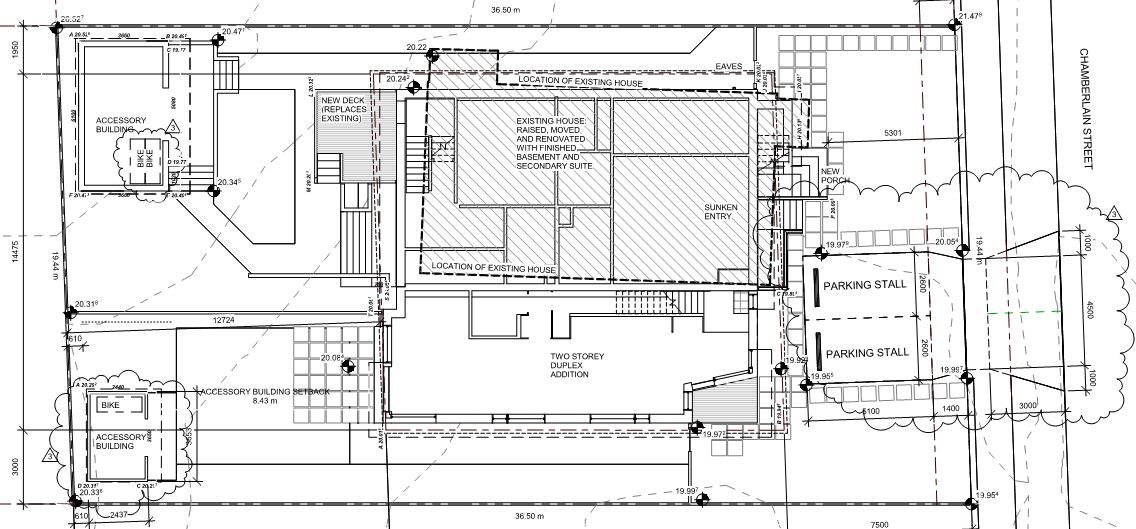
After: We’ve shifted the house back 0.7 m and shortened up the back end of the new addition to achieve the 1.4 m setback at the front without infringing on rear setback limits:

This design change has the added bonus of simplifying the enclosure shape, which is good for Passive House, and we’re pleased with this evolution.

Roof Transition:

The City questioned the transition between old and new roofs. Something wasn’t working, and they rightly pointed out a weakness in our design, if not a simple lack of clarity.

We bandied about the idea of a more dramatic change to the existing hip roof to a gable roof. In addition to being a bolder shape, a gable roof would open up the potential for a loft space, vaulted ceilings and other cool design elements.

But then we thought through the implications – changing most of the roof line, extending the walls up to create the gable; interior redesign to include a stair or other access to the loft space, and potential zoning floor area restrictions we might now bump up against. Besides the fact that our existing house would no longer resemble its original self, there were a whole host of ripple effects that were going to add cost and stretch out the project timeline.

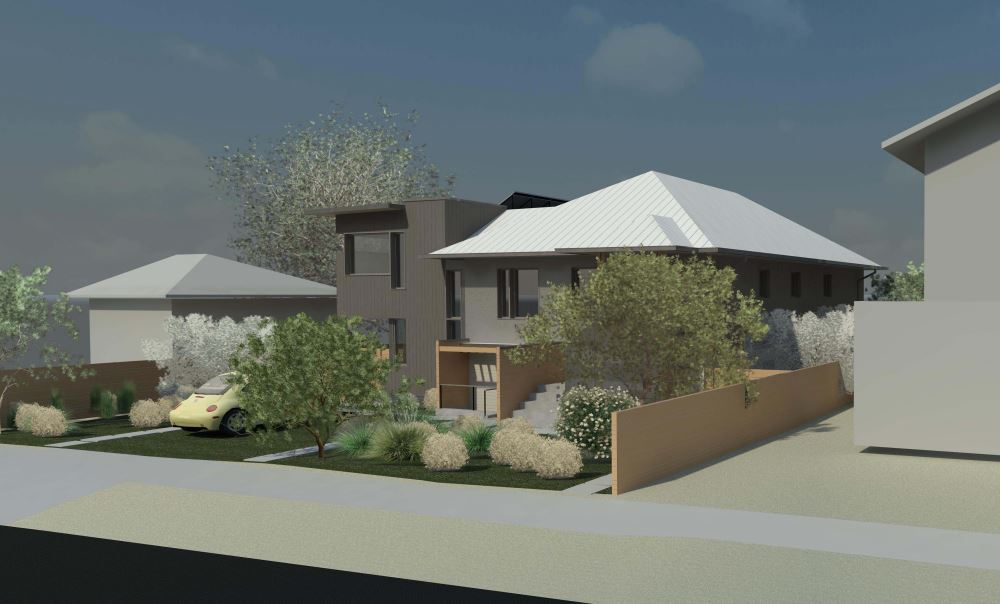
Fortunately, though, as the creative process often goes, this exercise led Mark A to a more elegant solution for the hip roof, which is what we chose to stick with. Here is the before transition from old to new:

And the after:

Renderings by Mark Ashby Architecture

We’ve been working on these revisions for the past six weeks. When complete, we will submit an updated set, a revised letter to Mayor and Council, and an updated narrative. We may get another round of comments, or if all goes well, we will move on to the meeting of the Committee of the Whole – one step closer to rezoning approval, and we’re holding firm on our current goal to be under construction this summer!

Filed Under: Design, Featured, Rezoning Tagged With: energy efficient design, infill, rezoning, ultra low energy

Over to You, City!

December 1, 2016 by clove 1 Comment

We have officially submitted our rezoning application! And don’t be silly – of course it didn’t go as smoothly as expected. One of these days, I will know better.

View from the northeast. Rendering Mark Ashby Architect

View from the northeast, rendering Mark Ashby Architect

A couple of Thursdays ago, I hauled 10 lbs and $120 worth of paper down to City Hall for my 11 AM appointment, including:

  • 80 sheets of 24 x 36 plans (5 sets)
  • 2 sets of 11 x 17 plans
  • 3 sets of 8.5 x 11 plans
  • letter to Mayor and Council
  • completed Rezoning Application forms
  • plus a check for $2150
  • and a flash drive with PDF versions of all of the above

At this required appointment, a staffer takes a first pass to check for completeness before your application wends it way through the various departments. I suspect this is ultimately a time saver for everyone, although it left me with a feeling that I’m navigating my way through a labyrinth with more dead ends than ways through. In reality, there is simply a lot for a first timer to wrap one’s head around and get right.

Turns out we were missing the “average proposed grade” calculation and a line indicating such on elevations and sections. We were also missing a label for the setback distance between the main structure and the accessory building.

I was told to come back again when I had corrected these omissions. I grumbled that there would be no celebrating that weekend, and grumbled louder that I had to haul the giant roll of paper back home; reprint and repeat. The patient staffer assured me that it would be quicker next time because she’d already checked everything else.

So Mark A made the requested changes, I reprinted the five affected sheets in the various sizes and quantities, reassembled the sets, and made a second trip down to City Hall the following Tuesday after work.

One thing that I thought to ask at this second appointment was about the Development Permit Application. From what I understood, the Rezoning Application is required for a change in use to a property; for example, from single family to two-family. A Development Permit Application is also required for any requested variances; for example, moving parking from the rear to the front yard. I had  been told by my planner contact that they would review both applications at the same time. Was there a separate application and fee for the Development Permit piece? Oh, yes, in fact there was. Fortunately, I was able to fill out the second application on the spot, and add the extra $750 to the $1400 check I was already writing for the rezoning.

I’m happy to report that this time, our application was accepted and the 6-8 month  processing time clock has officially started ticking!

I feel a muted celebration is in order as we await the first round of comments. We already know that adding a suite to a duplex is not allowed in the current zoning, and the staffer pointed out as much. Our proposal is well aligned with the more current Official Community Plan (OCP). Still, there is a possibility that the city will recommend rejecting our proposal on the basis of existing zoning, and we will have to appeal to City Council to vote against city staff recommendations, but in line with the OCP. We’re building exactly the same square footage as we would build if we were not adding a suite, and by adding the suite, we are adding housing diversity and affordability in an extremely efficient manner – all key goals of the OCP. So we’ll see.

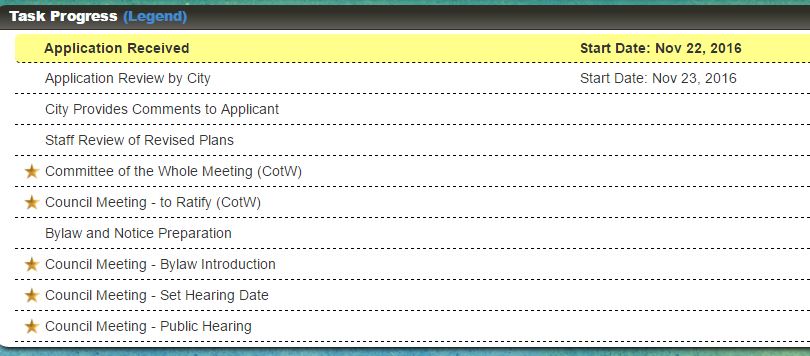
And here’s a fun feature: I can track the progress of our application (and any other application) with the City’s Development Tracker app:

development-tracker

We can expect comments within a few weeks. Stay tuned!


Filed Under: Featured, Rezoning Tagged With: rezoning, ultra low energy

Community Meeting: Success!

November 20, 2016 by clove Leave a Comment

Our community meeting was a success! (At least it felt that way for a while.)

The intent of this meeting, hosted by the local Community Association Land Use Committee (CALUC), is to gather comments from neighbours that will be submitted as part of your rezoning application. The comments may also lead to design changes. While this is the official opportunity to gather community input, you’d be foolish not have at least introduced the project to your neighbours well in advance. In our case, we are over a year into the conversation.

I had sat in on several meetings for other projects, so I knew the general format. Still, I felt a lot of uncertainty before our meeting because I didn’t know who would be there besides our neighbour who had vocally opposed our small lot subdivision proposal.

The meeting started at 7 PM. There were four projects on the agenda, and we were #2. The room was packed and stuffy. I knew a handful of people.

The first project was a proposed 4-storey condo building to replace two single family homes across from Beacon Hill Park. The presentation went for an hour and a half, with a lot of discussion around scale, height, parking, privacy, views, and south-facing light – very typical discussion points from what I’ve seen.

After much of the room cleared out, we taped up our drawings and presented to about 15 people plus 5 members of the CALUC. At least 8 people were there for our project; many but not all were familiar faces.

We heard the full range of comments, from ‘everything about it is brilliant’ to ‘everything about it is horrible’. No kidding! On the whole, though, the feedback was very positive, and we had a thoughtful conversation about how to do creative infill in our city. I hesitate to represent the comments of others, so I will just say that those who supported the project seemed aligned with what we were aiming for, while the ‘horrible’ comment was too vague to draw any constructive criticism from. Our neighbours who were strongly opposed to the small lot subdivision focused on the details – plantings between our properties, the design of the roof line etc, which I took as an encouraging sign.

To get to this point feels like an accomplishment, even though we still face many more steps before we can break ground.

We originally chose this property because it is in a fabulous location and well suited to a small infill project. Early on, I heard a lot of stories from neighbours who had fought off various developments over the years. I wondered whether we had chosen the wrong neighbourhood. And yet we persisted through comments like ‘You’re ruining the neighbourhood’, ‘I’ll fight this to the death’ and ‘We’ll have to sue you’. We clung to the encouragement of those who liked what we were doing, and in talking to as many people as we could, we discovered that opposition was very localized; a minority talking like a majority. Still, we listened. We changed our design. And here we are, ready to submit our rezoning application.

And I actually believe even more strongly now that this is the perfect neighbourhood for our project. The way it has evolved reflects not only our vision and values, but also those we share with our neighbours. It reflects the eclectic and thoughtful character of and characters in our community.

POSTSCRIPT: I since received an email from a neighbour who attended the meeting that was very negative and attacking on our character. Two steps forward…

A friend told me before we started on this path that someone will always hate your project, no matter what you do. Fair enough, but I could do without the personal attacks. Needing a lift, I went for a long walk and checked out a couple of Passive House project tours that were happening around town (the 5th Street Passive House currently under construction and the North Park Passive House, which has been occupied for over a year). I got a few new ideas and my spirit was buoyed by the conversations I had with people who are committed to improving our environment, enthusiastic about learning, open about making mistakes, and hopeful for the future.

To all of you: Namaste!


Filed Under: Rezoning Tagged With: community engagement, energy efficient design, infill, neighbourhood engagement, rezoning, ultra low energy

  • 1
  • 2
  • Next Page »

Who is Stretch Developer?

Stretch Developer is written by Christy Love. In partnership with my husband Matt, we are challenging ourselves to create the kind of homes we want to live in and see more of in our community. Home is the incredible Victoria, BC, Canada.

Sign up!

Sign up to receive email notifications of new posts.

Recent Posts

  • New Uses for Old Wood Part 2 September 26, 2021
  • Ongoing Preparations for the Apocalypse August 13, 2021
  • Things We’ve Noticed – Energy Edition May 29, 2021
  • Passive House Suite for Rent April 17, 2021
  • Things We’ve Noticed – Comfort Edition March 14, 2021

Blogs We Like

Green Building Advisor Blogs

Musings of an Energy Nerd

Treehugger

Talk to ARYZE

Recent Posts

  • New Uses for Old Wood Part 2
  • Ongoing Preparations for the Apocalypse
  • Things We’ve Noticed – Energy Edition
  • Passive House Suite for Rent
  • Things We’ve Noticed – Comfort Edition
  • New Uses for Old Wood Part 1

Tags

budget building permit cabinet construction climate action climate change community engagement construction deep energy retrofit design design progress development permit duplex duplex + suite energy consumption energy efficient design financing financing passive house finding land food security home inspections infill low energy design neighbourhood engagement net zero passive house Passive House comfort Passive House construction Passive House construction costs passive house for sale Passive House performance Passive House performance; Sanden CO2 heat pump Passive House rental Passive House systems passive house testing performance pro forma property search tips reclaimed wood reclaimed wood construction rezoning roof row house small lot development small lot subdivision ultra low energy

Copyright © 2026 · Metro Pro Theme on Genesis Framework · WordPress · Log in


Loading Comments...