Stretch Developer

Taking urban development into our own hands

  • Home
  • About
  • The Project
    • Finding a Property
    • Design
    • Approvals
    • Financing
    • Construction
    • Performance
  • Blog
  • Contact
  • Rental Suite

Things We’ve Noticed – Energy Edition

May 29, 2021 by clove Leave a Comment

Over the past couple of months, I’ve been tying up loose ends on our project. In addition to upping my accounting skills by sorting out the GST and capital gains tax owing for the sale of the other half, I (finally) finished up our Passive House certification documentation, which was tedious if not difficult. As I await what will most surely be a request for more documentation from the certifier, I thought I’d have a look at how our actual energy consumption compares to both the modeled consumption and our project goals.

Here’s our latest 12 months of BC Hydro electricity bills (May 2020 to April 2021, for our “half” of the duplex, which includes our place and the small rental suite):
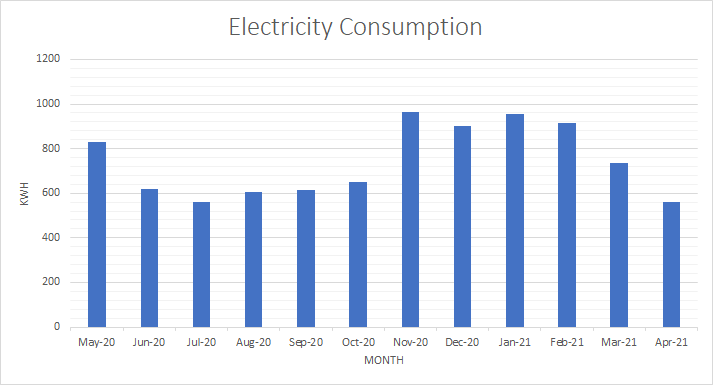
As a crude estimate of heating energy, we can take the lowest monthly consumption (in this case, last July or this April, at about 560 kWh) and assume that is the base – or non-heating – consumption for each month, and everything above that is for heating.

Here’s how this compares to the per unit area consumption in the model:

MeasuredModeled in PHPP
Annual total site energy, kWh/m24731.9
Annual total heating energy, kWh/m212.814.5

So we’re at 12% below the predicted heating energy consumption, but 47% higher than the predicted total site energy. I have a few thoughts on this:

  • The Passive House model notoriously underestimates base load consumption, partly because the system was developed by Germans who use less energy than North Americans. Not that aspiring to be more like our German friends by taking two minute showers and turning off the water while shampooing isn’t worthwhile, but even 47 kWh/m2 per year is very low when you consider that the North American average is more like 220. Even the German average is over 100.
  • May 2020 looks anomalous. My notes tell me that last spring we had the upstairs in-floor heating in the bathroom set a bit too high (it is an electric resistance mat under the tiles).
  • We also had a tenant in the suite through August who controlled his own electric resistance wall heater and tended to prefer relatively warm temperatures. I also note that we have not had a tenant in the suite since September, so these two considerations might cancel each other out, but we’re likely to see some continued variation as we rent out the suite.
  • The model does not include electricity consumed in Matt’s workshop – another reason why some sub-metering would be useful.
  • Working From Home and a bit of Schooling From Home. That would be me, for most of the last year, Matt for half the year, and our daughter for a few months. More lights on throughout the day, plus one or two computers and various power tools in use likely bumped up our total.

Even given these variations from the model, I think these results are amazing. They show that our enclosure first approach has achieved its intent, i.e. to dramatically decrease the heating demand of our home. I also feel very confident about our choices to invest in a very high performing heat recovery ventilator and to spend a bit more for a very efficient CO2 heat pump hot water heater.

Now let’s have a look back to our original project goals as they relate to energy:

  • To follow passive design principles with the potential for net zero energy consumption and zero operating carbon emissions
  • To build three units of housing that consume less energy than the original single family house

Given that BC’s electricity grid is mostly clean, we are allowed to claim zero operating carbon by virtue of being all-electric. In truth, there are still carbon emissions associated with electricity generation in the province – most significantly when we import from carbon intensive sources – but it’s still dramatically lower than using natural gas or other combustion fuels on-site.

Regarding the original house’s energy consumption, recall that our pre-project consumption was ~123 kWh/m2, which is 2.6 times higher than where we’re at now on a per unit area basis. And that was in a home that was unacceptably heated to anything close to today’s comfort standards. Our new neighbours have only been in the other half of the duplex since October and we’ll have to wait until they’ve been in for at least a year to get a total for the whole site. Beyond this, we will be looking to add solar PV and see how close we can get to net zero energy consumption.

Was there a sense of sacrifice to achieve this level of energy consumption? That’s the beauty of building like this. We have way less energy consumption and better comfort and air quality. Yes, I do enjoy finding ways to reduce waste of all kinds. Yes, I did decide that having very warm feet when walking into the upstairs bathroom was not worth the electricity cost and dialed that thermostat back. But, to the horror of my German friends and the water starved nations of the world, I still take long hot showers. What can I say? It’s where I do my best thinking and it’s a tough habit to break. All in all, we feel pretty spoiled.

Filed Under: Featured, Performance Tagged With: Passive House performance

Things We’ve Noticed – Comfort Edition

March 14, 2021 by clove Leave a Comment

We’ve now been living in our Passive House for about 16 months, although we were still installing and commissioning things early on. We’ve now had a full summer and most of a winter to experience the space and play around with how we run it. Here are a few things we’ve noticed so far specific to summer and winter comfort.

In the summer:

The Passive House software allows a modelled design to have no more than 10% of all indoor hours above 25 C. If you crammed all that time together, it would be over a month of living in a space that’s warmer than that. Our model predicted 2% of hours above 25 (assuming no “free” cooling by opening windows in the evening). Through our first summer, I only saw the interior temperature peak above 25 a handful of times and while not sweltering, I don’t think I would have been ok with a month straight being that warm.

Having said that, we don’t have mechanical cooling, nor do I think we need it. Instead, there are things we have been doing – or will do this summer – to make best use of our dirurnal climate through natural ventilation and to limit the amount of heat coming in.

I played around with our heat recovery ventilator’s boost and bypass modes during the warmest days last summer. Both functions can provide a cooling effect. Boost mode simply increases the airflow. Bypass mode bypasses the heat exchanger, which is useful when the outdoor temperature dips in the evening while it’s still warmer inside. During these times, I often switched the HRV to both boost and bypass to deliver the maximum amount of cooler outdoor air.

Our boost mode airflow changes the entire volume of the house 1.2 times every hour. Given this, I had expected that when the outdoor temperature dipped overnight in our coastal climate, it would have cooled the house quite quickly. This was not our initial experience. A few things I think are moderating this impact:

  • Our Zehnder Q600 was still doing some heat exchange even when in “100% bypass” mode. I’m guessing this is a limitation of the heat exchanger design.
  • Our HRV has seen a lot of construction dust since we installed it. A dirty filter can reduce airflow by 15-20% and when I recently changed a quite dirty filter, our airflow on normal popped up from 157 CFM on “normal” mode to 184 (and from 232 to 265 on boost mode). Something to pay more attention to this summer.
  • I also expect there are other internal gains that may be taking longer to cool on those very warm days. Our downstairs floor slab does get direct solar gain during sunny summer afternoons which likely continues to radiate throughout the evening.

What worked way faster and better was cranking open one east facing and one west facing upstairs window after the temperature dipped in the evening, which created a lovely cross breeze that cooled things down very quickly. On the list for this summer is to get screens installed on those high impact windows so that we can leave them open longer as needed without the wasps and moths also getting in. Sometimes just the sensation of moving air makes all the difference in our perception of comfort. I could see a simple circulating fan being quite useful in houses that don’t have as effective window placement for cross ventilation.

We also spent our first summer with no window coverings and minimal exterior shading. While interior shades are not great for preventing overheating in homes with poorly insulated windows and high solar heat gain, I do expect they will mitigate the late afternoon direct solar gain through our large west facing window. I will be testing this theory this summer, now that we have shades like civilized people. And we remain open to the possibility of adding exterior shading in the future. So lots of “plan b” options – at least in today’s climate – before we would even consider mechanical cooling.

In the winter:

Our main heat source is the Sanden CO2 air-to-water heat pump supplying infloor hydronic heat through our downstairs slab. This works really well, and feels nice on the feet too. We kept the system very simple and did not install any hydronic zones upstairs.

Similar to my comment about summer air distribution, I found that the HRV did not spread the heat from downstairs around the house as much as I’d expected. We do most of our living upstairs and I found as much as a ~2C difference between the upstairs and downstairs temperatures on the coldest days.

We do have electric resistance radiant heat in our upstairs bathroom floor but I’ve been avoiding turning it up too high given the electricity cost. It could make up the difference, but I’d prefer that our heat pump do most of the work given that it’s 2-4 times as efficient as electric resistance. I also noticed – now that we’re getting some early spring sunshine- that direct solar gain through that big west window adds an extra degree upstairs on sunny afternoons. I’ve been idly pondering future options for those cold days without sun, which may include adding a hydronic radiant panel upstairs (fed by the heat pump), or possibly putting a small hydronic coil in the supply air duct.

For now, though, pulling on a sweater is good enough, and I can’t complain about that. My old fleece housecoat, which I would often wear over my clothes in my pre-Passive House days, has hung unused in the closet and is probably due for the donation bin. Thank you, old housecoat, for your years of faithful service, but I just don’t need you anymore.

Filed Under: Featured, Performance Tagged With: Passive House comfort, Passive House performance

Things That Go Buzz in the Night

May 16, 2020 by clove Leave a Comment

People who live in Passive Houses say that when you virtually eliminate all outside noise through your well insulated and airtight enclosure, the noises inside become much more apparent. So what are the things that go bump or (more likely) buzz in the night in a Passive House?

When we’re not making noise ourselves, our fridge is by far the loudest thing in our home. Beyond purchasing an EnergyStar appliance that you know will run relatively efficiently, there’s not a lot to be done here, and the background hum of a fridge is not a concern in my books.

The ventilation system is extremely quiet. Very efficient heat recovery ventilators like the Zehnder Q series units we have are not only inherently more quiet than less efficient units, they are also tested to meet stringent sound performance requirements. In occupied spaces, it is inaudible except when we operate in boost mode and even then, we can only hear a slight whir if all else is silent and we train our ears to hear it.

The hydronic heating system is also very quiet. In the mechanical room we can hear the low hum of two small pumps moving water through the pipes when there is a call for heat.

So far so good. But what was that godforsaken buzzing sound? I only heard it on our side when in the mechanical room, but in the other unit, it was very apparent upon opening the front door- the kind of whiny buzz that could be used for sleep deprivation and other forms of subtle torture.

Further investigation identified the culprit, which was this innocent looking guy:

This is an ASCO RedHat general duty actuator for a solenoid valve that is part of the emergency drain down system (which protects the heat pump in the event of a power outage). It consumes about 10W and is continuously powered, which equals not only unwanted noise, but wasted energy.

Some back and forth with Len, our neighbourhood hydronic specialist, and a bit of googling turned up this RedHat electronically enhanced solenoid actuator, a next generation product that reportedly only consumes ~1 W and is specifically designed for applications where noise is an issue:

$400 in parts and a couple hours of Len’s time later, et viola, problem solved. I can now say with confidence that all is quiet on the Passive House front.

Filed Under: Featured, Performance Tagged With: Passive House performance

The Quest for Simplicity

September 29, 2018 by clove Leave a Comment

As our beloved hole continues to take shape, the more technical among our readers may be wondering how things are looking on the Passive House modeling side.

As currently modeled in the Passive House Planning Package (PHPP), we are just squeaking by on the certification requirements. We had a Design Stage Review done by our certifier, Brittany, around the time we submitted for our Building Permit in the spring. The Design Stage Review is meant to be done before we start digging a big hole; and ideally, to give us some assurance that if things go according to plan, we are likely to achieve certification. Or, conversely, we would know early enough if any bigger changes were required. The review left me feeling confident in our design but with a long list of comments to respond to. Many of these comments involved refining conservative placeholder values for things like thermal bridging.

If I’m perfectly frank, I’d rather have a tooth pulled than spend a whole Saturday on PHPP updates. But there’s also the fact that things are still in flux, and while I want to know the energy impact of design changes, I am resistant to the notion that PHPP is our ultimate decision maker. There are design questions that absolutely impact the passive house model (and its predicted energy use), but are also influenced by other factors like practicality, cost, and aesthetics. PHPP doesn’t care about any of these things.

One thing that the model and I both care a lot about is simplicity. My strong inclination is to remove design complications, which by extension, tend to also remove modeling complications.

Here are the design questions we have been working through over the last while. We’re tackling each in the priority that Interactive needs answers to keep the project on schedule. I will tweak values in PHPP to test the impact, but will officially update them when we are satisfied that we have made good choices based on all of our criteria. With a bit of synergistic karma, our quest for simplicity will also lead to a certifiable passive house.

Roof Shape: Since we have to rebuild it anyway, we’ve chosen to do away with the hip roof on the ‘existing’ half. It’s a dramatic aesthetic improvement in my opinion but also a major simplification.

new gable roof (with the same floor plan)

old hip roof

Modeling the original hip roof was a less than satisfying experience. I could not completely capture the intersection of multiple hip roof slopes with the low slope roof of the new half using simple geometry and the dimensions provided on the drawings. And Interactive would have to build this! A gable roof is so much simpler to model and build.

The downside of this change is that the City needs to approve it. We are told it will only take a few weeks, but we have to submit a modified Development Permit package for the planning department’s review AND a revised Building Permit Package for the code inspection side. Good times.

Windows and Doors: We’re confirming final details of our Cascadia Universal Series fiberglass window and door order, which includes committing to the Solar Heat Gain Coefficient (SHGC) for the glazing. This is the value that determines how much heat is allowed through the windows versus reflected away. Higher is better in the model because it allows in more ‘free heat’, but lower is better to prevent overheating, and I think lower is ultimately the better way to go given our climate trends. I’m leaning toward using the lower value (Cardinal 360/180) on the south and west windows and the higher (Cardinal 270/180) on the north and east.

Much more fun than picking a SHGC for glazing is picking custom colours for our front entry doors. Thanks to our kindergartener’s astute design sense, there will be a purple door!

Ventilation: Each half of the duplex will have distinct heat recovery ventilation systems. We had been mulling over whether to pay for the more expensive Paul Novus units that have better heat recovery than the Zehnder units. This makes a difference of about 1 kWh/m2 heating demand, which is not insignificant when the maximum allowable is 15. I’ve got the less efficient Zehnder units in the model now, but this dilemma is likely to resolve itself even more favorably when the new Zehnder Q-series units become available in early 2019. They have vastly improved efficiency at much lower cost than the Paul units. Whoopee.

Heating and Domestic Hot Water Heating:  We have chosen to go with Sanden CO2 heat pumps for domestic hot water heating and in-slab radiant hydronic heating on the ground floors. These are air-to-water heat pumps that use CO2 as the heat transfer medium instead of something like R410-A. This technology has so much potential because most other refrigerants have several hundred to several thousand times the global warming potential of CO2. And the thing that doesn’t get talked about (and as far as I can tell has not been studied) is that typical refrigerant-based systems leak refrigerant like crazy. Anecdotal evidence suggests that 80% of the refrigerant that gets added to a system leaks out into the atmosphere.

The limitation of CO2-based systems is that they can only do heating, whereas other refrigerant based systems can provide both heating and cooling. We’re not currently planning to add mechanical cooling and we’re hoping that by the time the climate here becomes California, we’ll have sufficient shade trees to limit our exposure.

I’ve chatted with a few people who have experience with a Sanden “combi” system, including Peter J from Cascadia Architects. He has a functioning system in his Passive House home and shared a few tips for making sure it works properly without overheating the house – like heating the slab overnight and then shutting it off during the day and having a couple of supplemental heat sources for the few very cold days.

And further to the simplicity theme: by using polished concrete floors on the ground floors, we can embed the hydronic tubing; do one concrete pour and save on other floor finishes. It also makes for a clean modern look that we quite like.

And a Bunch of Little Things: I’m keeping a running markup of all the little things that occur to us the more we stare at the drawings – like moving a toilet location; combining the laundry and mechanical rooms to remove a wall and a door; shifting a window so there is room for a single bed along one wall. So basically thinking carefully about what it will be like to live in the space and making sure it works.

We’re quickly approaching the point where we’ve firmed up the bigger system choices. I will then do another update of PHPP, after which we’ll have a very good idea how the numbers will work out. Our decision-making will then shift toward things like kitchen cabinets and countertops and away from things with an appreciable impact on energy demand.

Filed Under: Design, Featured, Performance Tagged With: passive house, Passive House construction, Passive House performance, Passive House systems, ultra low energy

Who is Stretch Developer?

Stretch Developer is written by Christy Love. In partnership with my husband Matt, we are challenging ourselves to create the kind of homes we want to live in and see more of in our community. Home is the incredible Victoria, BC, Canada.

Sign up!

Sign up to receive email notifications of new posts.

Recent Posts

  • New Uses for Old Wood Part 2 September 26, 2021
  • Ongoing Preparations for the Apocalypse August 13, 2021
  • Things We’ve Noticed – Energy Edition May 29, 2021
  • Passive House Suite for Rent April 17, 2021
  • Things We’ve Noticed – Comfort Edition March 14, 2021

Blogs We Like

Green Building Advisor Blogs

Musings of an Energy Nerd

Treehugger

Talk to ARYZE

Recent Posts

  • New Uses for Old Wood Part 2
  • Ongoing Preparations for the Apocalypse
  • Things We’ve Noticed – Energy Edition
  • Passive House Suite for Rent
  • Things We’ve Noticed – Comfort Edition
  • New Uses for Old Wood Part 1

Tags

budget building permit cabinet construction climate action climate change community engagement construction deep energy retrofit design design progress development permit duplex duplex + suite energy consumption energy efficient design financing financing passive house finding land food security home inspections infill low energy design neighbourhood engagement net zero passive house Passive House comfort Passive House construction Passive House construction costs passive house for sale Passive House performance Passive House performance; Sanden CO2 heat pump Passive House rental Passive House systems passive house testing performance pro forma property search tips reclaimed wood reclaimed wood construction rezoning roof row house small lot development small lot subdivision ultra low energy

Copyright © 2026 · Metro Pro Theme on Genesis Framework · WordPress · Log in


Loading Comments...