We’re targeting net-zero energy consumption and zero carbon emissions in the operation of our post-project home. Say what?
Net zero energy means that, on an annual basis, we generate as much energy as we use. So unless we have an oil well on our property, we are drastically reducing both our fossil fuel consumption and our utility grid dependence. Zero carbon emissions simply means that we don’t burn any fossil fuels to operate our home.
A home could use one or more different sources of site-generated renewable energy – solar photovoltaics or solar thermal, for example. I’m keeping things simple for the moment by assuming that we will only use solar photovoltaics to generate electricity. Unless we include battery storage, we will still be drawing electricity from the grid when the sun isn’t shining or when our demand is higher than our panels can provide. But in a place like BC that has a net-metering program, we will also be feeding back into the grid when we’re generating more than we need.
So can anyone just plunk a bunch of solar panels on the roof and viola: net zero energy? Not so fast. With the amount of energy most houses use today, you’d need a much bigger roof than you have. Allow me to demonstrate with our existing house.
In an earlier post, I estimated our current annual energy consumption to be about 13,270 kWh per year, or ~120 kWh/m2 of conditioned floor area, based on our first 6 months of utility bills. This is actually an ok number given that we have three chimneys, single pane windows, and all sorts of leaks and drafts. It’s about 45% lower than the average Canadian home and on par with the Germans. We turn things off when we aren’t using them, but we also shiver through the winter with an inadequate heating system.
We now have a full year of electricity consumption data to update my earlier guestimate. Our actual one-year consumption was 13,700 kWh, or 123 kWh/m2/year. The daily consumption curve looks like this:
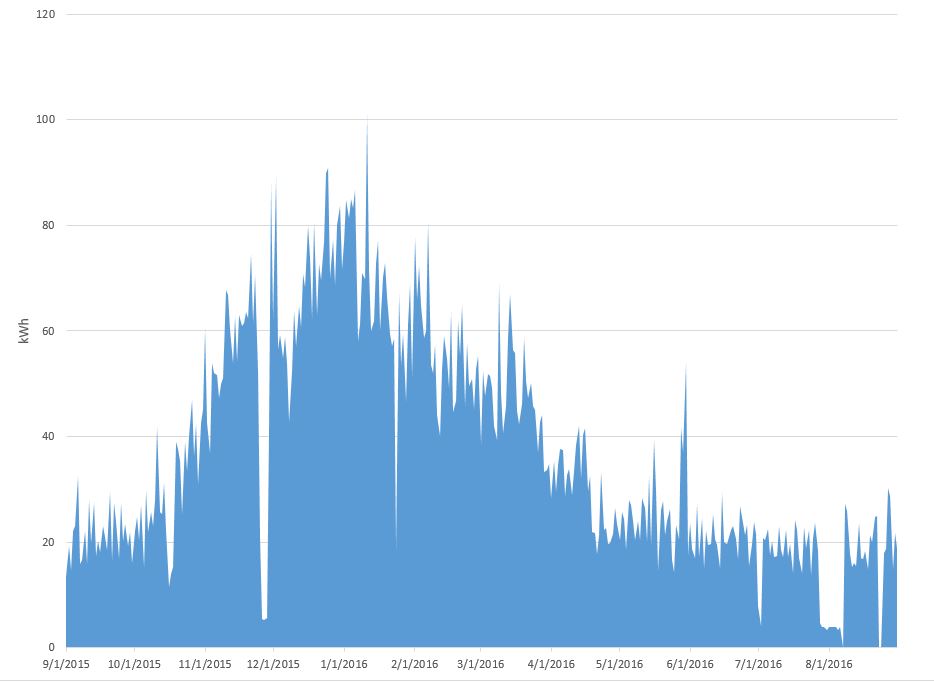
Full year of energy consumption for our existing house
The ‘curved’ part is the energy we used for heating. If you drew a straight line across the flatter portion of the graph, the area below the line would roughly represent our non-heating energy use, which stays relatively constant throughout the year.
So that’s the energy demand side. Let’s now turn to the solar PV question.
I called up Power to the People, who will do a free, high level evaluation of the solar potential of your house, based on a google earth analysis, some rules of thumb, and an assumption that your roof is not shaded. Here’s what their evaluation spat out for our existing house:
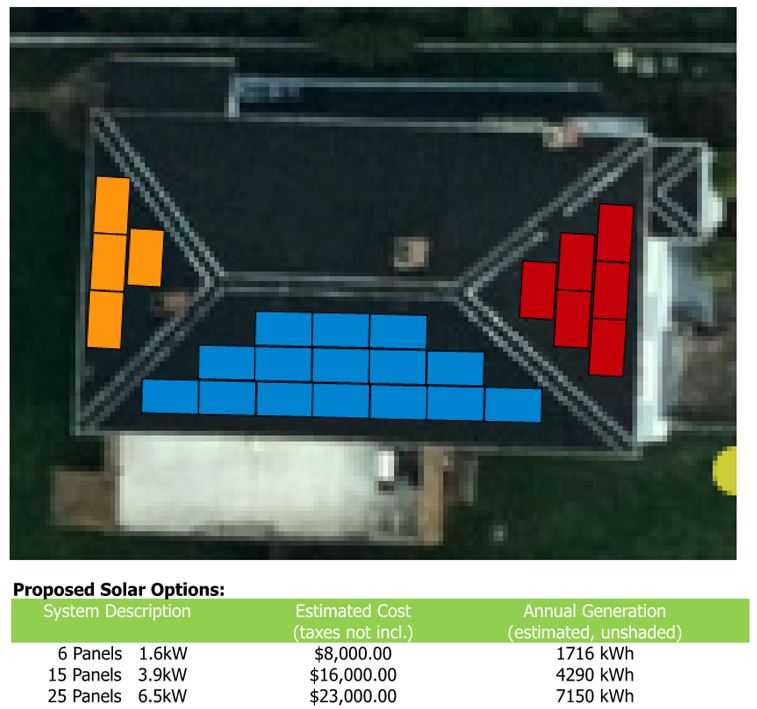
Power to the People Solar PV Analysis
If we covered our south, east, and west roofs with panels, we could generate 7150 kWh annually. This is a little over half of our current consumption. We would have to reduce our consumption by nearly half to achieve our next zero energy vision using only solar PV.
Is this even possible? The Passive House approach promises a 90% reduction in heating demand by focusing primarily on the design of the building envelope. According to my rough estimate, about 50% of our current consumption is for heating. So it would be doable if we both dramatically reduced our heating demand by improving the envelope and found some additional ways to save. I predict, for instance, that my long hot shower habit will be curbed when our house feels warm and comfortable in the winter. We’ve also heard that people who live in passive houses do not use dryers because the heat recovery ventilator helps clothes dry so quickly.
So we think it’s challenging but doable, and our example illustrates two things:
- The first step must be to reduce demand through passive strategies, like extra insulation, increased air tightness, and better windows.
- The way you live in your house matters too! Turning off lights and electronics, limiting long hot showers and dryer use etc. The lower you can get your energy demand, the more likely you can meet your annual average with site-generated energy.
One of the most exciting prospects about following the passive house approach is that we can reach our goal while feeling WAY more comfortable and having WAY better air quality. Win win!

Leave a Reply