Stretch Developer

Taking urban development into our own hands

  • Home
  • About
  • The Project
    • Finding a Property
    • Design
    • Approvals
    • Financing
    • Construction
    • Performance
  • Blog
  • Contact
  • Rental Suite

To Passive House or Not to Passive House (Responding to City Comments Part 2)

February 17, 2017 by clove Leave a Comment

The city asked in their first rezoning review if we were willing to sign a covenant to seek Passive House certification. Good question and the time has come to answer it!

(Read more about Passive House and other approaches we considered.)

There are a couple of good reasons to pursue Passive House certification:

  • Understanding the nuances of the process by going through it.
  • Marketability – it’s becoming increasingly recognized and sought out by savvy buyers around here.

Because of what I do for a living, though, I am inclined to remain certification-system-agnostic. If we go for Passive House, it’s because I want to test it out. We’re not doing it because we think it’s the only way to a good building and to a sustainable future. It is a way. Focusing on passive principles, like airtightness, well insulated walls, no thermal bridging, and effective ventilation – is a very straightforward way to dramatically reduce our energy consumption and greenhouse gas emissions, and I do believe this is a critical approach to building better buildings. A house that consumes 20 kWh/m2/yr instead of the 15 required by Passive House at the end of the day is still miles ahead of a typical one that consumes 100.

I’m also very curious about the impact of occupant behavior. Could we build something slightly less than a passive house and use as little energy through conscious consumption? Would we be more uncomfortable? Is there an ideal balance that is something less than Passive House but right in our mild west coast climate? These are difficult questions to answer on a single project, but interesting all the same.

I’ve had in my mind from the beginning what I believed to be a reasonable but very high performing wall assembly: 2×4 wood frame cavity with batt insulation; plywood sheathing, weather barrier, 6” of mineral fibre insulation; rainscreen and cladding. We’re on board for a high-efficiency heat recovery ventilator (Zehnder, Paul or similar) and we’re set on good triple pane windows. We’re committed to renewables with a goal of net zero energy consumption and zero greenhouse gas emissions.

But I was not sure about other pieces like the amount of roof and below slab insulation. And I wasn’t sure how this would all add up in the eyes of Passive House. There was no way of getting around it – I had to model it in PHPP, the Passive House (giant) spreadsheet software.

In early January, I took the 3-day Passive House modeling course as a follow-up to the 5-day design course I took three years ago. I’ve since been chipping away at the model to give us more confidence about what we are prepared to commit to in our re-submission to the city.

I’m relieved to report that I am *almost* finished the model.

The first time going through a whole model for a smaller house takes at least 3 days, assuming you’ve had some training. I’m 24 hours in so far, and this includes a fair bit of head scratching, learning, looking at other examples, going back and fixing mistakes.

I would recommend to anyone who has the luxury to devote 3 whole days in a row to get your head into it; even half days are wonderful. I found two hours at a time is about the minimum to feel productive. And keep moving – if I got stuck and bogged down by something, I moved on to make progress elsewhere, then looped back after I’d had a bit of time to digest the issues, or could ask someone for guidance.

The modeling tool itself is not difficult provided you are comfortable using Excel, but it does take time to understand the intent of each entry and to follow the protocols where they exist. The most frustrating part of the modeling for me was that there are several key entries that require significant work in the background – for example, calculating total floor area, heat loss area, and domestic hot water pipe lengths – but lead to a single number entered into a single excel cell. The progress is significant but can feel small.

Here is the heart of what you get out of the model:
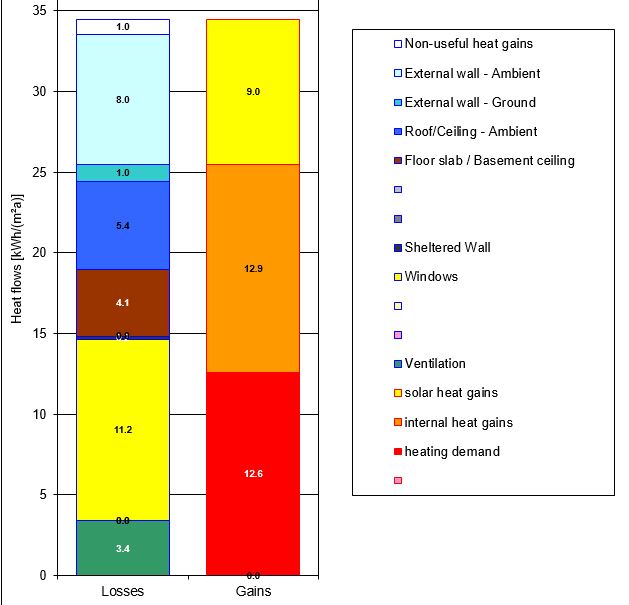
The software is really an energy balancing tool in which your goal is to moderate heat losses (e.g. through your walls and windows), and then balance them with gains (e.g. through people, light bulbs, appliances, as well as solar gains through windows). The remaining imbalance is your heating demand, represented by the red chunk in the ‘gains’ bar above – this is what you have to add to the space, and this is the number that Passive House requires you to keep less than or equal to 15 kWh/m2/year.

I still have a few key inputs to add, but am feeling confident that this is within reach for our project and we are likely to go for it. In the meantime, time to reclaim my personal wellness time and get outside for some fresh pre-spring air! Thanks for reading!
 

Filed Under: Performance, Rezoning Tagged With: energy efficient design, passive house, performance, ultra low energy

The Path to Decarbonization and Net Zero Energy

October 13, 2016 by clove Leave a Comment

We’re targeting net-zero energy consumption and zero carbon emissions in the operation of our post-project home. Say what?

Net zero energy means that, on an annual basis, we generate as much energy as we use. So unless we have an oil well on our property, we are drastically reducing both our fossil fuel consumption and our utility grid dependence. Zero carbon emissions simply means that we don’t burn any fossil fuels to operate our home.

A home could use one or more different sources of site-generated renewable energy – solar photovoltaics or solar thermal, for example. I’m keeping things simple for the moment by assuming that we will only use solar photovoltaics to generate electricity. Unless we include battery storage, we will still be drawing electricity from the grid when the sun isn’t shining or when our demand is higher than our panels can provide. But in a place like BC that has a net-metering program, we will also be feeding back into the grid when we’re generating more than we need.

So can anyone just plunk a bunch of solar panels on the roof and viola: net zero energy? Not so fast. With the amount of energy most houses use today, you’d need a much bigger roof than you have. Allow me to demonstrate with our existing house.

In an earlier post, I estimated our current annual energy consumption to be about 13,270 kWh per year, or ~120 kWh/m2 of conditioned floor area, based on our first 6 months of utility bills. This is actually an ok number given that we have three chimneys, single pane windows, and all sorts of leaks and drafts. It’s about 45% lower than the average Canadian home and on par with the Germans. We turn things off when we aren’t using them, but we also shiver through the winter with an inadequate heating system.

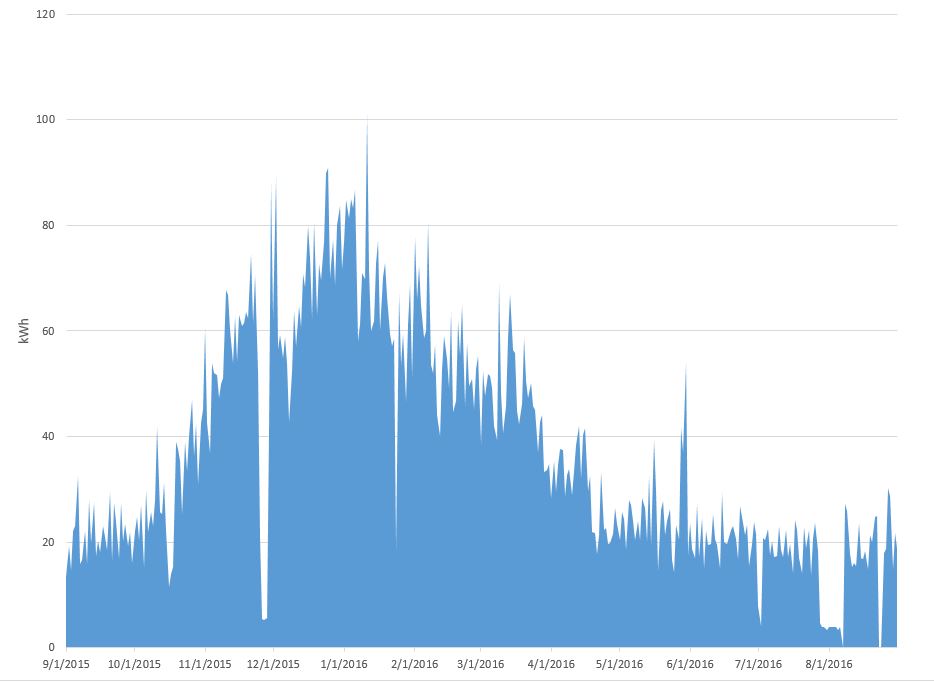
We now have a full year of electricity consumption data to update my earlier guestimate. Our actual one-year consumption was 13,700 kWh, or 123 kWh/m2/year. The daily consumption curve looks like this:

Full year of energy consumption for our existing house

Full year of energy consumption for our existing house

The ‘curved’ part is the energy we used for heating. If you drew a straight line across the flatter portion of the graph, the area below the line would roughly represent our non-heating energy use, which stays relatively constant throughout the year.

So that’s the energy demand side. Let’s now turn to the solar PV question.

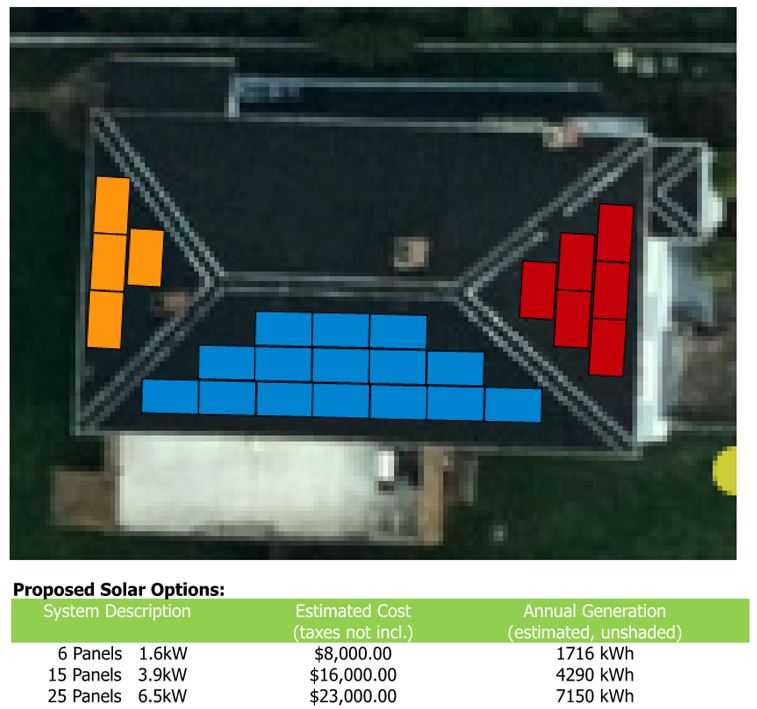
I called up Power to the People, who will do a free, high level evaluation of the solar potential of your house, based on a google earth analysis, some rules of thumb, and an assumption that your roof is not shaded. Here’s what their evaluation spat out for our existing house:

Power to the People Solar PV Analysis

Power to the People Solar PV Analysis

If we covered our south, east, and west roofs with panels, we could generate 7150 kWh annually. This is a little over half of our current consumption. We would have to reduce our consumption by nearly half to achieve our next zero energy vision using only solar PV.

Is this even possible? The Passive House approach promises a 90% reduction in heating demand by focusing primarily on the design of the building envelope. According to my rough estimate, about 50% of our current consumption is for heating.  So it would be doable if we both dramatically reduced our heating demand by improving the envelope and found some additional ways to save. I predict, for instance, that my long hot shower habit will be curbed when our house feels warm and comfortable in the winter. We’ve also heard that people who live in passive houses do not use dryers because the heat recovery ventilator helps clothes dry so quickly.

So we think it’s challenging but doable, and our example illustrates two things:

  1. The first step must be to reduce demand through passive strategies, like extra insulation, increased air tightness, and better windows.
  2. The way you live in your house matters too! Turning off lights and electronics, limiting long hot showers and dryer use etc. The lower you can get your energy demand, the more likely you can meet your annual average with site-generated energy.

One of the most exciting prospects about following the passive house approach is that we can reach our goal while feeling WAY more comfortable and having WAY better air quality. Win win!


Filed Under: Featured, Performance Tagged With: energy consumption, energy efficient design, passive house, performance, ultra low energy

Design Charrette!

January 8, 2016 by clove 4 Comments

I hosted our design and build team at RDH for a design charrette in early December. I waited to hold this meeting until after we’d talked with enough neighbhours that we felt comfortable moving forward, and after we felt confident that we would be able to finance the project. We’d waste a lot of work and money on the detailed design if we didn’t have sufficient support on both fronts.

The goal of this meeting was to discuss big design choices in the context of cost, constructability, zoning, and performance, and then turn the design team loose to bring it to a point that we can present to the Community Association, and ultimately assemble our rezoning application package.

Around the table were Mark A (Architect), Mark B (Builder), Ian Scott (Planning Guru), Rob Lepage (RDH Building Science expert), and Kate Stefiuk (Landscape Designer). I felt awed and grateful that this talented and knowledgeable group of individuals was here to help make our project happen.

We hashed out most of the big design questions in three hours at the office. Mark A, Kate and I then fortified ourselves against the December rain with sushi and miso soup and wandered our property for another hour to discuss the landscape design in context. A productive day!

Here are the key items we discussed and agreed on (see the project page for the basic scope):

  • Building Shape
  • Suite vs. No Suite
  • Building Entries
  • Enclosure Design and Materials
  • Systems
  • Parking
  • Landscape and Storm Water Design
  • Accessory Buildings
  • Energy Modeling
  • Existing House Elements to Retain
  • Schedule

Building Shape:

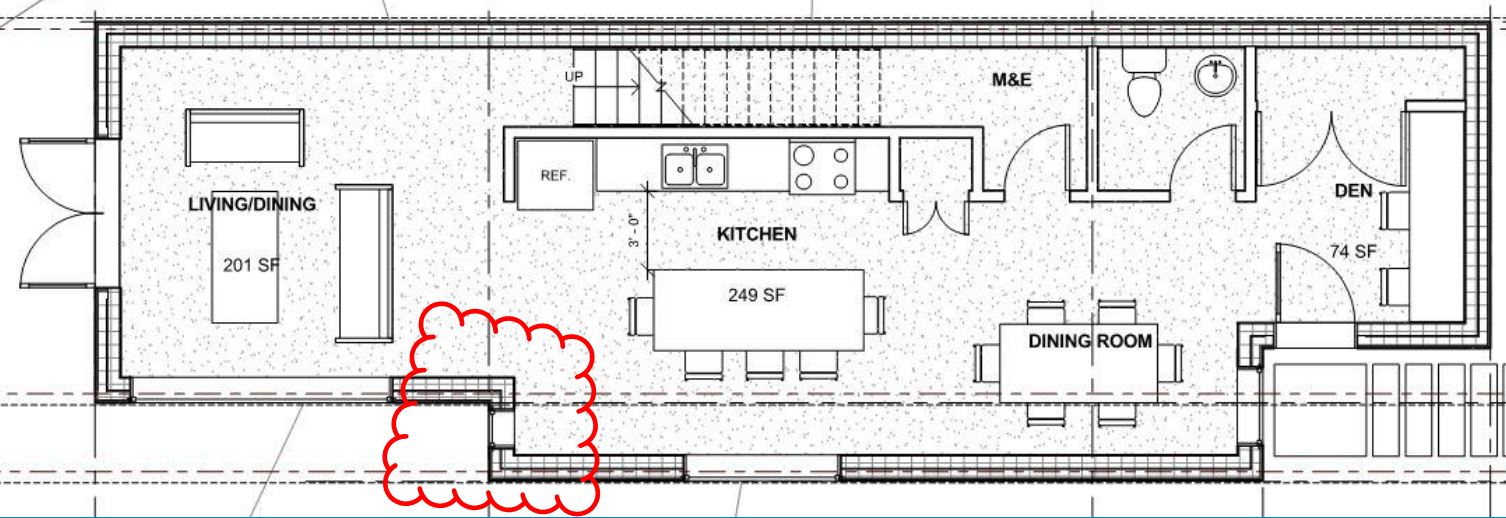
The ideal passive house has 4 corners. Why? Well, you are investing more material into the envelope than a typical building to super insulate it. Every time you turn a corner, you have to transition all that material.  The cost of detailing is much higher than a straight wall, and the likelihood that the detailing will end up being less than perfect is high. This leads to increased thermal bridging and increased heat loss. So to build a high performing envelope in a cost effective manner, the less corners the better. The challenge then lies with the architect to dress up a box!

Fortunately we’re already starting with simple shapes. The existing house is a rectangle and we will maintain the existing footprint. The new house is very close to a rectangle, currently showing one wall bump to work around some setback challenges:

New house bump

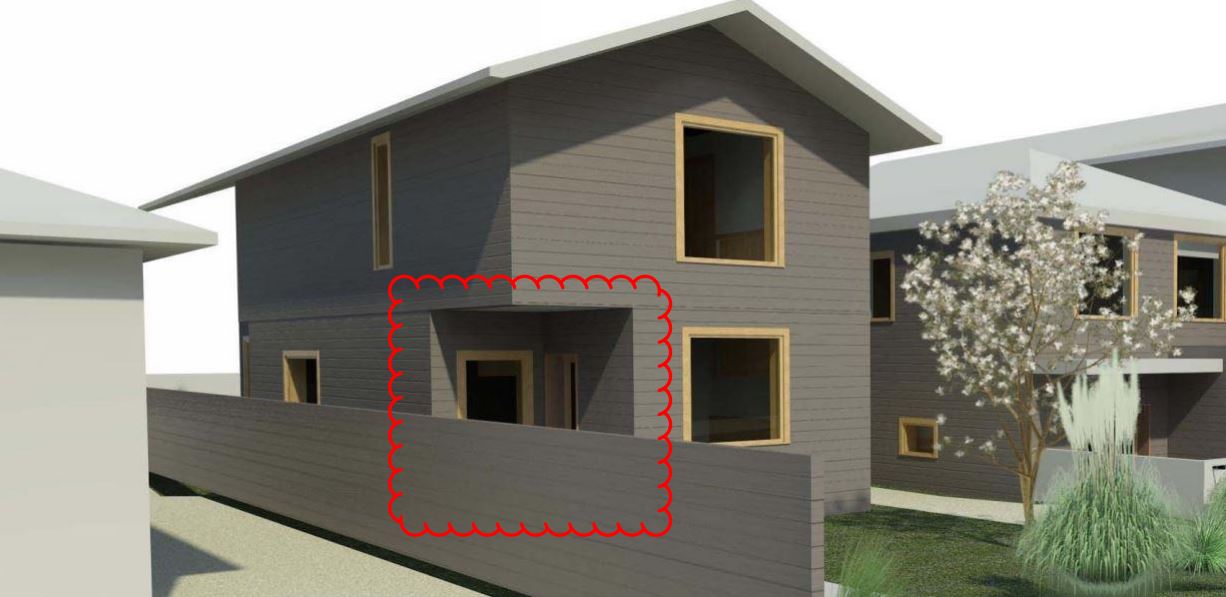
and a tricky cut-out detail at the entry, which will add cost and compromise performance due to complicated detailing:

New house entry

The wall bump is ok because it is simply an extra corner. Mark B suggested redesigning the front entry, though.

Suite vs. No Suite:

The City planner I met with back in October believed that the suite was the thorniest element of our proposal, since it is not supported by existing small lot zoning. However, our neighbours were either neutral or in support of adding the suite. Our design team felt that we could make a late change it would make or break our project, so we’re sticking with the suite for now.

Building Entries:

Ian suggested we consider making the existing house main entry more like a traditional front porch. This suggestion was based on his experience with city design guidelines and the typical feedback these projects receive. I am deferring to Mark A on this one, as I believe that a design can be modern, welcoming from the street, and fit with the neighbhourhood fabric without having to mimic historic styles.

Downstairs bike entry: We need an easy entry into the downstairs for bike storage. This we know from years of hauling bikes in and out every day; up and down skinny stairwells, around tight corners and various other less-than-ideal arrangements. The easier it is, the more likely we will continue riding every day forever. We may also have some limited bike storage space in Matt’s detached workshop, but a storage space in the main house for at least the most used bikes is really the best arrangement for comfort and ease of access.

Enclosure Design & Materials:

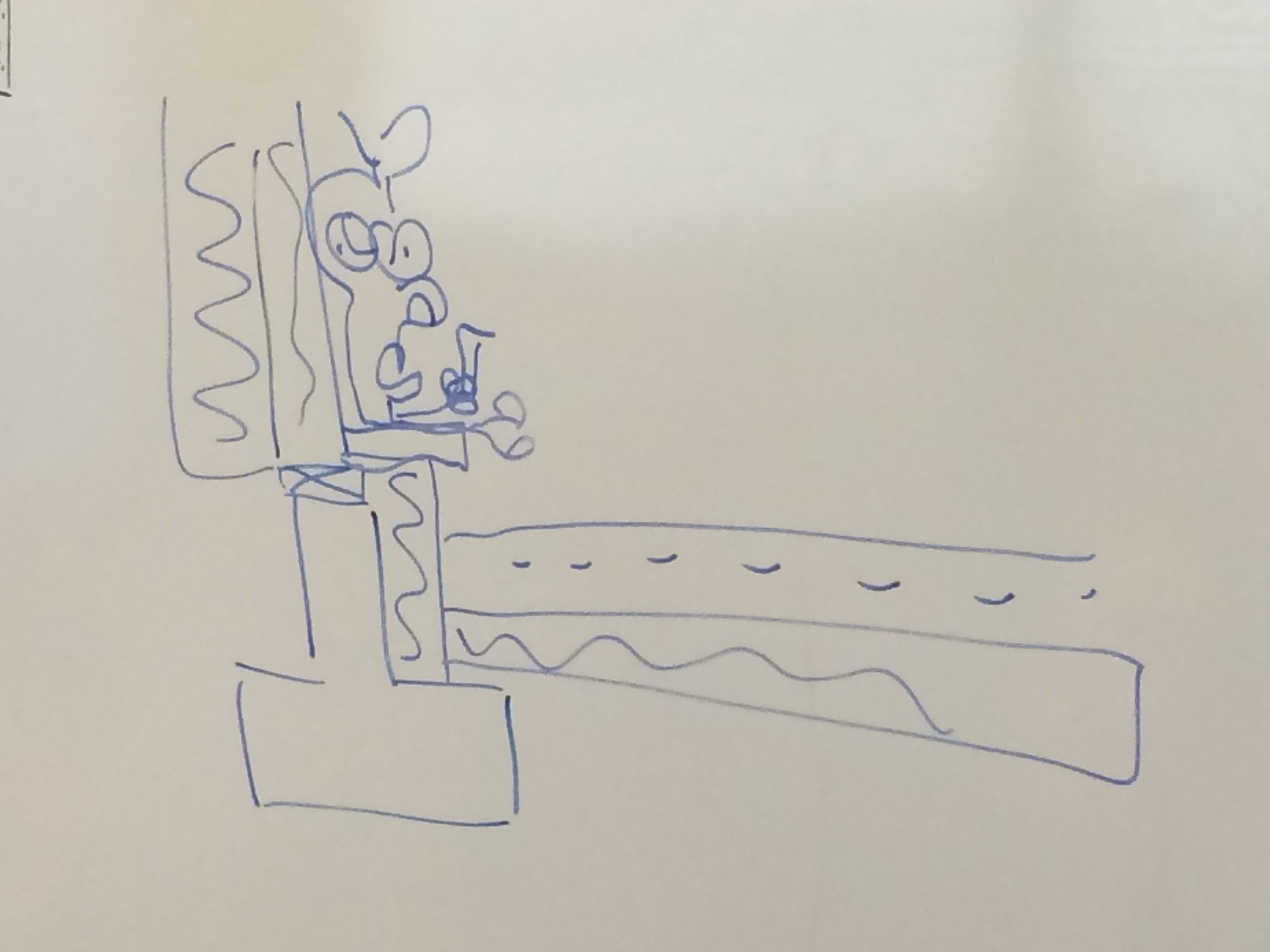
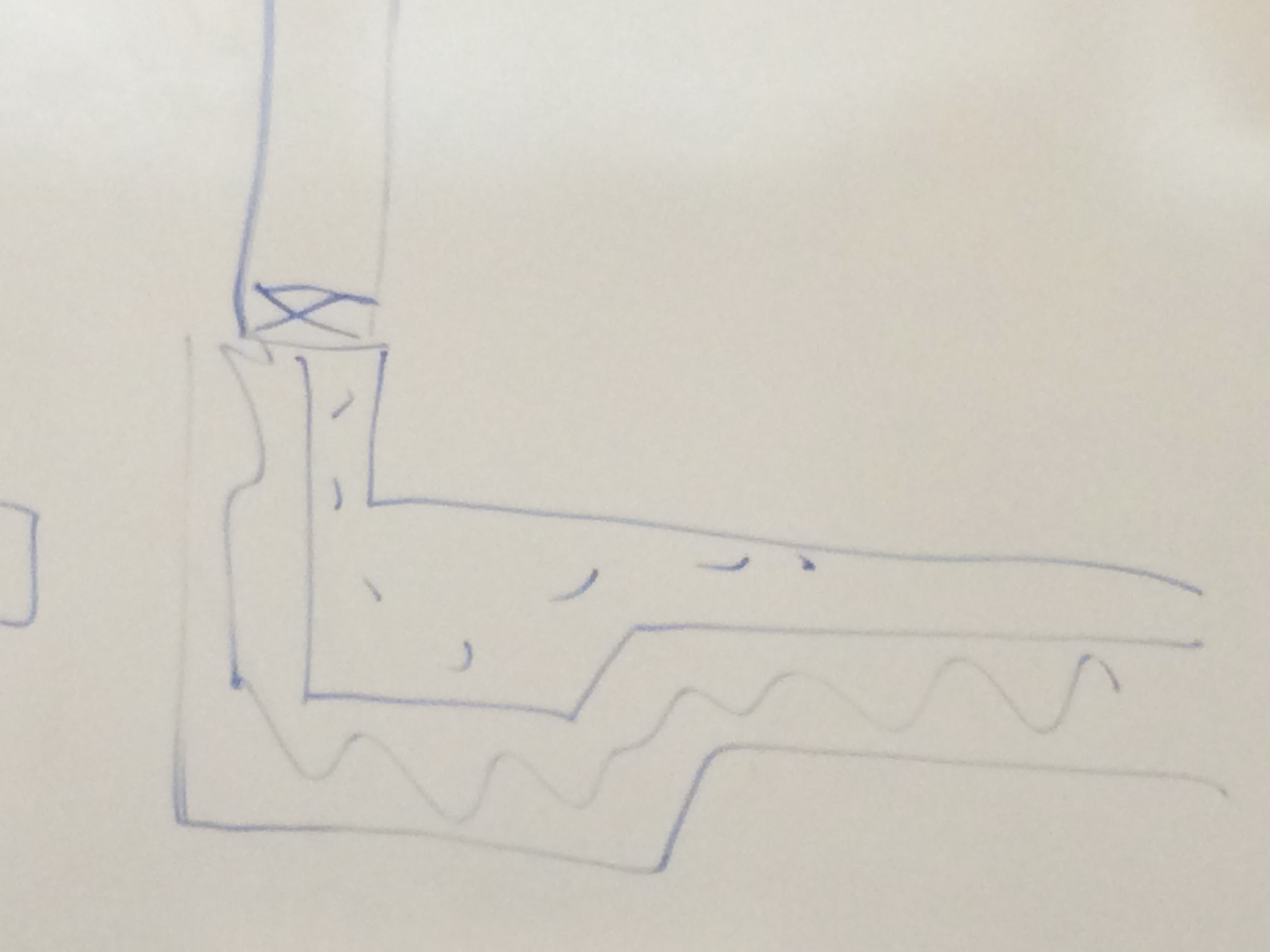
  1. Foundations: We are assuming that we will rebuild the foundation of the existing house after it is lifted and we are thinking of using a similar approach for both houses – a slab on grade with traditional footings and insulation stuck between, like this (squiggly lines are insulation):Foundation Sketch - proposedThis approach will save cost compared to doing something like this, where we’d have to insulate under the footings:Foundation Option
  2. Blasting? Yes, hitting bedrock is a real possibility in our location. It actually makes me wonder if that is the reason the existing house is tucked off to the north side of the property. We will do some exploratory digging later on to get a better idea. Mark B suggested including a budget of $5,000-$10,000 just in case.
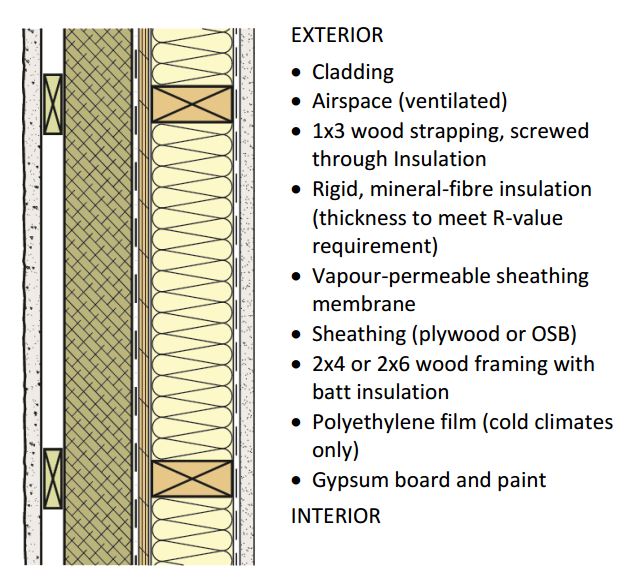
  3. Exterior Walls: We will take the existing house walls down to studs and apply a similar approach to both new and existing: taped plywood sheathing + weather resistive barrier like SIGA Majvest (which Mark B says is cost competitive and easier to work with than Tyvek) or other weather resistive barrier + rockwool + strapping + cladding, similar to this:

    Source: Guide for Designing Energy Efficient Building Enclosures

    Source: Guide for Designing Energy Efficient Building Enclosures

  4. Roof: Mark B advised sticking with interior attic insulation given the cost of exterior insulating the roof, even though I like the conceptual simplicity of exterior insulation. The detailing for transitioning the air barrier and insulation from the exterior to interior is straightforward. We need to poke our heads into the attic space of our existing house to better understand our existing condition.
  5. Windows: We are assuming triple pane. The material is to be determined, but we will aim to carry budget for high performing wood windows and we can always downgrade from there. Our preference would be for wood or fiberglass windows. We’d like to avoid products containing PVC, and I’ve heard mixed results about the long-term performance of reinforced vinyl products. If we do go for Passive House certification, our window options are more limited, since we have to select certified products. Mark B said that Optiwin windows from Germany have proven to be the most reliable and cost competitive certified products despite shipping from Europe. He suggested a budget of $60-70/sq.ft. for windows.

Systems:

We will install all-electric systems for both houses, using a high-efficiency heat recovery ventilator (HRV) for ventilation + solar PV + some form of electric supplementary heat, to be determined based on our modeled heating loads. I am also curious about the new Tesla house battery, although BC Hydro’s net-metering rate (the price at which they will buy energy from us) for site generated electricity is actually very good ($0.0999/kWh)*, and may make energy storage unnecessary at least in the near term.

*Our current Step 1 rate (for consumption up to 1376 kWh) is $0.0797/kWh and the Step 2 rate is $0.1195/kWh. If we can stay under the Step 1 threshold (entirely feasible in a low energy house), we can actually net a profit if we generate more than we consume.

Lighting will be all LED, both houses. Other systems, like domestic hot water and possibly grey water re-use are to be determined.

Parking:

Parking is always a hot topic that gets way more attention than it deserves. If we didn’t have so many cars, we wouldn’t have so much trouble finding places to put them and it just wouldn’t be such a big deal.

Alas, we’re not there yet – we are here. “Here” is a zoning requirement to provide one off-street parking spot per single family dwelling. The rental suite does not require an additional off-street spot, thankfully.

We started out with parking in the front because the lot width is tight. Then we moved it to the back with a shared driveway because I figured people walking by our house would not want to see cars parked in front.

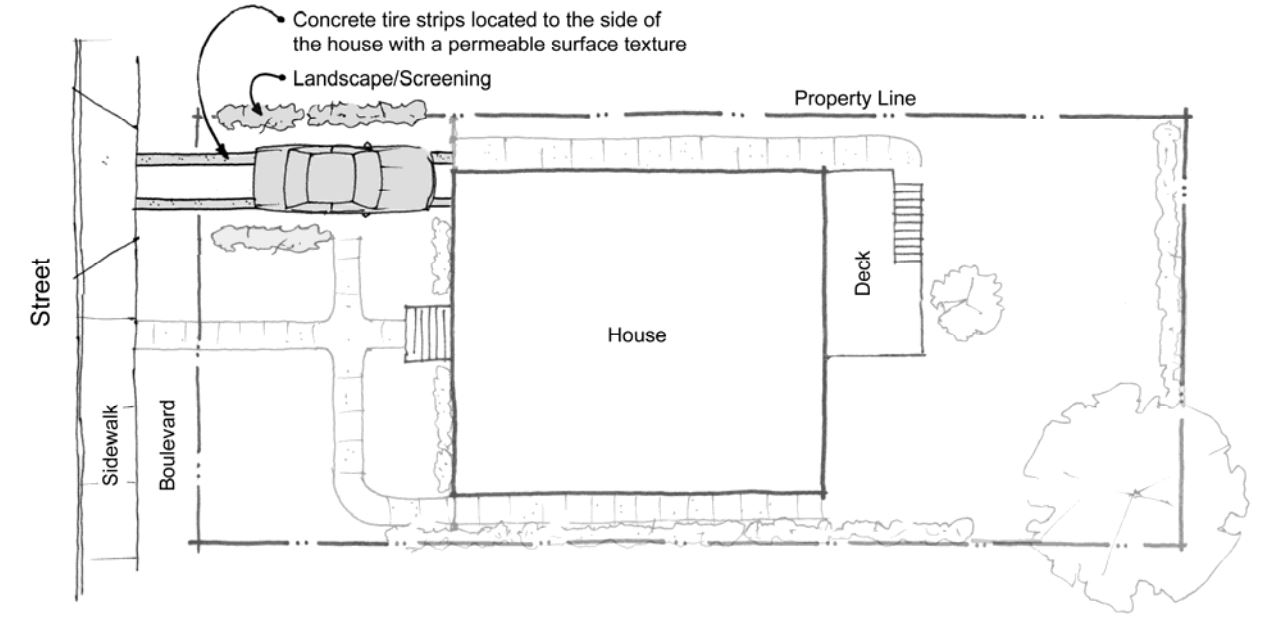
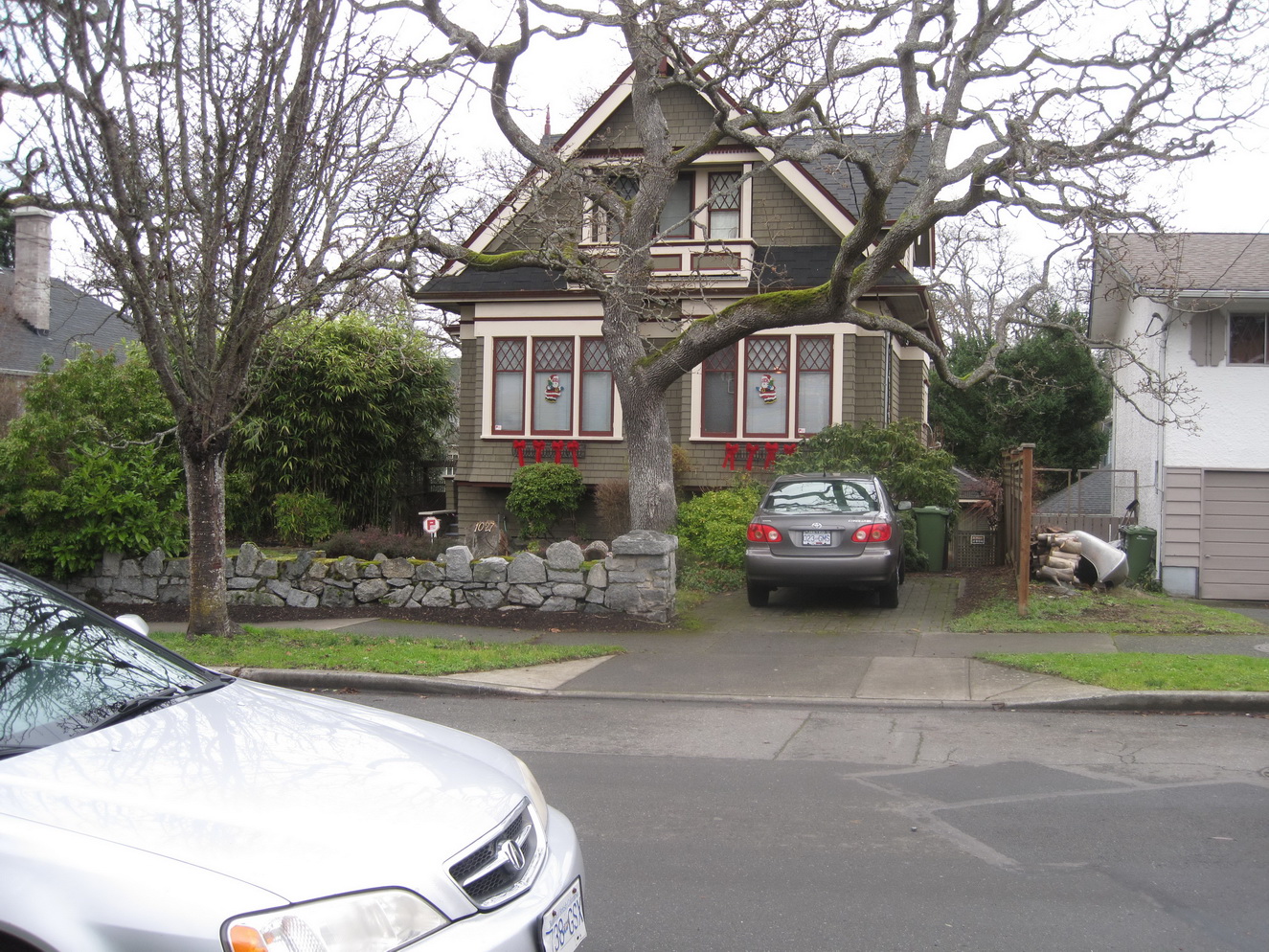
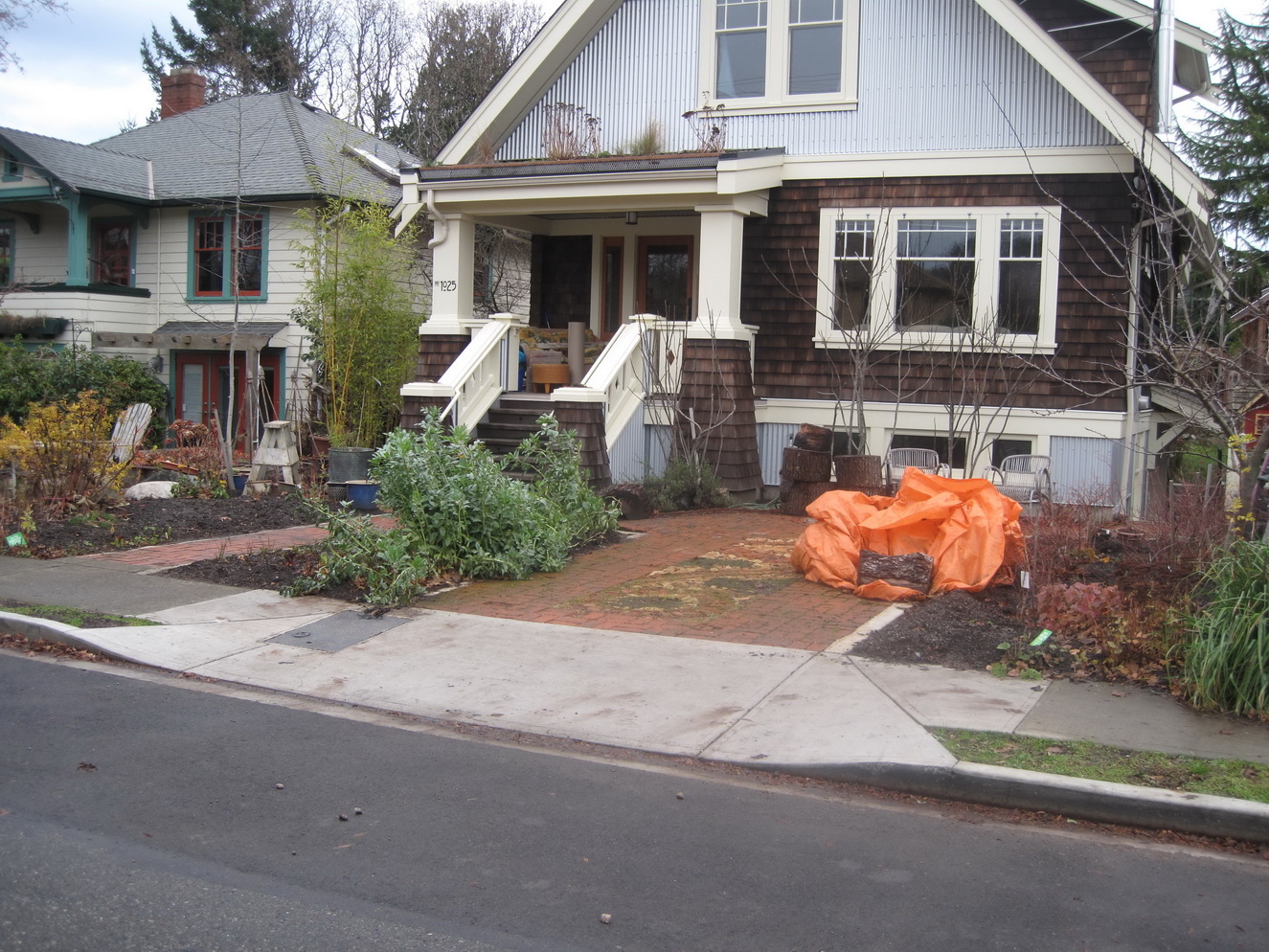
Turns out that our neighbourhood has an entirely different approach to parking. The R1-G zoning that governs typical single family home developments has evolved to allow parking in the front; the idea being that having a couple of well-placed permeable parking strips in the front of the house means that parking is provided off the street while consuming the least amount of green space. Providing parking in the rear means a long driveway, turnaround space, and cars idling in the back yard.

Here’s a snapshot from the parking guidelines, along with a few photos of front yard parking in the neighbourhood:R1G front yard parking

IMG_6206_2

Neighbourhood example of front of house parking

IMG_6208_2

An example with creative application of permeable pavers

Neighbhourhood example of front yard parking area. This one has a patio that appears to straddle the property line with its neighbour. A nice human-scale touch.

This one has a patio that straddles the property line with its neighbour; a nice human-scale touch


Our neighbor several doors down on Clare St enlightened me of this approach and it makes a lot of sense. The back yards that share a fence between Clare and Chamberlain Streets are all green space. There is not a single car parked behind a house. The effect is of a large park space as far as birds are concerned. Many of the yards even have gates between them, encouraging outdoor exploration and connection for humans too.

So we’re back to the front yard. The compromise is that we will be proposing two driveways in order to break up the parking for the two houses, whereas with the shared drive aisle to the back yard, we had only one driveway. But I think on balance this is a better approach.

Landscape + Storm Water Design:

Mark A, Kate, Matt and I discussed the landscape design onsite after our charrette. Being onsite allowed us consider the design within the context of neighbouring properties and sight lines.

This is what we want the landscape design to do:

  • Encourage/facilitate connection with outdoors
  • Enhance privacy between connecting properties at the rear of the houses, particularly with respect to window sight lines
  • Include playful natural features for kids (small hills etc)
  • Include rain gardens to slow storm water flow
  • Create a back yard oasis
  • Include a tree retention + tree management plan – this is required for the rezoning package. We will also ask the arborist to advise on the large gary oak tree next door, whose branches and drip line overlap the proposed new house.
  • Use permeable driving strip/parking pads

Accessory buildings:

Matt’s workshop behind the existing house will be~12×18, with single phase power and decent insulation, but less than the main house.

For the new house, we will plan for an accessory building for additional storage given compact floor plan. It does not need power, but could provide electrical conduit for future. Insulation will be the same as Matt’s workshop.

Energy modeling:

I will do the energy model for the existing house; Mark A will do the new house. If we do seek Passive House certification, we can each obtain our “Certified Passive House Designer” designation having been the prime modeler and Passive House designer for one of the houses.

Existing house elements to retain to the extent possible:

  • Hardwood floors
  • Most exterior and interior framing
  • Solid wood doors
  • (Wonderfully long) clawfoot tub (add separate shower)
  • Farmhouse sink (kitchen)
  • Several interior walls (remove lathe + plaster)

Schedule:

We’re aiming to get the rezoning application submitted in February 2016, which is tight given that we have to present to the community association and collect signatures before that. If we can get it in by February, though, it is conceivable that we will have a building permit by the summer. Mark B advised that if he can start construction by early August at the latest, he can get the roof up before the rainy season (which for us is October-December). If we don’t get the permits by then, he advised waiting to start until the following January or February when the clouds lift again.

Sequencing of new and existing house construction: Ideally, we can complete both projects concurrently. It will be more efficient to pour the foundations at the same time, for example, since the main cost is getting the equipment on site. However, the sequencing will also depend on how our financing comes together and whether we need to move the existing house to register the new subdivision. If it costs us more to finance the project doing it all at once than we save through construction efficiencies, it will make more sense to do the new build first and then finance the renovation from the sale of the new house.


Filed Under: Design, Featured Tagged With: design, enclosure, energy modeling, foundations, parking, performance, roof, schedule, systems, walls

Passive House, Net Zero, or just a Pretty Good House?

August 16, 2015 by clove 2 Comments

Enerphit logoHere’s the lowdown on our current favourite approaches to achieve our project’s energy performance goals. We’re more interested in the principles than checking boxes or getting a plaque, and want to pick and choose what will work best for us. (And yes, there are other important goals like low water consumption, healthy and local materials, and creating something beautiful, but today we’re talking energy.)

  1. Passive House
  2. Net Zero House
  3. Pretty Good House

Passive House:

The Passive House standard has 3 key performance requirements:

  • Annual heating demand <= 15 kWh/M2/year. This is a 70-90% reduction over what most houses use for heating.
  • Total primary energy demand <= 120 kWh/M2/year (this is a measure of total energy consumption, including the energy required to generate and transport the energy from the source, using a single source energy factor for all of North America)
  • Air tightness, as Air Changes per Hour (ACH) <= 0.6 ACH50, as measured by a blower door test. This is about 4 times more airtight than a typical new house.

Here’s a snappy video that explains the fundamentals of the Passive House approach:

The basic concept of the Passive House standard is to focus first on the structure itself: highly insulated foundation, exterior walls, roof; airtight enclosure, and high performing windows – and then supplement with mechanical heating and/or cooling systems. So we reduce demand as much as possible first before looking at efficient ways to provide the remaining energy we need. Mechanical ventilation is also required to maintain air quality.

The requirements are performance based (focused on the end result rather than prescribing certain systems or building elements), but they do lead us to certain choices that we must make in order to meet the requirements, such as triple pane windows, very high performing heat recovery ventilators (HRVs), and thermal bridge-free construction. Equipment and windows must also be tested specifically to Passive House specifications, which can limit the available choices of certain products like HRVs.

Passive House does not require site-generated renewable energy, although it does provide a credit toward primary energy demand for on-site solar PV.

Passive House performance is modeled using PHPP, which is a giant spreadsheet that does a lot of backend calculating based on heat loss, heat gains, and local monthly average climate data.

For smaller buildings like ours, we will have difficulty meeting the standard without good unobstructed southern orientation (although there are a couple of new certification options that offer some hope – post to come). The south side yard is especially challenging because butting up against our desire to maximize south-facing windows are perfectly reasonable zoning requirements intended to protect the privacy of our neighbhours. Depending on the distance of the house to the property line, we are limited in the amount of glazing and the rooms in which we can have glazing facing the side yard.

What we do have going for us is a simple shape: both houses will basically be rectangles, which makes the detailing for no thermal bridging and a continuous air barrier much simpler (the less corners the better).

Regardless of whether we meet or seek official Passive House certification, I think the passive approach is common sense for any building anywhere, and this will form the foundation of our design approach.

Net Zero

Net zero energy means that, on an annual average basis, our project produces as much energy as we consume. Net zero carbon emissions means that we either purchase carbon offsets, or we avoid the use of fossil fuel based energy.

Can we produce on-site as much energy as we consume in a year? This will depend on three key things: the design of our enclosure to minimize energy loads, our behaviour as energy consumers, and the amount of solar PV capacity we can fit on the roof. In our case, BC Hydro allows net metering, so we can feed excess generated energy back into the grid, and draw it from the grid when we are in deficit.

Passive House does not require the use of on-site renewable energy, but it makes net zero energy consumption viable because it significantly reduces demand.

We’ll have to do some modeling to look at the solar potential of our roof in our specific location, as well as take a stab at estimating our energy demand to get a better sense of where we’re at.

I think this is a goal worth shooting for. We will design for an all-electric project with solar PV, since BC produces much of its electricity using “carbon-neutral” hydro electricity.

The Pretty Good House

The Pretty Good House is not so much a standard as a practical discussion happening on Green Building Advisor. It’s about making realistic choices based on the best bang for your buck in your climate, and still, by the way, ending up with something way better than code minimum. So not going quite as far as Passive House, but, say, 80% of the way there.

We’ve also seen a big variation in the actual energy consumption of certified Passive Houses, which reminds us of the critical importance of occupant behaviour. How does the impact of behaviour compare with the impact of a well designed home?

I like the Pretty Good House approach – and I would argue that it can lead us to a Really Good House – but it does require a sound understanding of the fundamentals. This is why programs like Passive House are great, because they work as learning tools.

So in summary, we will be applying passive house principles, striving for net zero energy consumption, and hopefully ending up with a couple of Really Good Houses. I am fortunate to work with a bunch of building science geniuses at RDH, who will help us get the details right.

Our project gives us a unique opportunity to compare an existing house retrofit to a new build on the same site, which is very exciting. There is also a new, slightly relaxed Passive House standard that was just released, designed for small houses on constrained lots like ours, so that might prove a viable option for us.

We will document our before and after energy consumption and share the results here. Stay tuned!

Filed Under: Featured, Performance Tagged With: energy consumption, net zero, passive house, performance, ultra low energy

Who is Stretch Developer?

Stretch Developer is written by Christy Love. In partnership with my husband Matt, we are challenging ourselves to create the kind of homes we want to live in and see more of in our community. Home is the incredible Victoria, BC, Canada.

Sign up!

Sign up to receive email notifications of new posts.

Recent Posts

  • New Uses for Old Wood Part 2 September 26, 2021
  • Ongoing Preparations for the Apocalypse August 13, 2021
  • Things We’ve Noticed – Energy Edition May 29, 2021
  • Passive House Suite for Rent April 17, 2021
  • Things We’ve Noticed – Comfort Edition March 14, 2021

Blogs We Like

Green Building Advisor Blogs

Musings of an Energy Nerd

Treehugger

Talk to ARYZE

Recent Posts

  • New Uses for Old Wood Part 2
  • Ongoing Preparations for the Apocalypse
  • Things We’ve Noticed – Energy Edition
  • Passive House Suite for Rent
  • Things We’ve Noticed – Comfort Edition
  • New Uses for Old Wood Part 1

Tags

budget building permit cabinet construction climate action climate change community engagement construction deep energy retrofit design design progress development permit duplex duplex + suite energy consumption energy efficient design financing financing passive house finding land food security home inspections infill low energy design neighbourhood engagement net zero passive house Passive House comfort Passive House construction Passive House construction costs passive house for sale Passive House performance Passive House performance; Sanden CO2 heat pump Passive House rental Passive House systems passive house testing performance pro forma property search tips reclaimed wood reclaimed wood construction rezoning roof row house small lot development small lot subdivision ultra low energy

Copyright © 2026 · Metro Pro Theme on Genesis Framework · WordPress · Log in


Loading Comments...