Stretch Developer

Taking urban development into our own hands

  • Home
  • About
  • The Project
    • Finding a Property
    • Design
    • Approvals
    • Financing
    • Construction
    • Performance
  • Blog
  • Contact
  • Rental Suite

Stuck in a Kafka Novel

April 19, 2019 by clove 8 Comments

Help, we’re stuck in a Kafka novel!

Kafkaesque:
: of, relating to, or suggestive of Franz Kafka or his writings especially : having a nightmarishly complex, bizarre, or illogical quality // Kafkaesque bureaucratic delays
…the word Kafkaesque is often applied to bizarre and impersonal administrative situations where the individual feels powerless to understand or control what is happening.

(Merriam-Webster)

As described here, we chose to change the roof shape of the ‘existing’ half of the duplex to a gable roof. This change required that we go through a Delegated Development Permit process.

A Delegated Development Permit (DDP) allows staff to review and approve “minor” changes to a Development Permit, which is a more streamlined process than applying for a completely new DP. We evaluated the timeline, cost and benefits and chose to go ahead, submitting the application in October. The first round of comments from staff were supportive of the roof change, but (of course) pointed out a few other minor items that would require a resubmission.

After we resubmitted in November (and were well into framing construction), the code inspector assigned to our project flagged the fact that we referred to existing structure in the Building Permit drawings but that there appeared to be no existing structure. We explained to the city planner that the design was the same, except that we had replaced existing with new framing (read the rationale here). Development Permits are intended to govern form and character, and this change had no impact on either. As such, it hadn’t occurred to us to talk with the planning department prior to dis-assembling. Apparently we were mistaken.

This revelation kicked us out of the DDP process. City staff said they were not comfortable approving this ‘major‘ change without council input and therefore instructed us that we needed to apply for a new Development Permit before we can continue work. Queue stop work order.

Surely this is not the first time that the late discovery of structural deficiencies has led to a change in approach, and surely applying for an entirely new development permit is not the only path? They said if we’d come to them before we dis-assembled the existing framing, they would have been able to work something out. Like what, keep a wall so we can still call it “existing”? The DP application form says to expect a 3-6 month process. How is that in any way reasonable for a project that is mid-construction?

Upon hearing this judgement, I did what any analytical person would do: I poured over the Local Government Act and Land Use Procedures Bylaw to understand the policy that was informing staff’s direction. I discovered two important things:

  • “Minor” and “Major” are not defined anywhere, so it’s up to someone’s subjective interpretation of what is a minor versus a major change. In our opinion, a change that can be documented by revising a couple of notes in the drawing package is a minor change – particularly when it has zero impact on form and character.
  • the Local Government Act provides a mechanism to appeal a planning department’s decision to deny a DDP application. The appeal process would mean that we could directly address Council and ask them to either uphold or overrule staff’s decision.

So when city staff rejected our DDP application, citing that they were uncomfortable proceeding without Council’s input, we invoked our right to appeal. Our sole interest was to resolve any concerns quickly so that we could continue with construction. A 3-6 month wait could be lethal to our small project.

A few days after notifying staff of our appeal, we received a letter from the city solicitor’s office saying that we could not in fact appeal. This is worth quoting:

You getting this? Neither are we. I guess that’s why they’re the lawyers and we’re not.

We’ve discussed this process at length with our planning consultant and we remain convinced that we have the policy backing to support our position and our right to appeal. How can staff’s direction be anything but a rejection of our application?

Unfortunately, our case is muddied by the perception that there is a lot of wanton demolition going on in our city by developers. The Acting Director of Planning said in our first meeting that just the week prior, they had a similar case come forward, and they seemed intent on following the same process for both, irrespective of the unique circumstances of each.

It became clear that City staff were not going to budge, despite many conversations and correspondence to address their stated concerns. Our last ditch attempt was to present directly to council at a public hearing (any citizen who submits the proper notice can address Council for up to 5 minutes). If staff were saying they weren’t comfortable moving forward without Council’s input, we would ask Council directly for their input.

I sent a letter to all councillors in advance of the public hearing to provide context and give them the best opportunity to consider our case and ideally, to pass a motion to allow staff to complete our DDP application. We had also exchanged several emails with the Mayor, who seemed willing to do what she could.

I gave my presentation, after which Mayor Helps thanked me and moved on to the next speaker with no further discussion.

We stuck around until the end of the meeting, and Ian (our planning consultant) had a discussion with the Acting Director and the city’s solicitor to better understand their rationale. We remain convinced that the solicitor’s advice is flawed, and listening to him speak left me with the impression that he just wants to be right. But to take up the matter further and engage our own legal advice would only mean more cost and time that we don’t have. We later learned that Mayor Helps had gone to staff earlier that day to ask if Council could in fact pass the motion we had requested, and was told that they could not. The Mayor seemed genuinely interested in helping our case, but was prevented from doing so by staff following the advice of their solicitor.

So we reluctantly raised the white flag (having lost nearly 2 months to the false hope that we could find another, faster resolution) and submitted a new Development Permit (complete with $3,000 application fee to review drawings that have already been reviewed). We are now well into Month 4 of the stop work order as we inch along the City’s review process, with an estimated delay-related cost of $30,000 so far.

Who does this serve? Why is the City not doing everything they possibly can to help projects that add housing and that are wholly consistent with both our climate action imperative and the City’s Official Community Plan? It’s counter-productive, non-collaborative, reactive, punitive, and mired in a procedure over which no one seems to have any control. I understand the need for policies and procedures, but when they’re just ticking boxes, there is a real cost (and a lost opportunity) that they either don’t appreciate or believe they are powerless to change.

The one voice of reason in all of this has been the manager of inspections, who allowed us to finish wrapping the house prior to enforcing the stop work order, so that the structure is protected from the elements. He has also since allowed us to complete the rest of the roof assembly to resolve some moisture and durability issues.

Stay tuned for a new public hearing. If you feel inclined, you are welcome to write a letter of support to mayorandcouncil@victoria.ca. And for those readers for whom this all sounds familiar, watch for the launch of our new city approvals survivors’ group!

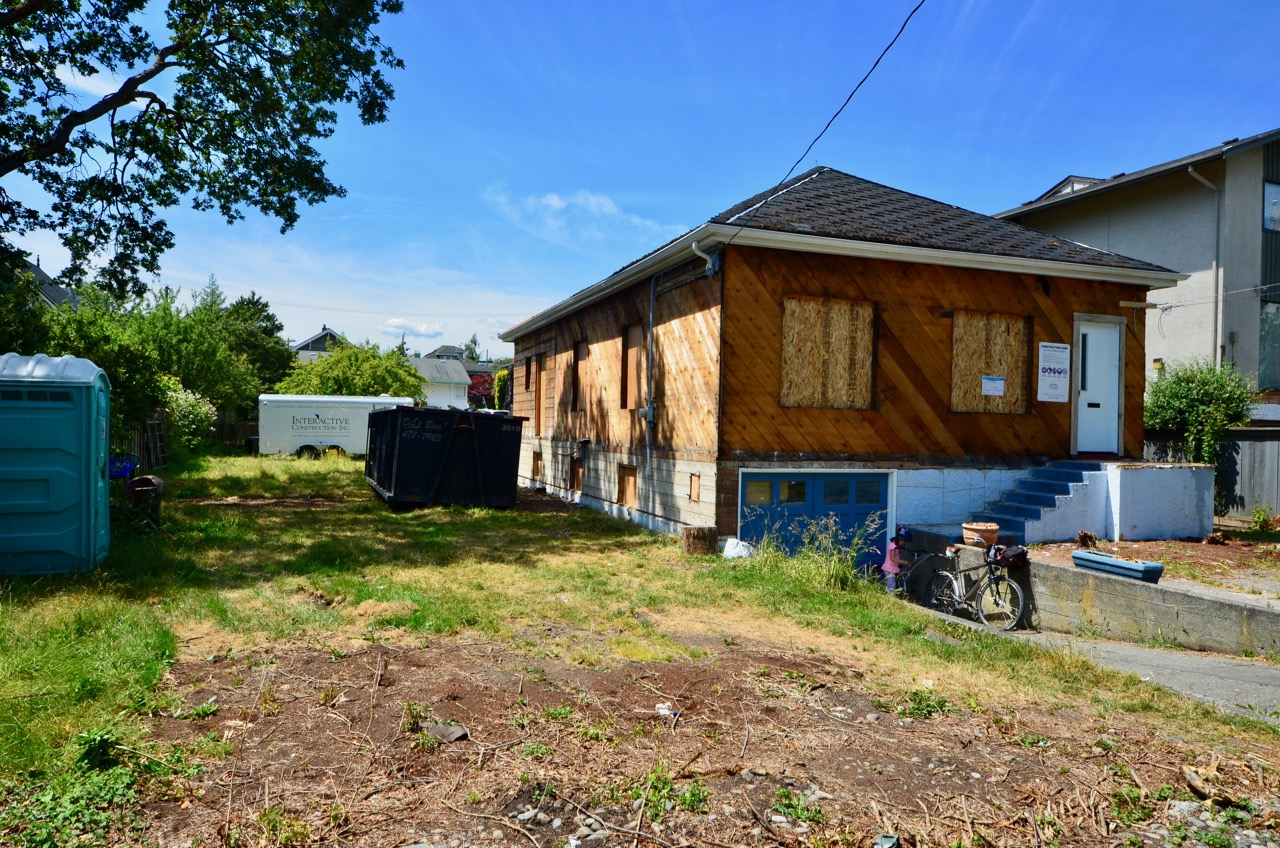
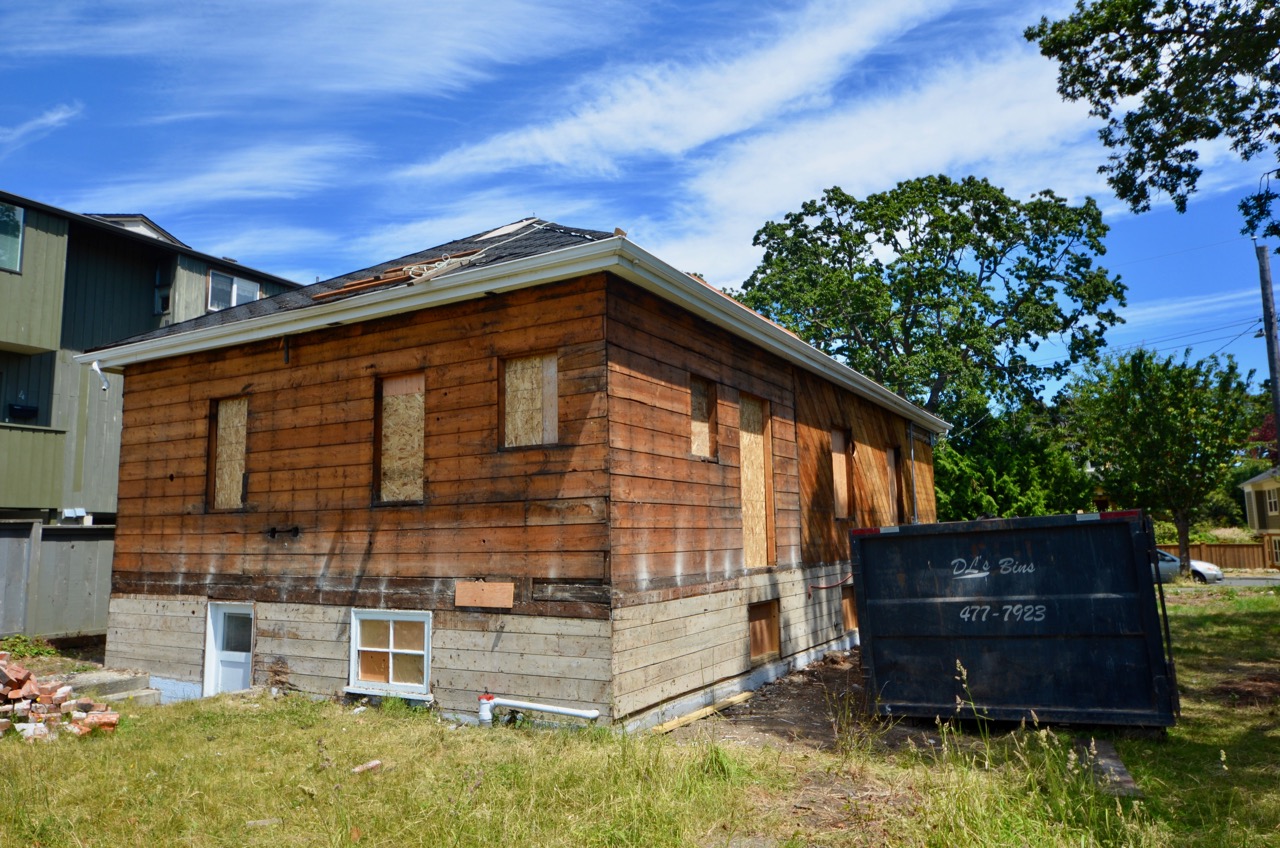
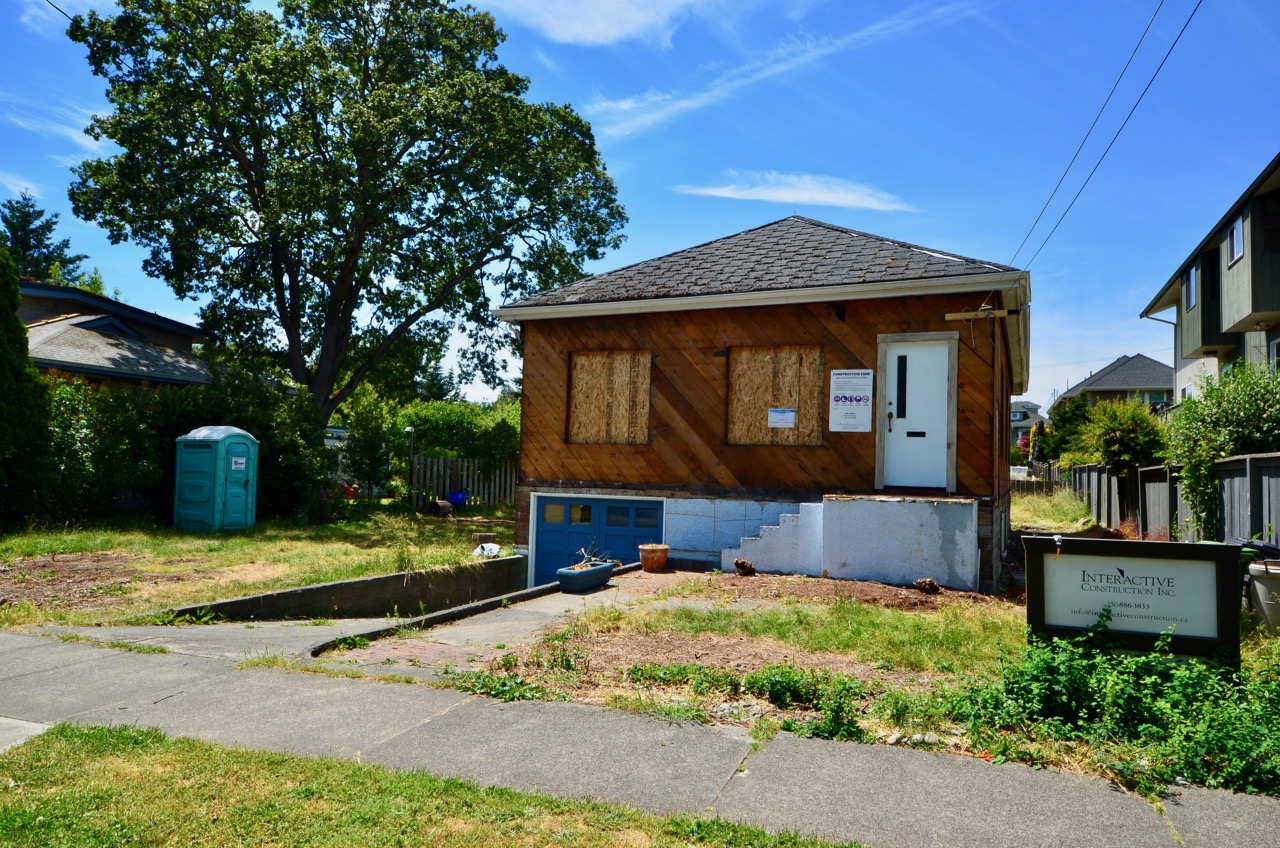
Here are some photos of where we’ve left things. While we wait, we can all at least appreciate our beautifully colourful Cascadia fibreglass entry doors.

Thanks for reading!

Filed Under: Construction, Featured, Rezoning Tagged With: development permit, infill

Is it Worth It?

July 13, 2018 by clove 1 Comment

We stopped by to check on things the other day, and arrived as our neighbour Patrick stood contemplating our house, his pair of pugs snuffling in the grass.

“Is it worth it?” he asked.

Was it worth keeping the existing house? His question hit squarely on the low-level malaise I had lately been nursing about the amount of our house that was left and would be left when all was said and done. Much less than I had expected or had wanted to believe.

All the Little Things

If we could ignore all the steps that led to this moment, the answer might be no, it’s not worth it. Recall, though, that our original plan was a small lot subdivision. In this scenario, we wouldn’t have even touched our existing house until the new one was built and sold. We would then have had numerous options for improving our house incrementally. Melding the two together appeased some of our neighbours and led to a more interesting design, but it also required a more complex and immediate transformation to the existing house.

Our structural engineer came on board late in the process and said we can’t keep the existing roof. We don’t know a lot about structural engineering, but now that the roof’s underside is fully exposed, we see surprisingly little wood up there. So we will now be building a new roof to match the shape of the old roof.

The framing of several interior walls – the location of which dictated our new layout – was also removed during the strip out process. After peeling off the drywall and the wallpaper and the planking, there just wasn’t much left.

$$$

Similarly, if we were to consider only the cost of keeping an old house like this and carefully rebuilding around it, the answer to Patrick’s question would most certainly be no. Two of the three builders who bid on our project more or less bluntly told us that it would be easier (read: cheaper) to build new. The careful deconstruction to save parts of the building, or even to thoroughly salvage a house being demolished, takes time (read: money). Granted, Matt has done a sizable chunk of the manual labour, and even with a full demo and new build, we would still pay hazmat and some demolition costs.

Our next step is to lift and shift the shell of our former house, which is now delaying the project as we wait on the sub-contractor who will do this work. Again, more time and more money we would not be putting out if we just built from scratch.

And Still…

Call it sentimentality if you like, but our house has become more than an “it” now that we’ve lived in it for a few years and have painstakingly peeled away the layers to reveal its bones. It (she?) is more like a person with a history etched by many hands over the years.

This house has stood in this place for over a hundred years. The sun has passed over it tens of thousands of times. Generations of people have walked their dogs past its front yard. Early owners added on the kitchen and bathroom, extended the roof, and shingled over the original lapped siding. Someone added bird wallpaper to the ceiling. Someone else painted over it.

Therefore…

In answer to Patrick’s question, I say no…and yes. We remind ourselves that our decisions are not informed purely by cost, as painful as that can be to our bottom line. It feels right to us to keep everything we can. I only wish we could have kept more of it. And I think what it comes down to is that, by the time you strip all the guts out, there actually isn’t much to a house.

If we’d found rot, the situation would have been even worse. But what is there is in great shape and we can be thankful for that. We can leave much of the exterior sheathing, walls and floor in place.

And so, here we are, our house waiting to be lifted, shifted, and placed back down on her new super-insulated, seismically resistant foundation.

We’ll keep and reuse many of the materials that we did remove, like:

  • good wood planking that Matt can use to build us a kitchen worth of cabinets and probably a kitchen table to boot
  • brick for outdoor landscaping
  • fir flooring that we can relay in the downstairs suite

We found new homes for many other things:

  • Our neighbour, Peter, spent a painstaking couple of weekends carefully prying off enough of our cedar shingle siding to patch the hole left when he removes his own chimney.
  • Another neighbour, Mike, left a note requesting the basement garage door when it’s ready for removal.
  • Someone we found through usedvictoria took the old oil furnace to replace his broken down one.
  • Another friend took our hot water tank for his reno project.
  • Any scrap wood put to the curb was scooped up almost instantly. Even the old built-in dishwasher was eventually picked up.
  • Interactive donated all the wiring and copper plumbing to Power to Be, to fund programs bringing people with barriers into nature.
  • We’ll donate the older but still functional appliances.

These parts and pieces of our original house will live on, their histories morphing as they are re-used by us or usefully absorbed or into other people’s homes. That is worth something too, right?


Filed Under: Construction, Featured Tagged With: construction, infill, Passive House construction

An Historic Moment in our Small Project’s Life

March 10, 2018 by clove 1 Comment

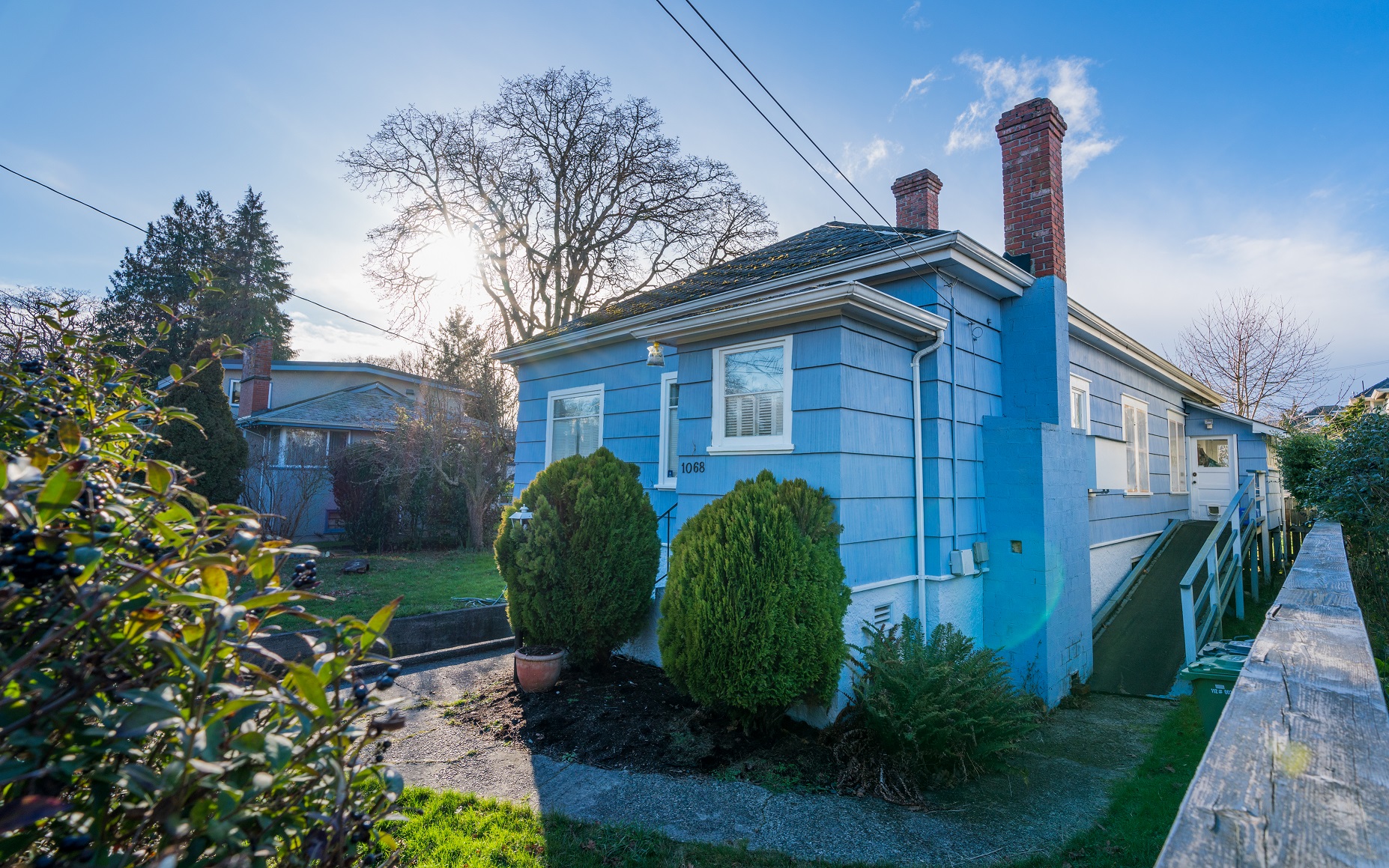
front view

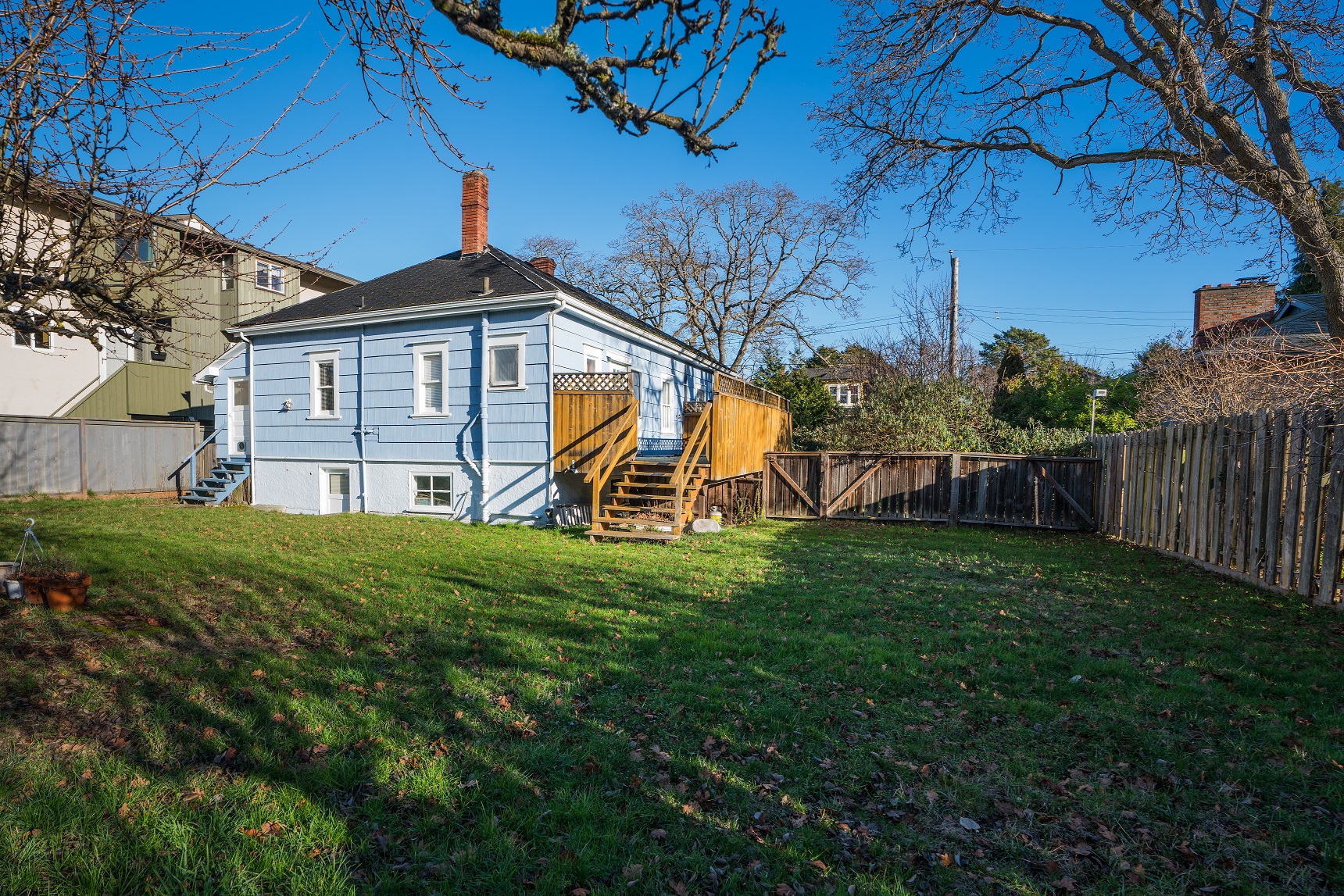
On Monday we finally heard the news we were hoping for: our financing is approved (!), nearly four months after we initiated our application (read the whole story). Then on Wednesday, I successfully submitted for our Building Permit (our second attempt after being turned away on a number of formatting technicalities).

It’s beginning to sink in that our vision may actually be realized in bricks and mortar – or, in our case, mostly wood and insulation. It will become even more real when construction starts within the next month.

2 years and 8 months after we closed on our property, it feels really good to have arrived at this moment. There are many things that could hinder us from finishing construction, but there is now nothing that will prevent us from starting. And as we’ve grown accustomed to overcoming challenges every step of the way – from losing out three times before finally landing the winning bid on our house, to facing combative neighbours, to being denied financing (to name a few!) – I’m feeling confident that we will be able to resolve the ones to come as well.

In the spirit of pretending we’ve just won a big award, I’d like to take this opportunity to thank the many wonderful friends and co-conspirators who have helped us get this far: our many supportive friends and neighbours; our creative design team (Mark, Kate, Jonathan, Ian), our enthusiastic and flexible builder, Russ; helpful city staff and a progressive City Council; our friends in the mortgage business pointing us in the right direction, and our dogged mortgage specialist (thanks Paul!) who was willing to keep working with us despite our early setbacks. Thank you thank you thank you!

To mark this moment before steeling ourselves for what’s to come, I thought I’d shared some last photos of our house in its current form. Thanks to my friend and co-worker Chris George for snapping these beauties.

rear view

front corner view

what’s to come

Filed Under: Featured, Financing Tagged With: infill, passive house

How Much We’ve Spent So Far

December 8, 2017 by clove 4 Comments

We have arrived at our first moment of financial reckoning. I’d budgeted $30,000 of self-financed work to get us through rezoning.

Here’s what we’ve actually spent:

  • Building & Landscape Design: $14,000. This includes two early concepts and a redesign; a full set of architectural drawings suitable for rezoning, plus Landscape Plan.
  • City Fees and Associated Costs: $4,500. This includes the rezoning application fee, the public hearing fee, plus a lot of printing – $787 worth of paper and signage! Forgive us, trees.
  • Site Survey: $1,350. Required for the application, as well as for our architect Mark A to create the Site Plan
  • Tree Preservation Plan: $500. Required for the application, completed by an arborist.
  • Existing House Stuff: $1,900. Includes hazardous materials survey so we don’t unwittingly poison anyone, plus a fee to get rid of our above-ground oil tank. Good riddance!

Total spent through approval of rezoning = $22,500

So, we are currently under budget for the items I had accounted for – woo, party!

Hold the phone, don’t send the invitations out just yet. There are a few asterisks and things I plain neglected in that innocent early budget.

The biggest of my omissions is the Building Permit fee at 1.25% of the construction budget. I’d thought somehow that this fee would be much smaller. Russ our builder is working on the budget as I type, but with my current, ever-escalating working number, we are looking at $11,000-$12,000. Half is due when we apply for our permit and the other half is due when we pick it up.

A few others:

  • Landscape Deposit – this one was a surprise. It’s required of any project that needs a Development Permit (determined based on location of the project from what I understand), and is equivalent to 120% of your landscape budget. Ouch. It’s a way for the City to ensure we follow through and finish up the landscaping. We’ll get the deposit back, but it hurts to have to come up with this at the front end.
  • Design package for Building Permit. The design drawings need to be fleshed out in more detail for our Building Permit application and for construction.
  • Builder Deposit. This goes toward actual construction costs, and provides assurance to Russ before he starts ordering stuff for our project. A reasonable expectation, but something that must be planned for.

For the sake of completeness, there are also some items that I handled myself but would have a real cost if we hired someone else to do them:

  • My general project development time, which I did not record consistently enough to provide a meaningful total (perhaps better not to know?). Let’s just say a lot of hours – planning the concept, coordinating with the team, consulting with neighbours, coordinating with the city, putting together presentations etc.
  • Passive House modeling costs. So far, I’ve spent 45 hours on the model. This includes a fair chunk of learning time, reworking, and remembering what I’d done when I put the model aside and came back to it several months later. The model still needs to be updated before we start construction, again after we change anything significant, and then finalized after construction is complete. As the project Passive House Consultant, I will also need to document the construction to show that we built what we modeled. Actual certification requires that we hire someone independent who is qualified, and we’re expecting to spend $5,000 for this piece.

So, overall we are doing OK budget-wise. We are not completely blowing the budget, but I missed a couple of key items in my first pass. This is nothing if not a learning process after all!

We’re working on financing now, so we hope to answer very soon whether this is all going to fly – stay tuned and thanks for reading!
Filed Under: Financing Tagged With: budget, financing, infill, passive house

It’s Unanimous!

November 17, 2017 by clove Leave a Comment

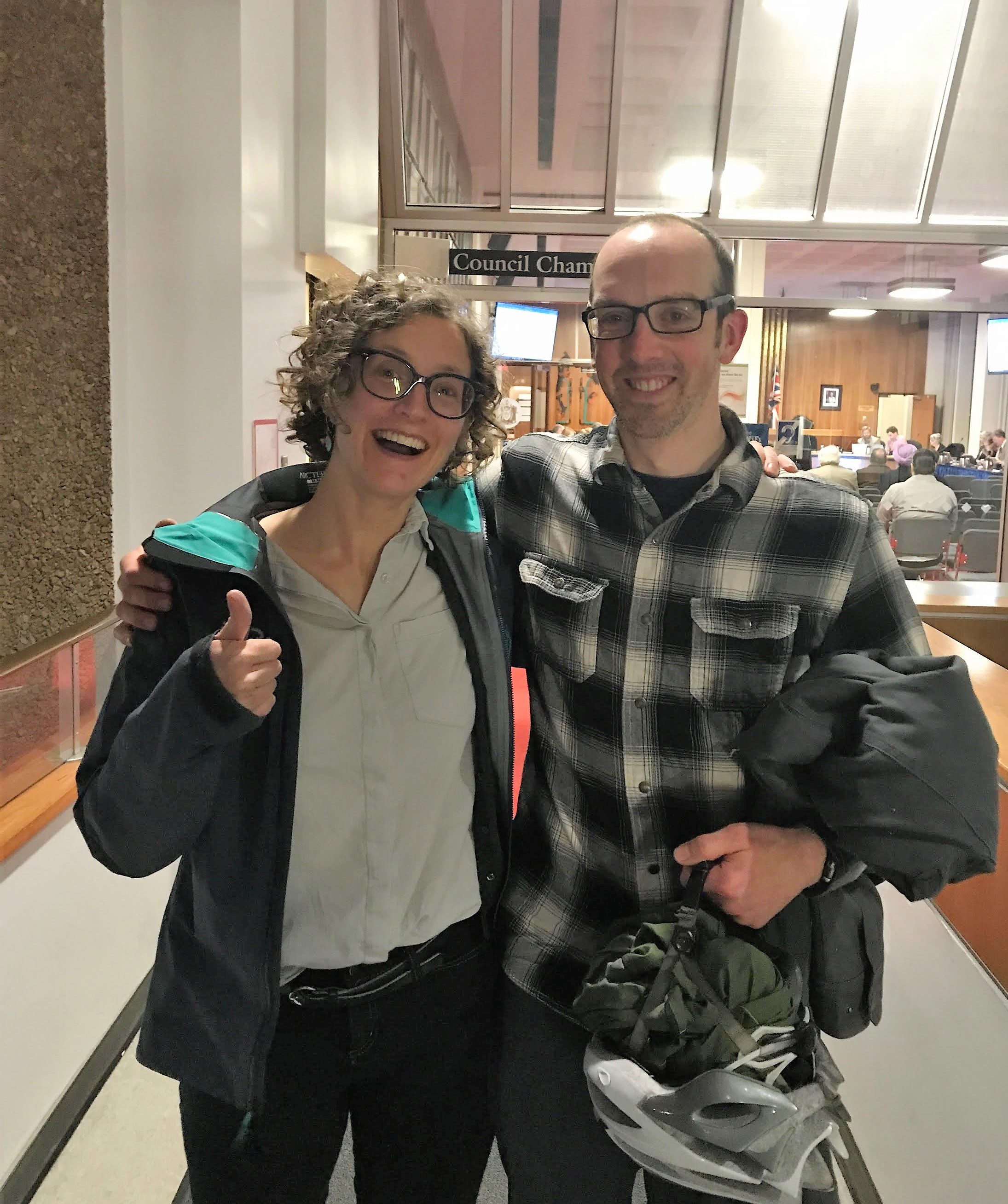
Matt and I outside Council Chambers post-public hearing

In my preparation for our public hearing, I replayed the cautionary voices of others who have done this before: ‘There is always someone who hates your project no matter what you do!‘ Or: ‘Sometimes you’ll go into the public hearing thinking you have community support only to be blindsided by a mutiny!’

My best case mental visualization of the event was that we would have enough positive voices to ring out over the negative ones. I sent invitations to everyone who had expressed support or interest throughout the process. A couple of neighbours said they would come, and a couple of others said they would write a letter. Otherwise, it felt (strangely?) quiet on our block in the days leading up to the hearing.

Here’s how it went down:

We were 3rd on the agenda of rezoning/development permit applications, and somewhere around 10th on the overall agenda, which meant we were called up at 8:45, over 2 hours into the evening’s proceedings. The public area of Council Chambers was full of people early on, and with each item that was ticked off the list, more and more people filtered out. A small group of our neighbours and friends were still among us, along with some people who were waiting for the agenda items after ours.

A member of City staff introduced the project and what was being proposed for Council consideration. I was then called up to the podium with a (strictly enforced!) maximum 15-minute window to present whatever we thought relevant to Council and the public. Using a pre-loaded presentation, I introduced our project goals and talked about our design choices, materials, and rationale. I described how the project fit into the Official Community Plan and the Gonzales Neighbourhood Plan. I summarized the consultation process and how it influenced the design. I concluded by expressing our appreciation for everyone who provided engaged input and ultimately made our project better.

Council then asked a couple of clarifying questions, then opened the floor to anyone who wished to speak for a (strictly enforced!) maximum of 5 minutes. Five neighbours spoke in support and none spoke against.

Every neighbour spoke so eloquently about their personal stories as they related to our project. One spoke about how the character of our community is not just about what the houses look like, but about the individuals who live here and make it their own. Another spoke about having lived on the block since he was 5. Another about how they’d originally lived in the townhouses next to us and then bought a house a few doors down so they could stay on the block as their family grew. This was by far my favourite part of the evening – each neighbour sharing their personal histories and experiences on the block, and their own reasons for supporting our project.

After everyone spoke, the public hearing portion closed. Council then asked a few more questions before offering their opinions on whether and why they supported prior to the final vote. All who spoke were emphatically in favour and the vote to approve our application carried unanimously.

Holy cow!

Never have I witnessed so much smiling and excitement at a public hearing! If you want to see it for yourself, you can watch it here (Nov 9, about 2h:45 in).

We owe thanks to City staff for their work moving this forward. Thank you to the City Councillors for their words of support and encouragement. And most of all, thank you to our neighbours and friends who have listened and made suggestions, shared their opinions and ultimately offered their support. We feel so fortunate to be part of such a strong, supportive, and forward-looking community.

We have some more work to do now to finalize the design prior to submitting for Building Permit. With a little luck, we will begin construction early in 2018. Thanks for reading and stay tuned!


Filed Under: Featured, Rezoning Tagged With: community engagement, infill, neighbourhood engagement, passive house, rezoning

You’re Invited!

November 3, 2017 by clove 4 Comments

Dear Readers, Friends, Neighbours,

Well here we are, finally approaching the moment when City Council will vote yes or no to our rezoning application. The rezoning is what will change the use of our property from single family to two-family + suite. If we get through this, all that is left in terms of the City’s process is to apply for the building permit to begin construction. 

First: We want to thank each of you who shared ideas for making our project better, for offering support, and even just for showing interest in what we are doing. Our project is better because of you! We have made many friends through this process and continue to be amazed by this incredible community we call home.

Second: We officially invite you all to join us at our public hearing next Thursday, November 9 at City Hall! The meeting starts at 6:30 and we are third on the agenda. The format is that we present for 10 to 15 minutes and then Council hears comments from any member of the public who wishes to speak.

If you can’t make the hearing, or speaking in public isn’t your thing, feel free to send a letter or email. These do get read and considered. Here are the City’s instructions for doing this:

For those who are unable to attend, your input can be via mail, an email to publichearings@victoria.ca, or you can drop off your written feedback at Victoria City Hall to the City Hall Ambassador located to the left of the main entrance. Correspondence should be received by 11 a.m. the day before the Council meeting.

Please note that all correspondence submitted will form part of the public record and will be published in the meeting agenda. Your address is relevant to Council’s consideration of this matter and will be included as part of the public record. If you choose to share your phone number and email address with us and wish that it not be disclosed, please let us know and we will ensure it remains confidential.

Thank you again and see you out there!


Filed Under: Featured, Rezoning Tagged With: community engagement, infill, neighbourhood engagement, passive house, rezoning, ultra low energy

Public Hearing, Here We Come

September 29, 2017 by clove 2 Comments

On one hand, this project feels like it’s taking forever (2 years and counting since we first shared our concept with our neighbours), but on the other, I’m not sure we’d be able to handle it if it moved any faster, what with the rest of life and all. We’re currently looking at a construction start of early 2018 and there’s a lot that has to happen before then!

At the Committee of the Whole meeting in August, Council voted 7 to 1 that our project was ready to go to public hearing. So mark your calendars for November 9, folks! This is the day we present to Council and the public, and anyone with an opinion is welcome to speak. After that, council weighs in and then votes yes or no to our application. If they vote yes, then we’re done with the rezoning part and can focus on getting to construction. If they vote no, it’s back to the drawing board.

Our general plan is that we be ready to submit for building permit as soon after the public hearing as possible. Once we have our building permit, we can start construction.

Here’s the “lot” that has to happen next:

  • Finish the passive house model to a point that our certifier can review it and flag anything big before we apply for our building permit.
  • Find a structural engineer to look at our renovation plans, as well as any strange lateral loads we are introducing by attaching a second house to the side of our current house. Last time I called around, half my calls went unanswered, and the other half said they were too busy to take on any more work. This input will be a requirement for our building permit.
  • Meet with Mark A (our architect) and Russ (our builder) to firm up our assemblies and talk about cost and constructability issues. The big one currently on my mind is how we will insulate a hip roof transitioning to a flat roof. We’d like to do exterior insulation, but how realistic/affordable/buildable will this be?
  • This meeting should give Russ what he needs to work up a construction budget, which we can then use to secure financing (another big looming question that I look forward to resolving very soon!).
  • Prepare for and present at the public hearing.
  • Prepare building permit drawings and apply for building permit.
  • Find a place to live during construction, pack up and move there!
  • Clear out as much of our existing house as we can before Russ takes over.

As for the rest of life, there’s work, hosting Thanksgiving dinner, celebrating our anniversary, visiting friends in Toronto, watching a few movies, hanging out with family and friends, riding bikes, sleeping, eating, reading, being healthy…no big deal, right?


Filed Under: Rezoning Tagged With: community engagement, infill, rezoning, ultra low energy

Portland Row House Tour

August 11, 2017 by clove Leave a Comment

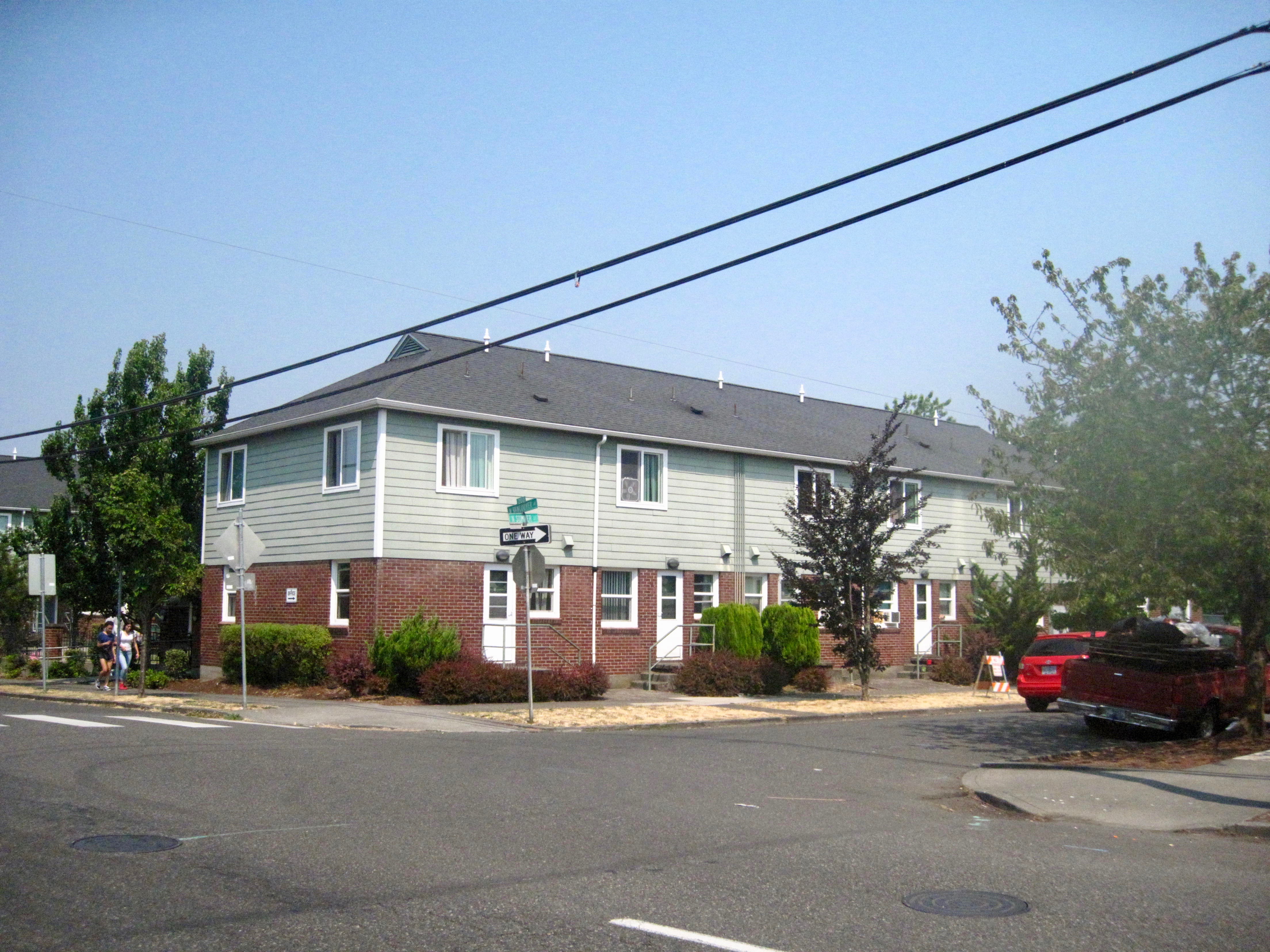
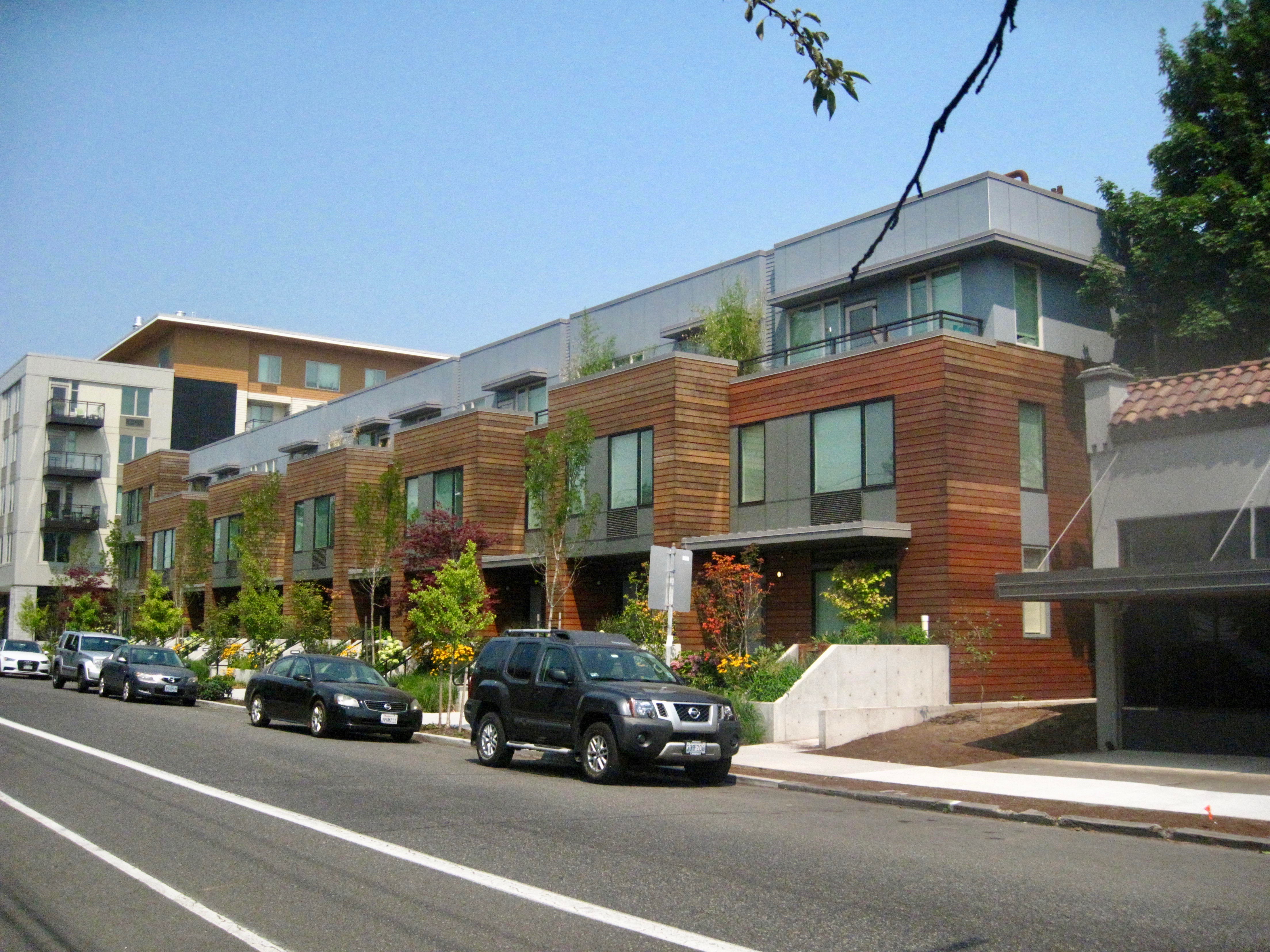
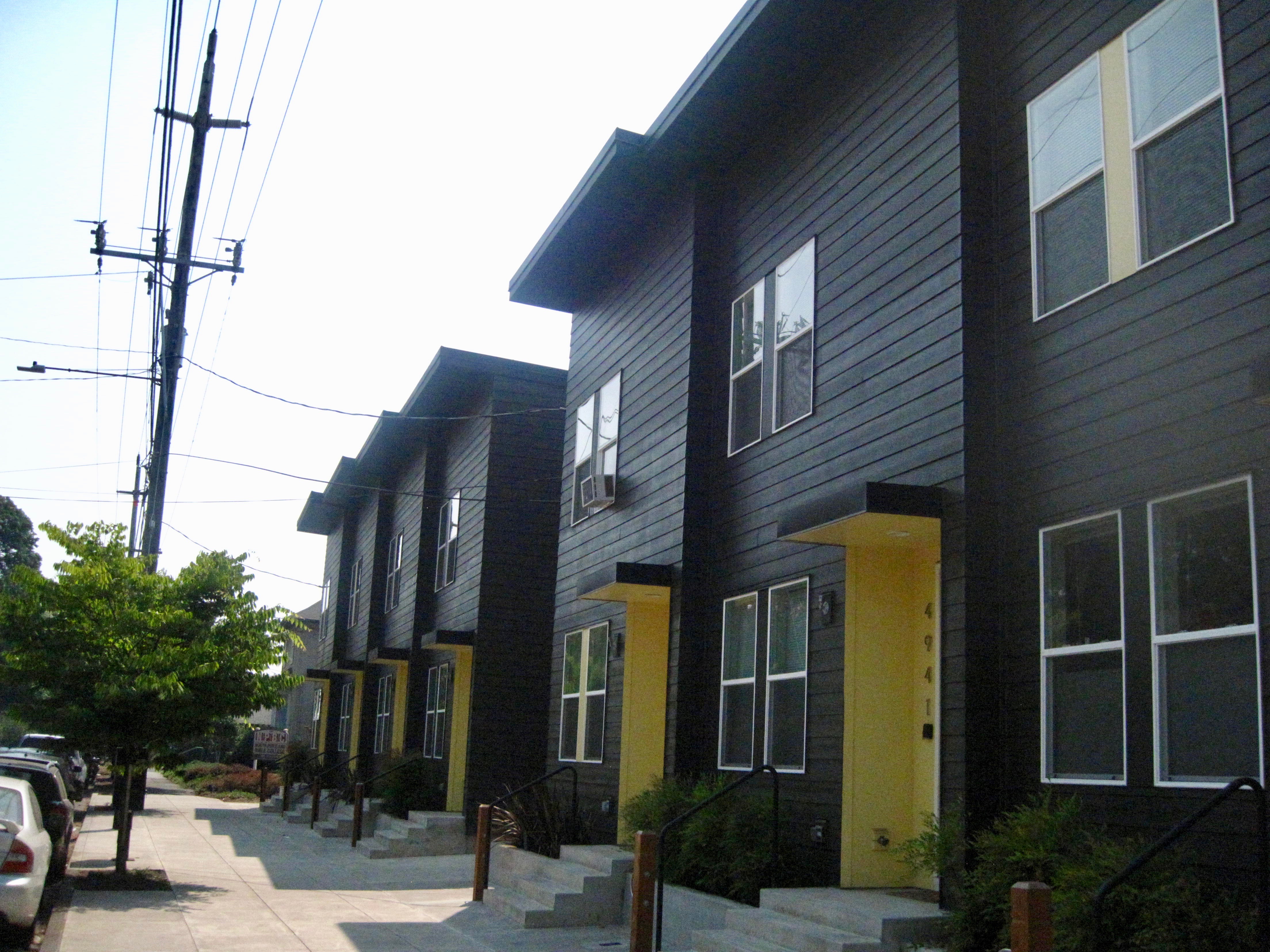
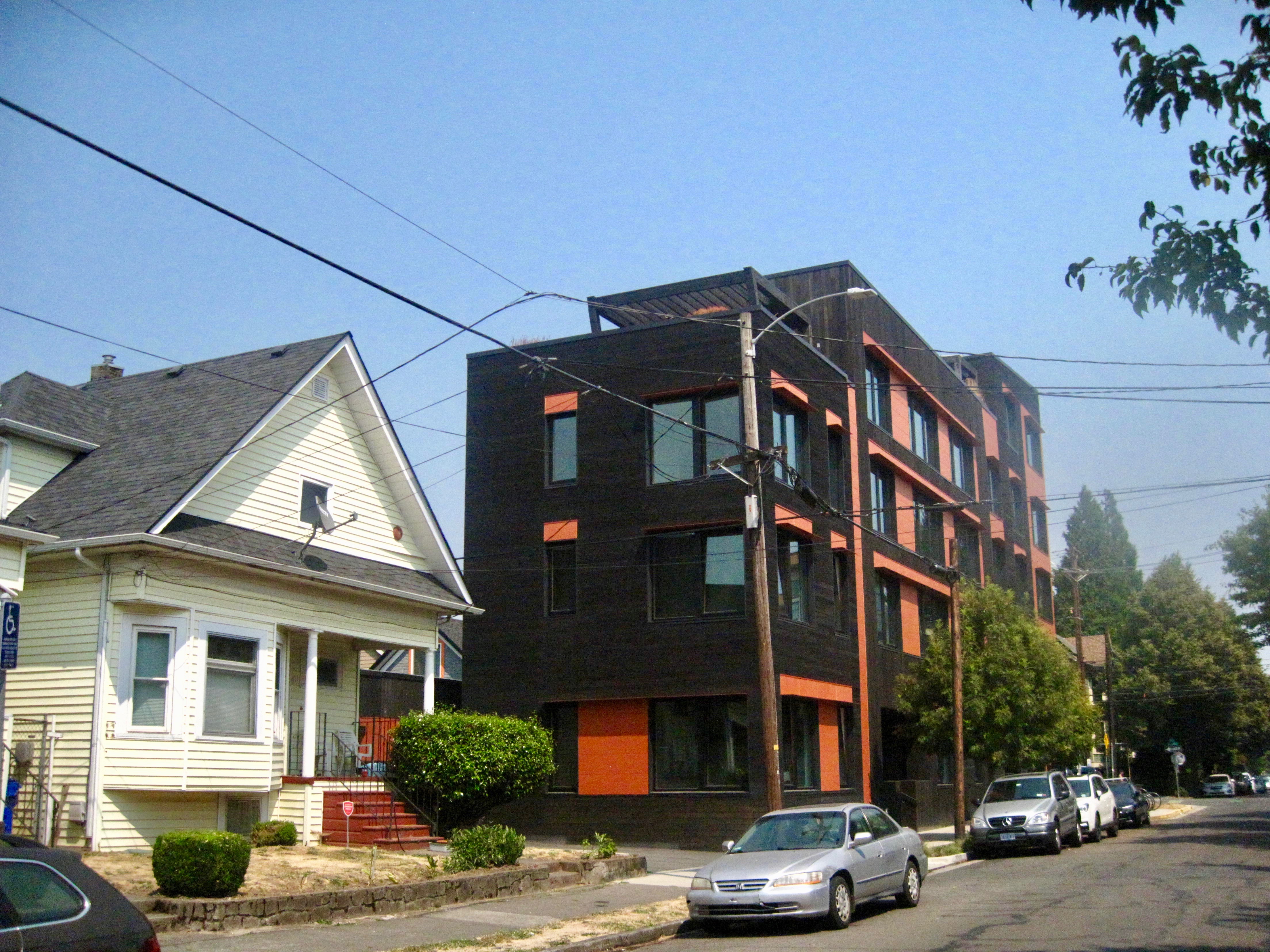
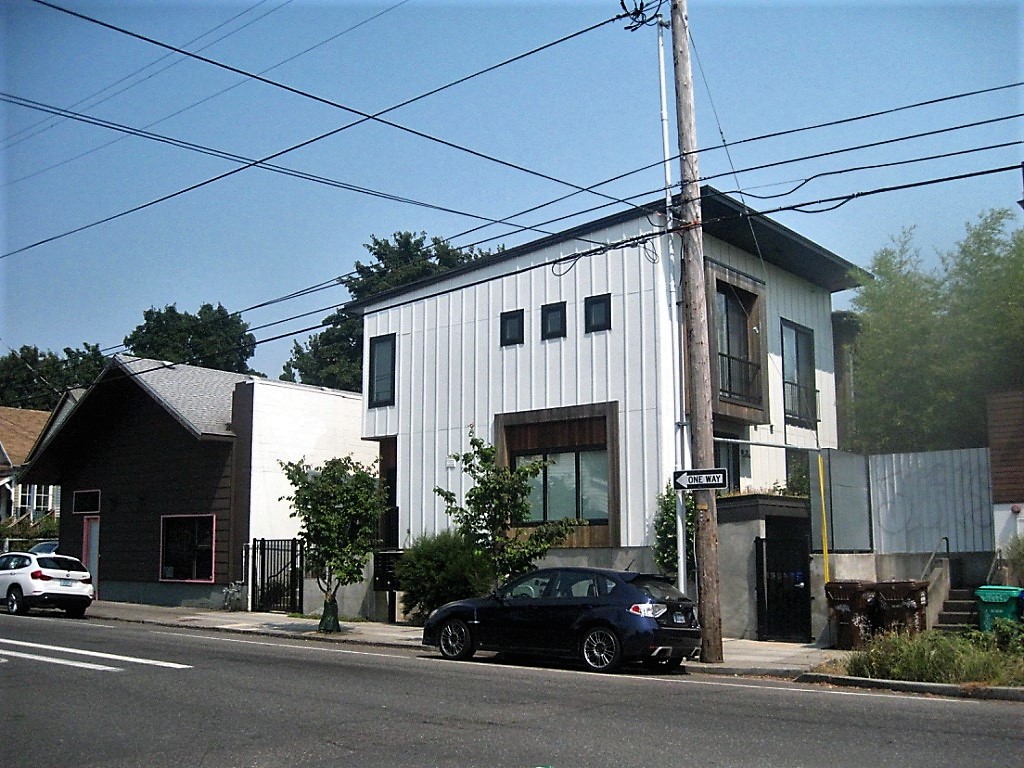
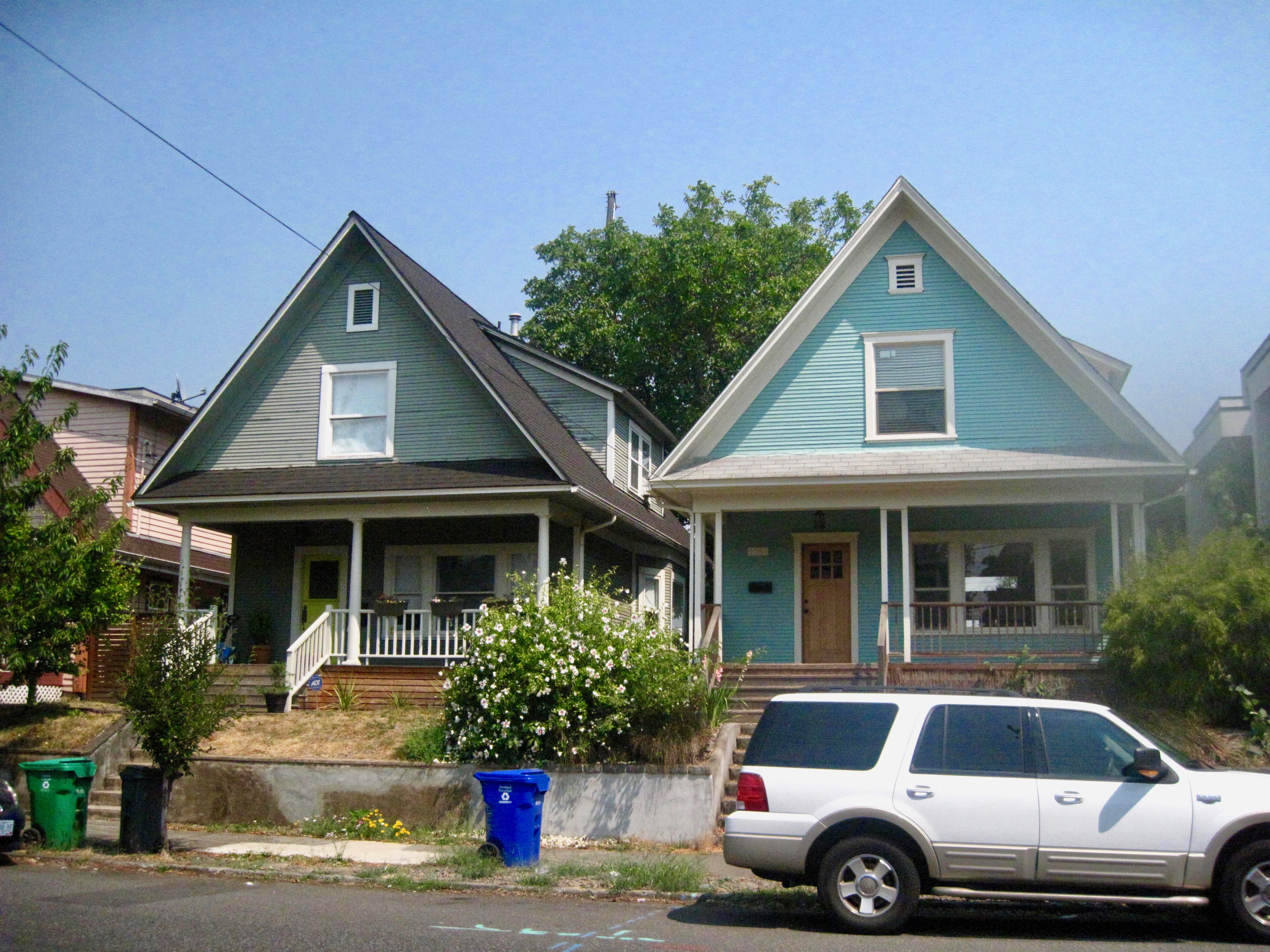
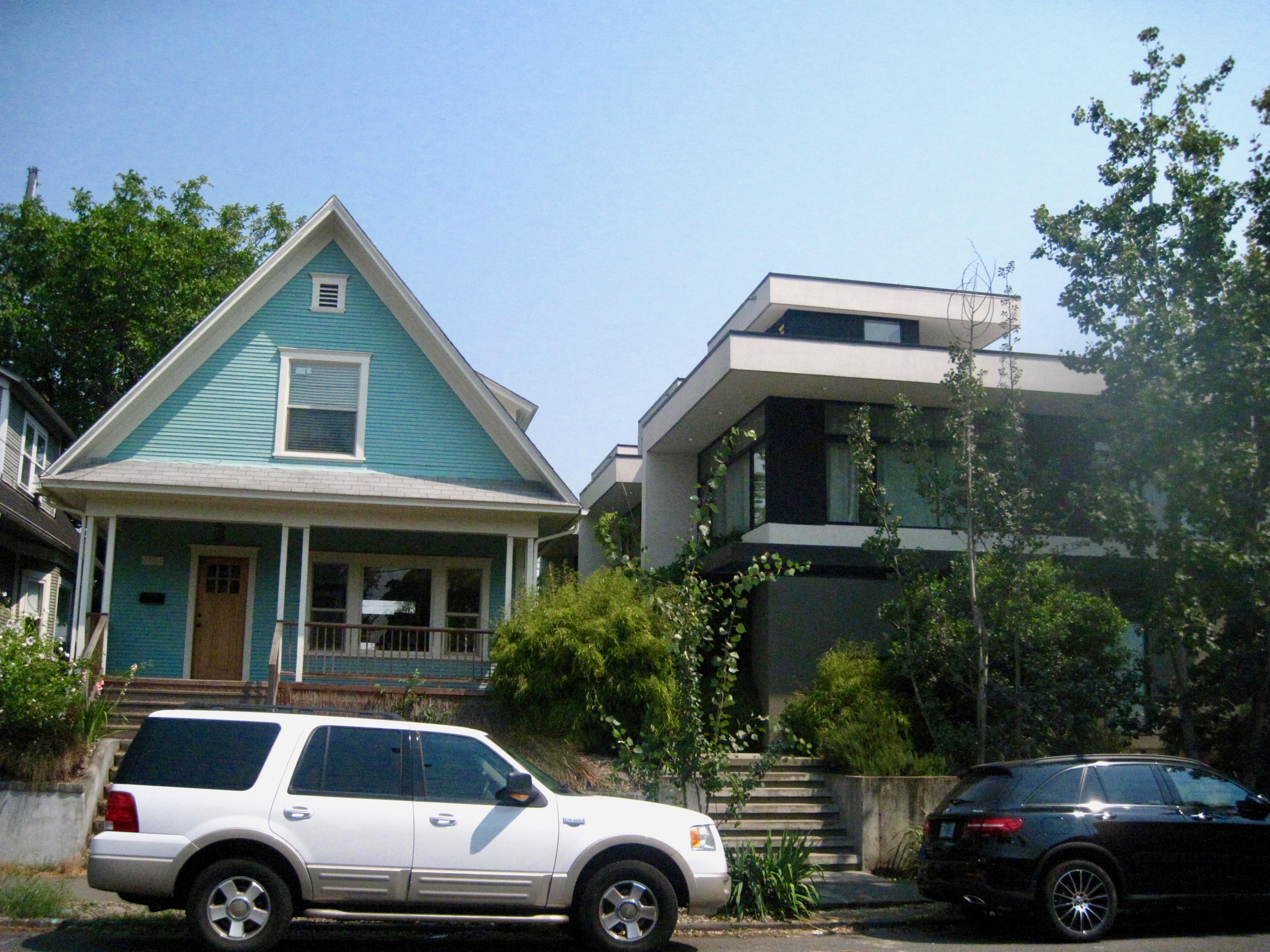
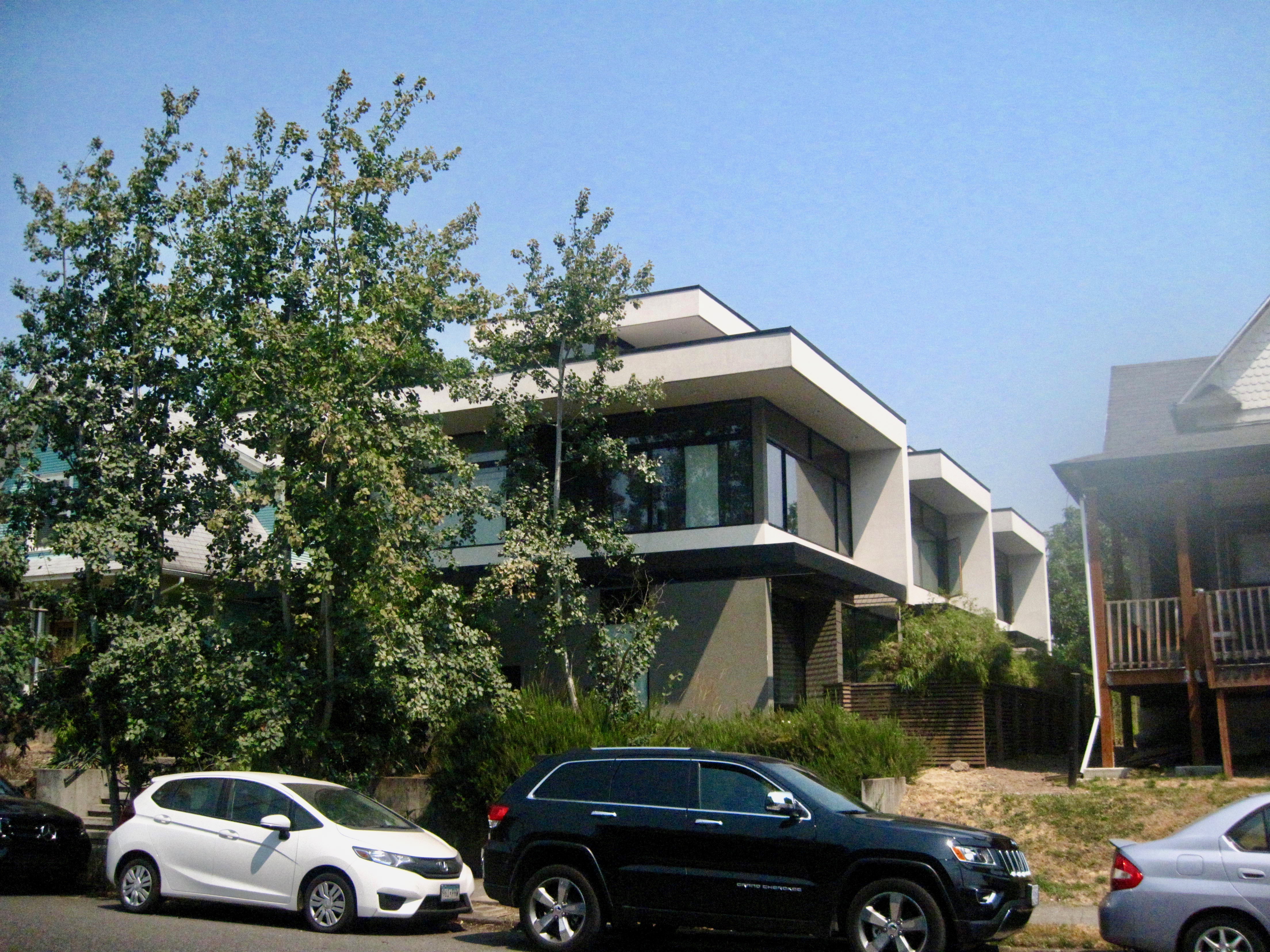
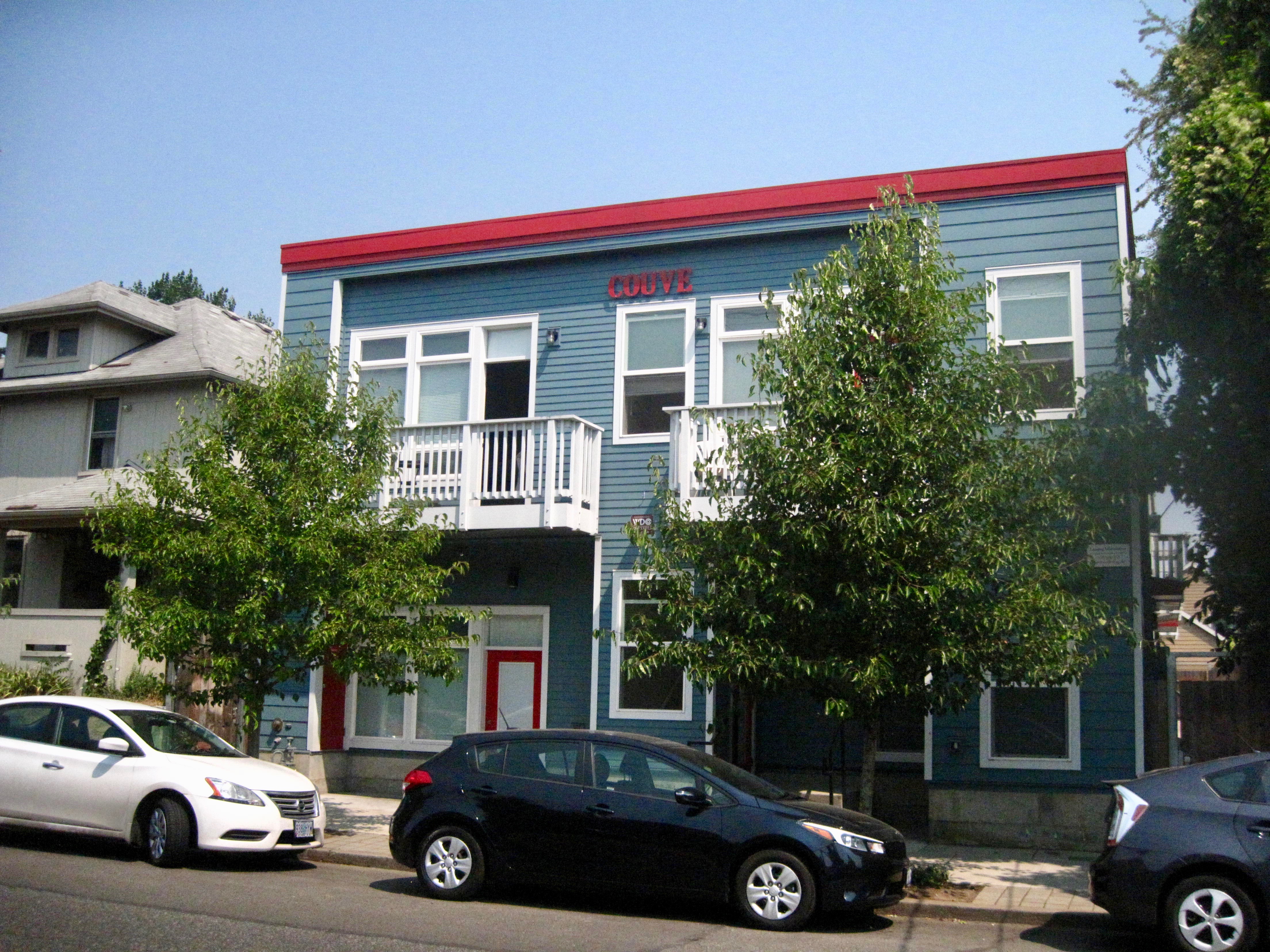
We were in Portland, OR last week, amidst the haze of wildfires and 39 degree C heat, where I snapped a few photos of some interesting row house and small multi-family projects. Most of these buildings are in the Vancouver/Williams Street corridor in northeast Portland. I love the palpable creativity of this city, and find that the mix of old and new adds richness to the city’s character and history.

Older walk-up apartment


Newer interpretations of the row house


Newer interpretations of the row house


Old meets new


ekoLiving‘s sweet Couve rental apartment building


Interesting example of an interior facing row house


Love these guys


And hello, what’s this?


It’s the 3-unit North House by William Kaven Architecture. I love this too.


Filed Under: Design, Featured Tagged With: infill, row house

A Sign of Progress

July 29, 2017 by clove Leave a Comment

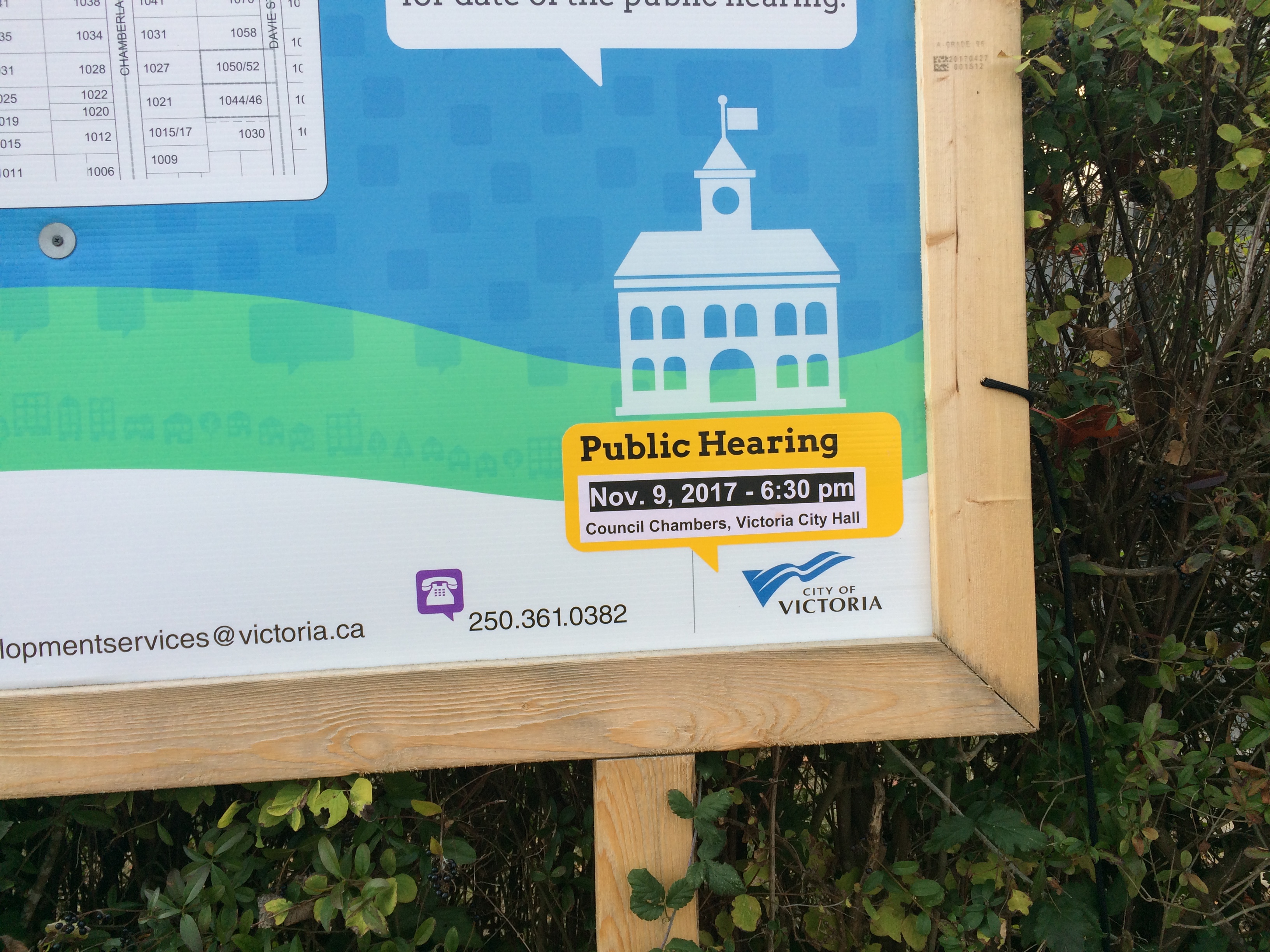
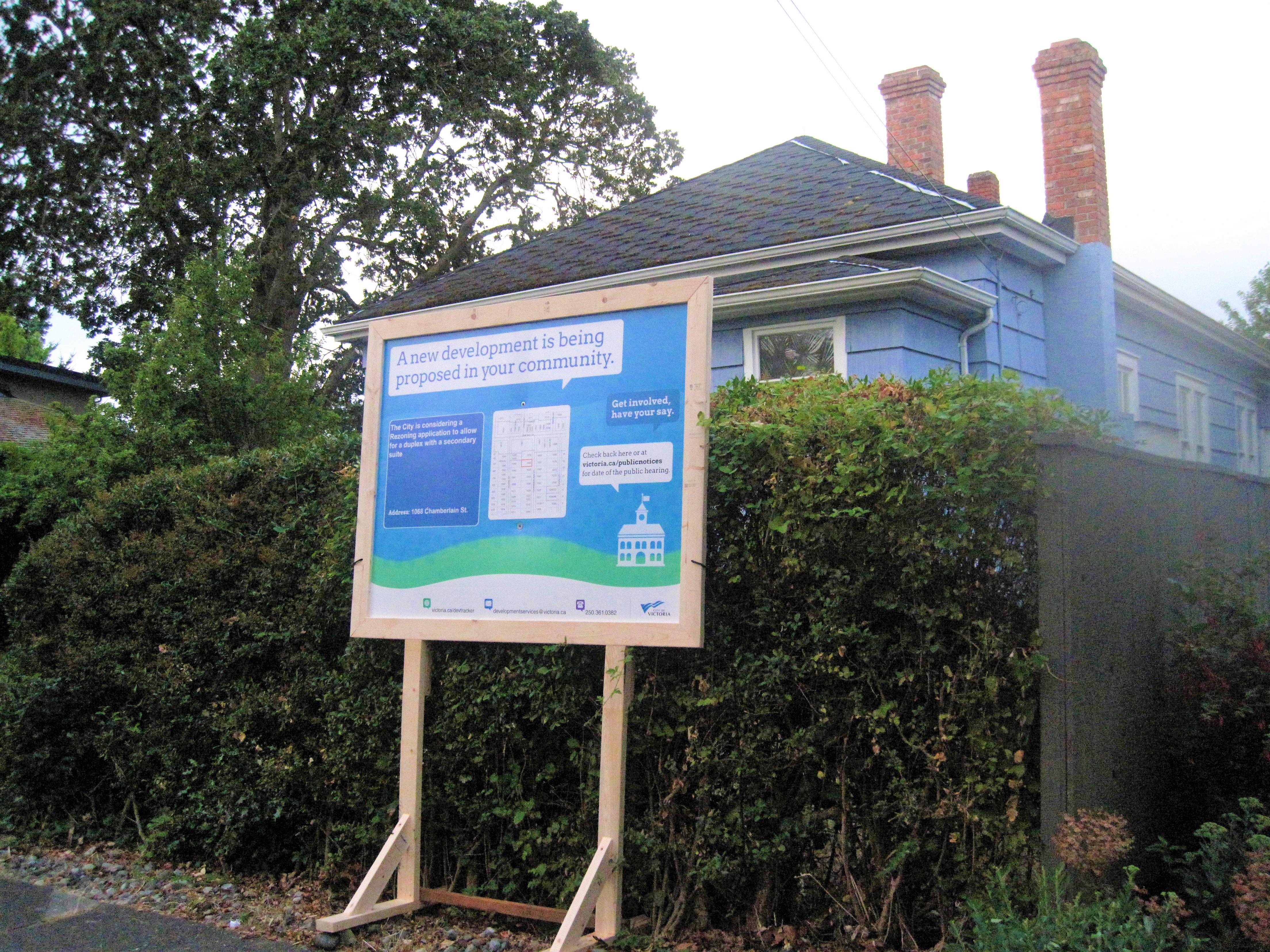
We posted this enormous sign in front of our house last weekend:

This sign means that we are on the agenda of an early August meeting of the Committee of the Whole, and it will stay up until the Public Hearing. The meeting of the Committee of the Whole is attended by both City Council and city staff, and it’s when they discuss staff’s recommendations for a given project application in advance of the Public Hearing. The meeting is open to all (you can view them in person or remotely here), but we are only allowed to listen in, not participate.

This is the last step toward rezoning approval before the public hearing. We would not expect any further comments from city staff, but it’s possible that Council may raise something major.

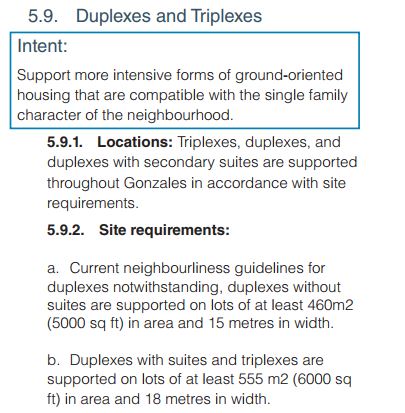
In other related news, I also recently reviewed our neighbourhood’s new draft Community Plan – the first update since 2002. Hey, get a load of this:

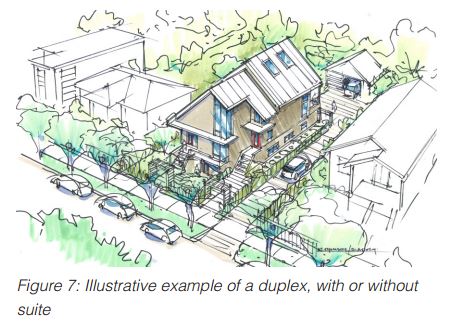
Duplexes + suites are specifically called out! This was the riskiest part of our rezoning application – that we were asking for a custom zoning because the existing two-family/duplex zoning does not allow suites within the duplex.

While we’ve heard in principle that the city wants more of this type of infill, and the Official Community Plan refers more generally to it, there is currently no zoning to support it. So having a nearly official document explicitly name what we are proposing is very encouraging.

Thanks to all of you who have followed along and supported the project so far!


Filed Under: Featured, Rezoning Tagged With: duplex + suite, infill, rezoning, ultra low energy

Argh, Parking! (Responding to City Comments Part 1)

February 17, 2017 by clove Leave a Comment

Lest you surmise I’ve been idly twiddling my thumbs for the past 3 months, I’m overdue to lift my head and share an update.

Besides shivering through Victoria’s longest cold snap in over 30 years, we’ve been working on 2 big things:

  1. Responding to the first round of city comments on our rezoning application.
  2. Completing the Passive House PHPP model.

I’ll cover the first item here. See this post for the Passive House model update.

We received our first round of comments back from the city on December 22 –  four weeks after we’d officially submitted. When I first reviewed the comments, I felt discouraged, as there appeared to be a long list of issues. But Ian, our planning consultant, pointed out this key sentence at the beginning of the letter:

The application as submitted can be considered with the land use policies relevant to the property.

Ian thought this was an excellent response. It is saying, albeit obliquely, that the city is likely to support our application, provided we address their comments. Great!

Ian and I met with the planner responsible for our project to clarify some of the comments. Nothing earth shattering resulted from this meeting, but it was good to have the face time and confirm that we understood their intent.

There were two major comments that affect our design: parking and roof lines.

Parking:

I long for the day when the level of consideration, money and space we devote to places to put our cars do not vastly overshadow the resources we devote toward places for people to actually live. Alas.

The rules around parking are largely inflexible and at odds with our desire to preserve green space on our urban lot. At the same time, the more we push the rules, the longer the timeline drags out and the less certain our outcome becomes, so we’re working toward a reasonable solution that satisfies city engineering but does not compromise our project goals.

We’re required to provide 2 off street parking spots for a duplex (the secondary suite does not require a third spot thankfully). Our neighbourhood has a precedent to allow for front yard parking, which we are invoking to preserve as much back yard space as possible.

One of the unbendable requirements is a 1.0 m setback from the rear of the parking spot to the property line. In the initial review, the engineering department also asked for an additional 1.4 m right of way in the front yard. Why? Because they might one day widen our entire block from the current 15 m street width to the more standard 18 m. Really? We already have sidewalks on both sides, parking on both sides, and boulevard green space between the sidewalks and street. The narrowness of our street also has the desired effect of slowing vehicle speeds. Sounds OK to me.

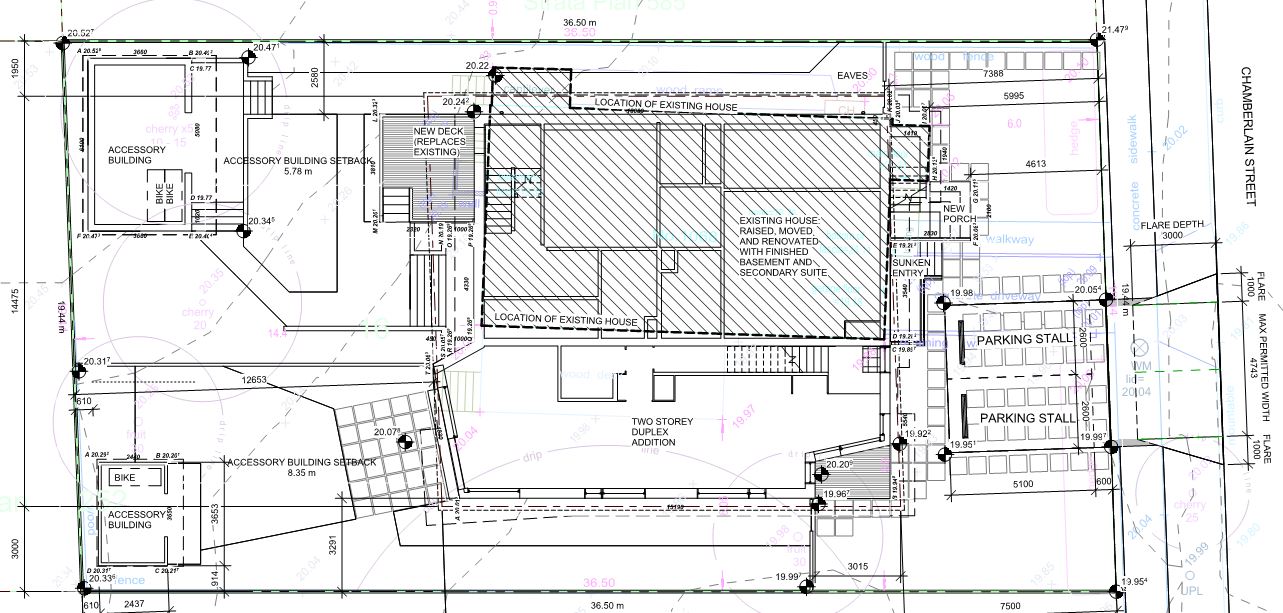
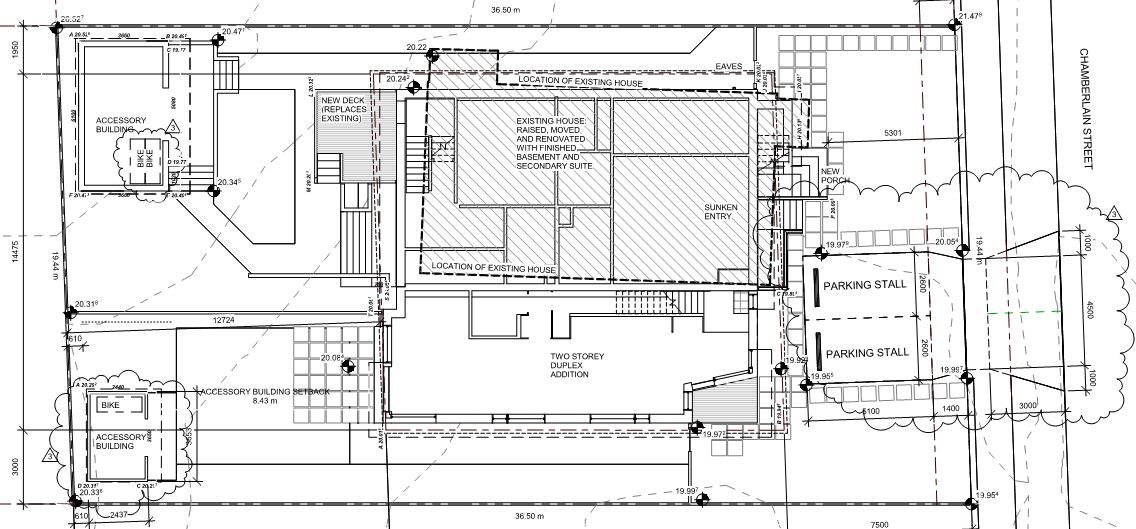
We do not agree with this request, nor is there any policy requirement that we grant this request. So we’ve decided to provide 1.4 m total, not 1.4 plus 1.0 m, as a compromise that we feel is likely to be accepted. Here’s how the design has evolved as a result:

Before: We were just a hair short of the 1.0 m required between the end of the stall and the property line, but thought we’d give it a shot:

After: We’ve shifted the house back 0.7 m and shortened up the back end of the new addition to achieve the 1.4 m setback at the front without infringing on rear setback limits:

This design change has the added bonus of simplifying the enclosure shape, which is good for Passive House, and we’re pleased with this evolution.

Roof Transition:

The City questioned the transition between old and new roofs. Something wasn’t working, and they rightly pointed out a weakness in our design, if not a simple lack of clarity.

We bandied about the idea of a more dramatic change to the existing hip roof to a gable roof. In addition to being a bolder shape, a gable roof would open up the potential for a loft space, vaulted ceilings and other cool design elements.

But then we thought through the implications – changing most of the roof line, extending the walls up to create the gable; interior redesign to include a stair or other access to the loft space, and potential zoning floor area restrictions we might now bump up against. Besides the fact that our existing house would no longer resemble its original self, there were a whole host of ripple effects that were going to add cost and stretch out the project timeline.

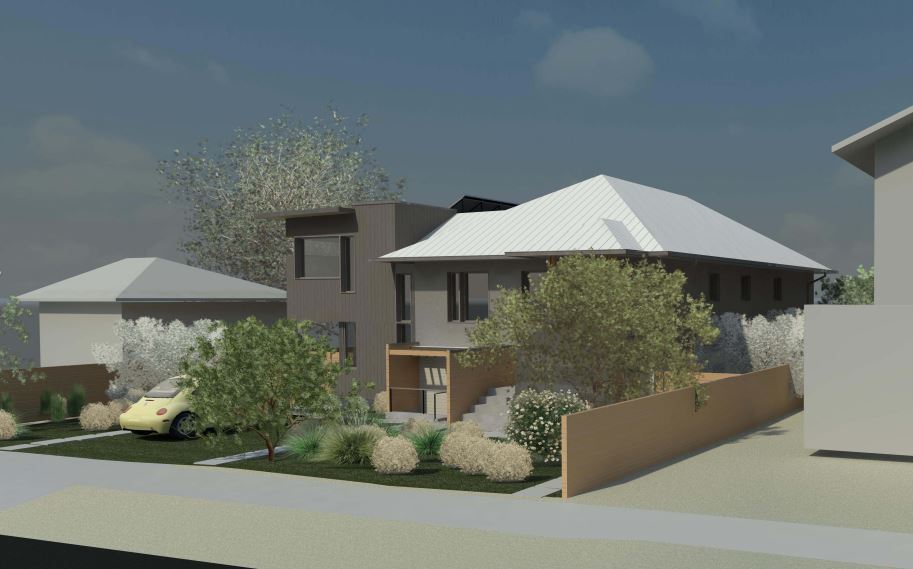
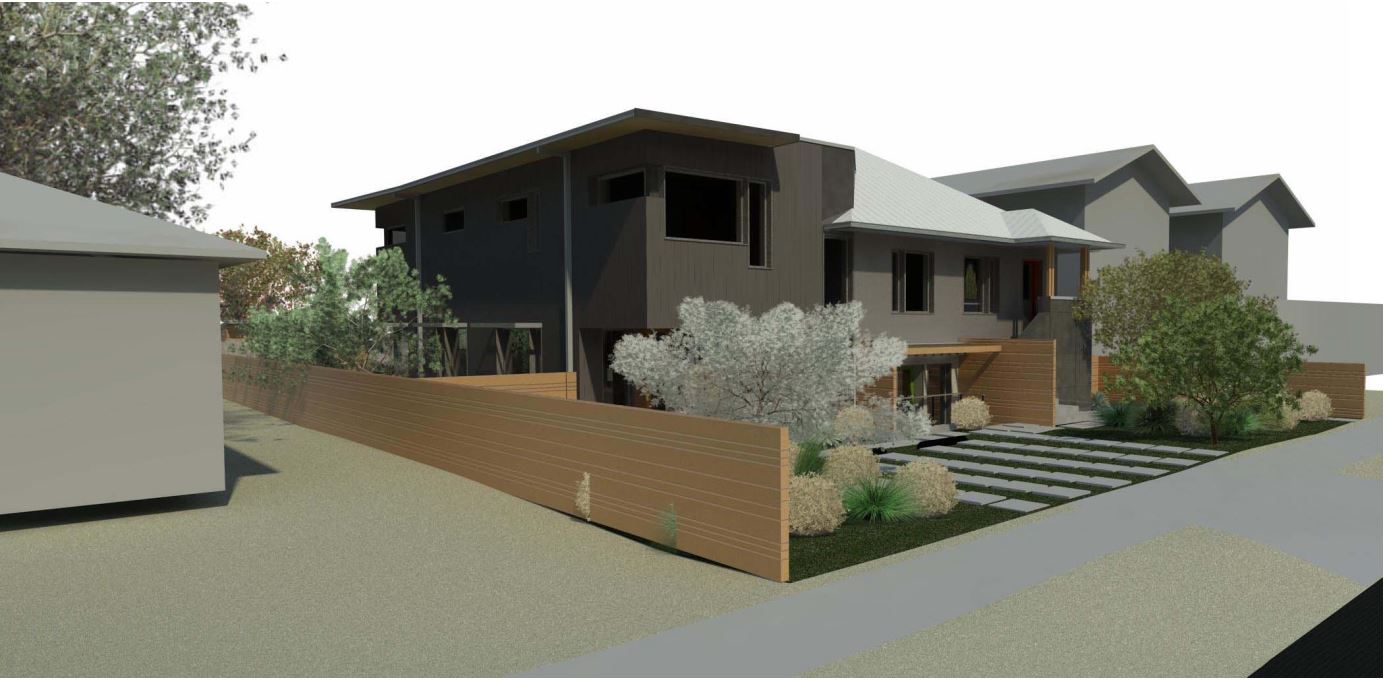
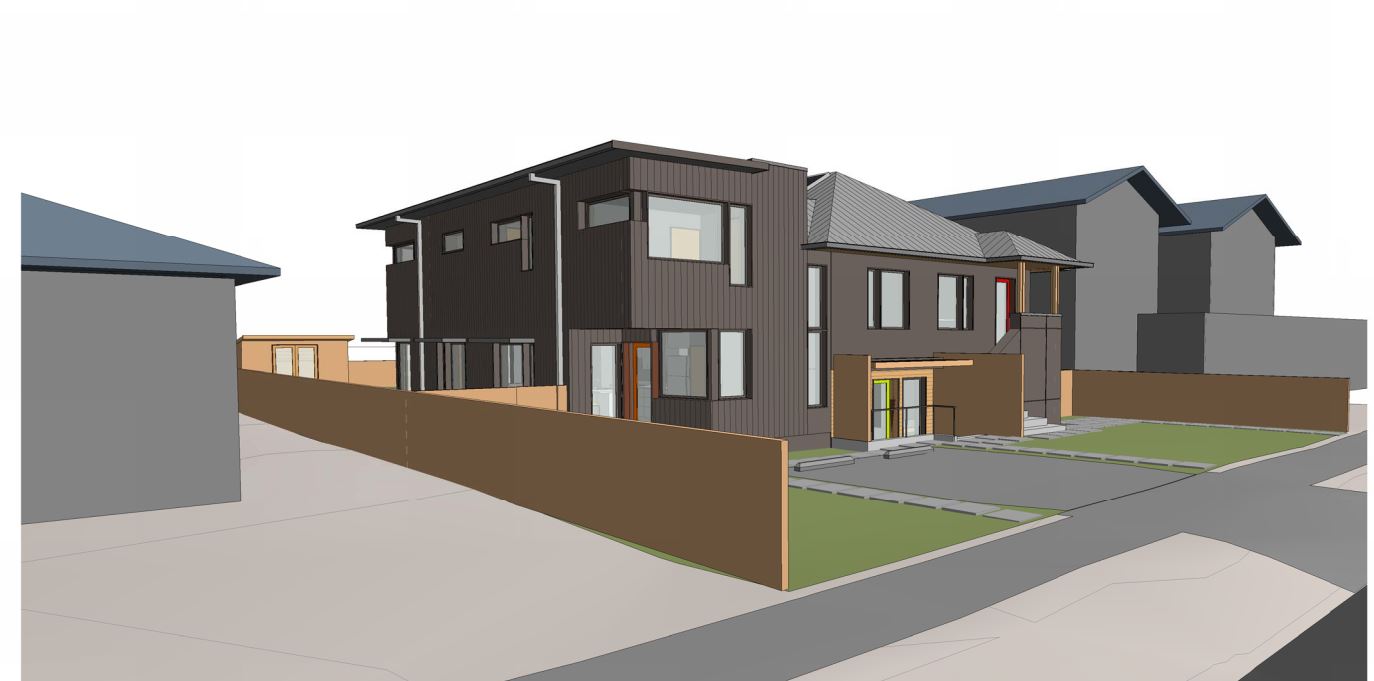
Fortunately, though, as the creative process often goes, this exercise led Mark A to a more elegant solution for the hip roof, which is what we chose to stick with. Here is the before transition from old to new:

And the after:

Renderings by Mark Ashby Architecture

We’ve been working on these revisions for the past six weeks. When complete, we will submit an updated set, a revised letter to Mayor and Council, and an updated narrative. We may get another round of comments, or if all goes well, we will move on to the meeting of the Committee of the Whole – one step closer to rezoning approval, and we’re holding firm on our current goal to be under construction this summer!

Filed Under: Design, Featured, Rezoning Tagged With: energy efficient design, infill, rezoning, ultra low energy

  • 1
  • 2
  • Next Page »

Who is Stretch Developer?

Stretch Developer is written by Christy Love. In partnership with my husband Matt, we are challenging ourselves to create the kind of homes we want to live in and see more of in our community. Home is the incredible Victoria, BC, Canada.

Sign up!

Sign up to receive email notifications of new posts.

Recent Posts

  • New Uses for Old Wood Part 2 September 26, 2021
  • Ongoing Preparations for the Apocalypse August 13, 2021
  • Things We’ve Noticed – Energy Edition May 29, 2021
  • Passive House Suite for Rent April 17, 2021
  • Things We’ve Noticed – Comfort Edition March 14, 2021

Blogs We Like

Green Building Advisor Blogs

Musings of an Energy Nerd

Treehugger

Talk to ARYZE

Recent Posts

  • New Uses for Old Wood Part 2
  • Ongoing Preparations for the Apocalypse
  • Things We’ve Noticed – Energy Edition
  • Passive House Suite for Rent
  • Things We’ve Noticed – Comfort Edition
  • New Uses for Old Wood Part 1

Tags

budget building permit cabinet construction climate action climate change community engagement construction deep energy retrofit design design progress development permit duplex duplex + suite energy consumption energy efficient design financing financing passive house finding land food security home inspections infill low energy design neighbourhood engagement net zero passive house Passive House comfort Passive House construction Passive House construction costs passive house for sale Passive House performance Passive House performance; Sanden CO2 heat pump Passive House rental Passive House systems passive house testing performance pro forma property search tips reclaimed wood reclaimed wood construction rezoning roof row house small lot development small lot subdivision ultra low energy

Copyright © 2026 · Metro Pro Theme on Genesis Framework · WordPress · Log in


Loading Comments...