Stretch Developer

Taking urban development into our own hands

  • Home
  • About
  • The Project
    • Finding a Property
    • Design
    • Approvals
    • Financing
    • Construction
    • Performance
  • Blog
  • Contact
  • Rental Suite

Financing 103

July 1, 2016 by clove Leave a Comment

When comparing our small lot vs. attached duplex development options, I’d heard that financing would likely be more straightforward for a small lot subdivision because we’d have a legal bare lot as security for the lender. With the attached option, we wouldn’t have much until the building is finished.

I’d found a private lender who was not scared off by a duplex/existing building reno; with more flexibility than a bank or credit union, but at a higher interest rate (8-10%). For our project, they would loan one (big) amount to cover our current mortgage and the construction financing. We’d only pay interest on the amount spent, but from day one we’d be paying 8-10% on our current mortgage. With a 10 month construction period, that translates to about $38,000 in interest just for our existing mortgage, and we’d be paying interest in the realm of $50,000 for the whole build. Ouch.

I talked with some other people who have more experience with this stuff, and they suggested we talk with the local credit unions. They will be more conservative than a private lender and more flexible than a big bank, but with interest rates more in line with big bank rates. So I called up a couple of local ones.

The first thing that caught my attention were their rates. Prime + 2% for the construction financing. So, more like 4.7%, which is a heck of a lot better than 8-10%.

Generally speaking, this is how a credit union would structure the lending:

  1. We would terminate our existing mortgage (paying the penalty that is stipulated in our terms – in our case, 3 months’ interest).
  2. We would take out a standard residential mortgage for the existing house, at standard mortgage rates (say 2.8%), which will always be kept separate from the construction loan.
  3. We would take out a construction loan for the new build/major reno. They will charge a 1% construction financing fee and will lend 75-80% of the project’s appraised final value. The 20-25% we need to put in can be a combination of cash and equity.
  4. Similar to the private lend, we would only pay interest on the money actually spent. The money is drawn corresponding with project construction milestones (as verified by an appraiser) – also the same as the private lender.
  5. We would have to self-finance to a point. That point is AT LEAST after approval of rezoning, but depending on which option we pursue, and who the lender is, may vary beyond that. For the small lot subdivision, it’s likely we’d have to self-finance past rezoning approval and to the approval of the subdivision, which may or may not include completion of the subdivision. This is a pretty big grey area, since the cost to fully service the lot (required to complete the subdivision) was quoted to me by the city as being in the realm of $25,000 – $30,000.

One of the credit union mortgage specialists I talked with got really nervous when I told her we were raising the existing house. She said that in this situation, they might be limited to lending based on land value alone. The other credit union rep I talked with, on the other hand, said they were comfortable with house-raising (and in fact, she enjoyed seeing the pictures of the lift in progress).

In conclusion: The local credit unions offer better rates and a more attractive solution for either of our proposed options. The difference in costs between private lender rates and credit union rates could be as much as $30,000, which is a significant amount of money for a small project like ours. And it’s money that would disappear with no equity coming out the other end. We will be much better off going through a credit union provided we can meet their requirements. Also, the credit unions seemed comfortable with either option: small lot subdivision or attached duplex.

I would recommend calling several lenders as you’re planning your own project – private lenders, big bank, and credit unions. Even among the credit unions, their comfort level with our particular project varied.

And on that note, Happy Canada Day!
Filed Under: Financing Tagged With: budget, duplex, financing, infill, small lot subdivision

Checking in with the City

June 10, 2016 by clove 2 Comments

I met with the City Planner responsible for rezoning applications for a second time. I’d met with him much earlier in the process to present our small lot subdivision concept. This second meeting was to update him on our progress and to establish whether the planning department had a preference for the small lot subdivision or the attached duplex path. I had already poured over the respective rezoning requirements for both options, but I found that the duplex design guidelines were much less detailed than the small lot design guidelines.

The planner confirmed that, in terms of design, a small lot subdivision and duplex application are evaluated similarly. In neither case does his department judge a project based on whether it is a contemporary or a traditional design. They look more at elements like scale, form, variation in materials, and landscaping that reference dominant features in the neighbourhood. So that was good news.

I also followed up with calls to other city departments that will be reviewing our application. Here’s what I learned:

  • For the small lot subdivision, we can either add two curb cuts or one larger curb cut to serve both properties. The city has a slight preference for a single larger curb cut because it takes up less overall street parking space. An attached duplex will need two curb cuts spaced a minimum distance apart. We’ll want to have these details worked out before we submit to minimize redesign work.
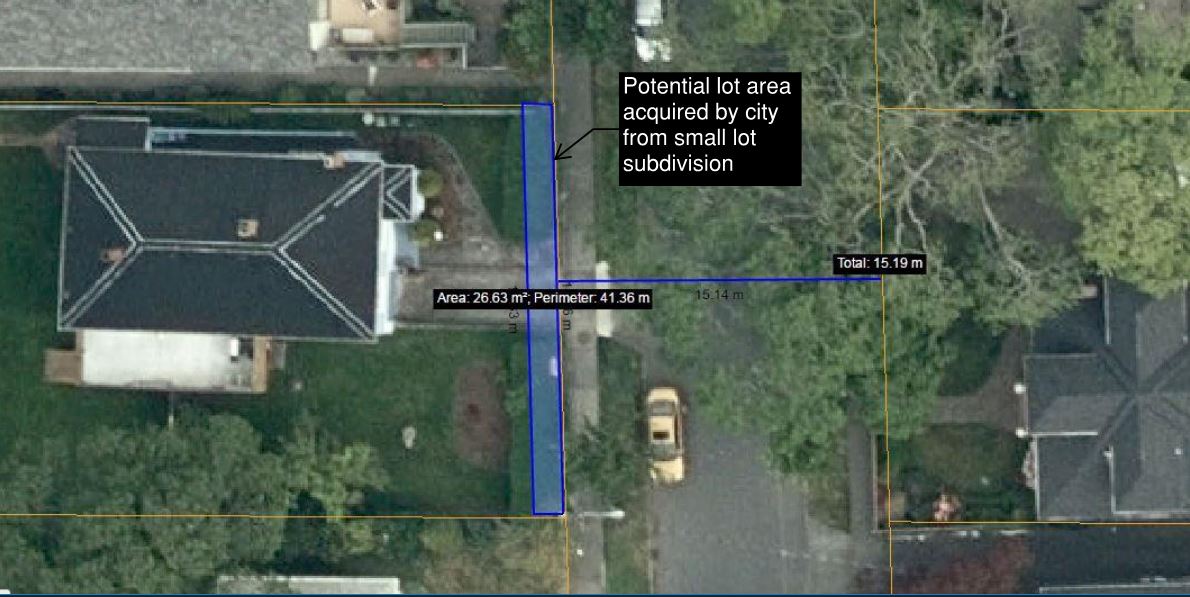
  • Here’s an interesting one: For the small lot subdivision, the city will ask for up to 1.5 meters of the depth of our lot as a dedication for widening the street. This is because our street is only 15 m wide and their standard is 18 m. So the city uses the subdivision as an opportunity to gain back up to half the missing road width, which they can then use to widen the boulevard or plant additional street trees. Here’s roughly what that would look like:

Small Lot Right of Way

  • The takeaway: make sure the small lot meets the minimum 300 sq m area with a 1.5 m swathe removed from it. With the current proposed property line location, one lot would dip below the minimum with that strip removed, and could potentially be rejected.
  • For the attached duplex option, this would not be a requirement. Score one for Plan B.

I hope that I will soon reach a point when I stop learning surprising new things every time I talk with someone about how to make our project happen. What I will say about working with the City of Victoria is that, while the rezoning process is an onerous one, its staff are available and willing to provide guidance. It’s easy to set up a meeting and if I call someone, they call me back within a couple of days. The trick is to figure out what questions you need to ask.

As we find answers and continue to hear input from others, Matt and I are solidifying our plan and feeling confident in our path forward. More to come soon!


Filed Under: Featured, Rezoning Tagged With: duplex, rezoning, small lot subdivision

Progress toward Continually Adjusted Expectations

June 3, 2016 by clove Leave a Comment

When doing something like this for the first time, I think it’s safe to say that your expectations for the amount of time the project will take and how much it will cost will creep toward longer and more expensive the deeper into it you get.

Take the budget category of “soft costs” for example. I like this term because it captures the malleable, ill-defined edges of a catch-all bin for all the costs you don’t yet fully understand. Things like design costs, engineering fees, rezoning application fees, permitting costs, miscellaneous city fees, site servicing fees, financing costs, and legal costs.

I learned from my latest call to the city that we should budget $25,000 – $30,000 to complete the small lot subdivision. This is only for servicing the lot (water, sewer), providing access (driveway and curb cut), and paying city fees. Yikes!

I laugh at the naïve me who a year ago estimated that the total cost to renovate our existing house would be about $100,000. Since that time, I’ve gotten a quote from a contractor who does interiors, plus a round estimate from our builder who will do the shell of the building (foundation, walls, windows, roof), and it’s looking more like $300,000 to do everything on our wish list.

I also marvel at the optimistic me of only 6 months ago, who thought we’d have our rezoning application submitted by February (which I’d already extended from a previous goal of ‘before Christmas’). The City of Victoria is special in the level of civic engagement it expects for all development projects. But especially so in a case like ours where we intend to continue living here once our project is complete, the amount of time we have invested to meet and listen to our neighbours is important and worthwhile. And it just takes time.

(Read this post to learn what our neighbours have said so far.)

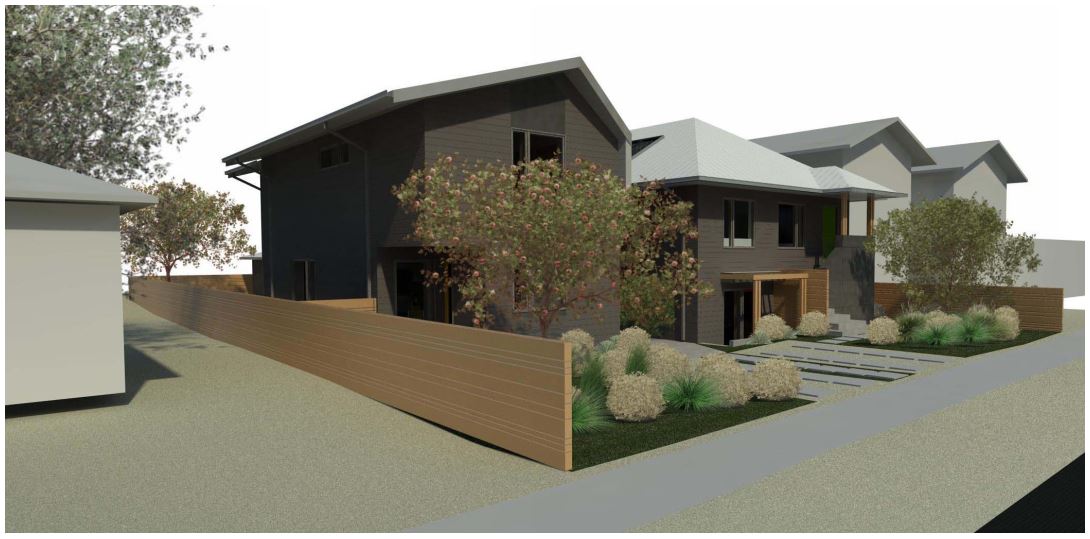
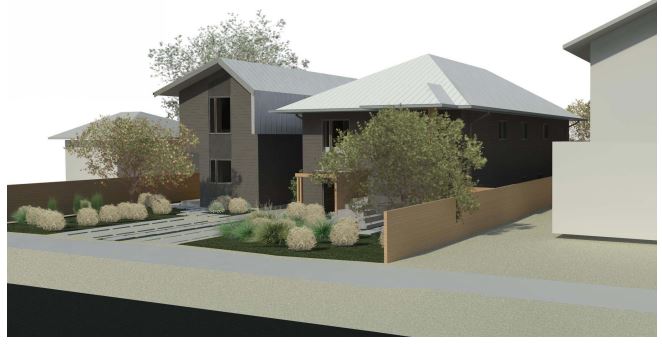
The biggest choice we are currently facing is whether we will continue with our small lot proposal or switch to our Plan B, the attached duplex option (shown below).

Preliminary concept for attached duplex option. Rendering by Mark Ashby Architecture

Preliminary concept for attached duplex option. Rendering by Mark Ashby Architecture.

It’s not as simple a decision as what our neighbours will be most likely to support, although that is an important piece. Financial risk is another big one, as the costs and financing options are different for the two options. What will work best for our family long-term? What is most likely to make it all the way to Council approval and actually be realized?

I’ve been spending my time lately looking for answers to as many of these questions as I can – calling various city departments, calling lenders, calling people who have done this before. Then Matt and I will sit down and evaluate our options against a list of criteria which is starting to take shape:

  • financing risk and financing costs
  • total cost and return on investment
  • maintaining/building positive relationships with our neighbours
  • best fit with the site and its immediate surroundings
  • lowest impact on the environment
  • what will work best for us long-term
  • likelihood of approval

Stay tuned and thanks for reading.

Filed Under: Financing Tagged With: community engagement, costs; financing, design progress, rezoning, small lot subdivision

Small Lot Design

May 23, 2016 by clove Leave a Comment

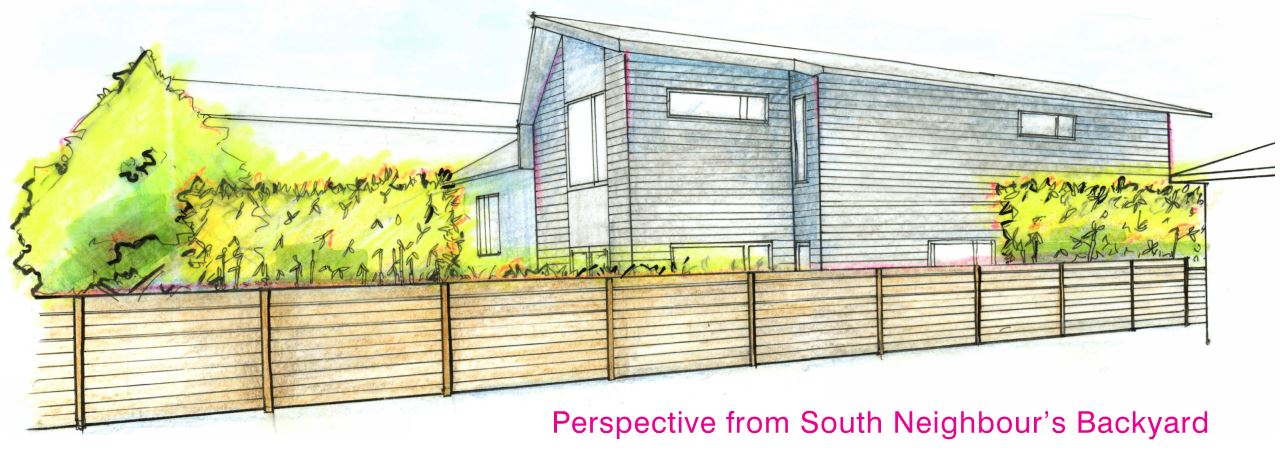
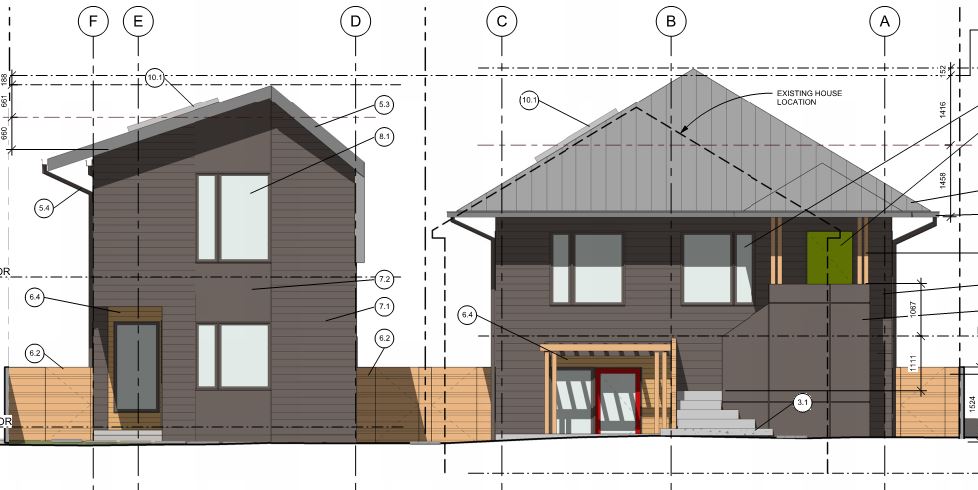
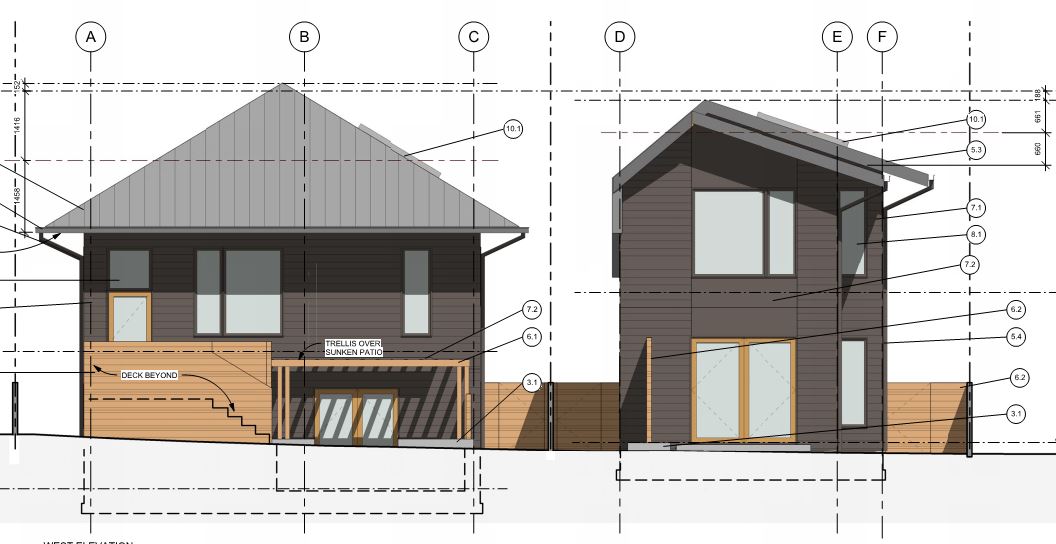
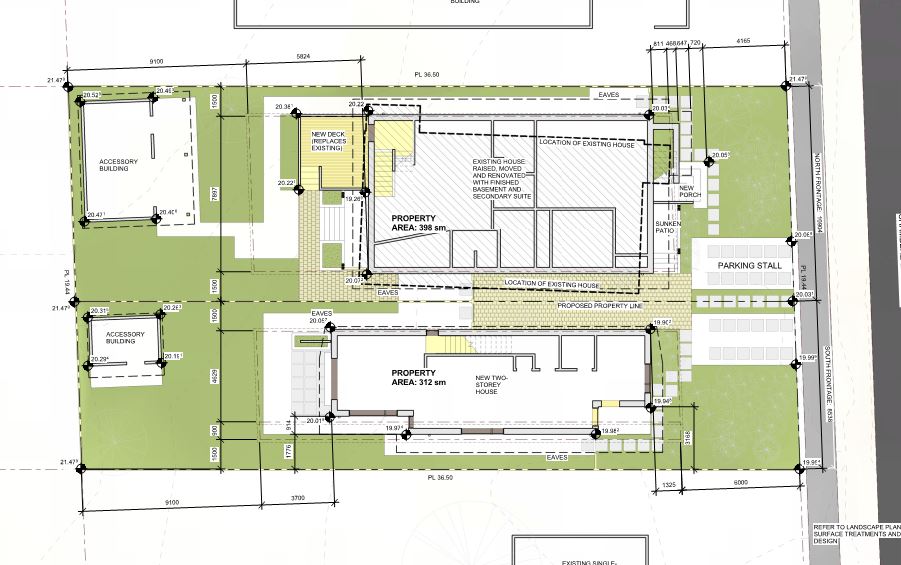
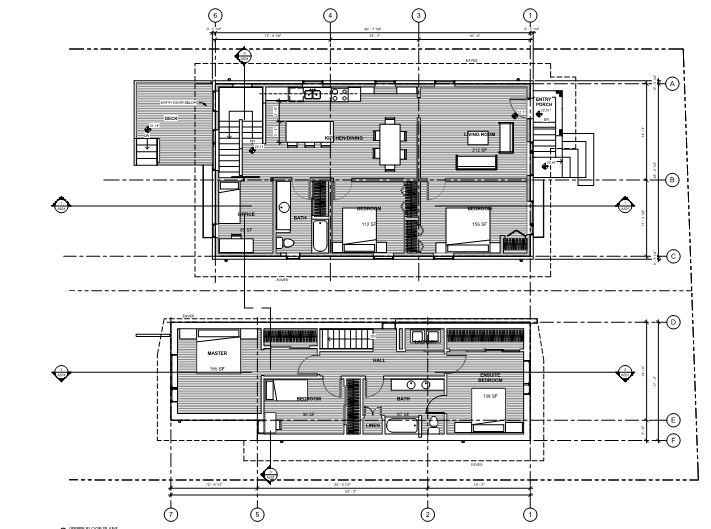
Here are some renderings and plans from the small lot design we have been sharing with our neighbours for the last few months.

I also presented this design at a preliminary meeting with the Fairfield Gonzales Community Association Land Use Committee (CALUC) in February. This was not the ‘official’ CALUC meeting, but rather a preliminary meeting that some neighbourhood committees request – an opportunity to introduce the project, meet the committee and hear their initial comments. We will apply to present at the “official” CALUC meeting when we are ready to submit the rezoning application, and we’re not there yet.

All renderings and plans are by Mark Ashby Architecture, unless otherwise noted.

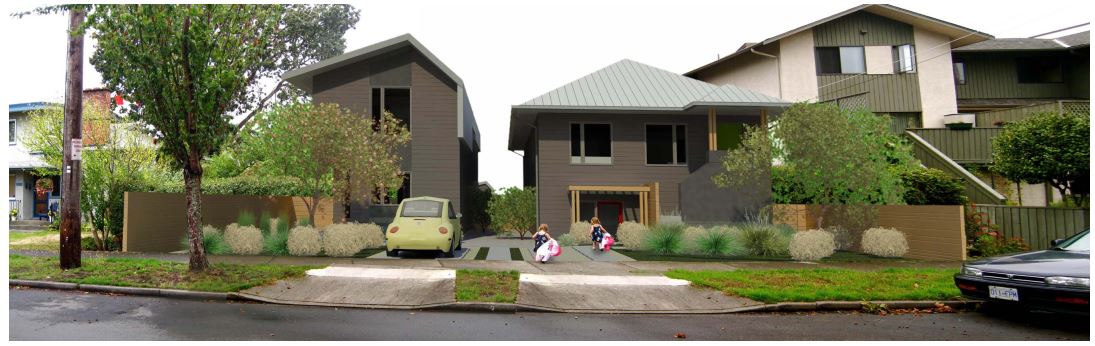
Streetscape After Rendering

Streetscape AFTER

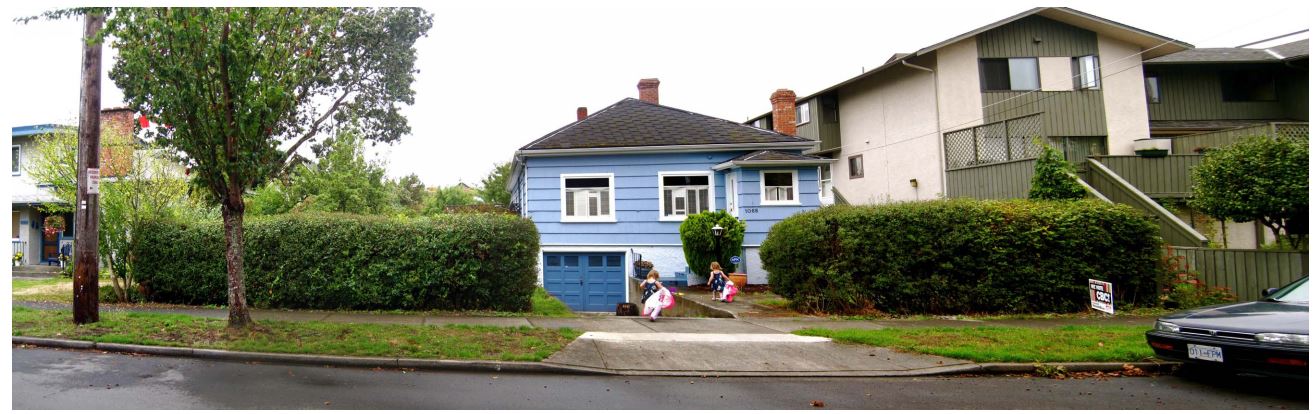
Streetscape Before Rendering

Streetscape BEFORE

View from the southeast, rendering Mark Ashby Architecture

View from the southeast

View from the northeast, rendering by Mark Ashby Architecture

View from the northeast

View from south neighbour's back yard, sketch by Kate Stefiuk

View from south neighbour’s back yard, sketch by Kate Stefiuk

East Elevation, rendering by Mark Ashby

East Elevation (front)

West Elevation (rear), rendering by Mark Ashby

West Elevation (rear

Site Plan, by Mark Ashby Architecture

Site Plan

Lower Floor Plans, by Mark Ashby Architecture

Lower Floor Plans

Upper Floor Plans

Upper Floor Plans

Filed Under: Design, Featured Tagged With: design progress, low energy design, small lot subdivision

Landscape Concept Design

February 12, 2016 by clove 1 Comment

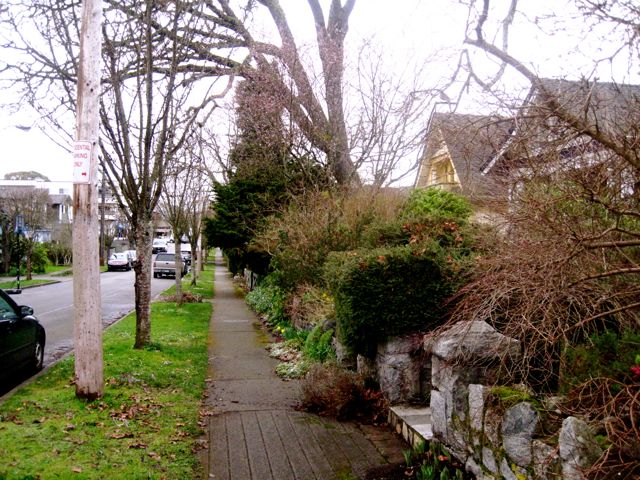
street landscape

A walk down our block

The landscape is a defining quality of our eclectic neighbourhood, and one of the goals of our design is to add something good to that landscape.

Streetscape Before Rendering

Streetscape Before

Streetscape After Rendering

Streetscape After, rendering by Mark Ashby Architecture

Here are a few key ingredients of the landscape concept:

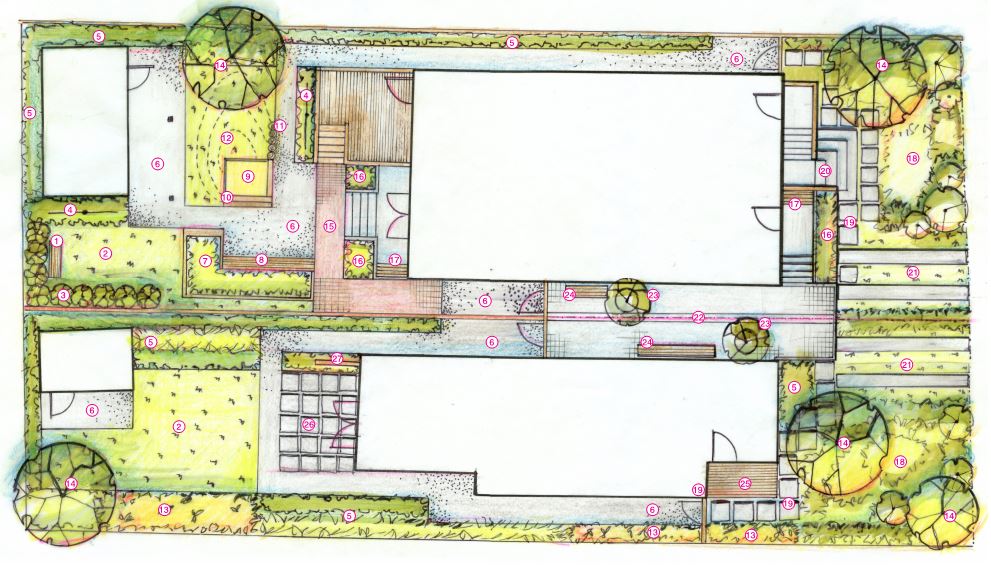
  • We want to feel a stronger connection to the outdoors and to extend our living space into the back yard. Mark A has redesigned the back of our existing house to strengthen that connection from the kitchen.
  • We want to grow food while playing outside. Kate S has packed a ton of beauty and functionality into a compact back yard space. Think veggie beds, espalier fruit trees, herb boxes, cedar benches, even a sand box for playing.

Landscape Concept Plan by Kate Stefiuk

Landscape Legend

Landscape Concept Plan by Kate Stefiuk

  • Deciduous trees can be natural allies for an ultra-low energy house. If placed well, they can shade windows from direct sun in the summer when you’re at risk of overheating, and then allow that direct sun in the winter when it helps warm the house. The tree in front of the new (south) house shown in the plan is an example, where it will shade the rising sun from the east facing windows in the summer.
  • We intend to manage storm water on-site. The City has an excellent guide in its DIY Rainwater Management Standards for incorporating storm water retention, management, and/or re-use strategies into the landscape design (with accompanying grants through its Rainwater Rewards program). We’re still working on which strategies will work on our site, and debating low tech solutions like rain gardens vs. higher tech solutions like using rainwater to flush toilets. I’m a big fan of simplicity and less a fan of systems that will require pumps and filters and continual maintenance. If anyone knows of a stylish but simple composting toilet, I’m all ears!

Filed Under: Design, Featured Tagged With: infill, landscape design, rain garden, small lot subdivision, storm water management

Talking with Our Neighbours Part 2

December 6, 2015 by clove 5 Comments

On Remembrance Day and I found myself with the gift of a free afternoon – a rare window of time during the day when I wasn’t working or with our daughter.

Despite a low-level trepidation, I folded the plans under my arm, donned my boots, scarf and mittens and thrust myself into the bright chilly November afternoon.

I started at the south end of the 100m radius on our block. A neighbhour several doors down was out raking leaves. I introduced myself, told her we were planning a project and asked if she wanted to hear a bit more. As I got into some of the goals of the project, she became increasingly engaged. She knew about Passive House; recognized that we had a huge lot that was likely to be developed by someone if not us, and said she would like to see our project happen. What a great (and relieving!) first conversation!

I talked with 5 more neighbhours that afternoon, including three who share a property line with us. 5 of the 6 people I talked with were either neutral or supportive. The 6th thought that the new lot and house seemed very narrow, but he also commended our ambitious plan.

So far so good!


I’ve now spent five afternoons door knocking and have had conversations with over 20 different neighbours. Each time, I have started with uncertainty and finished feeling buoyed by the largely positive response.

Here is a summary of the generally positive and constructive comments I have heard so far:

  • Most are either neutral or supportive of the project proposal
  • Many were supportive of adding modest density to the area
  • Most are either neutral or supportive of adding the suite to the existing house, citing the need to increase density and the diversity of housing options in the area
  • Neighbours sharing back yard boundaries want to ensure that their privacy is considered in the house and landscape design
  • One architect neighbour with a long history in the area suggested we move the parking back to the front of the property (see early design post). No other houses on the block with adjoining back yards on Chamberlain and Clare Streets have parking in the rear, which results in a large ‘park’ space that many of the residents value highly. There are even gates connecting many of the backyards.
  • Many expressed interest in and support for the energy efficiency/low energy approach to the design

Filed Under: Rezoning Tagged With: community engagement, neighbourhood engagement, rezoning, small lot subdivision

Early Meeting with the City Planner

October 9, 2015 by clove 1 Comment

Yesterday I met with the City of Victoria planner responsible for small lot subdivisions in our area. The purpose of this early meeting was to get a sense for any real or perceived barriers to approving our project from the planning department’s perspective. After we go through the community consultation process and submit our official rezoning application, it works its way through various engineering and planning departments and the planning department ultimately makes a recommendation for Council’s consideration.

When it comes to giving guidance around rezoning, planning staff are tasked with communicating what is allowed by already established zoning classes. They are unlikely to express support for a custom zoning proposal. A lot of work has gone into the creation and evolution of existing zoning and to have every developer come along and create something new would defeat the whole purpose of zoning regulations. The purpose of this early meeting was therefore to read between the lines and to get a sense for openness to our proposal.

The first thing the planner said, having given the schematic drawings a quick glance, was “this looks challenging.”

He felt that the biggest challenge was the addition of a suite to a small lot property (which is what the existing house would become after subdivision). It isn’t allowed in the existing small lot zoning, which is already very well established. It even has its own Design Guidelines.

There was plenty of nuance in our in-person conversation, including an acknowledgement of the importance of neighbourhood opinion. The nuance was absent from his follow-up email, which encouraged us to rework the project to meet existing zoning (i.e. no suite).

Although it feels like a rejection, I would be a fool to be surprised by this response. We already know that adding a suite in a small lot house is unprecedented. We also know that we need to creatively add housing in the most walkable neighbhourhoods of our city; to increase affordable housing and options for aging-in-place, and to reduce the impact of our buildings and lifestyles.

I debriefed with our planning guru Ian Scott and he said that he was expecting the planning department to say no, and that there was also a strong possibility that planning would recommend against the project in their report to council. The prospect that our project’s approval could come down to a final face-off between City staff and Council feels risky.  

However, Ian also said that none of the current zoning regulations has been updated to reflect the goals of the Official Community Plan (read post). So what it comes down to is whether we want – or can afford– to stick out our necks.

We would love to set a new precedent and to show what is possible with good design. And yet…are we willing to take the risk – the potential added expense and time to redesign and resubmit after a rejected application- in order to be the first to do something new? 

I was anxious to get going on our detailed design, but I still don’t know what many of our neighbhours think – particularly about the suite question. Our next logical step, then, is to talk with our neighbours about more of the specifics – show the renderings and gather their opinions about adding the suite, and then see how everything sits.

I think that if we can get a consensus that the project is very likely to get approved by both our neighbhours and city planning if we exclude the suite, then we would move toward that option.

Filed Under: Rezoning Tagged With: neighbourhood engagement, rezoning, small lot subdivision

Getting (Back) to the Basics

September 11, 2015 by clove 2 Comments

May 1_15_view of north side setback_MA

Current side yard setback with townhouse to the north

Our architect Mark A and I had our heads down for a while fiddling with house placement, window placement and property line locations to somehow wrestle our two houses (new + old) into existing R1-G2 small lot zoning allowances. We were doing weird things like removing all windows from the new house’s north face and sliding the property line to the very edge of the new house. The existing house simply doesn’t fit and I knew that, but even still, I started to despair that we were wanting to do too much with our lot and it was never going to fly.

So I lifted my head and sought an infusion of fresh perspective from our planing guru Ian Scott.

We met for coffee and went through the current plans. Ian offered some reassuring words that restored my confidence in our project; a key one being that window placement variances are commonly sought and granted for small lot properties, especially on the two facing walls of the subject homes. Mark A and I were fretting about the zoning requirement of 8’ (2.4 m) minimum setback to the property line to have windows in main living spaces like bedrooms. To meet this and keep a few windows on the south face of the existing house, we shifted the property line between the houses so far south that the new house’s lot became too small to meet the R1-G2 lot size requirement.

So, here are my key lessons from Ian:

  • Changes to lot size trigger rezoning
  • Window placement that varies from zoning requirements is a variance (i.e. not triggering rezoning, which is preferred wherever possible)
  • Setbacks that vary from zoning requirements are variances
  • Lot frontage that varies from zoning requirements is a variance
  • Site coverage that varies from zoning requirements is a variance

Ian’s suggestions made everything simple again:

  • Place windows strategically to protect privacy and apply for variances
  • Move the property line between the houses back to the middle of the shared driveway so that the lot sizes for both properties meet R1-G2 requirements.
  • The new house will apply for R1-G2 zoning with variances
  • The existing house will apply for a custom zone on the basis that we are adding a suite
  • Lot coverage for the existing house will also be a variance, on the basis that we are dealing with an existing building form.

Ian also helped me return to the key elements that define the project and that will communicate our intent and the project’s benefits to the neighbourhood, the community association, and ultimately, city staff and council.

Here’s how they’re shaping up:

  1. The lot is large enough to support two small lot homes, per the R1-G2 Zone Gonzales Small Lot District. This zoning was developed based on the Gonzales Neighbourhood Community Plan established in 2002.
  2. The proposed development supports several goals of the City’s Official Community Plan (OCP) by:
    • adding “gentle” density while respecting the single family character of the neighbhourhood
    • reducing energy consumption and carbon emissions through the creation of high performing but modestly sized housing options in a popular, walkable location for families
    • modifying the existing home to facilitate multi-generational living and aging in place
  3. The addition of the new ultra low energy home will finance extensive energy upgrades to the existing air leaky home and as a package, therefore, provide multiple benefits to the community in a way that retains and restores existing neighbourhood character.
  4. The shared driveway allows retention of the existing street tree and power pole, and will preserve the current level of available street parking.
  5. Retaining and improving the existing house conserves materials and preserves the basic shape and character of the home while significantly improving its comfort, energy performance, and useful life.

See this post for a more detailed rundown of key elements of the City’s OCP as it relates to our project.

Filed Under: Design, Featured, Rezoning Tagged With: design, rezoning, small lot subdivision

Learning from the Experts

June 26, 2015 by clove Leave a Comment

I met with Rus Collins of Zebra Design today. He a pioneer of small lot development in Victoria and spent a generous chunk of his Friday afternoon with me sharing his words of wisdom. He confirmed that I am on the right path by pursuing the subdivision option, as well as my plan to talk to the neighbhours early. He said that if I experience intense resistance in my early conversations, it might be best to cut our losses or wait a year before floating the idea again.

Here’s the process according to Rus (with some editorial added):

  1. Do a very simple sketch or two of what we are proposing. Spend as little time and money as possible at this stage, because you won’t get this money back if the project dies.
  2. Talk to our neighbhours with these early sketches to get a general sense for their openness to the project. While not required at this stage, it’s good to keep in mind that for the rezoning application in the City of Victoria, we will need signatures from 75% of our immediate neighbhours (anyone with a property line that is adjacent to ours at any point – across, beside and behind) confirming that they do not object to our plan. All adults of voting age count – so a couple living next door count as two votes. Renters and owners of a rental property all count as unique votes.
  3. Talk to the local area city planner. Present the sketches and our proposed variances from the zoning we intend to apply for, as well as the early neighbour reactions. If she doesn’t raise any red flags, proceed with design.
  4. Before launching into the full design, I recommend reviewing the Rezoning and/or Development Permit Application in detail, so you know what drawings need to be included in the package and what consultants you need on board. For Victoria, we need the following at a minimum:
    1. Site plan (i.e. civil engineer)
    2. Landscape plan (i.e. landscape architect or designer. Note a licensed architect is not required for a small project like our, but we’re using one, and it can help with the permitting process for anything ‘unusual’ like super-insulated walls)
    3. Floor plans (i.e. architect or designer; also a structural engineer for modifications to the existing house)
    4. Elevations
    5. Photos or illustrations showing proposal with flanking buildings
  5. Complete the full design.
  6. Review again with the city planner (recommended by Rus to avoid being blindsided after getting neighbourhood approval and having to redesign and go back to the community again).
  7. Present to the neighbhourhood association, in our case the Fairfield Community Association’s Advisory Design Committee. This process is also outlined in the rezoning application package document.
  8. Collect the 75% signatures.
  9. Complete and submit the rezoning and/or development permit application package, complete with application fee.

Rus felt the potential sticking point for our proposal was adding the suite to the existing house, given that it will become a small lot house. Current zoning does not allow for suites in small lot houses, and it’s often the addition of a suite that inflames the resistance of neighbhours. Most builders/owners will quietly add a suite later, and a quick survey of our block suggests that nearly every house on our block has some form of suite. It’s a reality of the local market that we both need rental accommodation and that many families need the additional income to afford their mortgages.

I would prefer to be above board in our application and advocate for the suite. If done well, it is a viable way to introduce a small increase in density to single family residential areas in the urban core. Our pitch is that we are creating housing for 2.5 families that uses less energy than the existing single family home on the property. I know that our current mayor Lisa Helps is open to making innovative projects happen and has been openly supportive of the North Park Passive House.

The existing but renovated house will create a transitional density between the adjacent townhouse to the north (FSR > 1.0) and the single family homes to the south (FSR = 0.5). The R1-G2 Small Lot Gonzales zoning allows for FSR = 0.55, which we can do for the new house. The existing house with suite will be less than 0.5. For the existing house, the basement area does not count toward the FSR calculation provided the bottom of the finished ceiling remains equal or less than 1.2 m above the average grade.

Rus thought we might be successful if we have a strong pitch (see Talking Points post). Overall, I left my meeting with Rus feeling optimistic about our chances. It’s also great to know that Rus is a potential resource-for-hire if we encounter difficulties getting through the rezoning process.

Filed Under: Featured, Rezoning Tagged With: rezoning, small lot subdivision

Who is Stretch Developer?

Stretch Developer is written by Christy Love. In partnership with my husband Matt, we are challenging ourselves to create the kind of homes we want to live in and see more of in our community. Home is the incredible Victoria, BC, Canada.

Sign up!

Sign up to receive email notifications of new posts.

Recent Posts

  • New Uses for Old Wood Part 2 September 26, 2021
  • Ongoing Preparations for the Apocalypse August 13, 2021
  • Things We’ve Noticed – Energy Edition May 29, 2021
  • Passive House Suite for Rent April 17, 2021
  • Things We’ve Noticed – Comfort Edition March 14, 2021

Blogs We Like

Green Building Advisor Blogs

Musings of an Energy Nerd

Treehugger

Talk to ARYZE

Recent Posts

  • New Uses for Old Wood Part 2
  • Ongoing Preparations for the Apocalypse
  • Things We’ve Noticed – Energy Edition
  • Passive House Suite for Rent
  • Things We’ve Noticed – Comfort Edition
  • New Uses for Old Wood Part 1

Tags

budget building permit cabinet construction climate action climate change community engagement construction deep energy retrofit design design progress development permit duplex duplex + suite energy consumption energy efficient design financing financing passive house finding land food security home inspections infill low energy design neighbourhood engagement net zero passive house Passive House comfort Passive House construction Passive House construction costs passive house for sale Passive House performance Passive House performance; Sanden CO2 heat pump Passive House rental Passive House systems passive house testing performance pro forma property search tips reclaimed wood reclaimed wood construction rezoning roof row house small lot development small lot subdivision ultra low energy

Copyright © 2026 · Metro Pro Theme on Genesis Framework · WordPress · Log in


Loading Comments...