Stretch Developer

Taking urban development into our own hands

  • Home
  • About
  • The Project
    • Finding a Property
    • Design
    • Approvals
    • Financing
    • Construction
    • Performance
  • Blog
  • Contact
  • Rental Suite

It’s Unanimous!

November 17, 2017 by clove Leave a Comment

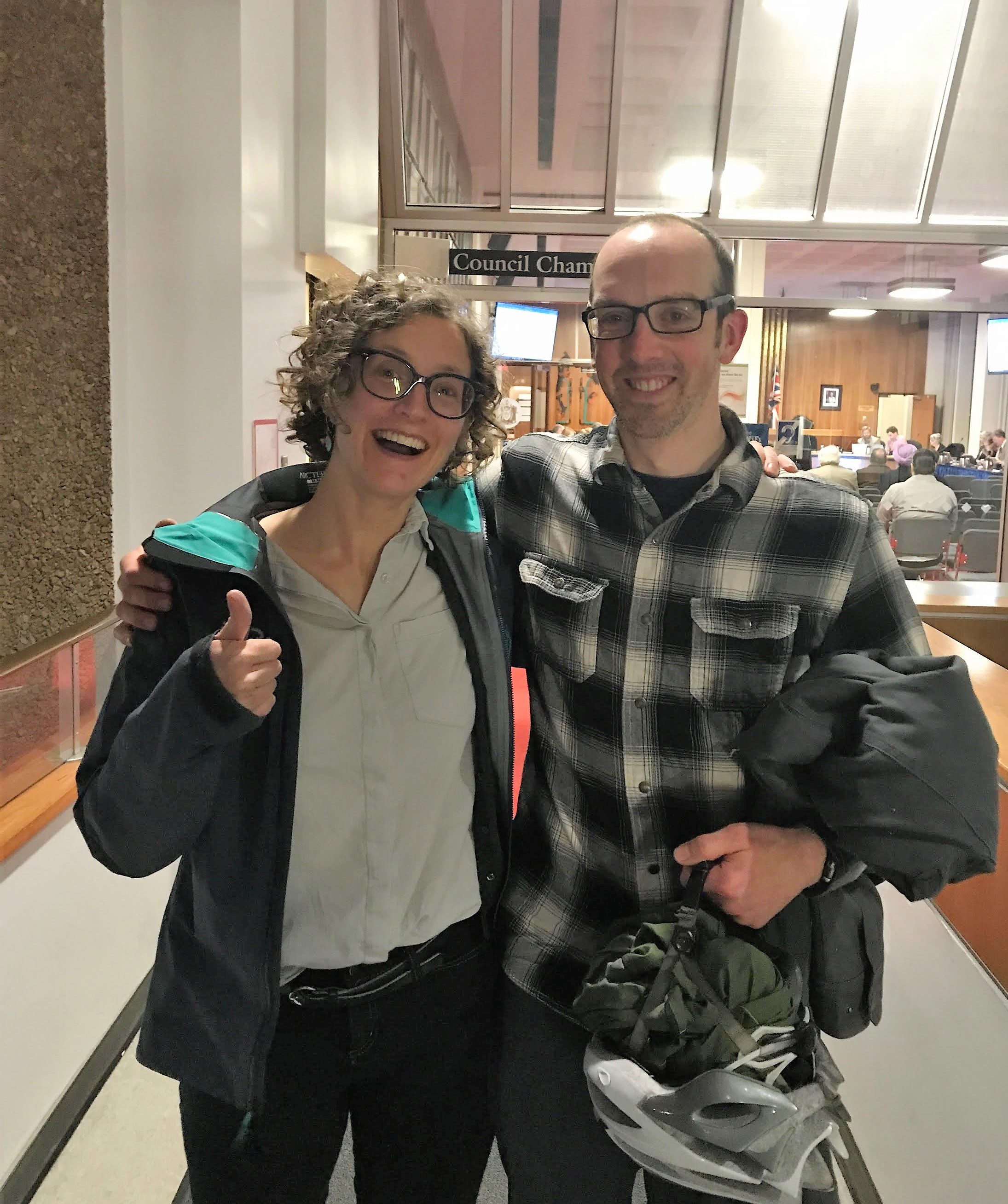
Matt and I outside Council Chambers post-public hearing

In my preparation for our public hearing, I replayed the cautionary voices of others who have done this before: ‘There is always someone who hates your project no matter what you do!‘ Or: ‘Sometimes you’ll go into the public hearing thinking you have community support only to be blindsided by a mutiny!’

My best case mental visualization of the event was that we would have enough positive voices to ring out over the negative ones. I sent invitations to everyone who had expressed support or interest throughout the process. A couple of neighbours said they would come, and a couple of others said they would write a letter. Otherwise, it felt (strangely?) quiet on our block in the days leading up to the hearing.

Here’s how it went down:

We were 3rd on the agenda of rezoning/development permit applications, and somewhere around 10th on the overall agenda, which meant we were called up at 8:45, over 2 hours into the evening’s proceedings. The public area of Council Chambers was full of people early on, and with each item that was ticked off the list, more and more people filtered out. A small group of our neighbours and friends were still among us, along with some people who were waiting for the agenda items after ours.

A member of City staff introduced the project and what was being proposed for Council consideration. I was then called up to the podium with a (strictly enforced!) maximum 15-minute window to present whatever we thought relevant to Council and the public. Using a pre-loaded presentation, I introduced our project goals and talked about our design choices, materials, and rationale. I described how the project fit into the Official Community Plan and the Gonzales Neighbourhood Plan. I summarized the consultation process and how it influenced the design. I concluded by expressing our appreciation for everyone who provided engaged input and ultimately made our project better.

Council then asked a couple of clarifying questions, then opened the floor to anyone who wished to speak for a (strictly enforced!) maximum of 5 minutes. Five neighbours spoke in support and none spoke against.

Every neighbour spoke so eloquently about their personal stories as they related to our project. One spoke about how the character of our community is not just about what the houses look like, but about the individuals who live here and make it their own. Another spoke about having lived on the block since he was 5. Another about how they’d originally lived in the townhouses next to us and then bought a house a few doors down so they could stay on the block as their family grew. This was by far my favourite part of the evening – each neighbour sharing their personal histories and experiences on the block, and their own reasons for supporting our project.

After everyone spoke, the public hearing portion closed. Council then asked a few more questions before offering their opinions on whether and why they supported prior to the final vote. All who spoke were emphatically in favour and the vote to approve our application carried unanimously.

Holy cow!

Never have I witnessed so much smiling and excitement at a public hearing! If you want to see it for yourself, you can watch it here (Nov 9, about 2h:45 in).

We owe thanks to City staff for their work moving this forward. Thank you to the City Councillors for their words of support and encouragement. And most of all, thank you to our neighbours and friends who have listened and made suggestions, shared their opinions and ultimately offered their support. We feel so fortunate to be part of such a strong, supportive, and forward-looking community.

We have some more work to do now to finalize the design prior to submitting for Building Permit. With a little luck, we will begin construction early in 2018. Thanks for reading and stay tuned!
 

Filed Under: Featured, Rezoning Tagged With: community engagement, infill, neighbourhood engagement, passive house, rezoning

You’re Invited!

November 3, 2017 by clove 4 Comments

Dear Readers, Friends, Neighbours,

Well here we are, finally approaching the moment when City Council will vote yes or no to our rezoning application. The rezoning is what will change the use of our property from single family to two-family + suite. If we get through this, all that is left in terms of the City’s process is to apply for the building permit to begin construction. 

First: We want to thank each of you who shared ideas for making our project better, for offering support, and even just for showing interest in what we are doing. Our project is better because of you! We have made many friends through this process and continue to be amazed by this incredible community we call home.

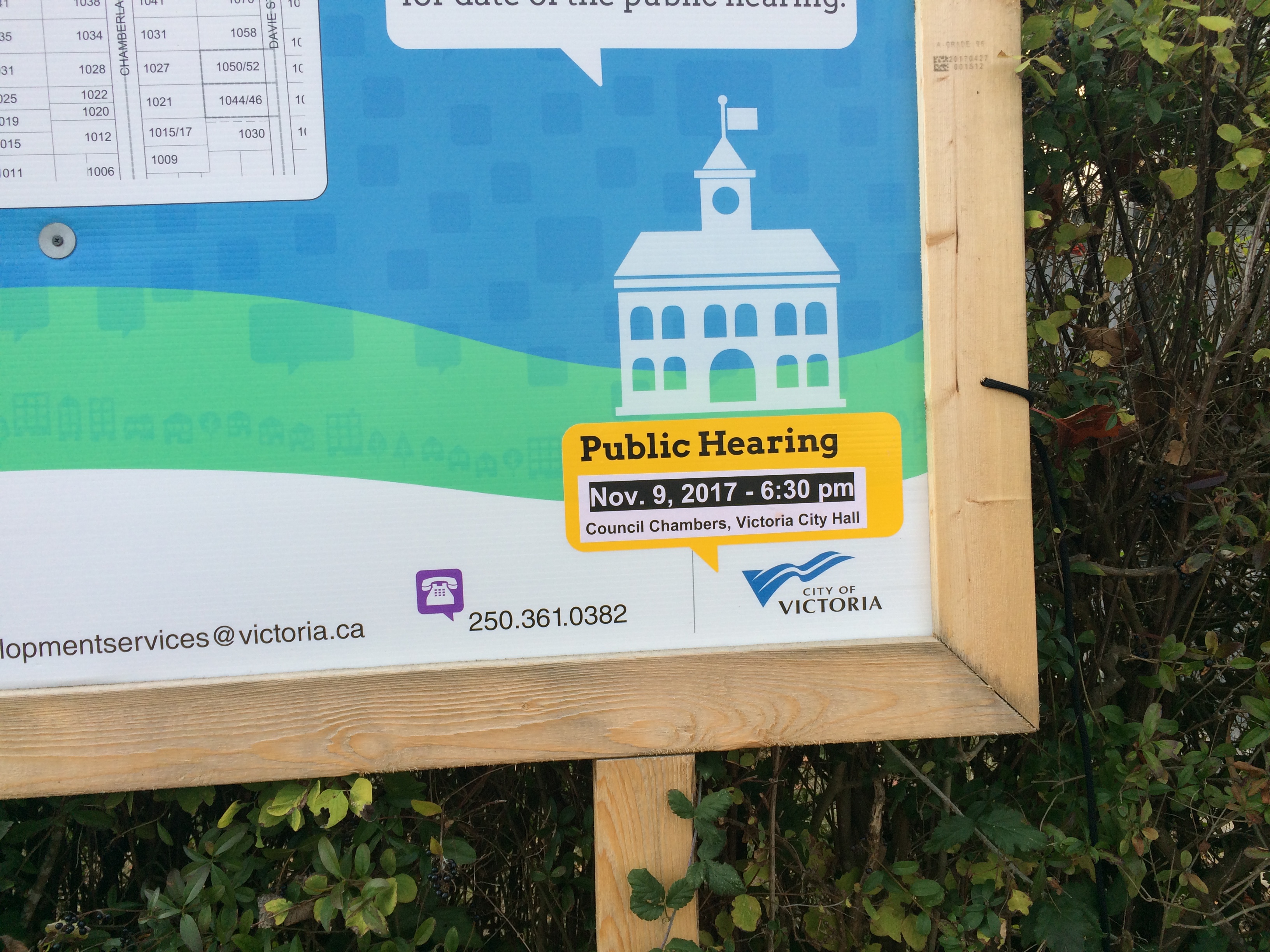
Second: We officially invite you all to join us at our public hearing next Thursday, November 9 at City Hall! The meeting starts at 6:30 and we are third on the agenda. The format is that we present for 10 to 15 minutes and then Council hears comments from any member of the public who wishes to speak.

If you can’t make the hearing, or speaking in public isn’t your thing, feel free to send a letter or email. These do get read and considered. Here are the City’s instructions for doing this:

For those who are unable to attend, your input can be via mail, an email to publichearings@victoria.ca, or you can drop off your written feedback at Victoria City Hall to the City Hall Ambassador located to the left of the main entrance. Correspondence should be received by 11 a.m. the day before the Council meeting.

Please note that all correspondence submitted will form part of the public record and will be published in the meeting agenda. Your address is relevant to Council’s consideration of this matter and will be included as part of the public record. If you choose to share your phone number and email address with us and wish that it not be disclosed, please let us know and we will ensure it remains confidential.

Thank you again and see you out there!


Filed Under: Featured, Rezoning Tagged With: community engagement, infill, neighbourhood engagement, passive house, rezoning, ultra low energy

Community Meeting: Success!

November 20, 2016 by clove Leave a Comment

Our community meeting was a success! (At least it felt that way for a while.)

The intent of this meeting, hosted by the local Community Association Land Use Committee (CALUC), is to gather comments from neighbours that will be submitted as part of your rezoning application. The comments may also lead to design changes. While this is the official opportunity to gather community input, you’d be foolish not have at least introduced the project to your neighbours well in advance. In our case, we are over a year into the conversation.

I had sat in on several meetings for other projects, so I knew the general format. Still, I felt a lot of uncertainty before our meeting because I didn’t know who would be there besides our neighbour who had vocally opposed our small lot subdivision proposal.

The meeting started at 7 PM. There were four projects on the agenda, and we were #2. The room was packed and stuffy. I knew a handful of people.

The first project was a proposed 4-storey condo building to replace two single family homes across from Beacon Hill Park. The presentation went for an hour and a half, with a lot of discussion around scale, height, parking, privacy, views, and south-facing light – very typical discussion points from what I’ve seen.

After much of the room cleared out, we taped up our drawings and presented to about 15 people plus 5 members of the CALUC. At least 8 people were there for our project; many but not all were familiar faces.

We heard the full range of comments, from ‘everything about it is brilliant’ to ‘everything about it is horrible’. No kidding! On the whole, though, the feedback was very positive, and we had a thoughtful conversation about how to do creative infill in our city. I hesitate to represent the comments of others, so I will just say that those who supported the project seemed aligned with what we were aiming for, while the ‘horrible’ comment was too vague to draw any constructive criticism from. Our neighbours who were strongly opposed to the small lot subdivision focused on the details – plantings between our properties, the design of the roof line etc, which I took as an encouraging sign.

To get to this point feels like an accomplishment, even though we still face many more steps before we can break ground.

We originally chose this property because it is in a fabulous location and well suited to a small infill project. Early on, I heard a lot of stories from neighbours who had fought off various developments over the years. I wondered whether we had chosen the wrong neighbourhood. And yet we persisted through comments like ‘You’re ruining the neighbourhood’, ‘I’ll fight this to the death’ and ‘We’ll have to sue you’. We clung to the encouragement of those who liked what we were doing, and in talking to as many people as we could, we discovered that opposition was very localized; a minority talking like a majority. Still, we listened. We changed our design. And here we are, ready to submit our rezoning application.

And I actually believe even more strongly now that this is the perfect neighbourhood for our project. The way it has evolved reflects not only our vision and values, but also those we share with our neighbours. It reflects the eclectic and thoughtful character of and characters in our community.

POSTSCRIPT: I since received an email from a neighbour who attended the meeting that was very negative and attacking on our character. Two steps forward…

A friend told me before we started on this path that someone will always hate your project, no matter what you do. Fair enough, but I could do without the personal attacks. Needing a lift, I went for a long walk and checked out a couple of Passive House project tours that were happening around town (the 5th Street Passive House currently under construction and the North Park Passive House, which has been occupied for over a year). I got a few new ideas and my spirit was buoyed by the conversations I had with people who are committed to improving our environment, enthusiastic about learning, open about making mistakes, and hopeful for the future.

To all of you: Namaste!


Filed Under: Rezoning Tagged With: community engagement, energy efficient design, infill, neighbourhood engagement, rezoning, ultra low energy

CALUC, Here We Come!

October 10, 2016 by clove Leave a Comment

We are presenting our duplex proposal at the Fairfield Gonzales Community Association Land Use Committee (CALUC) on October 20! The Association’s political struggles have sufficiently abated that the Committee has resumed its activities.

Everyone who lives or runs a business within 100m of our property will receive a letter inviting them to the meeting, and anyone can attend. We present our plans; neighbours ask questions and provide comments, and the CALUC records those and submits them to the city. Depending on the comments received, we may make some revisions before submitting our official rezoning application. Then the 6-8 month clock starts ticking as our application wends its way through the various city engineering and planning departments.  If all that goes well, we present at a Public Hearing, at which City council votes yay or nay to approve our application.

Then we apply for our building permit and then we can put shovels to the ground – phew! With a little luck, we’ll get rolling with construction early next summer.

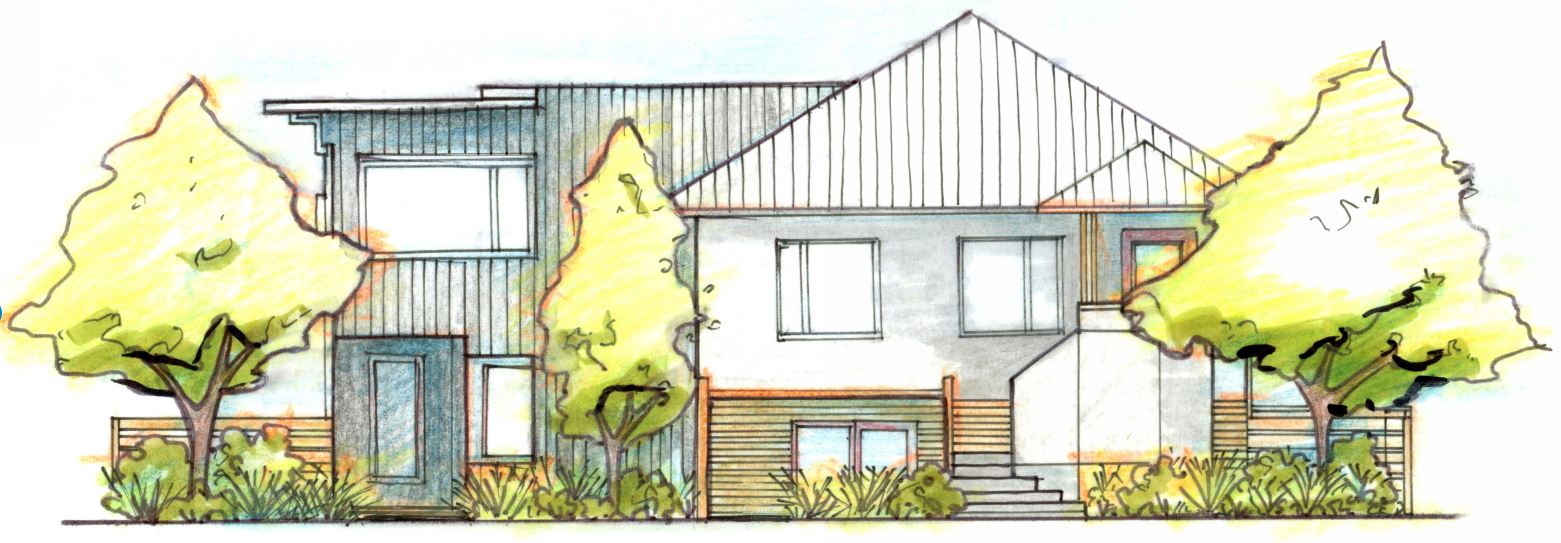
We are still tweaking a few things, but here’s how the design is shaping up.

Front Elevation, sketch Kate Stefiuk

Front Elevation, sketch by Kate Stefiuk

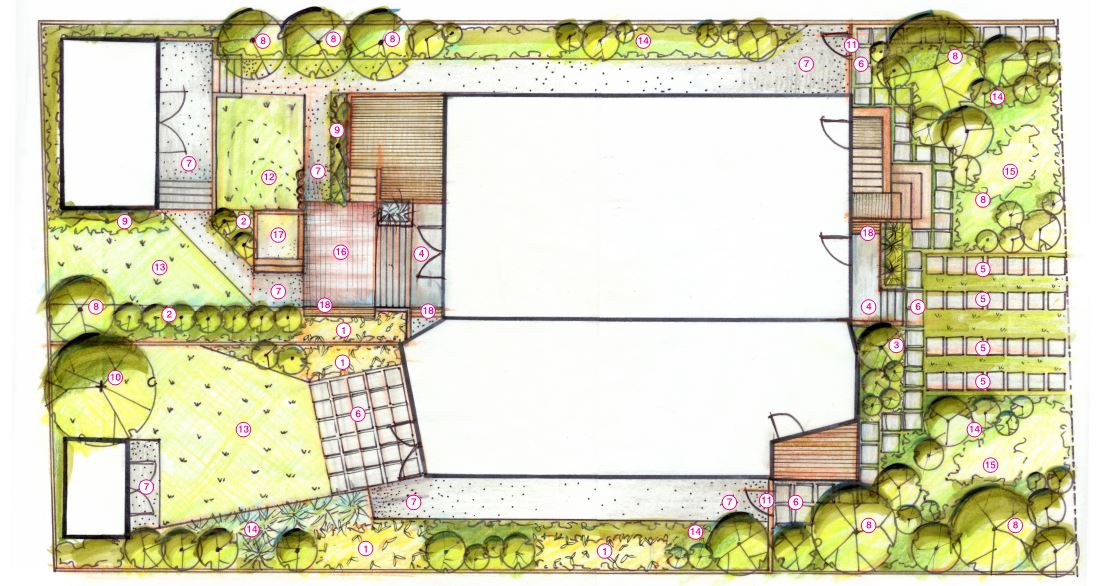
Landscape plan, sketch Kate Stefiuk

Landscape plan, sketch by Kate Stefiuk


Filed Under: Featured, Rezoning Tagged With: community engagement, neighbourhood engagement, rezoning

Remind Me Again Why We’re Doing This?

January 29, 2016 by clove 3 Comments

I’ve been learning through trial and error about how to communicate our project.

In my early conversations with our neighbours, I focused on sharing the basic information. What do we want to do and what does it look like? I knew I had to keep it short and not throw out too much information all at once. So I showed renderings, gave basic facts, and then somewhere in the muddle of it all, I practically whispered something about energy efficiency and my passion for sustainability – as if I was embarrassed to admit that this was the stuff that gets me up in the morning.

Then last week, I took a course in communication and leadership that convinced me I had it backwards. I need to lead with the vision and follow with the cool pictures and facts!

In other words, we must answer the question ‘why?’ at the very beginning of the conversation. If we answer the question later, it gets lost in the details. If we don’t answer it at all, we leave others to guess, and for many, ‘why’ is that we’re just another developer out to maximize profit.

So I tried it for myself, using the project narrative/letter to Council as my testing ground. Here’s the draft of the introduction:


This proposal is to modestly increase density in one of Victoria’s most walkable neighbourhoods, in a manner that exemplifies efficient design and construction practices, and respects the fabric of the existing established neighbourhood. The project is shaped by the following fundamental values (here comes the ‘why’):

  • We believe that we have the skills, materials, and available technologies – right now –  to build new homes that are significantly more energy and water efficient, comfortable, healthy and long-lasting than most of what is being built today.
  • We believe there is tremendous value in our existing homes and that there is much we can do to improve those as well.
  • We believe that environmental outcomes are at least as important as financial ones.
  • We believe that thoughtfully designed infill is critical to supporting a walking and biking culture.
  • We believe that sustainable design is compact design.
  • We believe that anyone can make a positive difference in their communities and this project is how we want to do it.

Starting with our vision – in a written narrative, a presentation, or an in-person conversation – reminds us what motivates us; what excites us; what pushes us out to knock on doors and jump through seemingly endless hoops. The fact that we have this opportunity to manifest so many of our core values in a real, live, bricks and mortar project is frankly incredible! It makes me want to jump up and cheer. So why in the world would we not start by sharing this enthusiasm?

You may not agree with our vision, and that’s OK. But the beautiful thing about sharing it is that it opens the door to conversation. It leads to questions. It may lead to disagreement.  It may lead to new ideas.

And by being clear about what we care about and where we are coming from, we are opening ourselves to the possibility that others are there with us.

What do you think?

(For a different spin on the same theme, check out architect Steve Ramos’ 7 Essential Public Speaking Lessons I Learned the Hard Way.)

Filed Under: Rezoning Tagged With: community engagement, energy efficient design, infill, neighbourhood engagement, rezoning

Talking with Our Neighbours Part 2

December 6, 2015 by clove 5 Comments

On Remembrance Day and I found myself with the gift of a free afternoon – a rare window of time during the day when I wasn’t working or with our daughter.

Despite a low-level trepidation, I folded the plans under my arm, donned my boots, scarf and mittens and thrust myself into the bright chilly November afternoon.

I started at the south end of the 100m radius on our block. A neighbhour several doors down was out raking leaves. I introduced myself, told her we were planning a project and asked if she wanted to hear a bit more. As I got into some of the goals of the project, she became increasingly engaged. She knew about Passive House; recognized that we had a huge lot that was likely to be developed by someone if not us, and said she would like to see our project happen. What a great (and relieving!) first conversation!

I talked with 5 more neighbhours that afternoon, including three who share a property line with us. 5 of the 6 people I talked with were either neutral or supportive. The 6th thought that the new lot and house seemed very narrow, but he also commended our ambitious plan.

So far so good!


I’ve now spent five afternoons door knocking and have had conversations with over 20 different neighbours. Each time, I have started with uncertainty and finished feeling buoyed by the largely positive response.

Here is a summary of the generally positive and constructive comments I have heard so far:

  • Most are either neutral or supportive of the project proposal
  • Many were supportive of adding modest density to the area
  • Most are either neutral or supportive of adding the suite to the existing house, citing the need to increase density and the diversity of housing options in the area
  • Neighbours sharing back yard boundaries want to ensure that their privacy is considered in the house and landscape design
  • One architect neighbour with a long history in the area suggested we move the parking back to the front of the property (see early design post). No other houses on the block with adjoining back yards on Chamberlain and Clare Streets have parking in the rear, which results in a large ‘park’ space that many of the residents value highly. There are even gates connecting many of the backyards.
  • Many expressed interest in and support for the energy efficiency/low energy approach to the design

Filed Under: Rezoning Tagged With: community engagement, neighbourhood engagement, rezoning, small lot subdivision

OK but HOW do we Talk with Our Neighbhours?

November 13, 2015 by clove Leave a Comment

I’ve described our project to neighbours we’ve gotten to know since moving in this summer. I need to broaden the circle to include neighbhours we haven’t yet met. But I’d been reluctant to take the next step and realized that I didn’t quite know how to initiate those conversations. I saw myself become the door-to-door solicitor that everyone avoids. I don’t want to impose myself and I don’t want to presume that everyone is interested or has the time to talk.

Deeper within my psyche lies the fear of launching our creation out into the universe and inviting feedback. It’s entirely possible that this project into which we have poured many hours of research and creative energy, could be hated. We are making ourselves vulnerable, and that is a little scary.

And yet – if we want to realize our project, it has to be done and the sooner the better. It’s even highly possible that we will learn something that will make our project even better. We’re early enough in the process that we can bend with the prevailing wind of community opinion.

Acknowledging the root of my reluctance, I turned off the timid voices in my head and converged on a plan of action. Yes, I will go door to door. But the purpose of my door knocking is simply to introduce the project; to ask if people want to learn more and then to arrange follow-up that meets their needs. This is a plan I can work with.


Filed Under: Rezoning Tagged With: community engagement, neighbourhood engagement, rezoning

The Radius of Neighbhourhood Consultation

October 31, 2015 by clove Leave a Comment

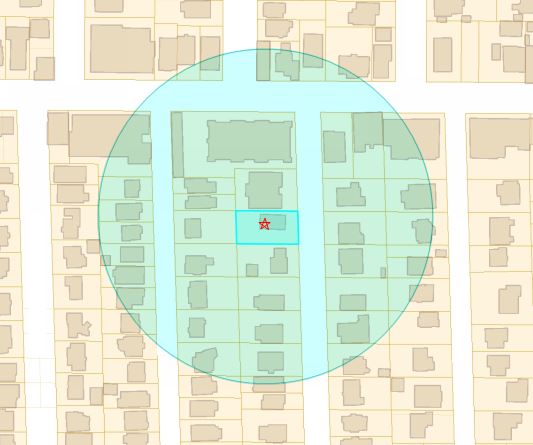
When our design is essentially complete, we will apply to present our project to a meeting of the Gonzales Neighbhourhood Community Association Land Use Committee (CALUC). The city mails notices of the meeting to all residents within a 100m radius of our property.

Here’s what that radius looks like (our house is the starred one in the middle):

notification radius for community mtg

The job of the CALUC is to record the general sentiment and specific comments of both the committee and any neighbhours in attendance. They submit these comments to the city and they are considered during the evaluation of our application.

As part of our application – and ideally before the CALUC meeting, we also have to petition all voting-age owners and renters of all properties sharing a property line or with a property line within 10m of ours. The properties outlined in red within the 100m radius shown in the image are the ones we are required to petition:

 signature radius for petition

The petition asks residents to indicate whether “I support the application” or “I am opposed to the application” and includes a space for comments. We tally up the “yeses” and the neutral non-responders and these have to represent a minimum of 75% of the total petitioned.

So my goal is to knock on as many of these doors as possible while we are still developing the design and can incorporate feedback.

Filed Under: Featured, Rezoning Tagged With: community engagement, neighbourhood engagement, rezoning

Early Meeting with the City Planner

October 9, 2015 by clove 1 Comment

Yesterday I met with the City of Victoria planner responsible for small lot subdivisions in our area. The purpose of this early meeting was to get a sense for any real or perceived barriers to approving our project from the planning department’s perspective. After we go through the community consultation process and submit our official rezoning application, it works its way through various engineering and planning departments and the planning department ultimately makes a recommendation for Council’s consideration.

When it comes to giving guidance around rezoning, planning staff are tasked with communicating what is allowed by already established zoning classes. They are unlikely to express support for a custom zoning proposal. A lot of work has gone into the creation and evolution of existing zoning and to have every developer come along and create something new would defeat the whole purpose of zoning regulations. The purpose of this early meeting was therefore to read between the lines and to get a sense for openness to our proposal.

The first thing the planner said, having given the schematic drawings a quick glance, was “this looks challenging.”

He felt that the biggest challenge was the addition of a suite to a small lot property (which is what the existing house would become after subdivision). It isn’t allowed in the existing small lot zoning, which is already very well established. It even has its own Design Guidelines.

There was plenty of nuance in our in-person conversation, including an acknowledgement of the importance of neighbourhood opinion. The nuance was absent from his follow-up email, which encouraged us to rework the project to meet existing zoning (i.e. no suite).

Although it feels like a rejection, I would be a fool to be surprised by this response. We already know that adding a suite in a small lot house is unprecedented. We also know that we need to creatively add housing in the most walkable neighbhourhoods of our city; to increase affordable housing and options for aging-in-place, and to reduce the impact of our buildings and lifestyles.

I debriefed with our planning guru Ian Scott and he said that he was expecting the planning department to say no, and that there was also a strong possibility that planning would recommend against the project in their report to council. The prospect that our project’s approval could come down to a final face-off between City staff and Council feels risky.  

However, Ian also said that none of the current zoning regulations has been updated to reflect the goals of the Official Community Plan (read post). So what it comes down to is whether we want – or can afford– to stick out our necks.

We would love to set a new precedent and to show what is possible with good design. And yet…are we willing to take the risk – the potential added expense and time to redesign and resubmit after a rejected application- in order to be the first to do something new? 

I was anxious to get going on our detailed design, but I still don’t know what many of our neighbhours think – particularly about the suite question. Our next logical step, then, is to talk with our neighbours about more of the specifics – show the renderings and gather their opinions about adding the suite, and then see how everything sits.

I think that if we can get a consensus that the project is very likely to get approved by both our neighbhours and city planning if we exclude the suite, then we would move toward that option.

Filed Under: Rezoning Tagged With: neighbourhood engagement, rezoning, small lot subdivision

Talking with our Neighbours – Part 1

September 14, 2015 by clove Leave a Comment

Yesterday I sat in the kitchen of our neighbhours immediately south of us and introduced our project over homemade ginger cookies. Mary and John* have lived in their house since the 1950s and are in many ways the heart of the neighbourhood. They know all the stories. They know everyone who lives on the block and everyone who used to live on the block. They know about the developments that have come and the ones that have been pushed away. They built onto their own tiny bungalow as their family grew to five kids. Mary showed me two photos in their front hall: one of the original 1940s bungalow and another with the first addition that John built himself in the evenings after work.

Given their status and history with the neighbhourhood, as well as the fact that they would be right next to our proposed new house, I felt they needed to be one of the very first I approached about our plans.

Mary’s first reaction was to say, “Oh, you’ll have a fight on your hands!” Something about ‘those small lot projects’ sounded like a sticking point for many in the neighbhourhood. She told a few stories of how the neighbhours had mobilized against past developments. She mentioned one fellow a block over who originally wanted to subdivide. All the neighbhours came out in protest, and in the end he built a duplex in the style of a heritage house, which Mary thought was beautiful. Many houses in the neighbourhood have been added to, or have been divided into suites over the years.

I asked Mary if she could describe the basis for resistance to past projects. “It’s change,” she said.

After feeling buoyed by my recent meeting with Ian Scott, I now feel deflated again. I realize I could do a better job of describing the project’s benefits, yet I don’t want to throw a big list out there the first time we talk. Neither do I want to have a fight on my hands. I want to have constructive conversations with our neighbours; to understand the issues and address them as best we can. This is our home too, after all, and we envision ourselves being here for the long-term.

And frankly, our property is ripe for development. It is the third property in from Oak Bay Avenue. It is the first house after the large mixed use building on the corner and the 6-unit townhouse next door. The house itself would have little value to a pure investor developer. Something will happen with this lot. A pure developer would surely tear down the existing house and fill the lot with as much square footage as possible. If we can accept that something will happen to our property, what is the best possible outcome? We think it’s a modest increase in density that maintains the neighbourhood’s single family character. We think it’s breathing new life into a solid 100+ year old home so it goes strong for another 100+ years. As a bonus, it will use a fraction of the energy it uses now.

We also think it’s creating a showcase – one new and one existing – of healthy, comfortable, ultra-low energy, high quality homes that go well beyond what is required by code. We want to show what is possible if we push ourselves a little to consider benefits beyond financial return and quality indicators beyond countertop material.

We think it’s even things like putting some thought and effort into the landscaping design so that people enjoy walking by and stopping for a chat.

So that’s me on my soapbox for today. I must maintain my enthusiasm, and, as always…be patient.

*Names changed to respect privacy.


Filed Under: Rezoning Tagged With: neighbourhood engagement, rezoning

Who is Stretch Developer?

Stretch Developer is written by Christy Love. In partnership with my husband Matt, we are challenging ourselves to create the kind of homes we want to live in and see more of in our community. Home is the incredible Victoria, BC, Canada.

Sign up!

Sign up to receive email notifications of new posts.

Recent Posts

  • New Uses for Old Wood Part 2 September 26, 2021
  • Ongoing Preparations for the Apocalypse August 13, 2021
  • Things We’ve Noticed – Energy Edition May 29, 2021
  • Passive House Suite for Rent April 17, 2021
  • Things We’ve Noticed – Comfort Edition March 14, 2021

Blogs We Like

Green Building Advisor Blogs

Musings of an Energy Nerd

Treehugger

Talk to ARYZE

Recent Posts

  • New Uses for Old Wood Part 2
  • Ongoing Preparations for the Apocalypse
  • Things We’ve Noticed – Energy Edition
  • Passive House Suite for Rent
  • Things We’ve Noticed – Comfort Edition
  • New Uses for Old Wood Part 1

Tags

budget building permit cabinet construction climate action climate change community engagement construction deep energy retrofit design design progress development permit duplex duplex + suite energy consumption energy efficient design financing financing passive house finding land food security home inspections infill low energy design neighbourhood engagement net zero passive house Passive House comfort Passive House construction Passive House construction costs passive house for sale Passive House performance Passive House performance; Sanden CO2 heat pump Passive House rental Passive House systems passive house testing performance pro forma property search tips reclaimed wood reclaimed wood construction rezoning roof row house small lot development small lot subdivision ultra low energy

Copyright © 2026 · Metro Pro Theme on Genesis Framework · WordPress · Log in


Loading Comments...