Stretch Developer

Taking urban development into our own hands

  • Home
  • About
  • The Project
    • Finding a Property
    • Design
    • Approvals
    • Financing
    • Construction
    • Performance
  • Blog
  • Contact
  • Rental Suite

OK but HOW do we Talk with Our Neighbhours?

November 13, 2015 by clove Leave a Comment

I’ve described our project to neighbours we’ve gotten to know since moving in this summer. I need to broaden the circle to include neighbhours we haven’t yet met. But I’d been reluctant to take the next step and realized that I didn’t quite know how to initiate those conversations. I saw myself become the door-to-door solicitor that everyone avoids. I don’t want to impose myself and I don’t want to presume that everyone is interested or has the time to talk.

Deeper within my psyche lies the fear of launching our creation out into the universe and inviting feedback. It’s entirely possible that this project into which we have poured many hours of research and creative energy, could be hated. We are making ourselves vulnerable, and that is a little scary.

And yet – if we want to realize our project, it has to be done and the sooner the better. It’s even highly possible that we will learn something that will make our project even better. We’re early enough in the process that we can bend with the prevailing wind of community opinion.

Acknowledging the root of my reluctance, I turned off the timid voices in my head and converged on a plan of action. Yes, I will go door to door. But the purpose of my door knocking is simply to introduce the project; to ask if people want to learn more and then to arrange follow-up that meets their needs. This is a plan I can work with.
 

Filed Under: Rezoning Tagged With: community engagement, neighbourhood engagement, rezoning

The Radius of Neighbhourhood Consultation

October 31, 2015 by clove Leave a Comment

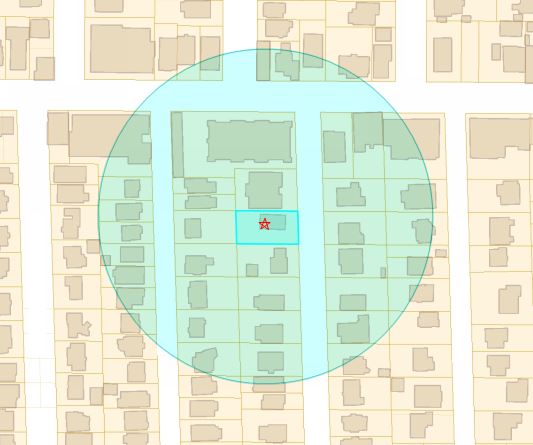
When our design is essentially complete, we will apply to present our project to a meeting of the Gonzales Neighbhourhood Community Association Land Use Committee (CALUC). The city mails notices of the meeting to all residents within a 100m radius of our property.

Here’s what that radius looks like (our house is the starred one in the middle):

notification radius for community mtg

The job of the CALUC is to record the general sentiment and specific comments of both the committee and any neighbhours in attendance. They submit these comments to the city and they are considered during the evaluation of our application.

As part of our application – and ideally before the CALUC meeting, we also have to petition all voting-age owners and renters of all properties sharing a property line or with a property line within 10m of ours. The properties outlined in red within the 100m radius shown in the image are the ones we are required to petition:

 signature radius for petition

The petition asks residents to indicate whether “I support the application” or “I am opposed to the application” and includes a space for comments. We tally up the “yeses” and the neutral non-responders and these have to represent a minimum of 75% of the total petitioned.

So my goal is to knock on as many of these doors as possible while we are still developing the design and can incorporate feedback.

Filed Under: Featured, Rezoning Tagged With: community engagement, neighbourhood engagement, rezoning

Official Community Plan Primer

September 30, 2015 by clove Leave a Comment

A narrative of how our proposed development aligns with the goals of the City’s Official Community Plan (OCP) and our local area plan will be a key piece of our rezoning application. So let’s see how our proposed project stacks up under the lens of the City of Victoria’s OCP and the Gonzales Neighbhourhood Community Plan, both of which will dictate the limits of our project.

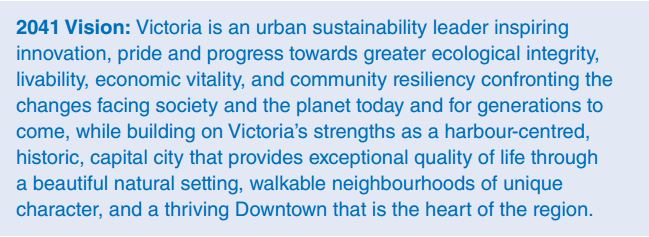
Here is the City’s vision for itself in 2041:

2_OCP_Vision

Pretty general stuff, but so far so good. We believe our project will inspire innovation toward community resiliency and will build on our city’s exceptional quality of life through its walkable neighbhourhoods of unique character.

Let’s dig a little deeper into the subject area goals that are most relevant to our development.

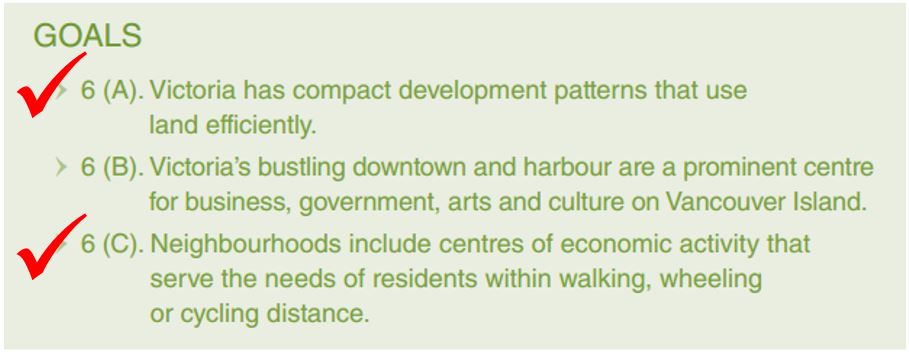
Goals for Land Development and Management:

3_Land Dev Goals

We’re adding a modest amount of new housing to an over-sized single family lot that is spitting distance from shops, bus lines, schools, parks, and bike routes. We’re not building that economic activity, but we are adding residents that will support this model of development.

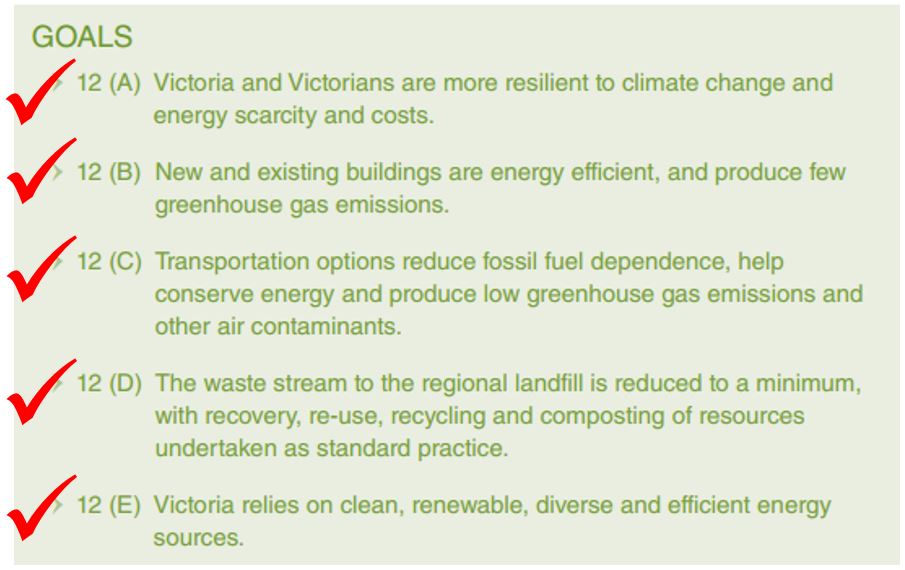
Goals for Climate Change and Energy:

4_Climate goals

We’re rebuilding an existing home rather than tearing it down. This existing home and the new home we add next to it will be designed to consume very little energy, and will rely solely on solar PV and non-fossil fuel based electricity. We will also consider material choices, favouring local, durable, and low embodied energy materials wherever possible.

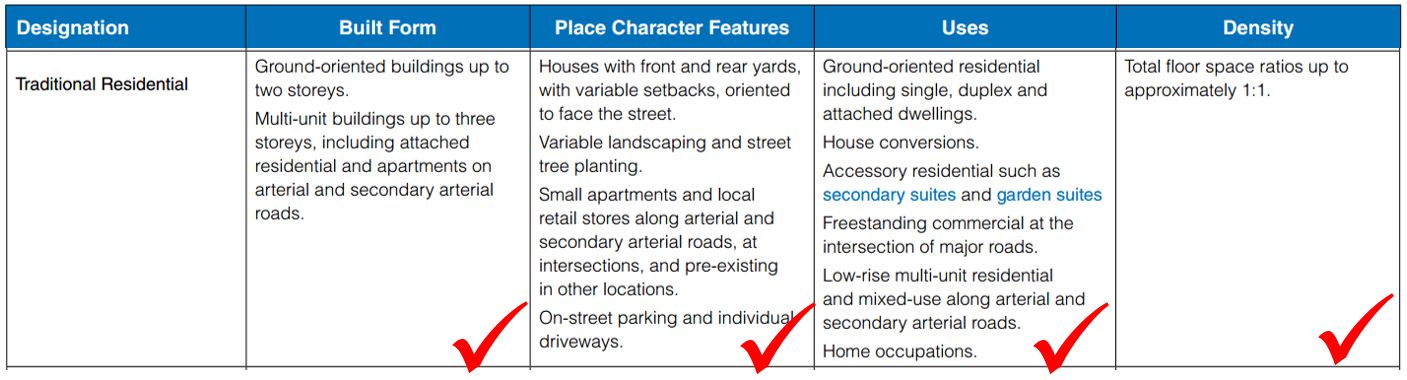
So looks like we are aligned on the broad goals of the OCP. We need to dig deeper to see what it says more specifically about the Traditional Residential area that characterizes our location.

Here’s the General Development Guidance for Urban and Traditional Residential areas:

5_Trad Res

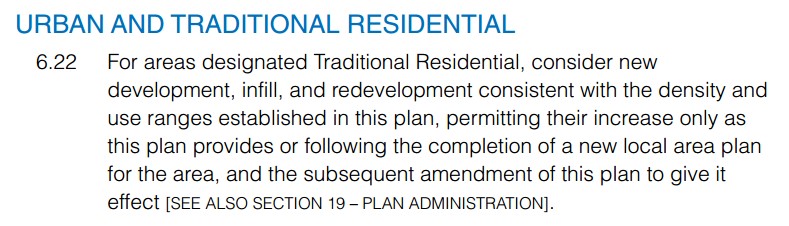
So now we have to look at the Urban Place Guidelines for Traditional Residential:

6_trad res

We’re proposing ground oriented buildings 2-storeys or less, with front and rear yards, thoughtful landscaping, off street parking, one single family home + one single family home with secondary suite, and floor space ratios of 0.5 and 0.6. So, check, check and check.

Things are looking good on the OCP front. What about in relation to the Gonzales Neighbhourhood Community Plan? This document is older than the OCP, published in 2002, so some elements may be outdated, but we still want to see if we are aligned with the plan’s overarching philosophy.

This Plan has three specific guidelines that most directly relate to our proposal:

  • 3.2.3 Retain and maintain the existing viable single family and detached housing stock.
  • 3.2.4 Retain existing, and where appropriate, encourage the provision of additional, affordable housing, e.g. “secondary suites” in houses.
  • 3.2.5 Maintain and enhance a diversity of housing in Gonzales to meet the needs of a variety of people with different needs and incomes.

Subsequent to the writing of this plan, the R1-G2 Gonzales Small Lot District zone was created, which supports in concept what we are proposing. See this post for a rundown of where we diverge. If we were not adding a suite, we could meet the R1-G2 zoning with variances – the addition of a suite to a small lot house kicks it into a custom zone based on R1-G2.

Filed Under: Rezoning Tagged With: community engagement, official community plan, rezoning

  • « Previous Page
  • 1
  • 2

Who is Stretch Developer?

Stretch Developer is written by Christy Love. In partnership with my husband Matt, we are challenging ourselves to create the kind of homes we want to live in and see more of in our community. Home is the incredible Victoria, BC, Canada.

Sign up!

Sign up to receive email notifications of new posts.

Recent Posts

  • New Uses for Old Wood Part 2 September 26, 2021
  • Ongoing Preparations for the Apocalypse August 13, 2021
  • Things We’ve Noticed – Energy Edition May 29, 2021
  • Passive House Suite for Rent April 17, 2021
  • Things We’ve Noticed – Comfort Edition March 14, 2021

Blogs We Like

Green Building Advisor Blogs

Musings of an Energy Nerd

Treehugger

Talk to ARYZE

Recent Posts

  • New Uses for Old Wood Part 2
  • Ongoing Preparations for the Apocalypse
  • Things We’ve Noticed – Energy Edition
  • Passive House Suite for Rent
  • Things We’ve Noticed – Comfort Edition
  • New Uses for Old Wood Part 1

Tags

budget building permit cabinet construction climate action climate change community engagement construction deep energy retrofit design design progress development permit duplex duplex + suite energy consumption energy efficient design financing financing passive house finding land food security home inspections infill low energy design neighbourhood engagement net zero passive house Passive House comfort Passive House construction Passive House construction costs passive house for sale Passive House performance Passive House performance; Sanden CO2 heat pump Passive House rental Passive House systems passive house testing performance pro forma property search tips reclaimed wood reclaimed wood construction rezoning roof row house small lot development small lot subdivision ultra low energy

Copyright © 2026 · Metro Pro Theme on Genesis Framework · WordPress · Log in


Loading Comments...