Stretch Developer

Taking urban development into our own hands

  • Home
  • About
  • The Project
    • Finding a Property
    • Design
    • Approvals
    • Financing
    • Construction
    • Performance
  • Blog
  • Contact
  • Rental Suite

Community Meeting: Success!

November 20, 2016 by clove Leave a Comment

Our community meeting was a success! (At least it felt that way for a while.)

The intent of this meeting, hosted by the local Community Association Land Use Committee (CALUC), is to gather comments from neighbours that will be submitted as part of your rezoning application. The comments may also lead to design changes. While this is the official opportunity to gather community input, you’d be foolish not have at least introduced the project to your neighbours well in advance. In our case, we are over a year into the conversation.

I had sat in on several meetings for other projects, so I knew the general format. Still, I felt a lot of uncertainty before our meeting because I didn’t know who would be there besides our neighbour who had vocally opposed our small lot subdivision proposal.

The meeting started at 7 PM. There were four projects on the agenda, and we were #2. The room was packed and stuffy. I knew a handful of people.

The first project was a proposed 4-storey condo building to replace two single family homes across from Beacon Hill Park. The presentation went for an hour and a half, with a lot of discussion around scale, height, parking, privacy, views, and south-facing light – very typical discussion points from what I’ve seen.

After much of the room cleared out, we taped up our drawings and presented to about 15 people plus 5 members of the CALUC. At least 8 people were there for our project; many but not all were familiar faces.

We heard the full range of comments, from ‘everything about it is brilliant’ to ‘everything about it is horrible’. No kidding! On the whole, though, the feedback was very positive, and we had a thoughtful conversation about how to do creative infill in our city. I hesitate to represent the comments of others, so I will just say that those who supported the project seemed aligned with what we were aiming for, while the ‘horrible’ comment was too vague to draw any constructive criticism from. Our neighbours who were strongly opposed to the small lot subdivision focused on the details – plantings between our properties, the design of the roof line etc, which I took as an encouraging sign.

To get to this point feels like an accomplishment, even though we still face many more steps before we can break ground.

We originally chose this property because it is in a fabulous location and well suited to a small infill project. Early on, I heard a lot of stories from neighbours who had fought off various developments over the years. I wondered whether we had chosen the wrong neighbourhood. And yet we persisted through comments like ‘You’re ruining the neighbourhood’, ‘I’ll fight this to the death’ and ‘We’ll have to sue you’. We clung to the encouragement of those who liked what we were doing, and in talking to as many people as we could, we discovered that opposition was very localized; a minority talking like a majority. Still, we listened. We changed our design. And here we are, ready to submit our rezoning application.

And I actually believe even more strongly now that this is the perfect neighbourhood for our project. The way it has evolved reflects not only our vision and values, but also those we share with our neighbours. It reflects the eclectic and thoughtful character of and characters in our community.

POSTSCRIPT: I since received an email from a neighbour who attended the meeting that was very negative and attacking on our character. Two steps forward…

A friend told me before we started on this path that someone will always hate your project, no matter what you do. Fair enough, but I could do without the personal attacks. Needing a lift, I went for a long walk and checked out a couple of Passive House project tours that were happening around town (the 5th Street Passive House currently under construction and the North Park Passive House, which has been occupied for over a year). I got a few new ideas and my spirit was buoyed by the conversations I had with people who are committed to improving our environment, enthusiastic about learning, open about making mistakes, and hopeful for the future.

To all of you: Namaste!
 

Filed Under: Rezoning Tagged With: community engagement, energy efficient design, infill, neighbourhood engagement, rezoning, ultra low energy

Financing 103

July 1, 2016 by clove Leave a Comment

When comparing our small lot vs. attached duplex development options, I’d heard that financing would likely be more straightforward for a small lot subdivision because we’d have a legal bare lot as security for the lender. With the attached option, we wouldn’t have much until the building is finished.

I’d found a private lender who was not scared off by a duplex/existing building reno; with more flexibility than a bank or credit union, but at a higher interest rate (8-10%). For our project, they would loan one (big) amount to cover our current mortgage and the construction financing. We’d only pay interest on the amount spent, but from day one we’d be paying 8-10% on our current mortgage. With a 10 month construction period, that translates to about $38,000 in interest just for our existing mortgage, and we’d be paying interest in the realm of $50,000 for the whole build. Ouch.

I talked with some other people who have more experience with this stuff, and they suggested we talk with the local credit unions. They will be more conservative than a private lender and more flexible than a big bank, but with interest rates more in line with big bank rates. So I called up a couple of local ones.

The first thing that caught my attention were their rates. Prime + 2% for the construction financing. So, more like 4.7%, which is a heck of a lot better than 8-10%.

Generally speaking, this is how a credit union would structure the lending:

  1. We would terminate our existing mortgage (paying the penalty that is stipulated in our terms – in our case, 3 months’ interest).
  2. We would take out a standard residential mortgage for the existing house, at standard mortgage rates (say 2.8%), which will always be kept separate from the construction loan.
  3. We would take out a construction loan for the new build/major reno. They will charge a 1% construction financing fee and will lend 75-80% of the project’s appraised final value. The 20-25% we need to put in can be a combination of cash and equity.
  4. Similar to the private lend, we would only pay interest on the money actually spent. The money is drawn corresponding with project construction milestones (as verified by an appraiser) – also the same as the private lender.
  5. We would have to self-finance to a point. That point is AT LEAST after approval of rezoning, but depending on which option we pursue, and who the lender is, may vary beyond that. For the small lot subdivision, it’s likely we’d have to self-finance past rezoning approval and to the approval of the subdivision, which may or may not include completion of the subdivision. This is a pretty big grey area, since the cost to fully service the lot (required to complete the subdivision) was quoted to me by the city as being in the realm of $25,000 – $30,000.

One of the credit union mortgage specialists I talked with got really nervous when I told her we were raising the existing house. She said that in this situation, they might be limited to lending based on land value alone. The other credit union rep I talked with, on the other hand, said they were comfortable with house-raising (and in fact, she enjoyed seeing the pictures of the lift in progress).

In conclusion: The local credit unions offer better rates and a more attractive solution for either of our proposed options. The difference in costs between private lender rates and credit union rates could be as much as $30,000, which is a significant amount of money for a small project like ours. And it’s money that would disappear with no equity coming out the other end. We will be much better off going through a credit union provided we can meet their requirements. Also, the credit unions seemed comfortable with either option: small lot subdivision or attached duplex.

I would recommend calling several lenders as you’re planning your own project – private lenders, big bank, and credit unions. Even among the credit unions, their comfort level with our particular project varied.

And on that note, Happy Canada Day!

Filed Under: Financing Tagged With: budget, duplex, financing, infill, small lot subdivision

On Courage and Cool Projects

April 8, 2016 by clove Leave a Comment

We are (still!) in the midst of neighbourhood consultation, and I will provide an update on that process very soon. Suffice to say that I occasionally wake in the middle of the night feeling anxious and in need of a fresh burst of inspiration. So for this post, I am sharing some big ideas from beyond our small project.

Last month I attended the Passive House Northwest Conference (PHNW)  in Portland Oregon to present the research RDH is doing at the North Park Passive House here in Victoria. I left the conference full of admiration for the people making incredible projects happen on our continent. And it really is about the people. These projects do not just materialize on their own accord. The people who are making them happen display incredible depths of courage and tenacity. Here I introduce you to two of these people and their projects.

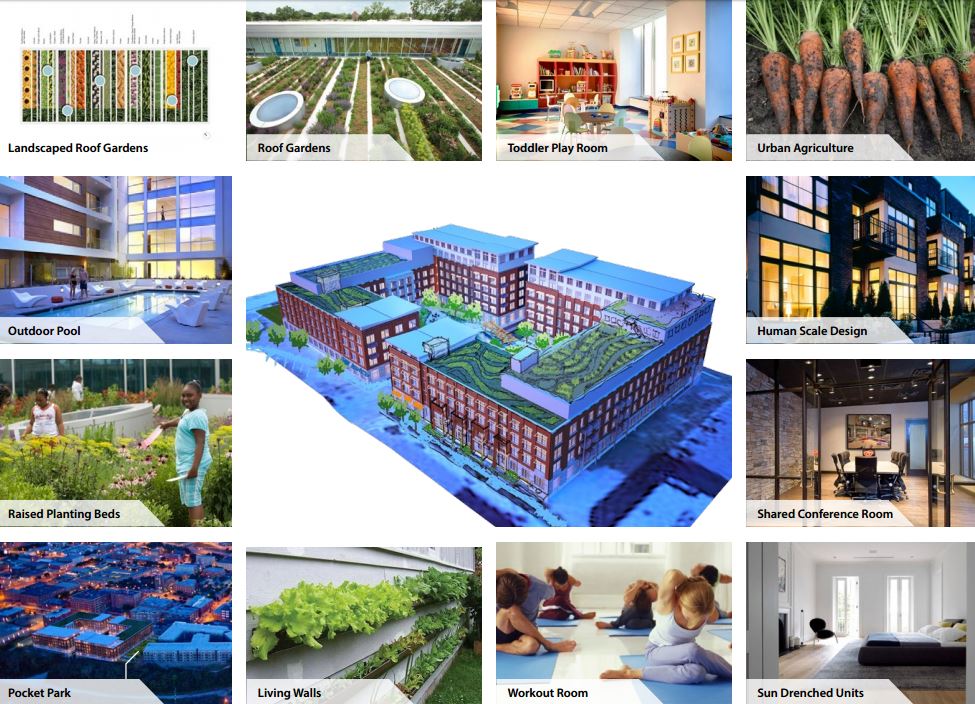
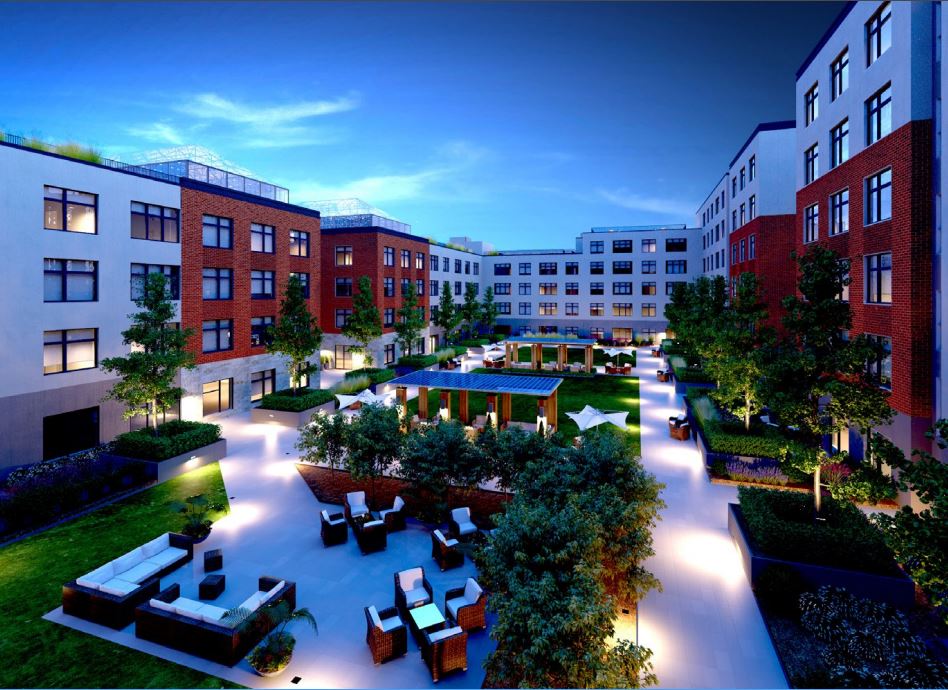
Second and Delaware

Arnold Development Group’s Second and Delaware project; rendering from Arnold’s PHNW presentation

  • Jonathan Arnold, President and CEO of Arnold Development Group, for his triple bottom line development model (one look at his Advisory Board will tell you this is a company committed to doing things differently) and his latest project at Second and Delaware in Kansas City. This project I love because it addresses everything that matters today in terms of development: energy, housing, food and transportation. It is a higher density rental project in the heart of the city that uses a traditional courtyard design. It is walkable and transit oriented. It is designed to meet the Passive House standard. It includes a diversity of housing types, including 20% ‘workforce’ housing. It includes space for urban farming. It is a place where people will want to live, can afford to live, and can do so with a light environmental footprint.

You can download his presentation from the conference here.

Second and Delaware 2

Second and Delaware features; from Arnold’s PHNW presentation

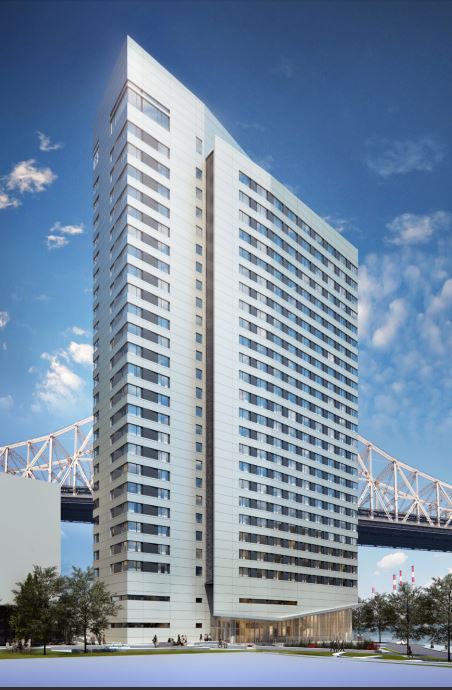
  • Lois B. Arena, Senior Engineer and Passive House Consultant at Steven Winter Associates , for driving the design of the world’s largest Passive House building – the Cornell Tech NYC Campus Residential Building, now under construction.
Cornell U

Cornell Tech NYC Residential Building, rendering from Arena’s PHNW presentation

Imagine that the fasteners that Lois needs to attach curtain wall with no thermal bridging did not exist before her project. She is drawing completely new details and training contractors. She is having to change existing building code to design the mechanical ventilation system. She is the one telling the contractors that they are simply going to have to do things differently – and she’s undoubtedly repeating this message over and over again. She joked about going grey within a couple of months of the start of construction, but what an accomplishment it will be after it’s complete.

Lois’ presentation (which will particularly appeal to the techies in the crowd) can be downloaded here.

When I see the sprawl in the outer edges of our city and the construction practices that focus on short term profit, I lose heart that things will change and change fast enough to have a real impact on climate change. Then I see projects like these. Big projects in big cities. People who are showing that it can be done and that designing for the environment goes hand in hand with fiscal common sense.

Returning to the really big picture, I want to close with an invitation to view Zack Semke’s fantastic keynote presentation at PHNW, which ended with a standing ovation. Zack opened with the worst case scenario: If we burn all remaining fossil fuels, Antarctica will melt and sea levels will rise by 200 ft. He asked: Are we all f****d no matter what we do?

I highly encourage you to flip through his slides – at turns shocking, hilarious, and inspiring as the key messages will shine through without having heard the talk.  Below is an excerpt – a graph of the relative prices of gas, coal, oil, LNG, and solar. The plummeting grey line is solar, and may represent what is called a “Black Swan” event – an event that changes everything and seems to have come out of nowhere. The internet is a black swan event. The plummeting price of solar PV? Could be a black swan event.

Price of PV Black Swan

Price of Solar PV vs gas, coal, oil, LNG.

Zack’s call to action is to resist climate denialism (there is no problem and/or we’re not part of the problem), overcome climate defeatism (we’re all f*****d anyway), and continue to take small local steps toward potentially huge collective change. Three cheers for courage and cool projects.

Filed Under: Featured Tagged With: climate change, community engagement, energy consumption, energy efficient design, infill

Landscape Concept Design

February 12, 2016 by clove 1 Comment

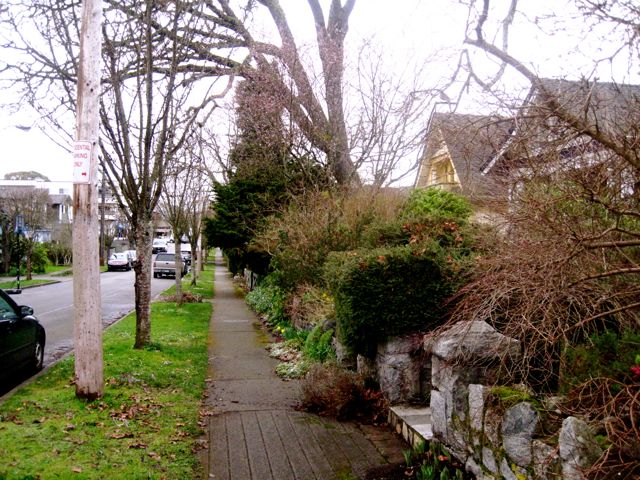
street landscape

A walk down our block

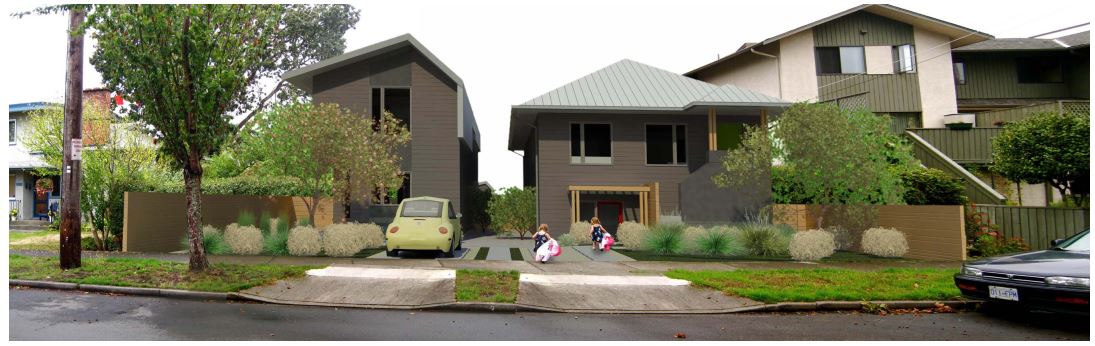
The landscape is a defining quality of our eclectic neighbourhood, and one of the goals of our design is to add something good to that landscape.

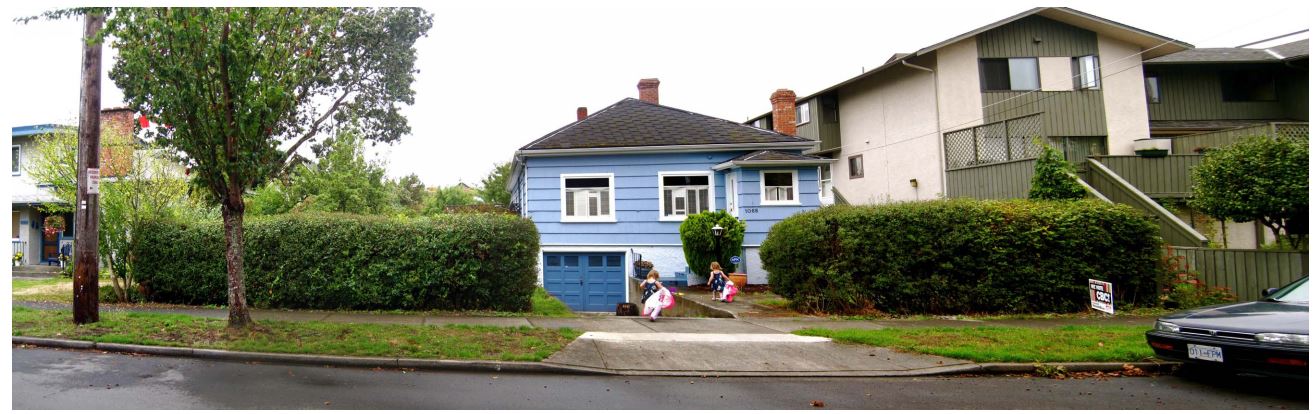
Streetscape Before Rendering

Streetscape Before

Streetscape After Rendering

Streetscape After, rendering by Mark Ashby Architecture

Here are a few key ingredients of the landscape concept:

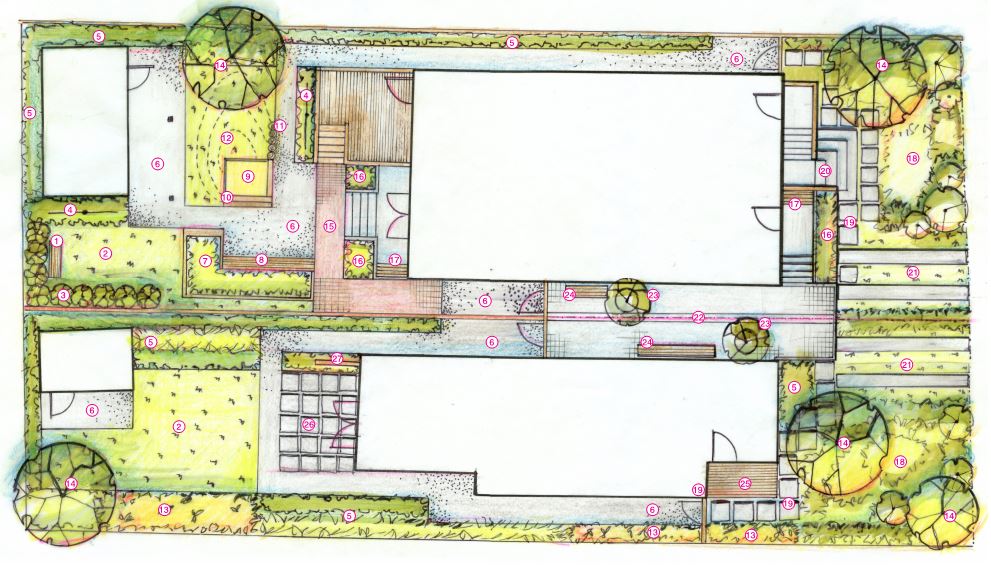
  • We want to feel a stronger connection to the outdoors and to extend our living space into the back yard. Mark A has redesigned the back of our existing house to strengthen that connection from the kitchen.
  • We want to grow food while playing outside. Kate S has packed a ton of beauty and functionality into a compact back yard space. Think veggie beds, espalier fruit trees, herb boxes, cedar benches, even a sand box for playing.

Landscape Concept Plan by Kate Stefiuk

Landscape Legend

Landscape Concept Plan by Kate Stefiuk

  • Deciduous trees can be natural allies for an ultra-low energy house. If placed well, they can shade windows from direct sun in the summer when you’re at risk of overheating, and then allow that direct sun in the winter when it helps warm the house. The tree in front of the new (south) house shown in the plan is an example, where it will shade the rising sun from the east facing windows in the summer.
  • We intend to manage storm water on-site. The City has an excellent guide in its DIY Rainwater Management Standards for incorporating storm water retention, management, and/or re-use strategies into the landscape design (with accompanying grants through its Rainwater Rewards program). We’re still working on which strategies will work on our site, and debating low tech solutions like rain gardens vs. higher tech solutions like using rainwater to flush toilets. I’m a big fan of simplicity and less a fan of systems that will require pumps and filters and continual maintenance. If anyone knows of a stylish but simple composting toilet, I’m all ears!

Filed Under: Design, Featured Tagged With: infill, landscape design, rain garden, small lot subdivision, storm water management

Remind Me Again Why We’re Doing This?

January 29, 2016 by clove 3 Comments

I’ve been learning through trial and error about how to communicate our project.

In my early conversations with our neighbours, I focused on sharing the basic information. What do we want to do and what does it look like? I knew I had to keep it short and not throw out too much information all at once. So I showed renderings, gave basic facts, and then somewhere in the muddle of it all, I practically whispered something about energy efficiency and my passion for sustainability – as if I was embarrassed to admit that this was the stuff that gets me up in the morning.

Then last week, I took a course in communication and leadership that convinced me I had it backwards. I need to lead with the vision and follow with the cool pictures and facts!

In other words, we must answer the question ‘why?’ at the very beginning of the conversation. If we answer the question later, it gets lost in the details. If we don’t answer it at all, we leave others to guess, and for many, ‘why’ is that we’re just another developer out to maximize profit.

So I tried it for myself, using the project narrative/letter to Council as my testing ground. Here’s the draft of the introduction:


This proposal is to modestly increase density in one of Victoria’s most walkable neighbourhoods, in a manner that exemplifies efficient design and construction practices, and respects the fabric of the existing established neighbourhood. The project is shaped by the following fundamental values (here comes the ‘why’):

  • We believe that we have the skills, materials, and available technologies – right now –  to build new homes that are significantly more energy and water efficient, comfortable, healthy and long-lasting than most of what is being built today.
  • We believe there is tremendous value in our existing homes and that there is much we can do to improve those as well.
  • We believe that environmental outcomes are at least as important as financial ones.
  • We believe that thoughtfully designed infill is critical to supporting a walking and biking culture.
  • We believe that sustainable design is compact design.
  • We believe that anyone can make a positive difference in their communities and this project is how we want to do it.

Starting with our vision – in a written narrative, a presentation, or an in-person conversation – reminds us what motivates us; what excites us; what pushes us out to knock on doors and jump through seemingly endless hoops. The fact that we have this opportunity to manifest so many of our core values in a real, live, bricks and mortar project is frankly incredible! It makes me want to jump up and cheer. So why in the world would we not start by sharing this enthusiasm?

You may not agree with our vision, and that’s OK. But the beautiful thing about sharing it is that it opens the door to conversation. It leads to questions. It may lead to disagreement.  It may lead to new ideas.

And by being clear about what we care about and where we are coming from, we are opening ourselves to the possibility that others are there with us.

What do you think?

(For a different spin on the same theme, check out architect Steve Ramos’ 7 Essential Public Speaking Lessons I Learned the Hard Way.)

Filed Under: Rezoning Tagged With: community engagement, energy efficient design, infill, neighbourhood engagement, rezoning

  • « Previous Page
  • 1
  • 2

Who is Stretch Developer?

Stretch Developer is written by Christy Love. In partnership with my husband Matt, we are challenging ourselves to create the kind of homes we want to live in and see more of in our community. Home is the incredible Victoria, BC, Canada.

Sign up!

Sign up to receive email notifications of new posts.

Recent Posts

  • New Uses for Old Wood Part 2 September 26, 2021
  • Ongoing Preparations for the Apocalypse August 13, 2021
  • Things We’ve Noticed – Energy Edition May 29, 2021
  • Passive House Suite for Rent April 17, 2021
  • Things We’ve Noticed – Comfort Edition March 14, 2021

Blogs We Like

Green Building Advisor Blogs

Musings of an Energy Nerd

Treehugger

Talk to ARYZE

Recent Posts

  • New Uses for Old Wood Part 2
  • Ongoing Preparations for the Apocalypse
  • Things We’ve Noticed – Energy Edition
  • Passive House Suite for Rent
  • Things We’ve Noticed – Comfort Edition
  • New Uses for Old Wood Part 1

Tags

budget building permit cabinet construction climate action climate change community engagement construction deep energy retrofit design design progress development permit duplex duplex + suite energy consumption energy efficient design financing financing passive house finding land food security home inspections infill low energy design neighbourhood engagement net zero passive house Passive House comfort Passive House construction Passive House construction costs passive house for sale Passive House performance Passive House performance; Sanden CO2 heat pump Passive House rental Passive House systems passive house testing performance pro forma property search tips reclaimed wood reclaimed wood construction rezoning roof row house small lot development small lot subdivision ultra low energy

Copyright © 2026 · Metro Pro Theme on Genesis Framework · WordPress · Log in


Loading Comments...