Stretch Developer

Taking urban development into our own hands

  • Home
  • About
  • The Project
    • Finding a Property
    • Design
    • Approvals
    • Financing
    • Construction
    • Performance
  • Blog
  • Contact
  • Rental Suite

It’s Unanimous (Again)

June 28, 2019 by clove 4 Comments

We got through public hearing #2. Phewf.

I had considered not presenting at all this time around (it is optional). Surely this was a no-brainer, right? Surely it’s in everyone’s best interest to approve our new Development Permit and just finish the project?

But then I watched the Committee of the Whole video (this is the meeting at which Council hears staff’s report and votes on whether to put the project forward for public hearing). They all voted in favour of proceeding, but one councilor was very critical of the design and suggested that it was only approved because of the existing house and with that constraint removed, the whole design could have been reconsidered (not in any practical way, but that’s another matter).

This was his perspective, but the sentiment at the first public hearing was extremely positive and it wasn’t just because we were re-using the existing house. Nevertheless, I realized that once again we had to do everything we could to ensure a positive outcome, especially since so many of the current councilors are new. I invited neighbours to write letters and a couple came out in support (thank you Gail and Len!). And I prepared another presentation in spite of my intense fatigue over the whole process.

After my presentation, the same councilor reiterated his negative opinion about the design and concluded by saying he hoped this sort of thing never happened again. Thankfully, the other councilors spoke more supportively and ultimately they all voted in favour.

So we’re back in business. I’ve mentally shifted gears back to critical path decision making. We also got notice that we will likely have to be out of our rental place by the end of October, so we are pushing hard for completion in 4 months – not impossible, but a challenge to be sure!

Here’s where we’re at:

roof bump-out framing in progress
Matt’s installed all of the clips that will secure the cladding to the framing (with 6″ Roxul Cavityrock insulation between)
back of house
back of house

Filed Under: Construction, Featured, Rezoning Tagged With: community engagement, Passive House construction
Making Lemonade (and Cabinets)

May 17, 2019 by clove Leave a Comment

I am convinced that one must be a dogged optimist to be a developer, as the actual completion of a project is simply the cumulative result of having solved innumerable problems along the way. If one stops believing that each new problem has a solution, the project dies.

And so it is with this spirit that we have made the most of our time waiting (and waiting…) for our new Development Permit. Here are a couple of big items we’ve been working on:

Interior Design

We hired an interior designer (welcome to the team, Lisa Dunsmuir of Step One Design!). We’d originally designed around the existing interior walls of our house because we were going to keep them. With that constraint gone, Lisa did a major redo that we think is a big improvement. She still had plenty of constraints to work with, mind you, given that all the windows, doors and ground level plumbing connections were already installed.

The biggest change to our half was to create a more distinct “front of house” (kitchen, living, entry) and “back of house” (bedrooms, bath) on the upper floor:

She also reworked our “mom suite” layout to be more functional:

On the other half, the biggest change was to rejig the upper floor to add an ensuite bath for the master bedroom (which we’re told people like):

We are now in the process of finalizing all finishes (carpet, tile, flooring, toilets, sinks, lighting etc). This has taken a surprising amount of time and now that we’ve gotten through most of it, I am grateful that we won’t be making these choices on the fly and trying to visualize how it will all work together on our own. The number of options in any one finish category is mind-boggling, and having Lisa funnel us into a just a few good ones has been incredibly valuable. Once we do get back to work on site, Lisa’s spec book and detailed drawings will allow the crew and contractors to move a lot faster.

Cabinets

Matt is now a cabinet maker! He’d allocated a chunk of his time over the winter and spring to work on our project. Since we can’t work on the actual house, we figured we could get a jump on interior finishes by making all of the mill work for our half. Working off Lisa’s drawings, Matt’s making the cabinet boxes out of plywood and will finish the drawer/door fronts and cabinet ends with processed fir from our old house. I think it will look beautiful. Here are some images of the process:

plywood cabinet boxes
Matt’s garage workshop at our interim rental house
true 2×4 from our old house
Matt runs the 2x4s through the table saw to cut them down to 1″ thickness and expose the straight grain, and then glues them together to make a 12″ wide panel
He then runs the panel through the surface planer to a 3/4″ thickness
Here he has glued two 12″ panels together to create a wider panel
sample of a completed (unfinished) panel
panels for side of lower cabinets and fridge cabinet

Filed Under: Construction, Design, Featured Tagged With: cabinet construction, Passive House construction

It’s All About the People

January 20, 2019 by clove 2 Comments

This stuff doesn’t get built by robots or aliens. At least not on our project, and at least as far as we can tell.

Aliens or not, the crew at Interactive have been exemplary. I continue to be amazed by what they accomplish in any given week.

A few of the crew from Interactive, plus Matt! L-R: Matt, Josh, Pat, Mitch, Brittany. They’re not just smiling because the brownies I brought them were so delicious; these are beautiful people!
If a project manager was a super hero, he’d be like Mike!

Probably because this is the first time Matt and I have done this, I feel a special kind of amazement seeing the crew transform our two dimensional drawings into three dimensions on site.

We had the location survey done recently – this is when the survey company checks the location of the building and issues a certificate verifying that it’s where it’s supposed to be. Russ, owner of Interactive, said casually, “Looks like we once again managed to put the house where it goes.” He’s done this a lot. To me, it’s all still a bit magical.

In 2D
In 3D

Filed Under: Construction, Featured Tagged With: Passive House construction

Construction Progress

December 28, 2018 by clove Leave a Comment

The crew at Interactive continues to impress with their quick progress and adaptiveness in the face of driving rain and near gale force wind storms. As they broke for a well deserved holiday, here’s how far we’ve come.

Prepping the low slope side for its roof; sheathing in progress; roof trusses installed in the sloped roof half
Sheathing progresses
Window bucks partially installed; attempting to protect the openings from wind and rain to be ready for window delivery
Prepping the window rough openings with impermeable membrane at the sill
Prepping window openings
Interactive spent a couple of days preparing the window rough openings, then managed to get all of the windows and all but two of the doors placed in one day
Cascadia Universal series windows and doors, with very low-e Cardinal triple glazing
Here is the same progression, viewing from the front of the house
Installing Soprema Sopraseal Stick VP, our waterproofing and air barrier

Filed Under: Construction, Featured Tagged With: Passive House construction

Framing Progress

November 16, 2018 by clove 2 Comments

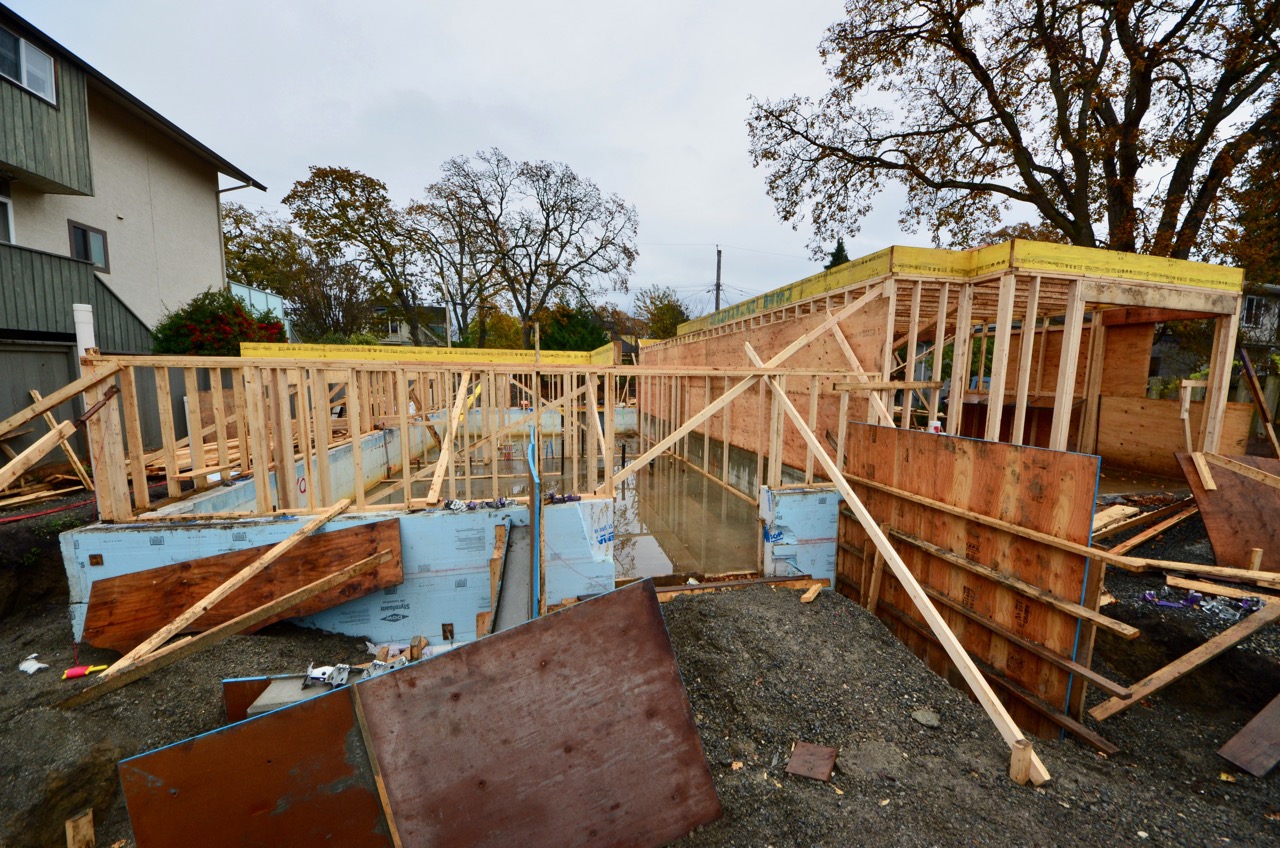
Framing has to be one of the most satisfying stages in a building’s construction. After feeling like we spent a dog’s age underground – not to mention the few years that came before we touched the merest speck of dirt – framing progress is fast and visible. We are now seeing plans on paper being rendered in three dimensions. Yeeha.

After getting this far a couple weeks ago:

front view

back view

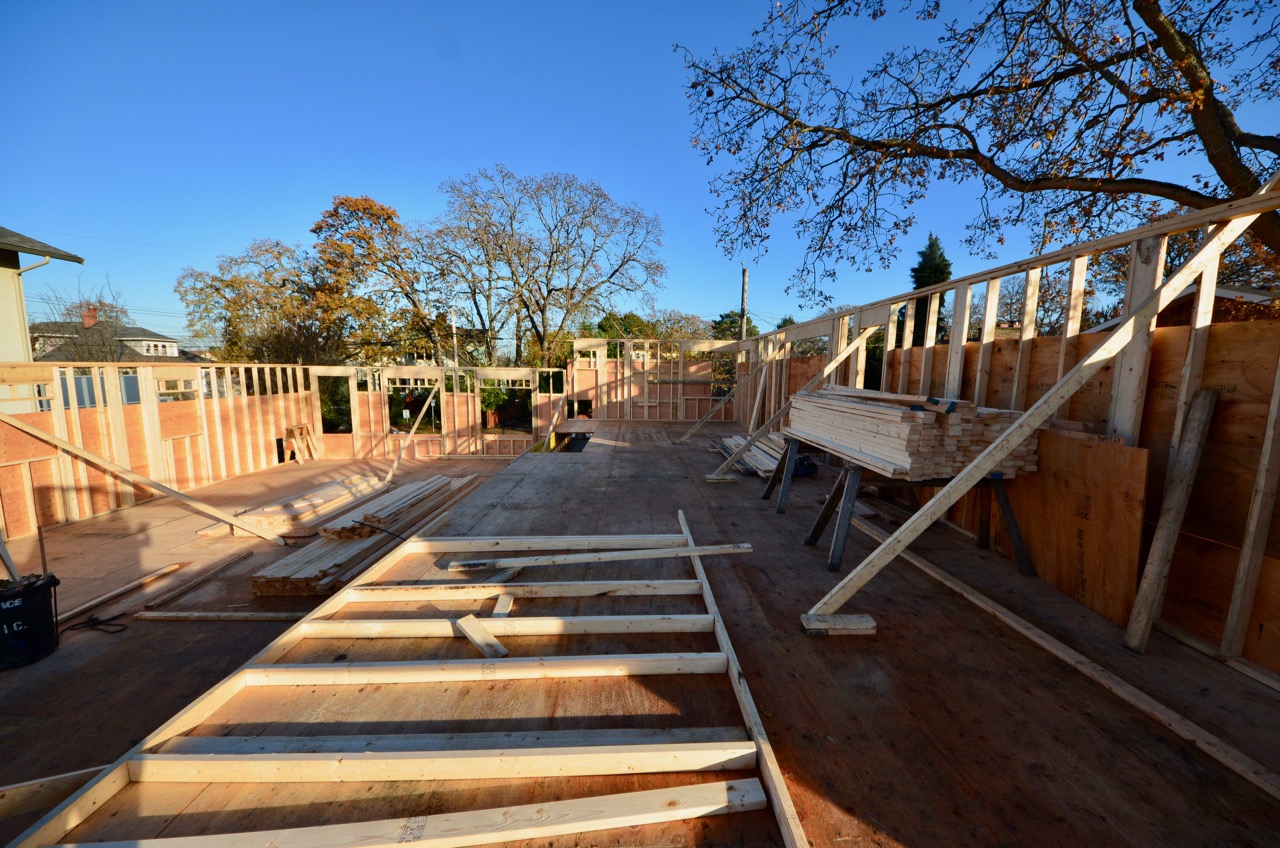
Last week’s highlight was taking the steps up to the second floor:

view from the top, looking east

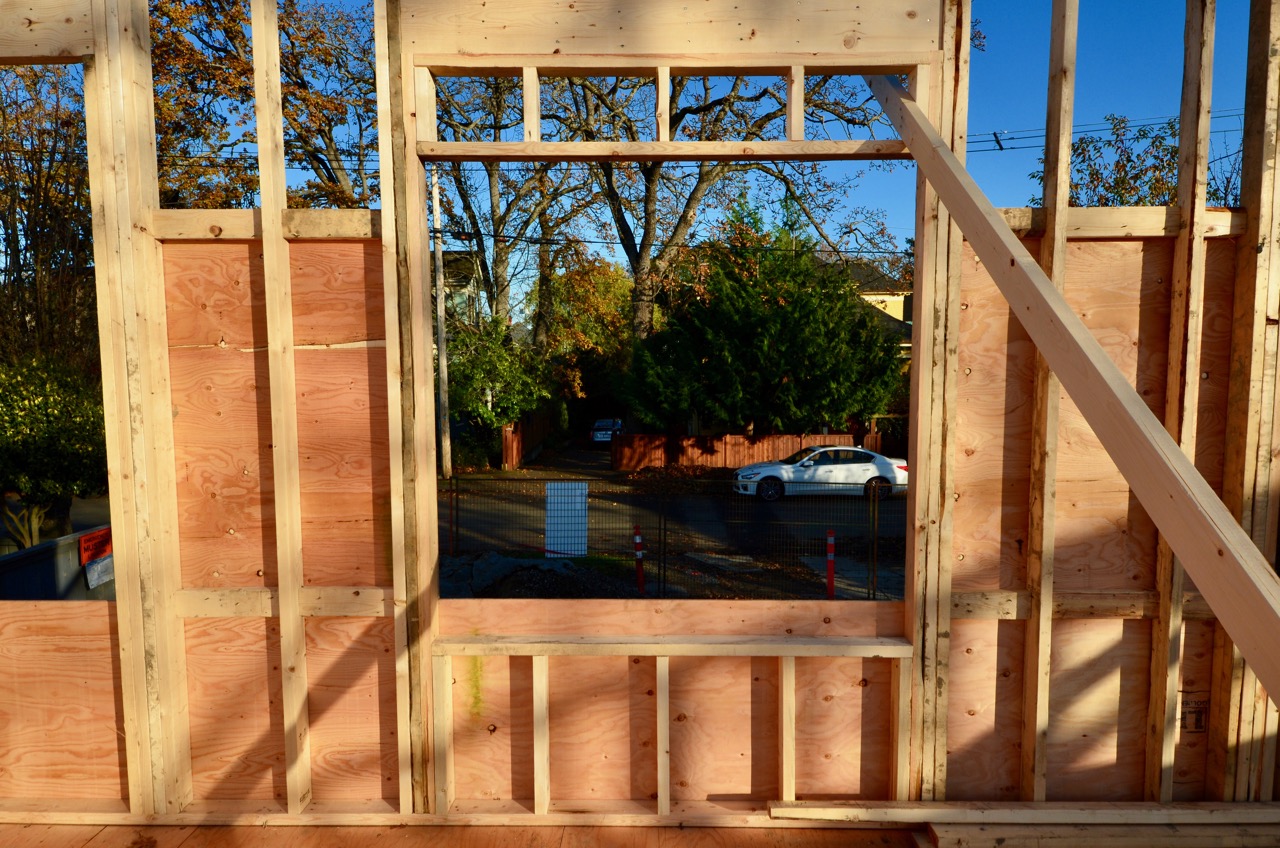
Then there was the thrill of standing where our kitchen will be, and then looking out the window opening of our new bedroom:

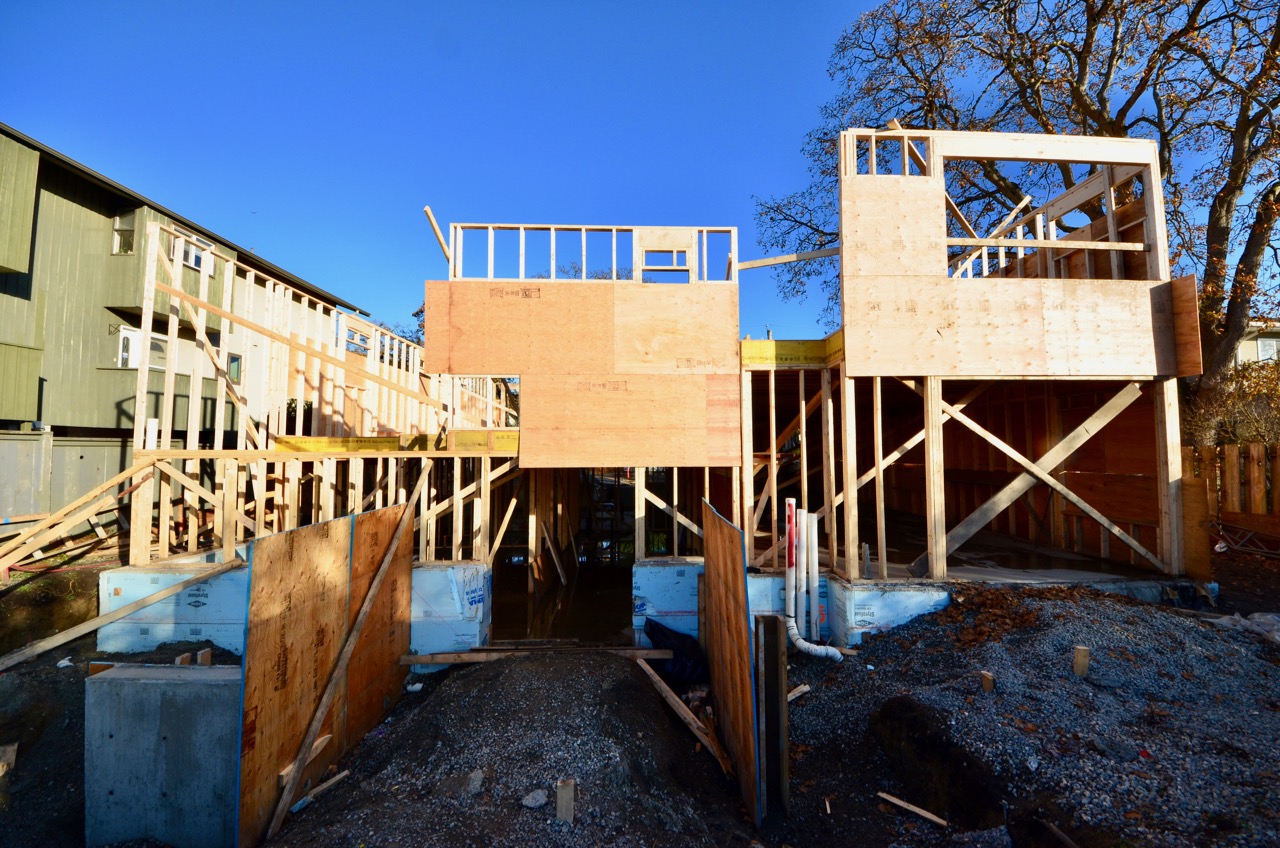
view from the front, this week

view from the back

Filed Under: Construction, Featured Tagged With: Passive House construction

Master Class in Construction Sequencing

November 1, 2018 by clove 2 Comments

Things are really zipping along on-site, thanks to some ingenious sequencing work by our Project Manager, Mike.

Here is the progress update in photos and a video.

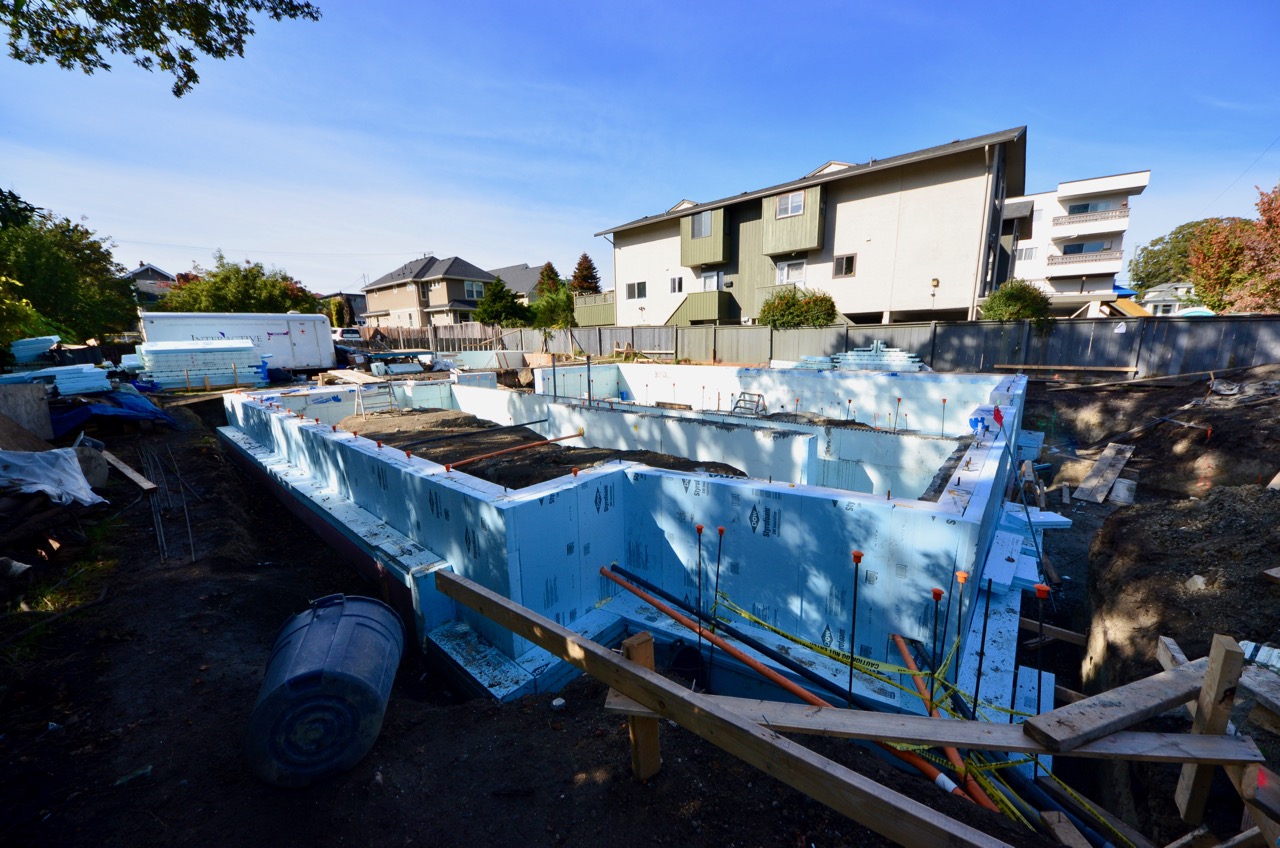
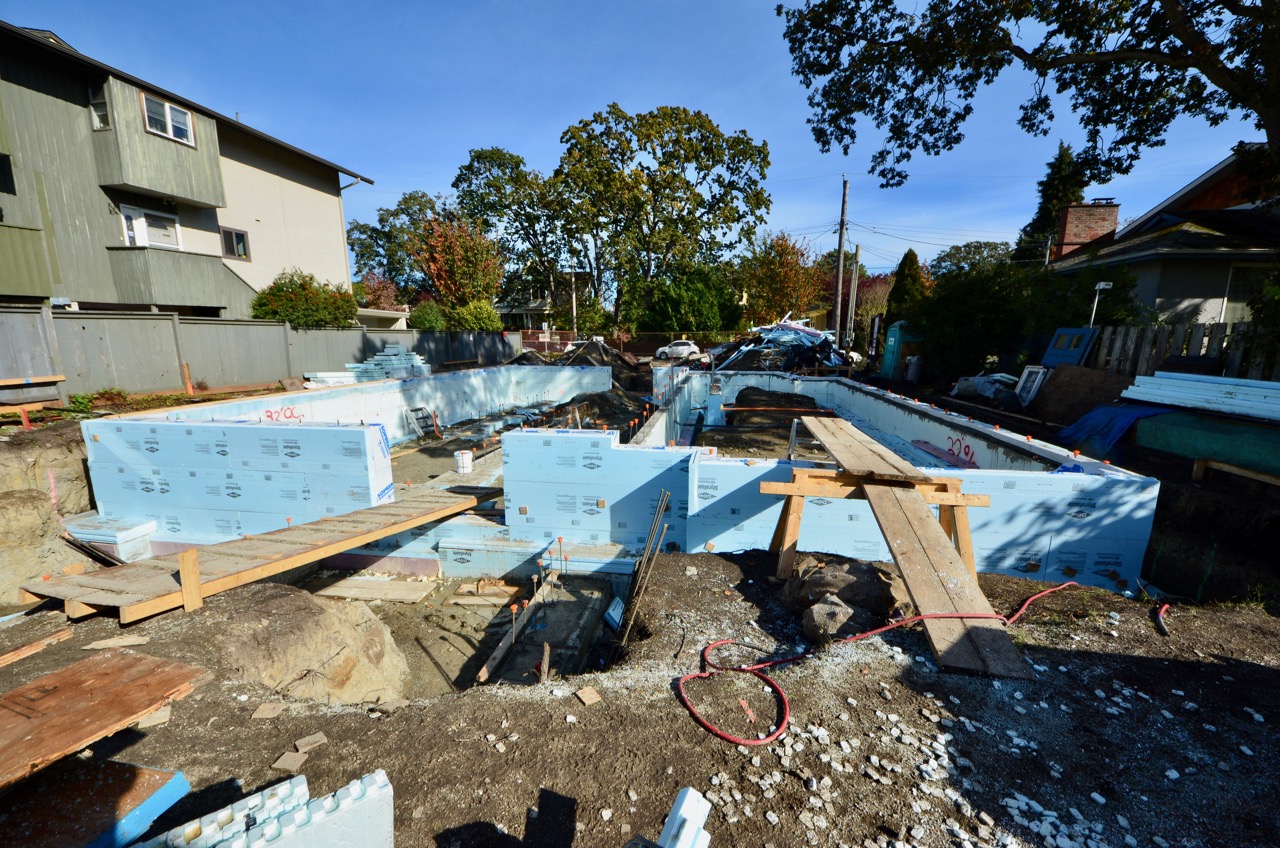
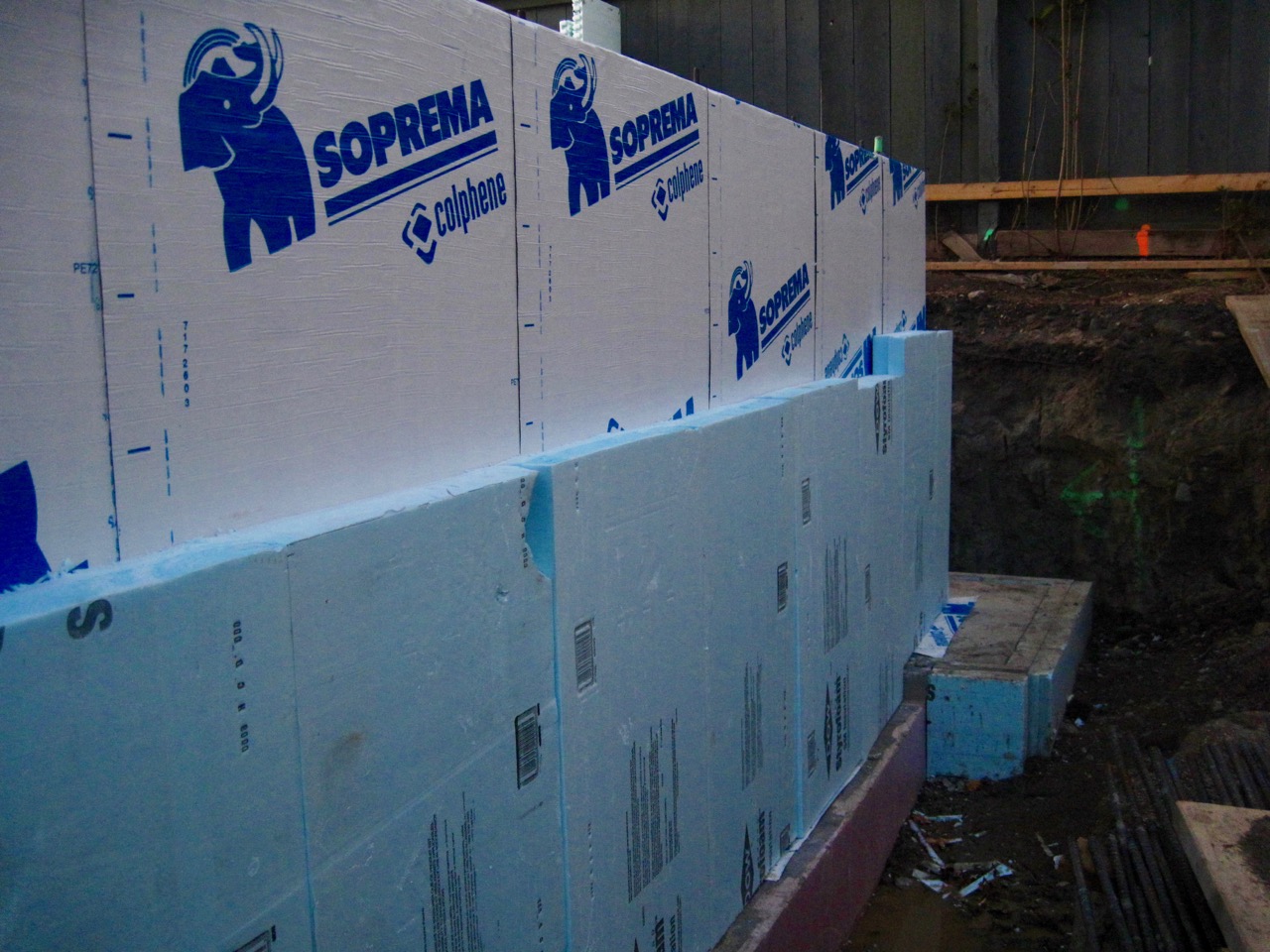
Insulated Concrete Form (ICF) foundation walls are wrapped with self-adhered waterproofing membrane. 4″ of additional rigid foam insulation is being installed on the outside of the ICFs for a total of just over 6″ insulation on the exterior side:

Here we can see the exterior rigid insulation on the foundation walls and 6″ of rigid insulation topping off (and surrounding) the footings:

View from the back yard:

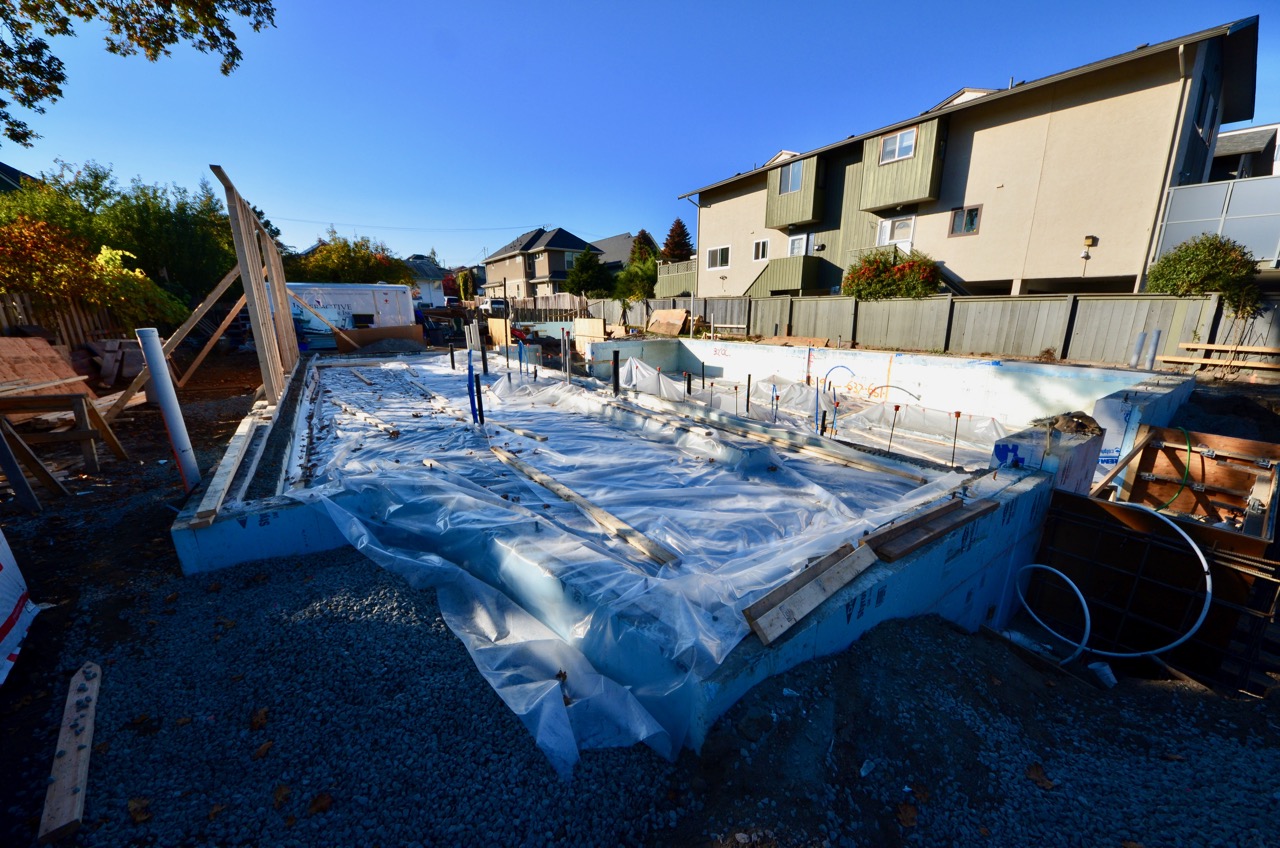
Below grade plumbing is installed; gravel is laid and protected with poly in preparation for pouring the below slab spray foam:

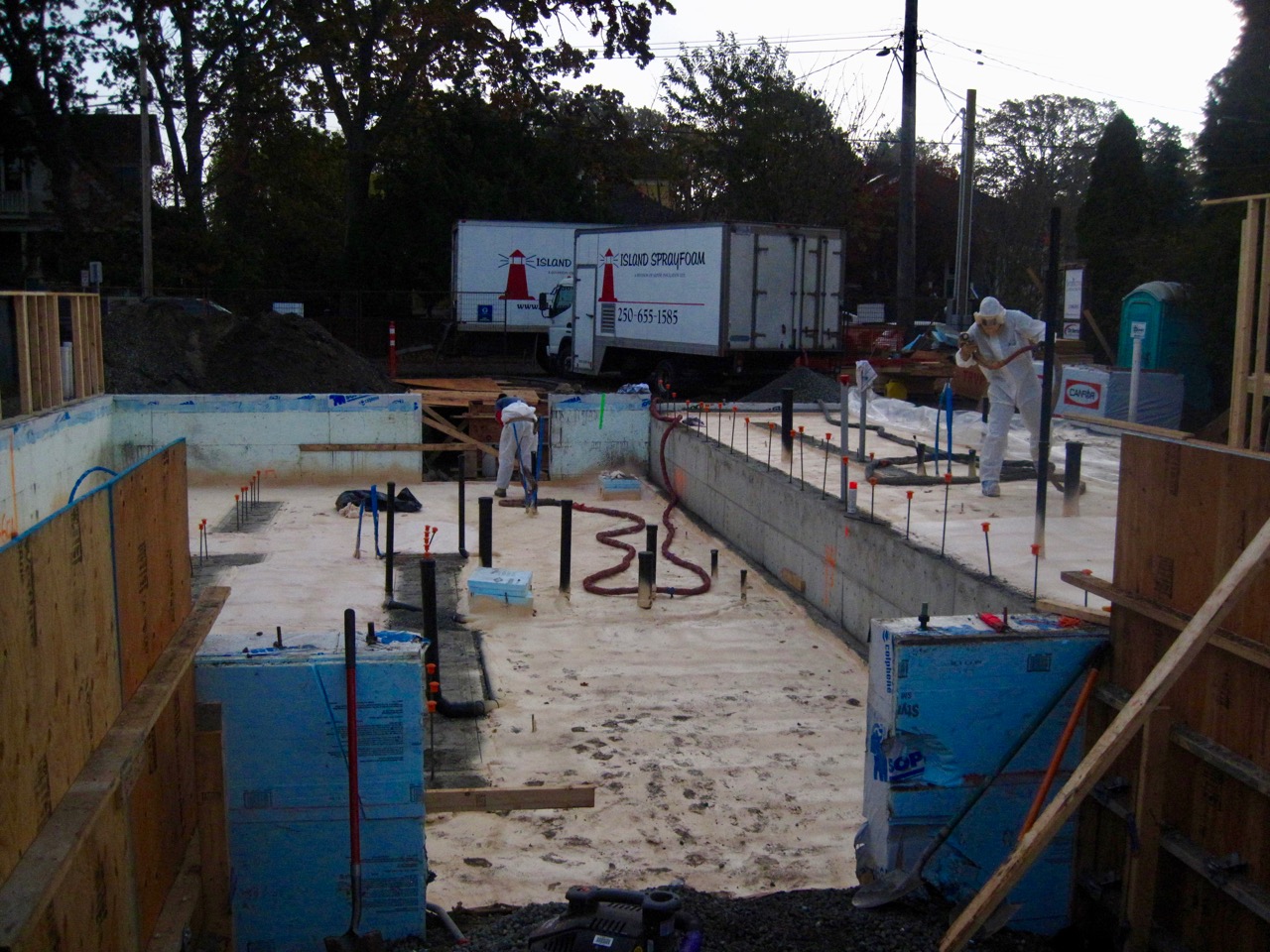
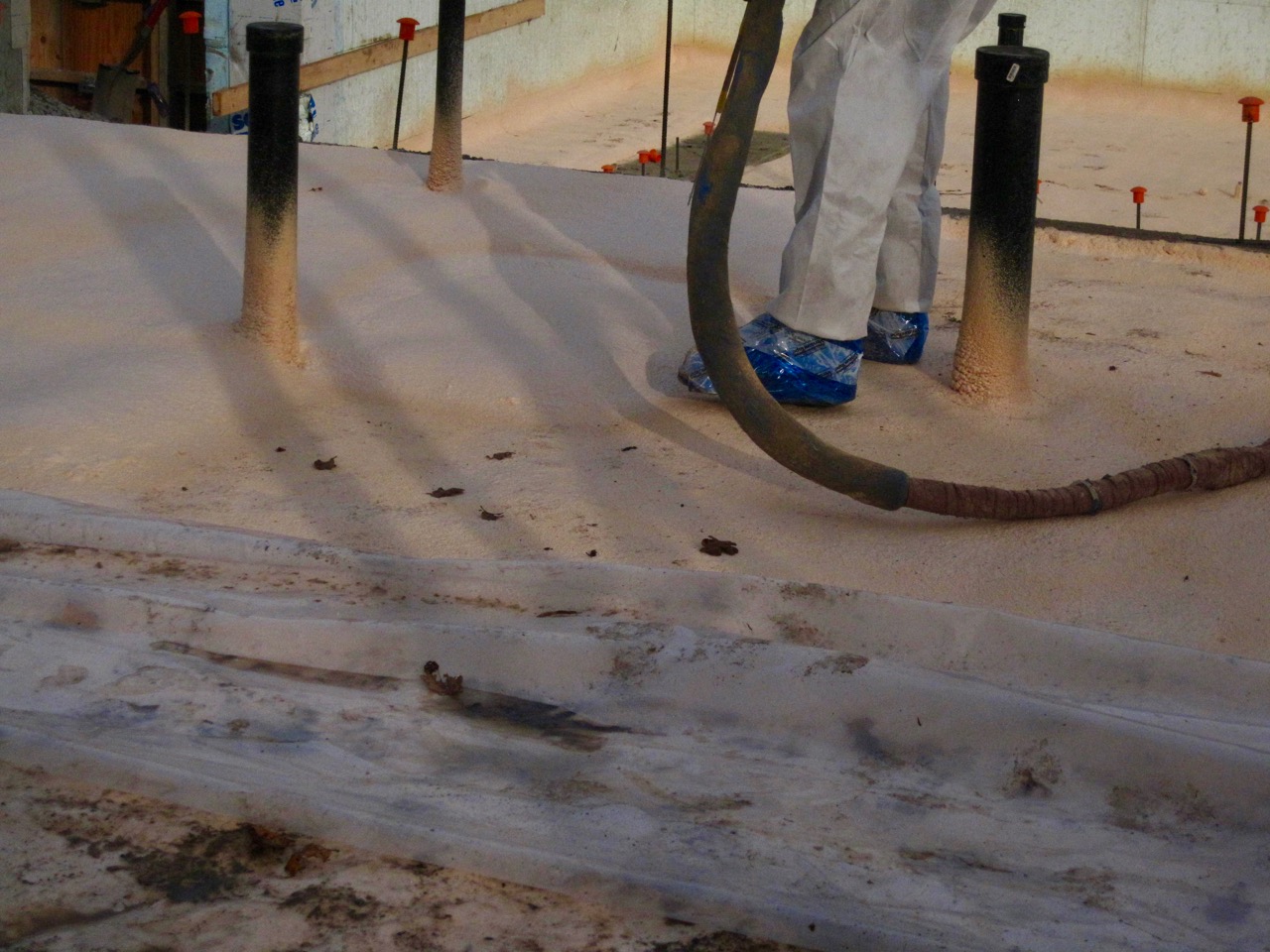
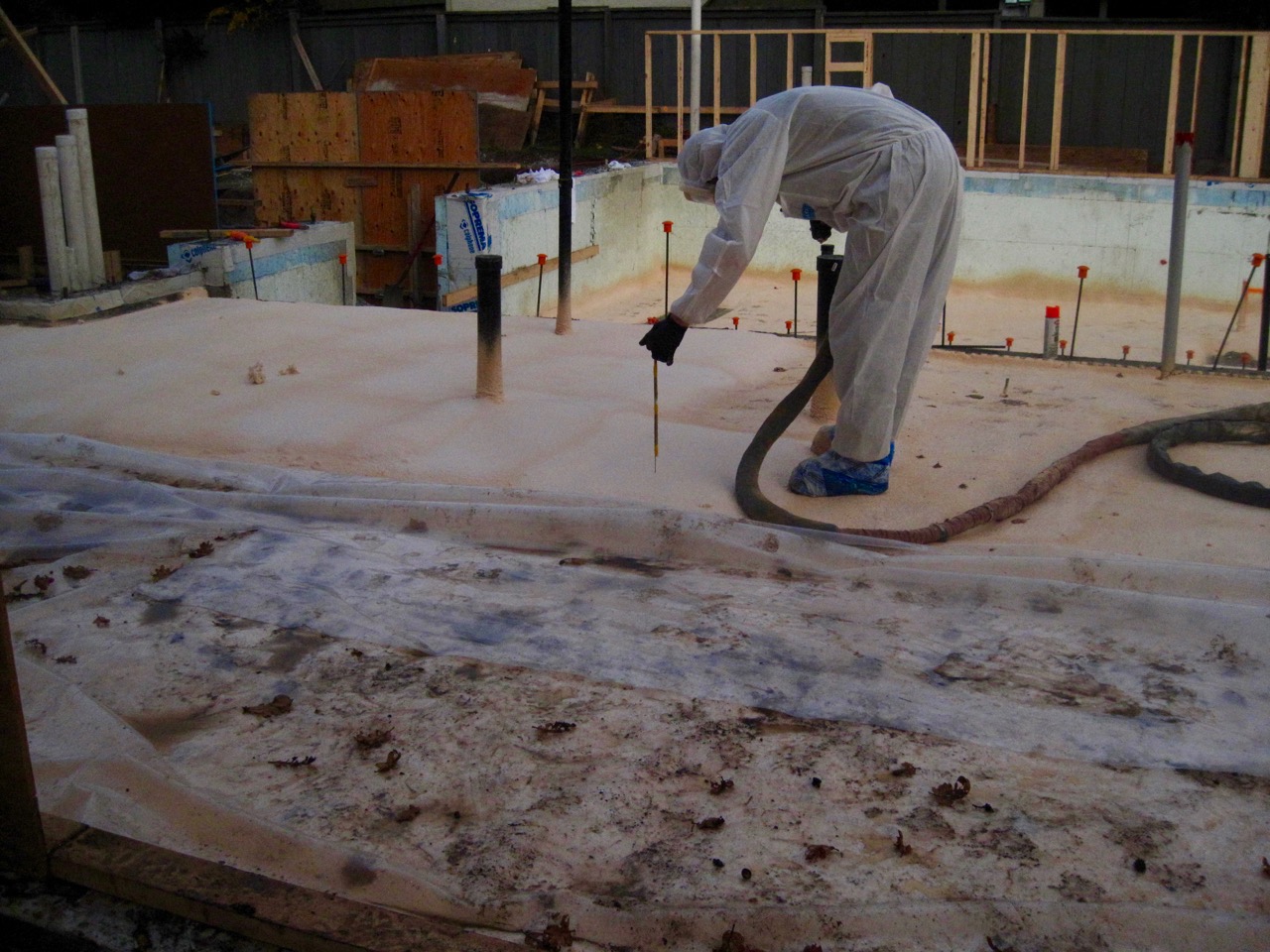
Spray foam was applied on Monday and Tuesday of last week (in four “lifts”, or separate applications):

We added 6.75″ total for R-40 below slab. The product is Heatlok Soya, which claims a more environmentally friendly blowing agent than previous generation products. It’s very sensitive to weather during application and curing, but the weather gods shined their temperate, dry smiles on us this week.

Spot checking the total thickness:

Here’s a short video of the application process:


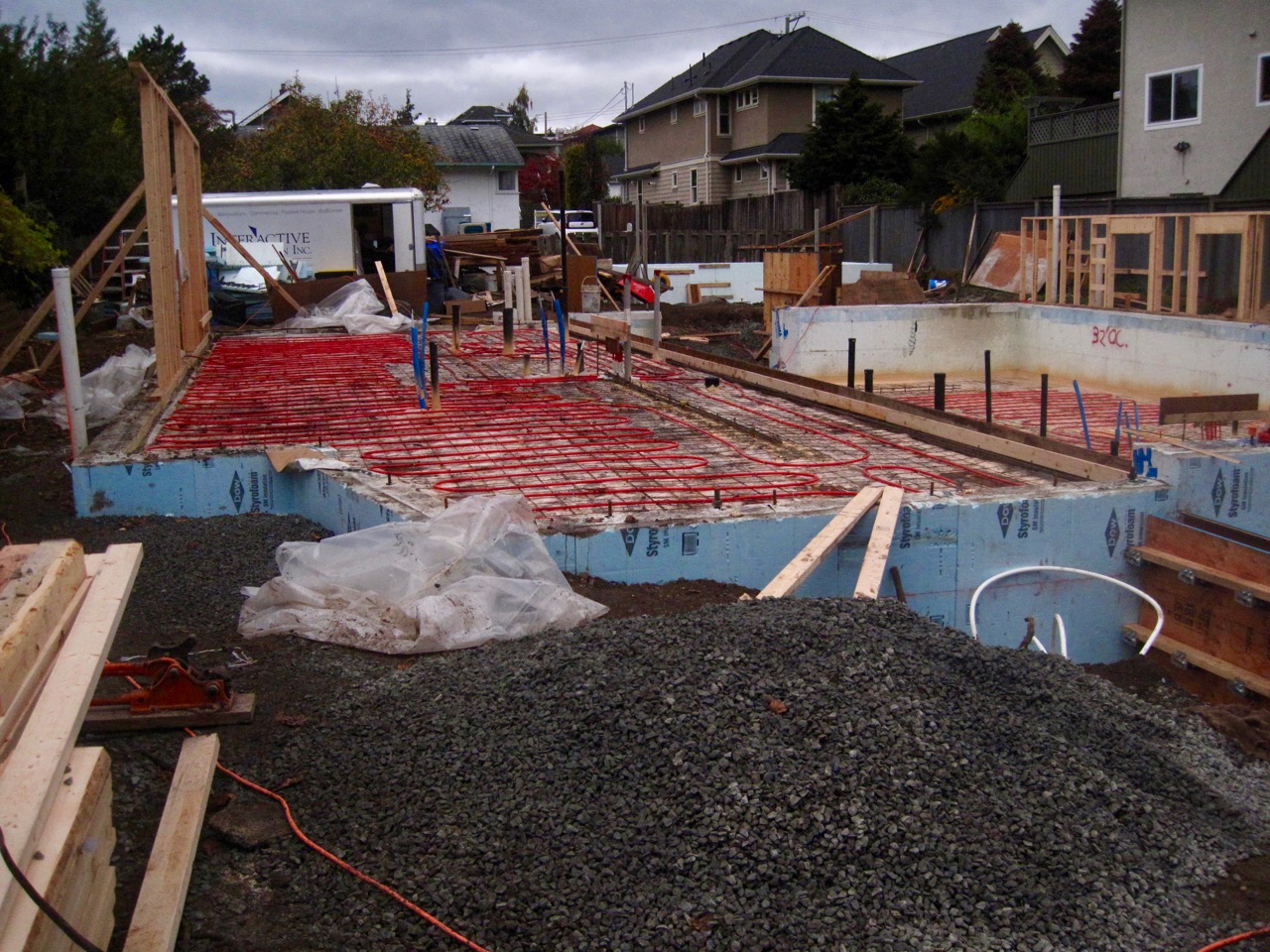
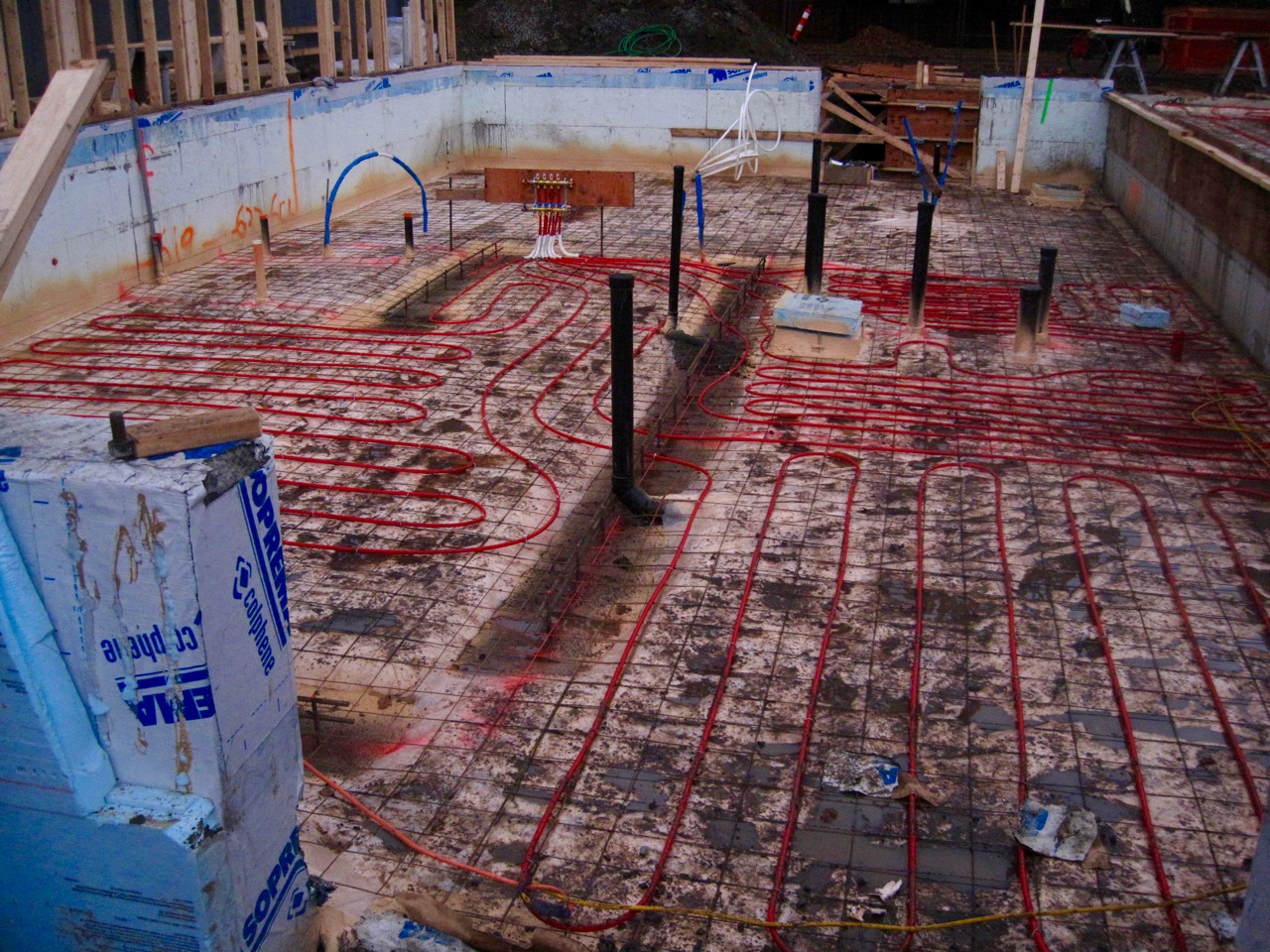
Tubing was then installed for the in-slab hydronic radiant heating system. This was Thursday:

Tubing spacing is ~12″ in most areas; tighter in the baths, and generally more widely spaced than in a non-Passive House due to the low heating load.

And by Friday we had a poured slab – two slabs, in fact; one for each side:

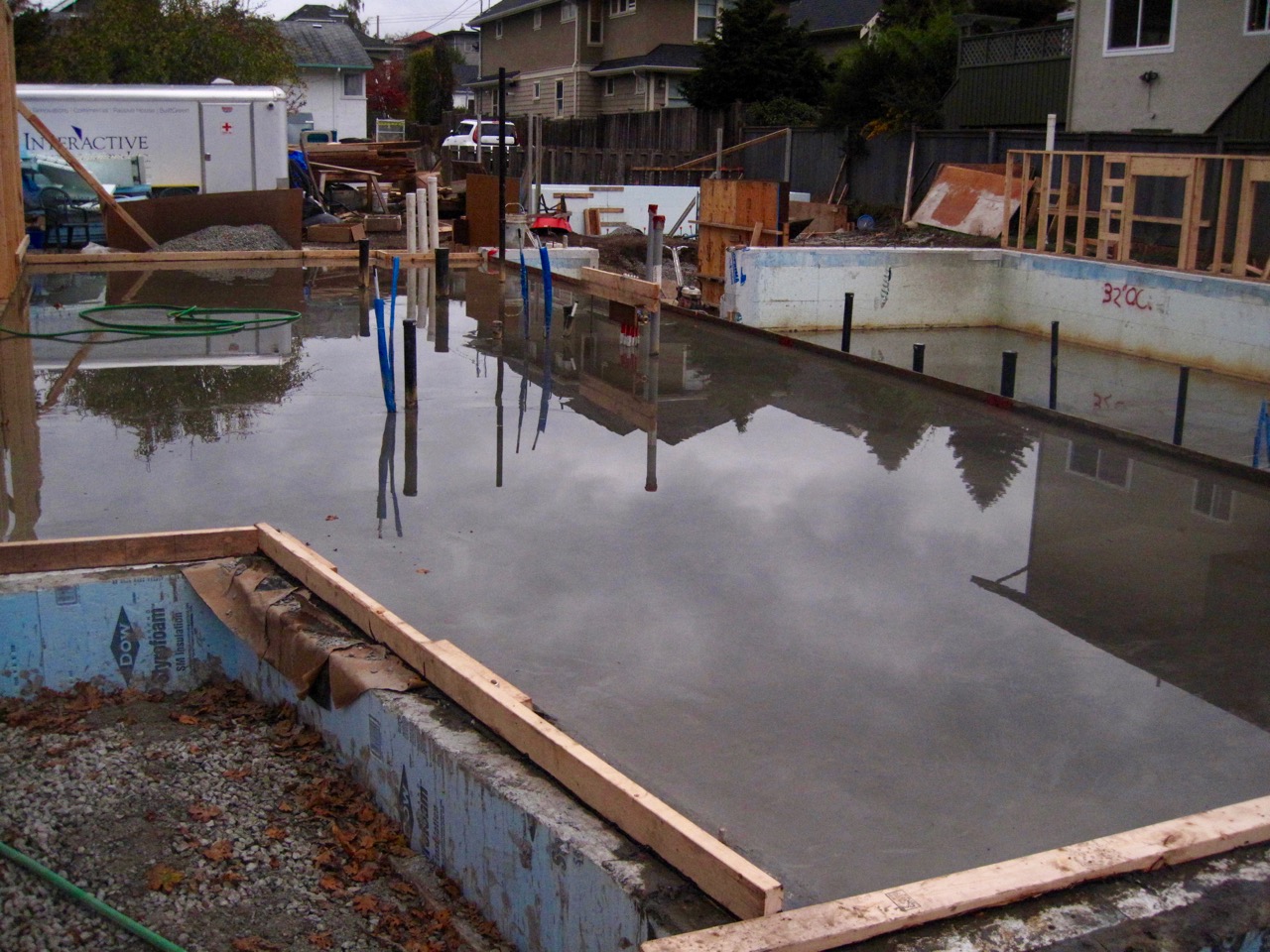
We kept it watered between weekend rain showers to encourage an even cure:

I think this means we can no longer call our project “the hole”. If we aren’t careful, pretty soon we’ll be calling it a house.


Filed Under: Construction, Featured Tagged With: construction, Passive House construction

The Quest for Simplicity

September 29, 2018 by clove Leave a Comment

As our beloved hole continues to take shape, the more technical among our readers may be wondering how things are looking on the Passive House modeling side.

As currently modeled in the Passive House Planning Package (PHPP), we are just squeaking by on the certification requirements. We had a Design Stage Review done by our certifier, Brittany, around the time we submitted for our Building Permit in the spring. The Design Stage Review is meant to be done before we start digging a big hole; and ideally, to give us some assurance that if things go according to plan, we are likely to achieve certification. Or, conversely, we would know early enough if any bigger changes were required. The review left me feeling confident in our design but with a long list of comments to respond to. Many of these comments involved refining conservative placeholder values for things like thermal bridging.

If I’m perfectly frank, I’d rather have a tooth pulled than spend a whole Saturday on PHPP updates. But there’s also the fact that things are still in flux, and while I want to know the energy impact of design changes, I am resistant to the notion that PHPP is our ultimate decision maker. There are design questions that absolutely impact the passive house model (and its predicted energy use), but are also influenced by other factors like practicality, cost, and aesthetics. PHPP doesn’t care about any of these things.

One thing that the model and I both care a lot about is simplicity. My strong inclination is to remove design complications, which by extension, tend to also remove modeling complications.

Here are the design questions we have been working through over the last while. We’re tackling each in the priority that Interactive needs answers to keep the project on schedule. I will tweak values in PHPP to test the impact, but will officially update them when we are satisfied that we have made good choices based on all of our criteria. With a bit of synergistic karma, our quest for simplicity will also lead to a certifiable passive house.

Roof Shape: Since we have to rebuild it anyway, we’ve chosen to do away with the hip roof on the ‘existing’ half. It’s a dramatic aesthetic improvement in my opinion but also a major simplification.

new gable roof (with the same floor plan)

old hip roof

Modeling the original hip roof was a less than satisfying experience. I could not completely capture the intersection of multiple hip roof slopes with the low slope roof of the new half using simple geometry and the dimensions provided on the drawings. And Interactive would have to build this! A gable roof is so much simpler to model and build.

The downside of this change is that the City needs to approve it. We are told it will only take a few weeks, but we have to submit a modified Development Permit package for the planning department’s review AND a revised Building Permit Package for the code inspection side. Good times.

Windows and Doors: We’re confirming final details of our Cascadia Universal Series fiberglass window and door order, which includes committing to the Solar Heat Gain Coefficient (SHGC) for the glazing. This is the value that determines how much heat is allowed through the windows versus reflected away. Higher is better in the model because it allows in more ‘free heat’, but lower is better to prevent overheating, and I think lower is ultimately the better way to go given our climate trends. I’m leaning toward using the lower value (Cardinal 360/180) on the south and west windows and the higher (Cardinal 270/180) on the north and east.

Much more fun than picking a SHGC for glazing is picking custom colours for our front entry doors. Thanks to our kindergartener’s astute design sense, there will be a purple door!

Ventilation: Each half of the duplex will have distinct heat recovery ventilation systems. We had been mulling over whether to pay for the more expensive Paul Novus units that have better heat recovery than the Zehnder units. This makes a difference of about 1 kWh/m2 heating demand, which is not insignificant when the maximum allowable is 15. I’ve got the less efficient Zehnder units in the model now, but this dilemma is likely to resolve itself even more favorably when the new Zehnder Q-series units become available in early 2019. They have vastly improved efficiency at much lower cost than the Paul units. Whoopee.

Heating and Domestic Hot Water Heating:  We have chosen to go with Sanden CO2 heat pumps for domestic hot water heating and in-slab radiant hydronic heating on the ground floors. These are air-to-water heat pumps that use CO2 as the heat transfer medium instead of something like R410-A. This technology has so much potential because most other refrigerants have several hundred to several thousand times the global warming potential of CO2. And the thing that doesn’t get talked about (and as far as I can tell has not been studied) is that typical refrigerant-based systems leak refrigerant like crazy. Anecdotal evidence suggests that 80% of the refrigerant that gets added to a system leaks out into the atmosphere.

The limitation of CO2-based systems is that they can only do heating, whereas other refrigerant based systems can provide both heating and cooling. We’re not currently planning to add mechanical cooling and we’re hoping that by the time the climate here becomes California, we’ll have sufficient shade trees to limit our exposure.

I’ve chatted with a few people who have experience with a Sanden “combi” system, including Peter J from Cascadia Architects. He has a functioning system in his Passive House home and shared a few tips for making sure it works properly without overheating the house – like heating the slab overnight and then shutting it off during the day and having a couple of supplemental heat sources for the few very cold days.

And further to the simplicity theme: by using polished concrete floors on the ground floors, we can embed the hydronic tubing; do one concrete pour and save on other floor finishes. It also makes for a clean modern look that we quite like.

And a Bunch of Little Things: I’m keeping a running markup of all the little things that occur to us the more we stare at the drawings – like moving a toilet location; combining the laundry and mechanical rooms to remove a wall and a door; shifting a window so there is room for a single bed along one wall. So basically thinking carefully about what it will be like to live in the space and making sure it works.

We’re quickly approaching the point where we’ve firmed up the bigger system choices. I will then do another update of PHPP, after which we’ll have a very good idea how the numbers will work out. Our decision-making will then shift toward things like kitchen cabinets and countertops and away from things with an appreciable impact on energy demand.

Filed Under: Design, Featured, Performance Tagged With: passive house, Passive House construction, Passive House performance, Passive House systems, ultra low energy

Construction Progress

September 14, 2018 by clove 1 Comment

Construction Progress: a more harmonious pairing of words I have yet to encounter during our project!

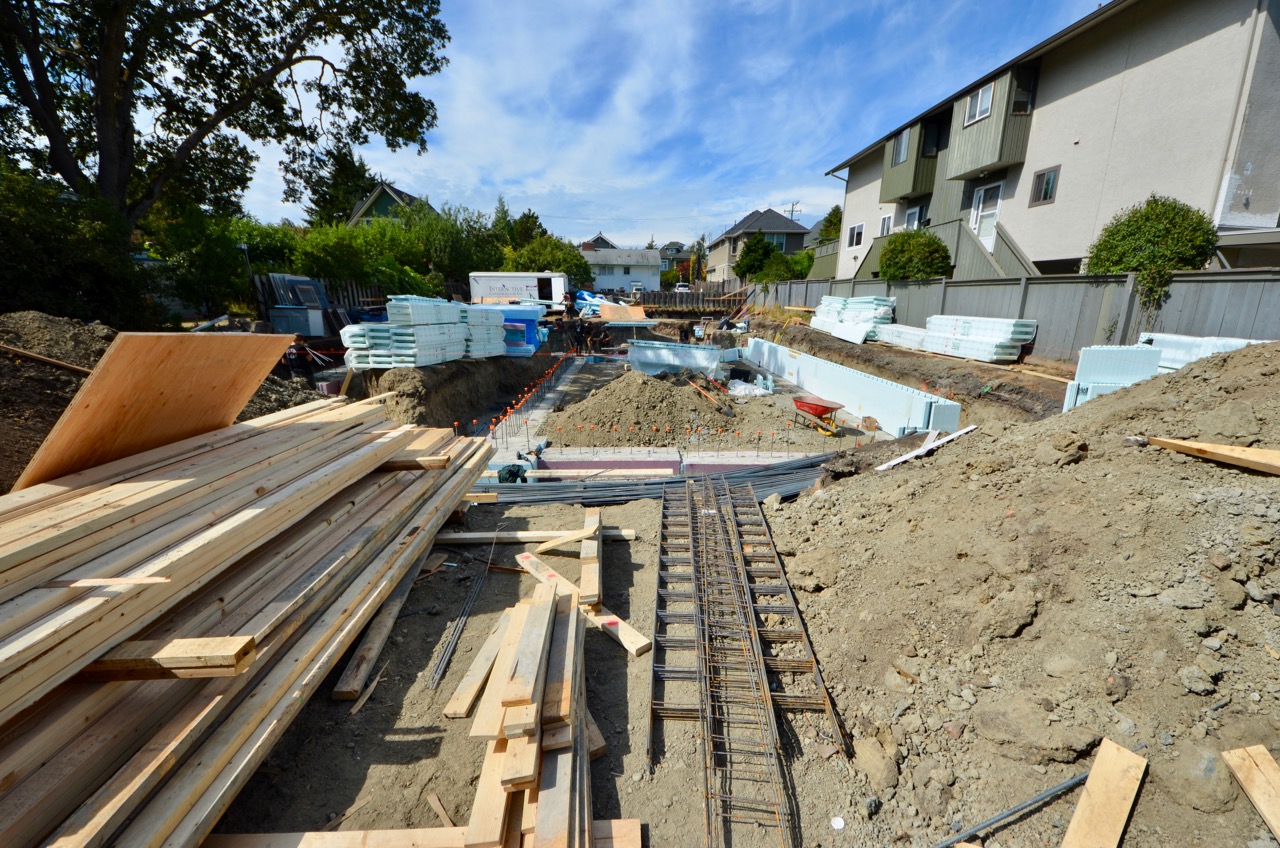
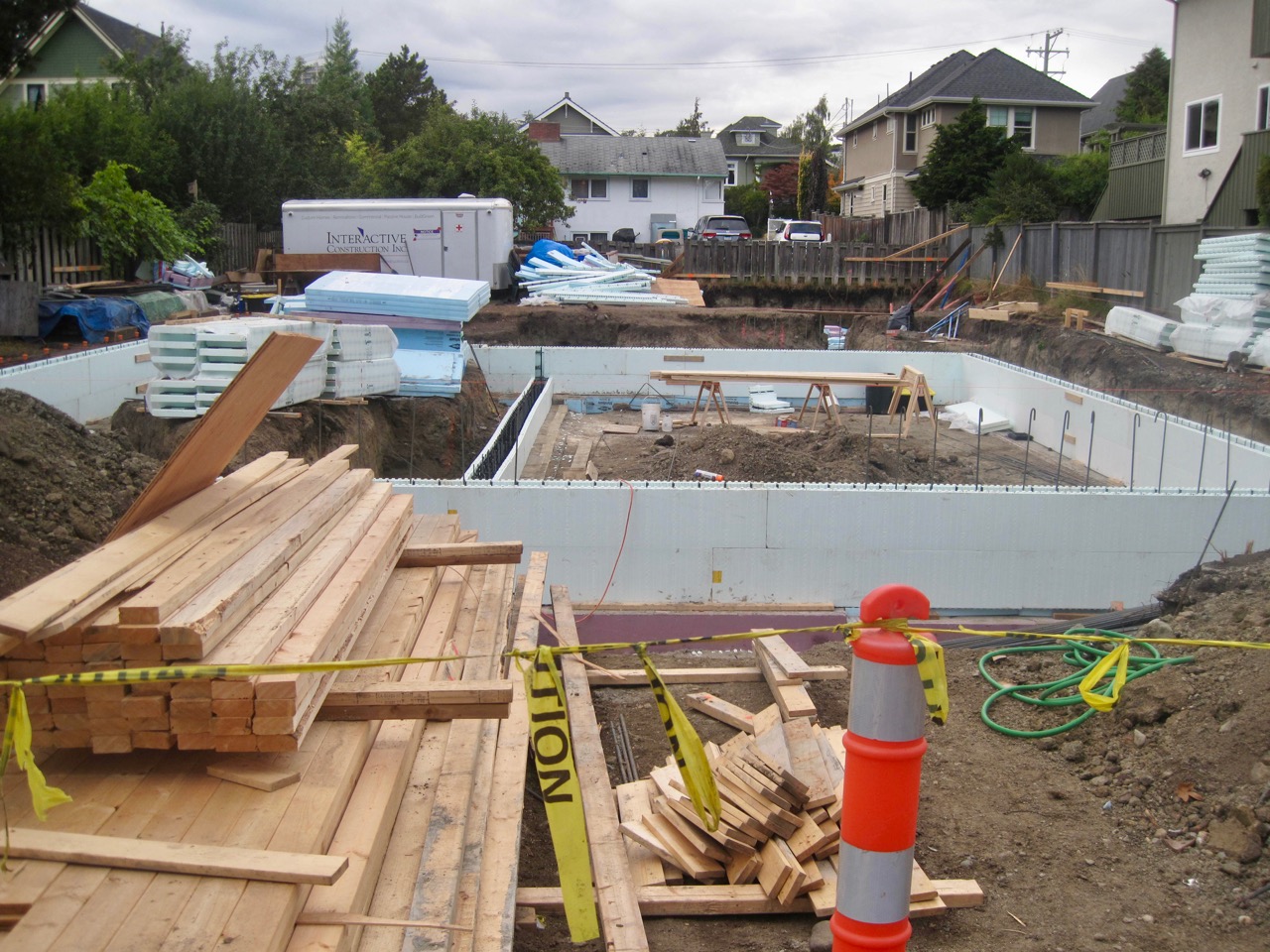
Here are some images from Interactive’s below-grade work over the last couple of weeks.

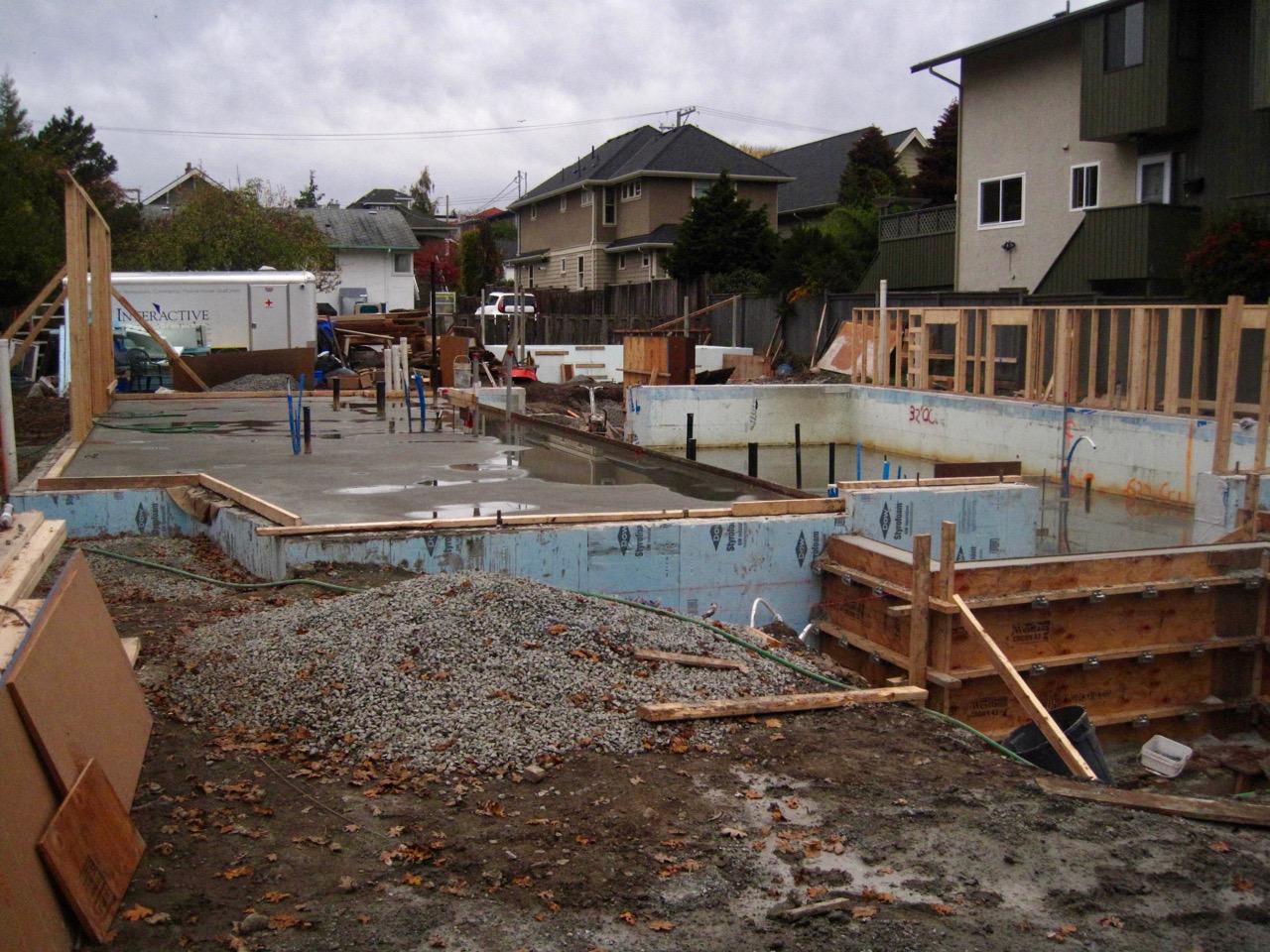
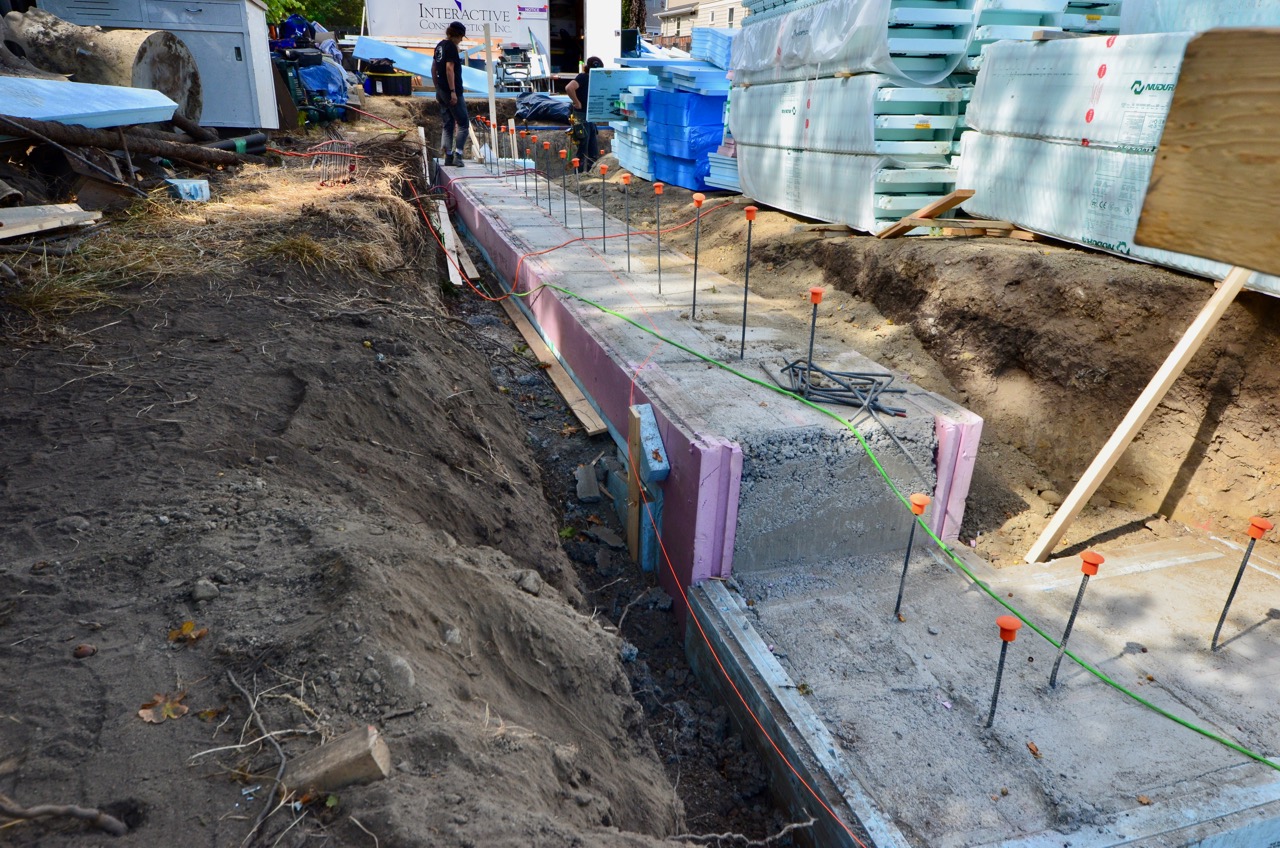
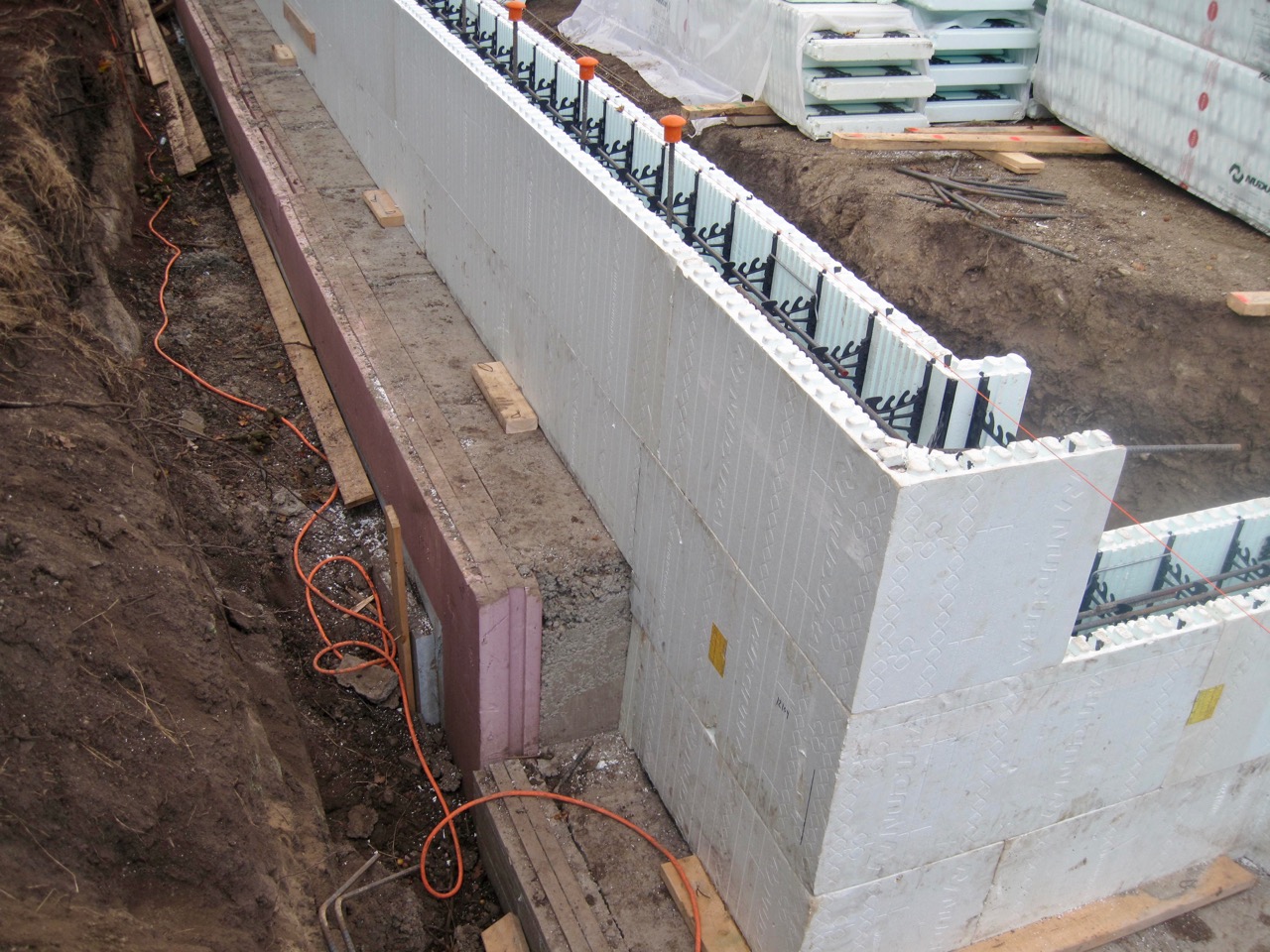
Footings are poured into a 6″ thick foam form and prepped for the Insulated Concrete Form (ICF) foundation walls

ICF forms going in

ICF forms going in

More ICF forms!

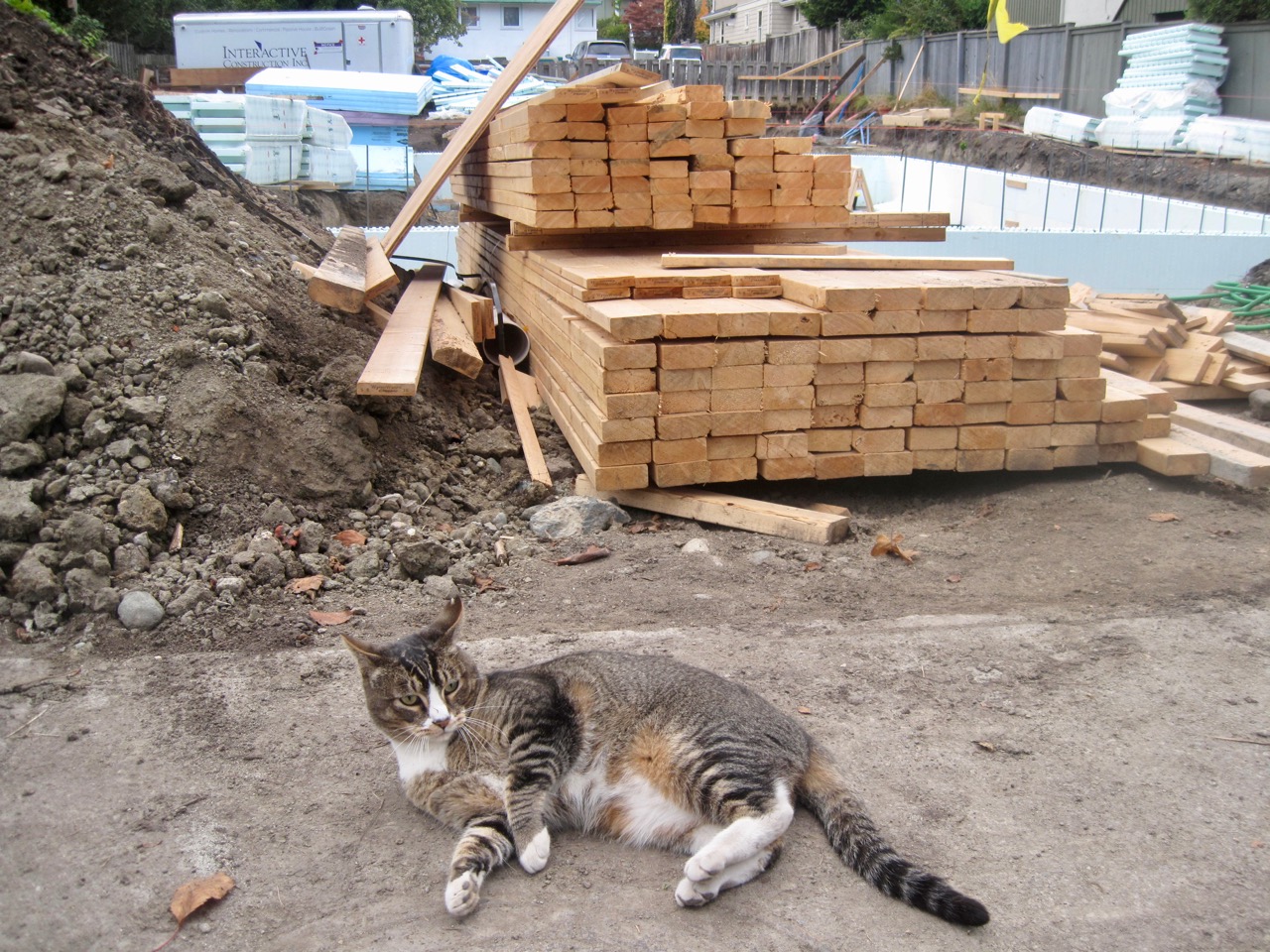
Fergus, after hours security cat

Filed Under: Construction, Featured Tagged With: Passive House construction

Is it Worth It?

July 13, 2018 by clove 1 Comment

We stopped by to check on things the other day, and arrived as our neighbour Patrick stood contemplating our house, his pair of pugs snuffling in the grass.

“Is it worth it?” he asked.

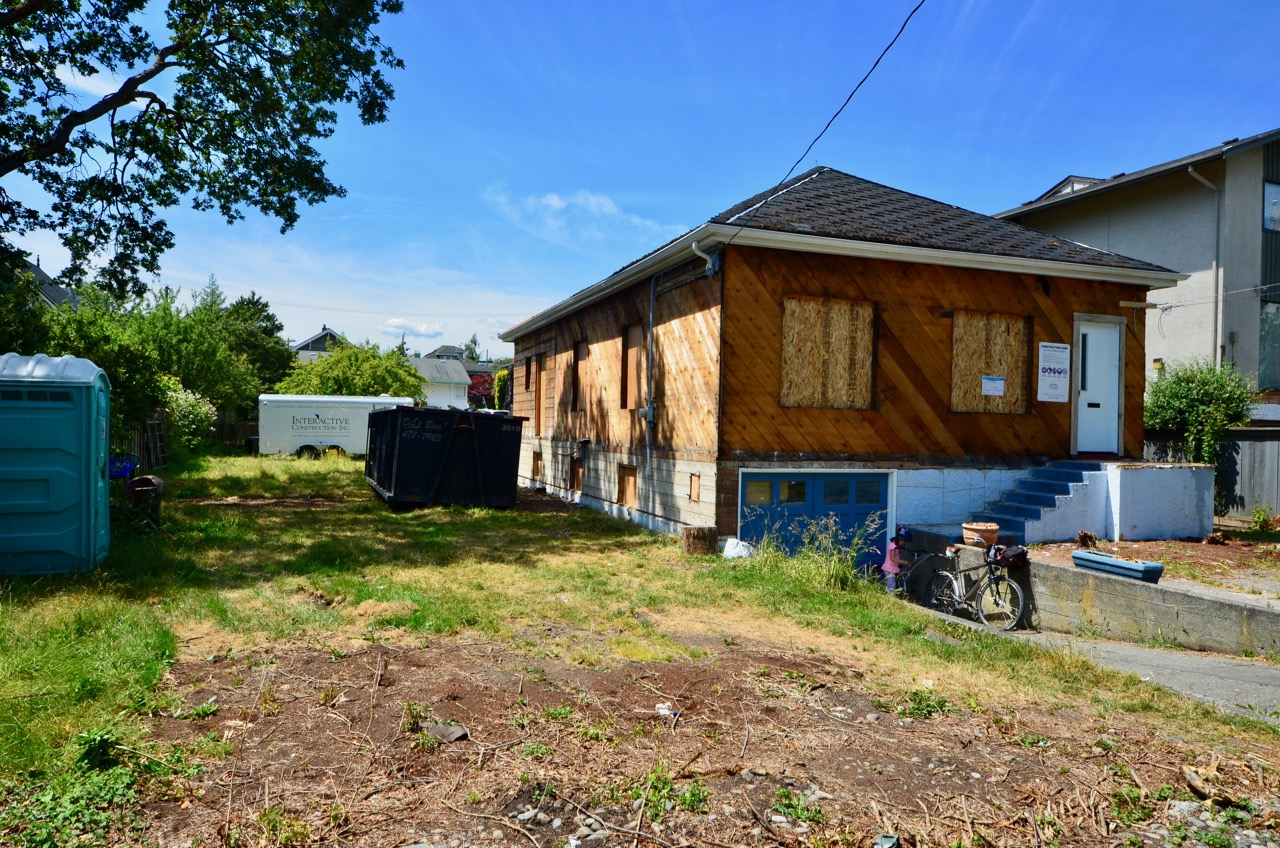
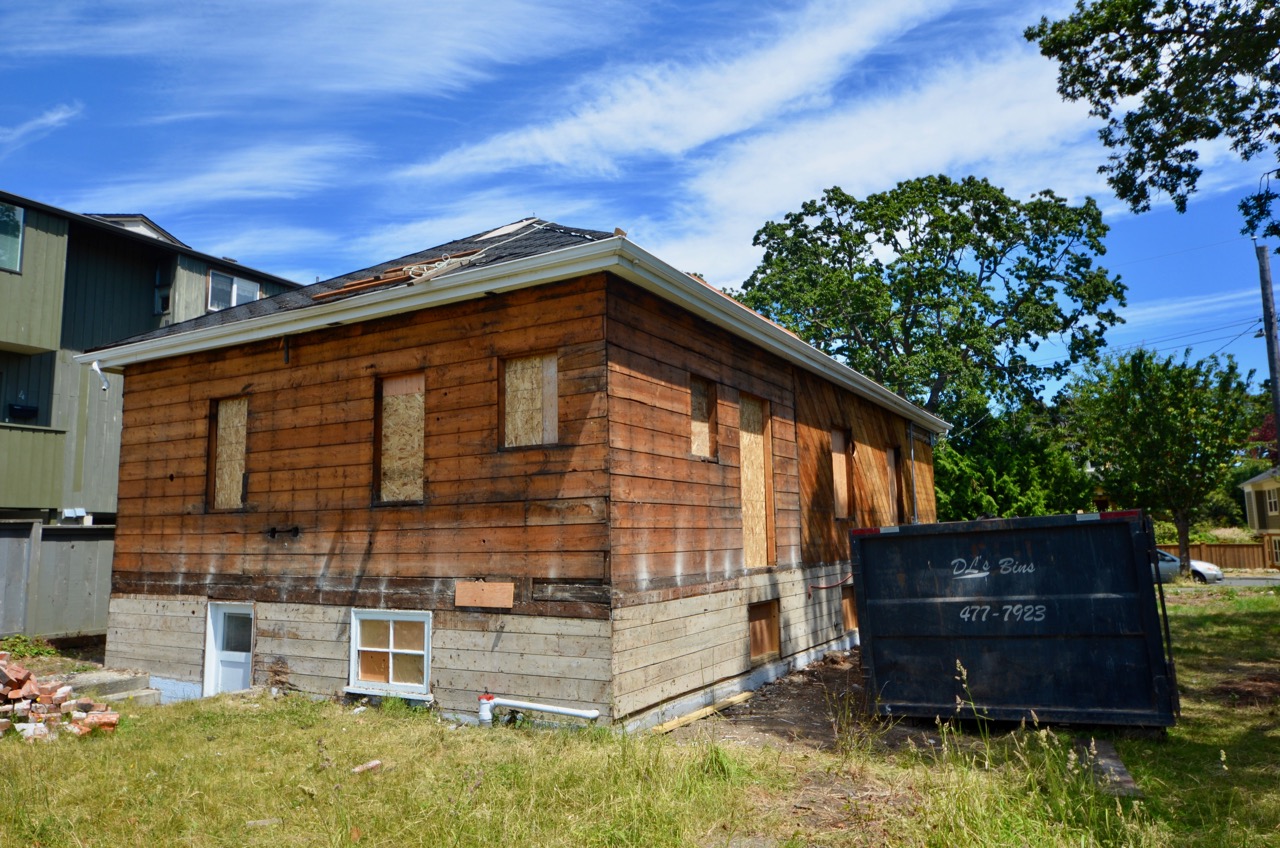
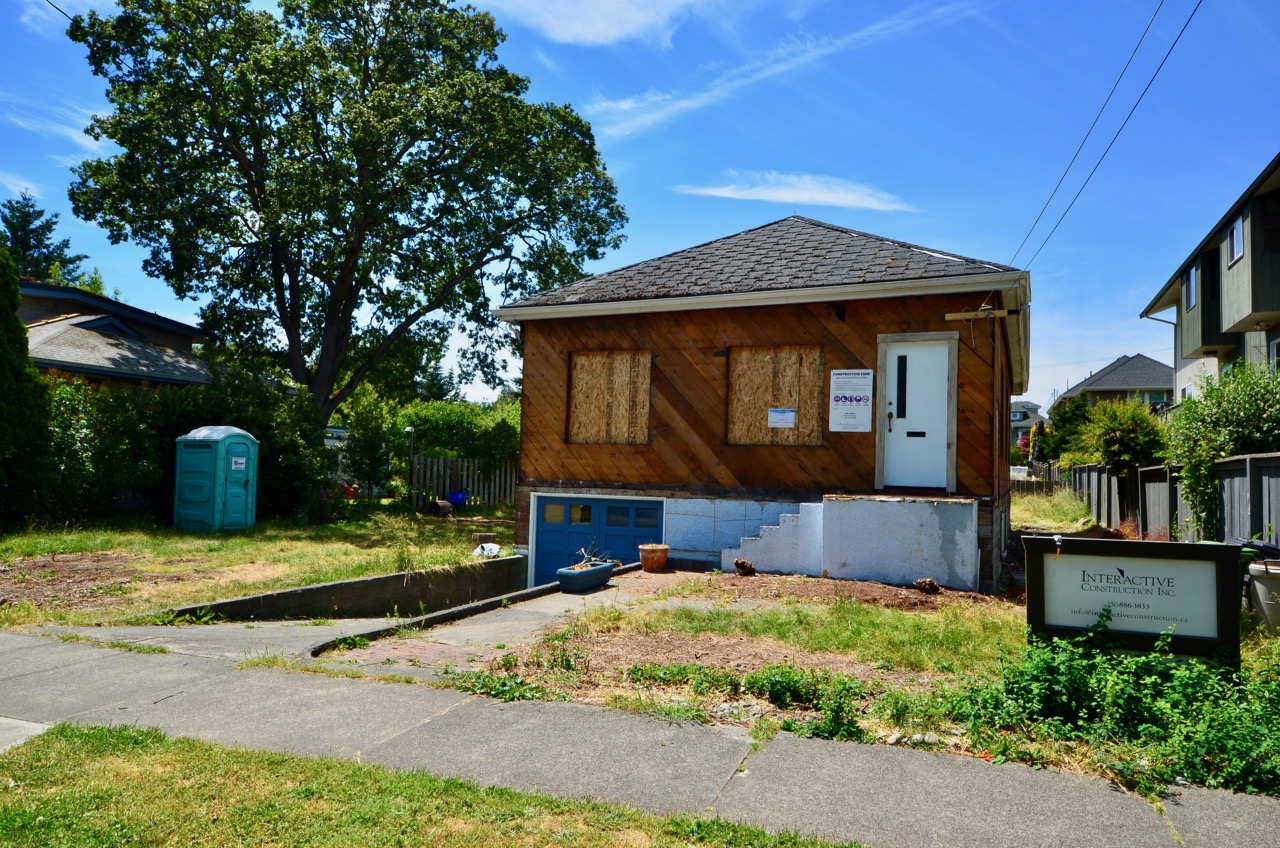
Was it worth keeping the existing house? His question hit squarely on the low-level malaise I had lately been nursing about the amount of our house that was left and would be left when all was said and done. Much less than I had expected or had wanted to believe.

All the Little Things

If we could ignore all the steps that led to this moment, the answer might be no, it’s not worth it. Recall, though, that our original plan was a small lot subdivision. In this scenario, we wouldn’t have even touched our existing house until the new one was built and sold. We would then have had numerous options for improving our house incrementally. Melding the two together appeased some of our neighbours and led to a more interesting design, but it also required a more complex and immediate transformation to the existing house.

Our structural engineer came on board late in the process and said we can’t keep the existing roof. We don’t know a lot about structural engineering, but now that the roof’s underside is fully exposed, we see surprisingly little wood up there. So we will now be building a new roof to match the shape of the old roof.

The framing of several interior walls – the location of which dictated our new layout – was also removed during the strip out process. After peeling off the drywall and the wallpaper and the planking, there just wasn’t much left.

$$$

Similarly, if we were to consider only the cost of keeping an old house like this and carefully rebuilding around it, the answer to Patrick’s question would most certainly be no. Two of the three builders who bid on our project more or less bluntly told us that it would be easier (read: cheaper) to build new. The careful deconstruction to save parts of the building, or even to thoroughly salvage a house being demolished, takes time (read: money). Granted, Matt has done a sizable chunk of the manual labour, and even with a full demo and new build, we would still pay hazmat and some demolition costs.

Our next step is to lift and shift the shell of our former house, which is now delaying the project as we wait on the sub-contractor who will do this work. Again, more time and more money we would not be putting out if we just built from scratch.

And Still…

Call it sentimentality if you like, but our house has become more than an “it” now that we’ve lived in it for a few years and have painstakingly peeled away the layers to reveal its bones. It (she?) is more like a person with a history etched by many hands over the years.

This house has stood in this place for over a hundred years. The sun has passed over it tens of thousands of times. Generations of people have walked their dogs past its front yard. Early owners added on the kitchen and bathroom, extended the roof, and shingled over the original lapped siding. Someone added bird wallpaper to the ceiling. Someone else painted over it.

Therefore…

In answer to Patrick’s question, I say no…and yes. We remind ourselves that our decisions are not informed purely by cost, as painful as that can be to our bottom line. It feels right to us to keep everything we can. I only wish we could have kept more of it. And I think what it comes down to is that, by the time you strip all the guts out, there actually isn’t much to a house.

If we’d found rot, the situation would have been even worse. But what is there is in great shape and we can be thankful for that. We can leave much of the exterior sheathing, walls and floor in place.

And so, here we are, our house waiting to be lifted, shifted, and placed back down on her new super-insulated, seismically resistant foundation.

We’ll keep and reuse many of the materials that we did remove, like:

  • good wood planking that Matt can use to build us a kitchen worth of cabinets and probably a kitchen table to boot
  • brick for outdoor landscaping
  • fir flooring that we can relay in the downstairs suite

We found new homes for many other things:

  • Our neighbour, Peter, spent a painstaking couple of weekends carefully prying off enough of our cedar shingle siding to patch the hole left when he removes his own chimney.
  • Another neighbour, Mike, left a note requesting the basement garage door when it’s ready for removal.
  • Someone we found through usedvictoria took the old oil furnace to replace his broken down one.
  • Another friend took our hot water tank for his reno project.
  • Any scrap wood put to the curb was scooped up almost instantly. Even the old built-in dishwasher was eventually picked up.
  • Interactive donated all the wiring and copper plumbing to Power to Be, to fund programs bringing people with barriers into nature.
  • We’ll donate the older but still functional appliances.

These parts and pieces of our original house will live on, their histories morphing as they are re-used by us or usefully absorbed or into other people’s homes. That is worth something too, right?


Filed Under: Construction, Featured Tagged With: construction, infill, Passive House construction

  • « Previous Page
  • 1
  • 2

Who is Stretch Developer?

Stretch Developer is written by Christy Love. In partnership with my husband Matt, we are challenging ourselves to create the kind of homes we want to live in and see more of in our community. Home is the incredible Victoria, BC, Canada.

Sign up!

Sign up to receive email notifications of new posts.

Recent Posts

  • New Uses for Old Wood Part 2 September 26, 2021
  • Ongoing Preparations for the Apocalypse August 13, 2021
  • Things We’ve Noticed – Energy Edition May 29, 2021
  • Passive House Suite for Rent April 17, 2021
  • Things We’ve Noticed – Comfort Edition March 14, 2021

Blogs We Like

Green Building Advisor Blogs

Musings of an Energy Nerd

Treehugger

Talk to ARYZE

Recent Posts

  • New Uses for Old Wood Part 2
  • Ongoing Preparations for the Apocalypse
  • Things We’ve Noticed – Energy Edition
  • Passive House Suite for Rent
  • Things We’ve Noticed – Comfort Edition
  • New Uses for Old Wood Part 1

Tags

budget building permit cabinet construction climate action climate change community engagement construction deep energy retrofit design design progress development permit duplex duplex + suite energy consumption energy efficient design financing financing passive house finding land food security home inspections infill low energy design neighbourhood engagement net zero passive house Passive House comfort Passive House construction Passive House construction costs passive house for sale Passive House performance Passive House performance; Sanden CO2 heat pump Passive House rental Passive House systems passive house testing performance pro forma property search tips reclaimed wood reclaimed wood construction rezoning roof row house small lot development small lot subdivision ultra low energy

Copyright © 2026 · Metro Pro Theme on Genesis Framework · WordPress · Log in


Loading Comments...