Stretch Developer

Taking urban development into our own hands

  • Home
  • About
  • The Project
    • Finding a Property
    • Design
    • Approvals
    • Financing
    • Construction
    • Performance
  • Blog
  • Contact
  • Rental Suite

Concept Development

August 12, 2015 by clove Leave a Comment

Subdivision_Rendering Aug 2015_NE Perspective

I met with our friend and architect, Mark Ashby today. We strategized about what appear to be our biggest issues with the detached house strategy: side setbacks and windows.

If we were building two new houses, we could easily meet the R1-G Gonzales Small Lot zoning. But because we want to retain the existing house, we are challenged to fit everything in. The existing house is 25 feet wide. The R1-G zoning requires 8’ (2.4m) setbacks to side property lines if you want to have any windows in “habitable” rooms; 5’ (1.8m) if you don’t want windows.

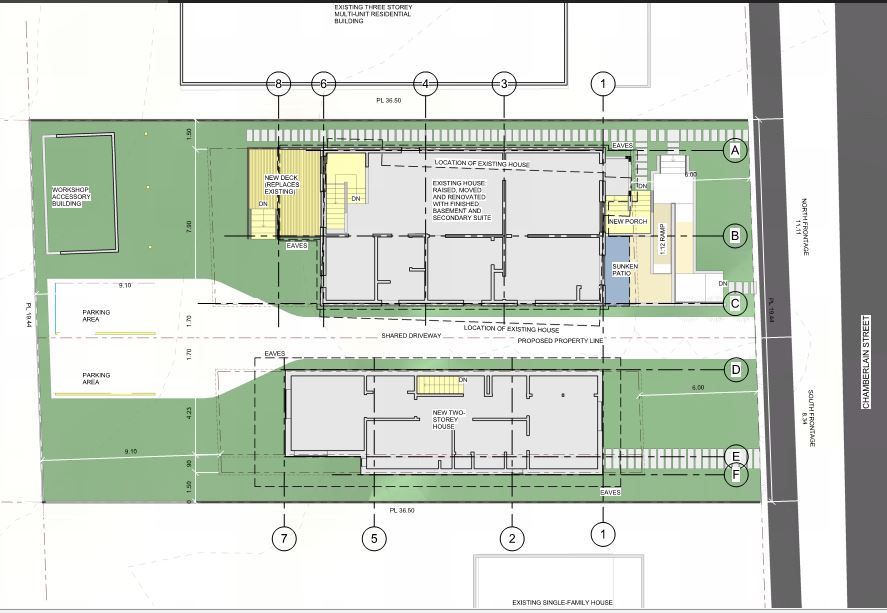
Our lot is 63.8 feet (19.44m) wide and 119.8 feet (36.5m) long. If we met the 8’ setbacks on each side of the existing house, we are left with only 23 feet for the new property. If we also added 8’ on each side of the new house, we’re left with a 7’ wide house! Not exactly viable. So we’re looking at walls that don’t need windows, and looking at variances that can still allow us to meet the intent of the setback/window requirements (ie maintaining privacy between properties).

What we are currently thinking is this:

  • Maintain the 8’ setback to the south property line so we can design south facing windows in the new house to get as much passive solar gain as possible.
  • Reduce the setbacks between the houses to 5’ on each side, creating a 10’ wide shared driveway to the back. Do not install any windows on the north side of the new house, but maintain some of the windows on the south side of the existing house to allow some natural light. There will be no privacy issues with this variance, since the new house has no windows facing the existing house.
  • Reduce the setback at the north property line to 5’, but maintain a few strategically placed windows to allow natural light/egress without compromising privacy for the townhouse property to the north.
  • This scheme reduces the width of the new house to about 16 feet outside dimensions, which is narrow but doable.

Here’s what this looks like on the site plan:
Site Plan_Sept 2015

Filed Under: Design, Rezoning Tagged With: design, rezoning, setbacks, small lot development, variances

Learning from the Experts

June 26, 2015 by clove Leave a Comment

I met with Rus Collins of Zebra Design today. He a pioneer of small lot development in Victoria and spent a generous chunk of his Friday afternoon with me sharing his words of wisdom. He confirmed that I am on the right path by pursuing the subdivision option, as well as my plan to talk to the neighbhours early. He said that if I experience intense resistance in my early conversations, it might be best to cut our losses or wait a year before floating the idea again.

Here’s the process according to Rus (with some editorial added):

  1. Do a very simple sketch or two of what we are proposing. Spend as little time and money as possible at this stage, because you won’t get this money back if the project dies.
  2. Talk to our neighbhours with these early sketches to get a general sense for their openness to the project. While not required at this stage, it’s good to keep in mind that for the rezoning application in the City of Victoria, we will need signatures from 75% of our immediate neighbhours (anyone with a property line that is adjacent to ours at any point – across, beside and behind) confirming that they do not object to our plan. All adults of voting age count – so a couple living next door count as two votes. Renters and owners of a rental property all count as unique votes.
  3. Talk to the local area city planner. Present the sketches and our proposed variances from the zoning we intend to apply for, as well as the early neighbour reactions. If she doesn’t raise any red flags, proceed with design.
  4. Before launching into the full design, I recommend reviewing the Rezoning and/or Development Permit Application in detail, so you know what drawings need to be included in the package and what consultants you need on board. For Victoria, we need the following at a minimum:
    1. Site plan (i.e. civil engineer)
    2. Landscape plan (i.e. landscape architect or designer. Note a licensed architect is not required for a small project like our, but we’re using one, and it can help with the permitting process for anything ‘unusual’ like super-insulated walls)
    3. Floor plans (i.e. architect or designer; also a structural engineer for modifications to the existing house)
    4. Elevations
    5. Photos or illustrations showing proposal with flanking buildings
  5. Complete the full design.
  6. Review again with the city planner (recommended by Rus to avoid being blindsided after getting neighbourhood approval and having to redesign and go back to the community again).
  7. Present to the neighbhourhood association, in our case the Fairfield Community Association’s Advisory Design Committee. This process is also outlined in the rezoning application package document.
  8. Collect the 75% signatures.
  9. Complete and submit the rezoning and/or development permit application package, complete with application fee.

Rus felt the potential sticking point for our proposal was adding the suite to the existing house, given that it will become a small lot house. Current zoning does not allow for suites in small lot houses, and it’s often the addition of a suite that inflames the resistance of neighbhours. Most builders/owners will quietly add a suite later, and a quick survey of our block suggests that nearly every house on our block has some form of suite. It’s a reality of the local market that we both need rental accommodation and that many families need the additional income to afford their mortgages.

I would prefer to be above board in our application and advocate for the suite. If done well, it is a viable way to introduce a small increase in density to single family residential areas in the urban core. Our pitch is that we are creating housing for 2.5 families that uses less energy than the existing single family home on the property. I know that our current mayor Lisa Helps is open to making innovative projects happen and has been openly supportive of the North Park Passive House.

The existing but renovated house will create a transitional density between the adjacent townhouse to the north (FSR > 1.0) and the single family homes to the south (FSR = 0.5). The R1-G2 Small Lot Gonzales zoning allows for FSR = 0.55, which we can do for the new house. The existing house with suite will be less than 0.5. For the existing house, the basement area does not count toward the FSR calculation provided the bottom of the finished ceiling remains equal or less than 1.2 m above the average grade.

Rus thought we might be successful if we have a strong pitch (see Talking Points post). Overall, I left my meeting with Rus feeling optimistic about our chances. It’s also great to know that Rus is a potential resource-for-hire if we encounter difficulties getting through the rezoning process.

Filed Under: Featured, Rezoning Tagged With: rezoning, small lot subdivision

  • « Previous Page
  • 1
  • 2
  • 3

Who is Stretch Developer?

Stretch Developer is written by Christy Love. In partnership with my husband Matt, we are challenging ourselves to create the kind of homes we want to live in and see more of in our community. Home is the incredible Victoria, BC, Canada.

Sign up!

Sign up to receive email notifications of new posts.

Recent Posts

  • New Uses for Old Wood Part 2 September 26, 2021
  • Ongoing Preparations for the Apocalypse August 13, 2021
  • Things We’ve Noticed – Energy Edition May 29, 2021
  • Passive House Suite for Rent April 17, 2021
  • Things We’ve Noticed – Comfort Edition March 14, 2021

Blogs We Like

Green Building Advisor Blogs

Musings of an Energy Nerd

Treehugger

Talk to ARYZE

Recent Posts

  • New Uses for Old Wood Part 2
  • Ongoing Preparations for the Apocalypse
  • Things We’ve Noticed – Energy Edition
  • Passive House Suite for Rent
  • Things We’ve Noticed – Comfort Edition
  • New Uses for Old Wood Part 1

Tags

budget building permit cabinet construction climate action climate change community engagement construction deep energy retrofit design design progress development permit duplex duplex + suite energy consumption energy efficient design financing financing passive house finding land food security home inspections infill low energy design neighbourhood engagement net zero passive house Passive House comfort Passive House construction Passive House construction costs passive house for sale Passive House performance Passive House performance; Sanden CO2 heat pump Passive House rental Passive House systems passive house testing performance pro forma property search tips reclaimed wood reclaimed wood construction rezoning roof row house small lot development small lot subdivision ultra low energy

Copyright © 2026 · Metro Pro Theme on Genesis Framework · WordPress · Log in


Loading Comments...