Stretch Developer

Taking urban development into our own hands

  • Home
  • About
  • The Project
    • Finding a Property
    • Design
    • Approvals
    • Financing
    • Construction
    • Performance
  • Blog
  • Contact
  • Rental Suite

A Sign of Progress

July 29, 2017 by clove Leave a Comment

We posted this enormous sign in front of our house last weekend:
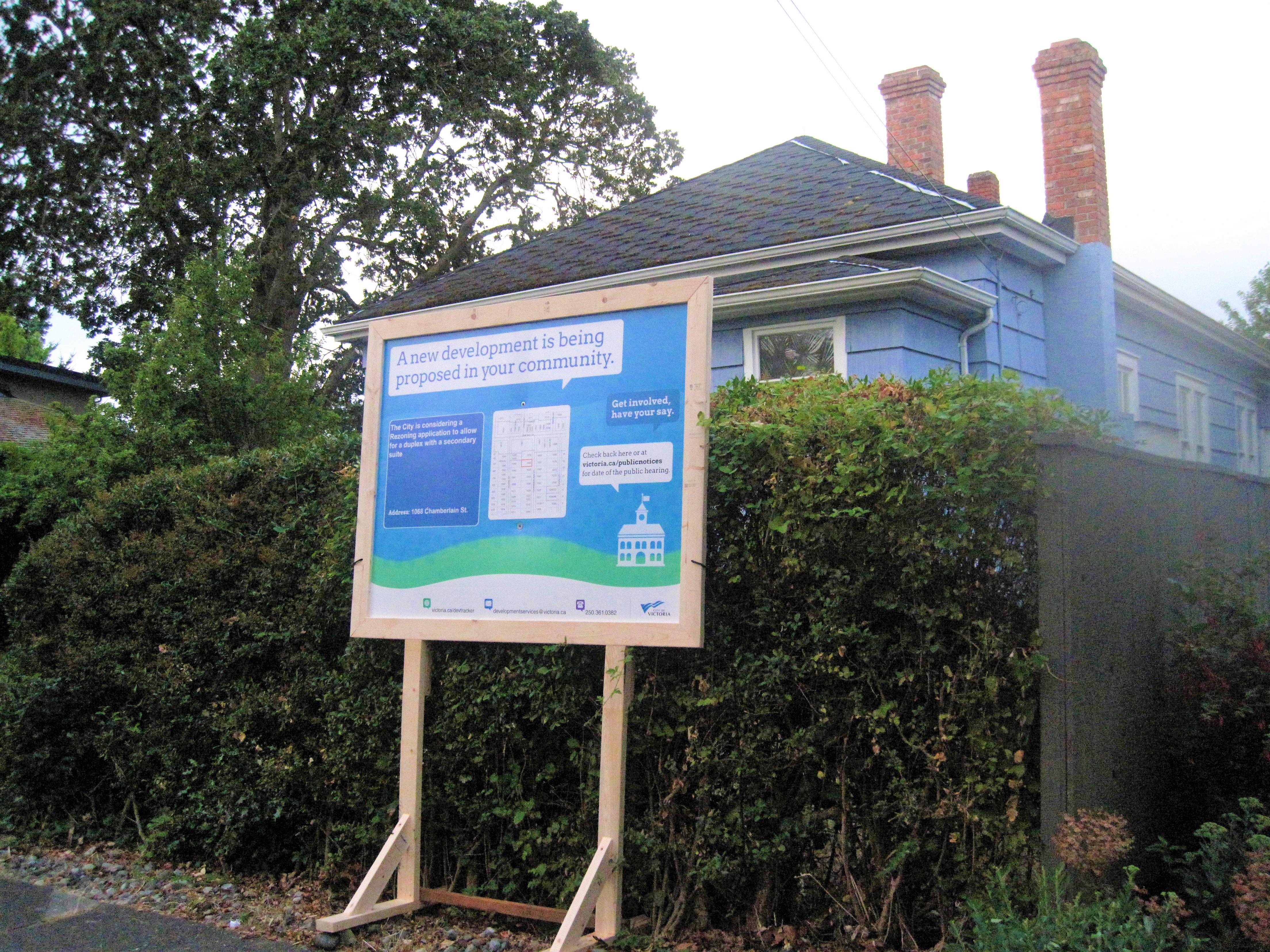
This sign means that we are on the agenda of an early August meeting of the Committee of the Whole, and it will stay up until the Public Hearing. The meeting of the Committee of the Whole is attended by both City Council and city staff, and it’s when they discuss staff’s recommendations for a given project application in advance of the Public Hearing. The meeting is open to all (you can view them in person or remotely here), but we are only allowed to listen in, not participate.

This is the last step toward rezoning approval before the public hearing. We would not expect any further comments from city staff, but it’s possible that Council may raise something major.

In other related news, I also recently reviewed our neighbourhood’s new draft Community Plan – the first update since 2002. Hey, get a load of this:
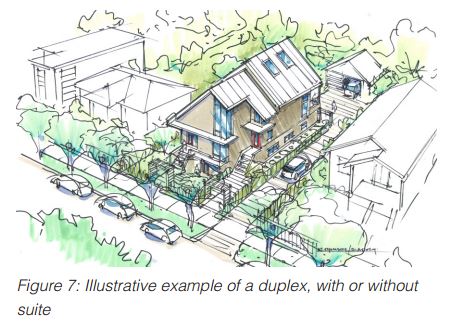
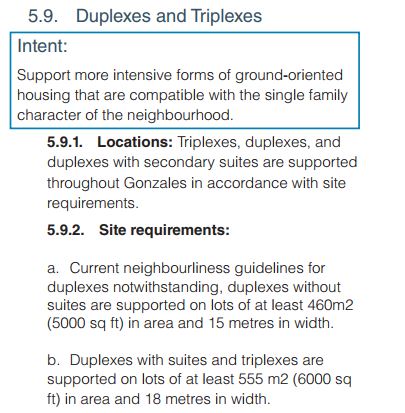
Duplexes + suites are specifically called out! This was the riskiest part of our rezoning application – that we were asking for a custom zoning because the existing two-family/duplex zoning does not allow suites within the duplex.

While we’ve heard in principle that the city wants more of this type of infill, and the Official Community Plan refers more generally to it, there is currently no zoning to support it. So having a nearly official document explicitly name what we are proposing is very encouraging.

Thanks to all of you who have followed along and supported the project so far!
 

Filed Under: Featured, Rezoning Tagged With: duplex + suite, infill, rezoning, ultra low energy

Choosing a Builder

June 24, 2017 by clove 1 Comment

For a successful Passive House or ultra low energy project, it’s important to bring your builder on board early – especially if you want one for a reasonable budget. Material, assembly, and detailing choices will all impact cost, and your builder will have the best insight on these impacts. On top of this, the local construction market is hot right now and some builders are booking a couple of years out. Planning ahead in any case is a necessity.

While a year or two ago, there was only one builder in town who had built a Passive House (shout out to Mark Bernhardt!), we now find ourselves in the enviable position of having several excellent choices.

We narrowed our search to three builders: NZ Builders, Bernhardt Contracting, and Interactive Construction. I have gotten to know all three through the Passive House community and my work at RDH, and all three are passionate about building ultra low energy homes. I mention them all because any one would be an excellent choice depending on the needs of your project. All three builders have at least one Passive House as well as other net zero/ultra low energy homes under their belts.

The downside to having these choices was that we’d have to say no to two of them – something I was not looking forward to. Matt and I took a similar approach we’ve taken when buying a house: establish our criteria, do our best to keep emotions out of it, and make the most rationale decision. Hiring a builder does add another layer of complexity over buying a house, though, because you are choosing not just the end product you think you will get, but also the person you will work closely with over the next year or more.

So what did our choice come down to? Prior experience was a prerequisite, but here are the other criteria we considered:

  • Enthusiasm and experience working with the existing house and materials:

How keen were they to work with the existing 100-year-old structure (framing, walls, roof) and existing materials (like our fir floors, solid wood doors, and bricks from our three chimneys)? Yes, it may ultimately be easier (and cheaper) to tear down and build new, but that is not what our design is about. Our existing house has a lot of good material in it. It shows none of the telltale signs of rot or other structural damage, and our design was specifically intended to preserve as much of the existing house form and materials as possible – and to look that way. If we were going to tear down and rebuild, the design would have been completely different.

The marriage of old with new. Rendering Mark Ashby Architecture


  • Crew size and proposed construction duration:

The ability to build as quickly as is reasonable will save us financing costs, as well as the amount of time we need to live/rent somewhere else. Available crew size varied and estimated construction ranged from 7 to 12 months.

  • Budget input:

We didn’t ask for a budget, but did ask for their input on whether they thought our budget was feasible. They all said No! The cost of materials has skyrocketed in the past year, and there is a severe skilled labor shortage locally. Our original construction budget of $600-650k, which seemed entirely reasonable a year or two ago, is now laughably low. Let’s all have a good laugh (cry) and move on, because we’re now likely to be pushing the $1M mark. On the plus side, the value of real estate has gone up significantly as well. Such is the inherent risk in development.

Budget projections from all three builders were in the same range for a new build, although a builder won’t do a detailed budget until you have signed on the dotted line. The number can vary widely depending on interior finishing choices that are largely up to us. Renovation costs are also more variable and depend heavily on what we find behind the walls and what we want to do with the interiors.

Hourly labour costs did vary between the builders and this was a factor in our decision-making. But again, difficult to judge whether that automatically leads to a more expensive project – especially if one builder places a heavy emphasis on upfront planning and another flies by the seat of their pants.

As one of our project goals is to reduce our cost of living, we will have to keep a close eye on budget and likely make some difficult decisions to keep costs within a range we are comfortable with.

  • Fit:

Fit was the toughest criteria for us to evaluate objectively. Is there a fit with our values, as well as how we think and work? Do they approach their work the way we do in terms of problem solving and attention to detail? How do they respond to our ideas?

I recommend spending a good amount of time talking with any builder you are considering, because this one comes down to intuition more than any other criteria. We also talked to people who have had homes built or renovated by each builder, and toured works in progress. In this exercise, we were looking at attention to detail and quality of finish work (but not necessarily the actual finishes, which reflect owner’s preference not builder’s skill). We were also listening for how the crew communicated with us and with each other.

In the end, our evaluation against our criteria led us to sign on the dotted line with Russ Barry at Interactive. Our signed letter of engagement allows Russ to slot us into his project schedule (likely for late this year, depending on our rezoning timeline).

Now what? Next month, we will meet with Russ and Mark A to hash through assembly details – from a Passive House performance, buildability and cost perspective – and firm up those pieces. This will allow Russ to develop a more detailed budget, and will allow me to refine the Passive House model. Closer to the start of construction, and before he starts ordering materials and otherwise committing financially to our project, we will need to give Russ a deposit to the tune of $30,000.

And of course, we are still waiting on rezoning, so we won’t get too far ahead of ourselves until we clear that hurdle. Stay tuned and enjoy our beautiful summer weather in the meantime!


Filed Under: Construction, Featured Tagged With: construction, passive house, ultra low energy

Inching Ever Closer to Rezoning Approval

June 2, 2017 by clove Leave a Comment

We submitted our revised rezoning package March 14 and received comments back from the City last week. We waited longer than we’d hoped for this response, but I’ve come to accept that things taking longer than hoped is standard operating procedure when developing a project.

Granted, we also threw a couple of wrenches into the process by pushing back on two of the City’s requests from the first round:

  1. The City asked us to provide an additional 1.4 m Statutory Right-of-Way in addition to the 1.0 m already required between the property line and the back of the parking stall (see this post for details). In Round 2 of comments, they have removed this request. Phew! As one of our project goals is to preserve as much backyard green space as possible, this is an excellent outcome. We can now move the building closer to the front of the lot as originally intended.
  2. The City had also asked if we were willing to sign a covenant to show we are serious about pursuing Passive House. Initially, we said yes to keep things moving, but then we thought about it some more and talked to a few friends about their painful experiences with covenants, and concluded that we’d be better off avoiding if possible.

A covenant is a legal encumbrance that gets attached to a property and stays there for the life of the property (in some cases), or is there until you have met certain conditions and it can be removed. In our case, the covenant would say that we are designing and building to the Passive House standard and when the city is satisfied that we are indeed building to the standard, then the covenant can be removed. The problem is that both the adding and removing of a covenant means thousands of dollars in legal fees that provide no lasting benefit to the project.

If we weren’t proposing to go well beyond code, we wouldn’t be facing these legal costs. So we are being penalized, not encouraged, for going above and beyond. This didn’t feel right and we believed it wasn’t what the City was going for either, so we wrote a letter suggesting that we instead demonstrate that we have engaged a Passive House Certifier to review and certify the project. This in itself is a several thousand dollar endeavor – but at least it is one that will have a lasting benefit on our project.

The City of Vancouver takes a similar approach. In Vancouver, Passive House is an accepted rezoning path – meaning, to rezone in that city, you have to go better than code minimum, and Passive House is one approved way to get there. No covenants are required, but their code inspectors have the authority to shut down a job site if they find that you are not building to the permitted documents. They also now have several Passive House trained staff, one of whom will be assigned to your project to help you work through the process.

Happily, the City of Victoria appears to be in agreement (or at least not opposed?), and asked us to update our letter to Mayor and Council to reflect this proposed approach.

Next Steps: We now have to update our drawings to remove any reference to the extra Statutory Right-of-Way, respond to a few other minor comments, update our letter to Mayor and Council, and resubmit the whole package.

We think this means that city staff are now preparing their report to the Committee of the Whole, which is a group composed of staff and council and is the last stop before our public hearing. With a little luck we will have an approved rezoning application in hand by mid-summer.

One step closer!

Filed Under: Featured, Rezoning Tagged With: passive house, rezoning

Argh, Parking! (Responding to City Comments Part 1)

February 17, 2017 by clove Leave a Comment

Lest you surmise I’ve been idly twiddling my thumbs for the past 3 months, I’m overdue to lift my head and share an update.

Besides shivering through Victoria’s longest cold snap in over 30 years, we’ve been working on 2 big things:

  1. Responding to the first round of city comments on our rezoning application.
  2. Completing the Passive House PHPP model.

I’ll cover the first item here. See this post for the Passive House model update.

We received our first round of comments back from the city on December 22 –  four weeks after we’d officially submitted. When I first reviewed the comments, I felt discouraged, as there appeared to be a long list of issues. But Ian, our planning consultant, pointed out this key sentence at the beginning of the letter:

The application as submitted can be considered with the land use policies relevant to the property.

Ian thought this was an excellent response. It is saying, albeit obliquely, that the city is likely to support our application, provided we address their comments. Great!

Ian and I met with the planner responsible for our project to clarify some of the comments. Nothing earth shattering resulted from this meeting, but it was good to have the face time and confirm that we understood their intent.

There were two major comments that affect our design: parking and roof lines.

Parking:

I long for the day when the level of consideration, money and space we devote to places to put our cars do not vastly overshadow the resources we devote toward places for people to actually live. Alas.

The rules around parking are largely inflexible and at odds with our desire to preserve green space on our urban lot. At the same time, the more we push the rules, the longer the timeline drags out and the less certain our outcome becomes, so we’re working toward a reasonable solution that satisfies city engineering but does not compromise our project goals.

We’re required to provide 2 off street parking spots for a duplex (the secondary suite does not require a third spot thankfully). Our neighbourhood has a precedent to allow for front yard parking, which we are invoking to preserve as much back yard space as possible.

One of the unbendable requirements is a 1.0 m setback from the rear of the parking spot to the property line. In the initial review, the engineering department also asked for an additional 1.4 m right of way in the front yard. Why? Because they might one day widen our entire block from the current 15 m street width to the more standard 18 m. Really? We already have sidewalks on both sides, parking on both sides, and boulevard green space between the sidewalks and street. The narrowness of our street also has the desired effect of slowing vehicle speeds. Sounds OK to me.

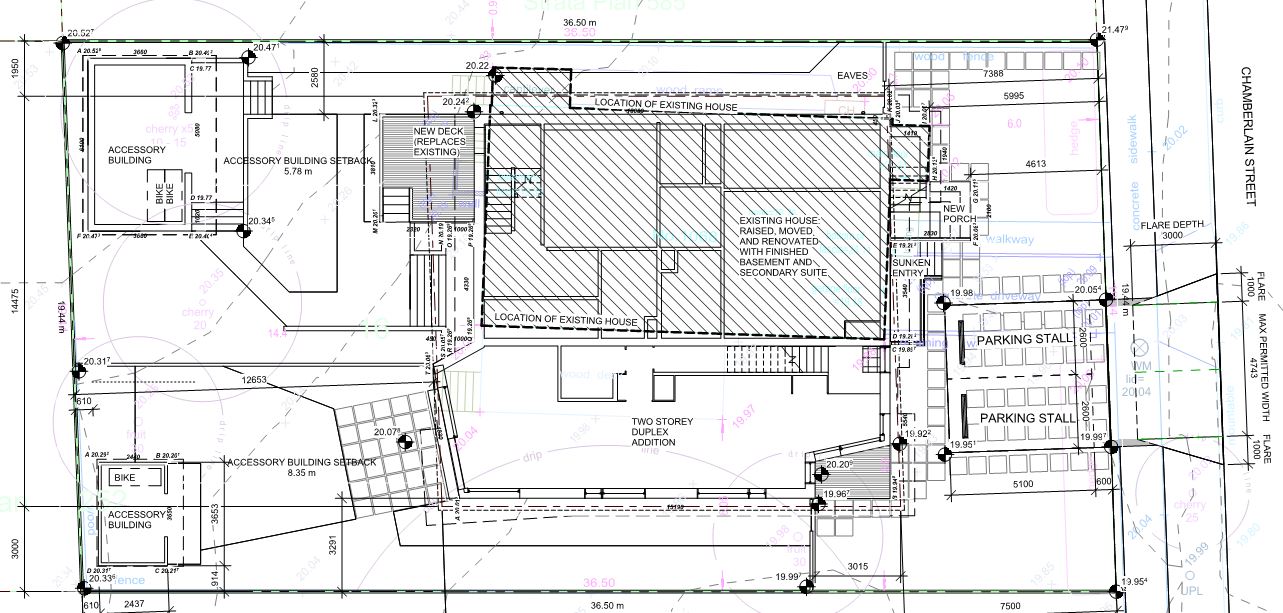
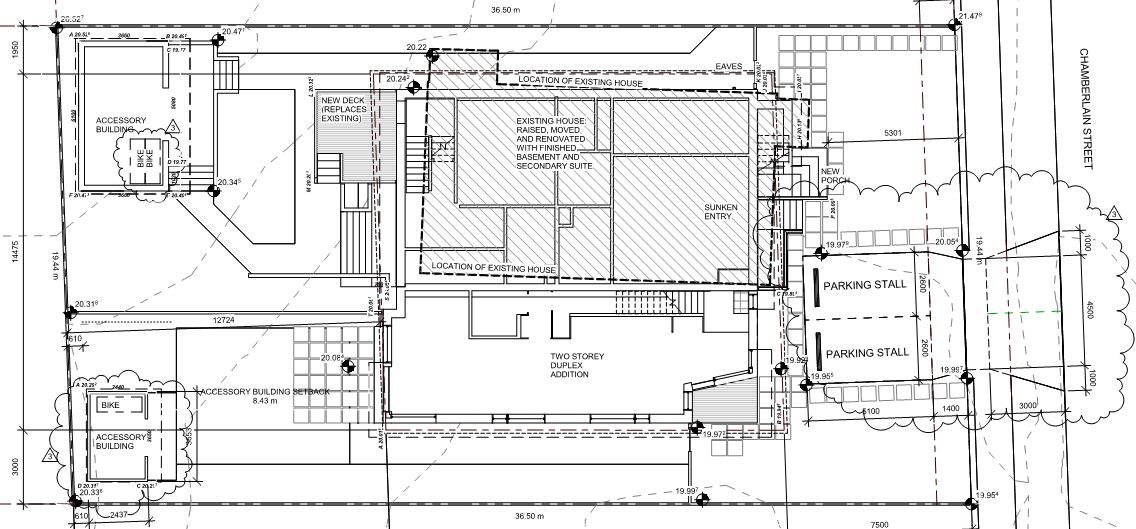
We do not agree with this request, nor is there any policy requirement that we grant this request. So we’ve decided to provide 1.4 m total, not 1.4 plus 1.0 m, as a compromise that we feel is likely to be accepted. Here’s how the design has evolved as a result:

Before: We were just a hair short of the 1.0 m required between the end of the stall and the property line, but thought we’d give it a shot:

After: We’ve shifted the house back 0.7 m and shortened up the back end of the new addition to achieve the 1.4 m setback at the front without infringing on rear setback limits:

This design change has the added bonus of simplifying the enclosure shape, which is good for Passive House, and we’re pleased with this evolution.

Roof Transition:

The City questioned the transition between old and new roofs. Something wasn’t working, and they rightly pointed out a weakness in our design, if not a simple lack of clarity.

We bandied about the idea of a more dramatic change to the existing hip roof to a gable roof. In addition to being a bolder shape, a gable roof would open up the potential for a loft space, vaulted ceilings and other cool design elements.

But then we thought through the implications – changing most of the roof line, extending the walls up to create the gable; interior redesign to include a stair or other access to the loft space, and potential zoning floor area restrictions we might now bump up against. Besides the fact that our existing house would no longer resemble its original self, there were a whole host of ripple effects that were going to add cost and stretch out the project timeline.

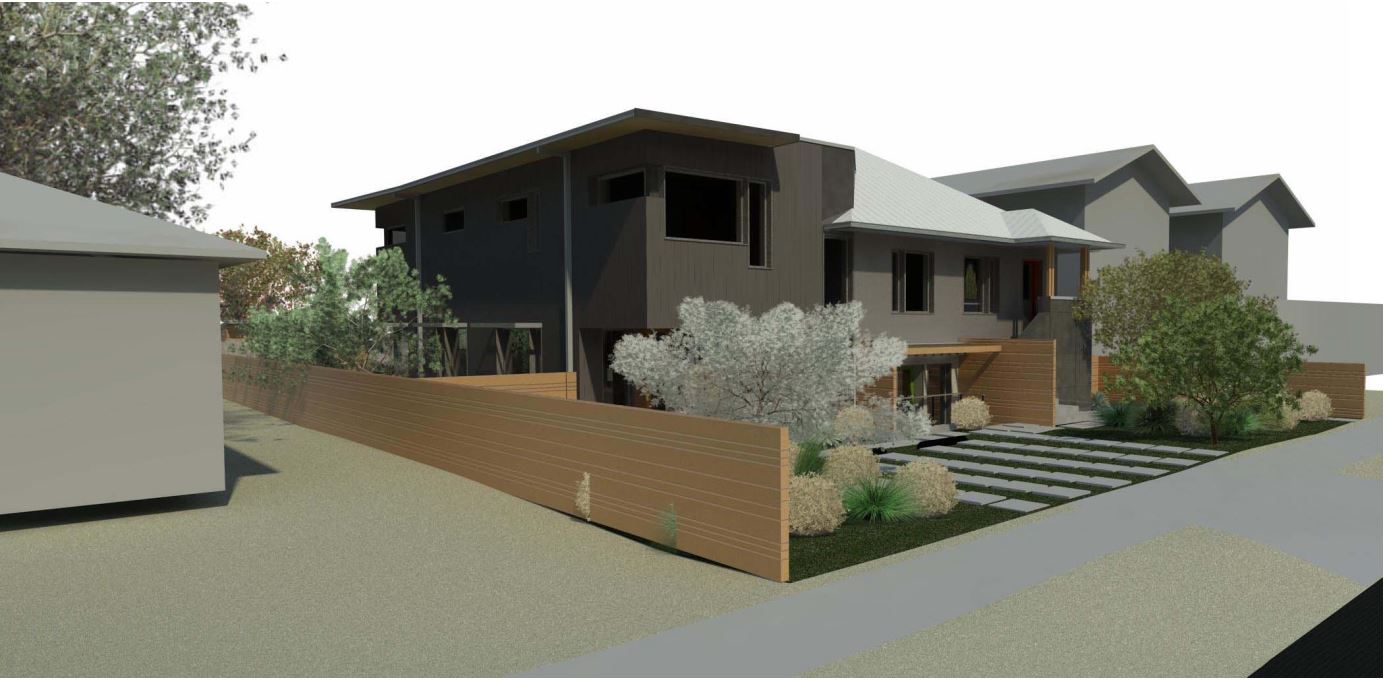
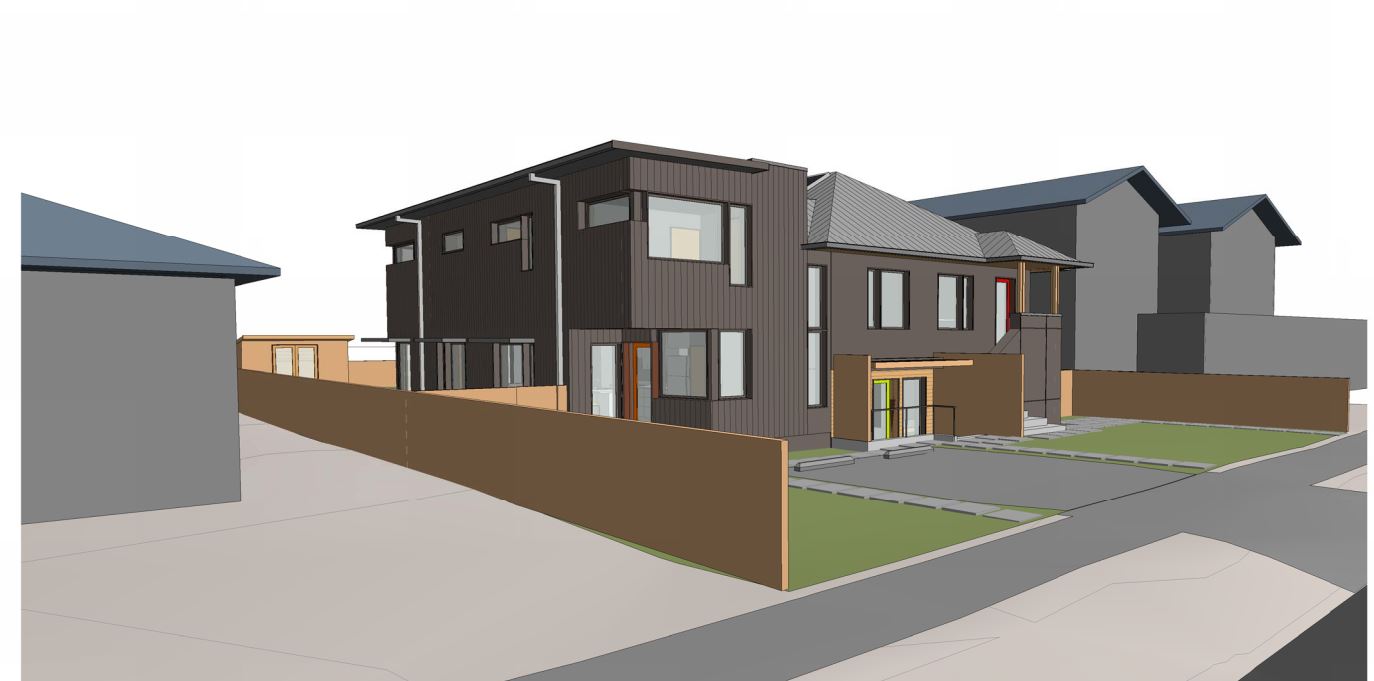
Fortunately, though, as the creative process often goes, this exercise led Mark A to a more elegant solution for the hip roof, which is what we chose to stick with. Here is the before transition from old to new:

And the after:

Renderings by Mark Ashby Architecture

We’ve been working on these revisions for the past six weeks. When complete, we will submit an updated set, a revised letter to Mayor and Council, and an updated narrative. We may get another round of comments, or if all goes well, we will move on to the meeting of the Committee of the Whole – one step closer to rezoning approval, and we’re holding firm on our current goal to be under construction this summer!

Filed Under: Design, Featured, Rezoning Tagged With: energy efficient design, infill, rezoning, ultra low energy

Over to You, City!

December 1, 2016 by clove 1 Comment

We have officially submitted our rezoning application! And don’t be silly – of course it didn’t go as smoothly as expected. One of these days, I will know better.

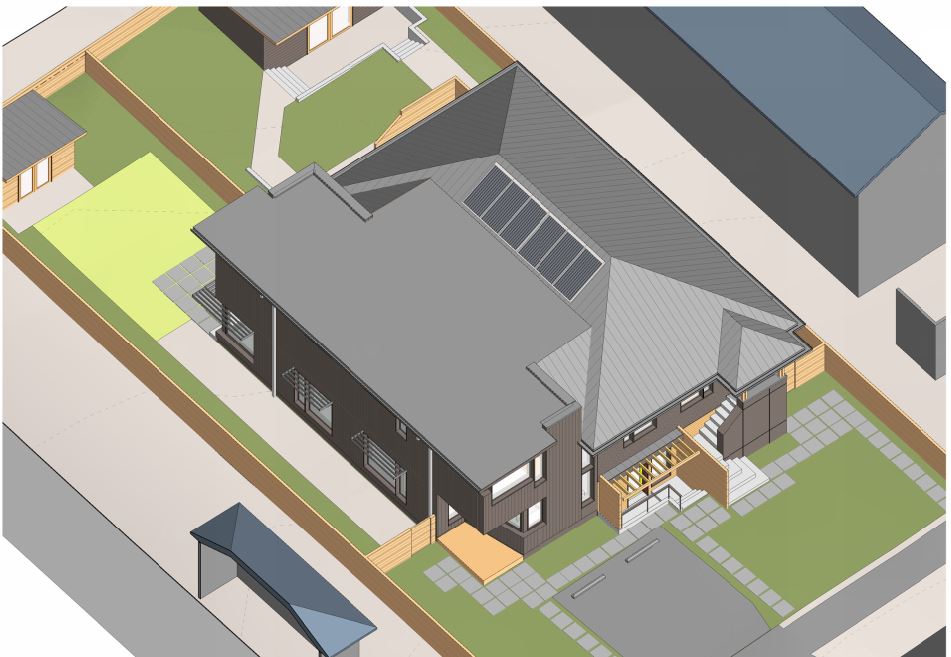
View from the northeast. Rendering Mark Ashby Architect

View from the northeast, rendering Mark Ashby Architect

A couple of Thursdays ago, I hauled 10 lbs and $120 worth of paper down to City Hall for my 11 AM appointment, including:

  • 80 sheets of 24 x 36 plans (5 sets)
  • 2 sets of 11 x 17 plans
  • 3 sets of 8.5 x 11 plans
  • letter to Mayor and Council
  • completed Rezoning Application forms
  • plus a check for $2150
  • and a flash drive with PDF versions of all of the above

At this required appointment, a staffer takes a first pass to check for completeness before your application wends it way through the various departments. I suspect this is ultimately a time saver for everyone, although it left me with a feeling that I’m navigating my way through a labyrinth with more dead ends than ways through. In reality, there is simply a lot for a first timer to wrap one’s head around and get right.

Turns out we were missing the “average proposed grade” calculation and a line indicating such on elevations and sections. We were also missing a label for the setback distance between the main structure and the accessory building.

I was told to come back again when I had corrected these omissions. I grumbled that there would be no celebrating that weekend, and grumbled louder that I had to haul the giant roll of paper back home; reprint and repeat. The patient staffer assured me that it would be quicker next time because she’d already checked everything else.

So Mark A made the requested changes, I reprinted the five affected sheets in the various sizes and quantities, reassembled the sets, and made a second trip down to City Hall the following Tuesday after work.

One thing that I thought to ask at this second appointment was about the Development Permit Application. From what I understood, the Rezoning Application is required for a change in use to a property; for example, from single family to two-family. A Development Permit Application is also required for any requested variances; for example, moving parking from the rear to the front yard. I had  been told by my planner contact that they would review both applications at the same time. Was there a separate application and fee for the Development Permit piece? Oh, yes, in fact there was. Fortunately, I was able to fill out the second application on the spot, and add the extra $750 to the $1400 check I was already writing for the rezoning.

I’m happy to report that this time, our application was accepted and the 6-8 month  processing time clock has officially started ticking!

I feel a muted celebration is in order as we await the first round of comments. We already know that adding a suite to a duplex is not allowed in the current zoning, and the staffer pointed out as much. Our proposal is well aligned with the more current Official Community Plan (OCP). Still, there is a possibility that the city will recommend rejecting our proposal on the basis of existing zoning, and we will have to appeal to City Council to vote against city staff recommendations, but in line with the OCP. We’re building exactly the same square footage as we would build if we were not adding a suite, and by adding the suite, we are adding housing diversity and affordability in an extremely efficient manner – all key goals of the OCP. So we’ll see.

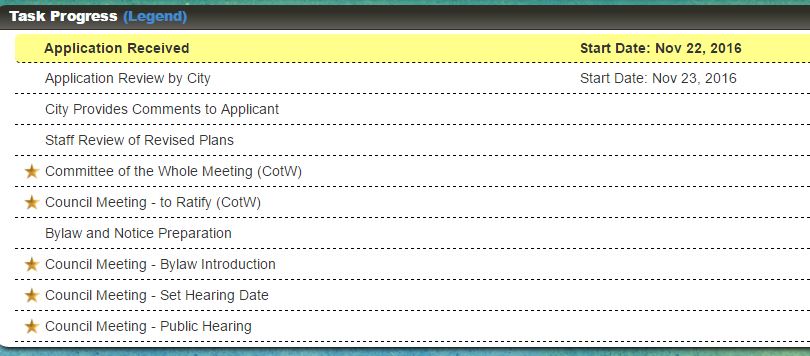
And here’s a fun feature: I can track the progress of our application (and any other application) with the City’s Development Tracker app:

development-tracker

We can expect comments within a few weeks. Stay tuned!


Filed Under: Featured, Rezoning Tagged With: rezoning, ultra low energy

Duplex Design

October 24, 2016 by clove Leave a Comment

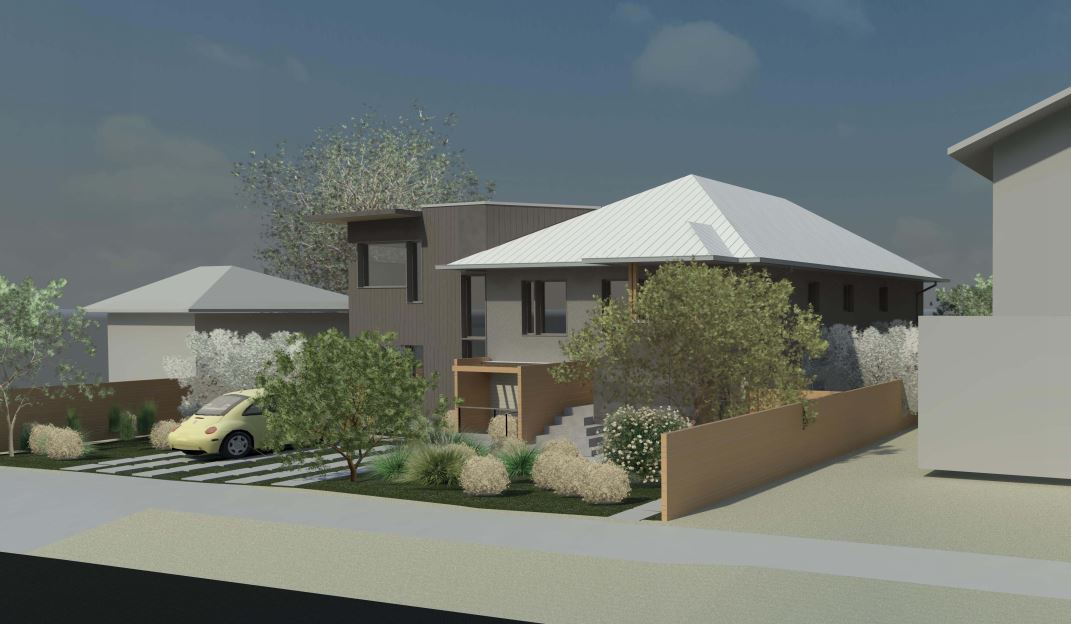
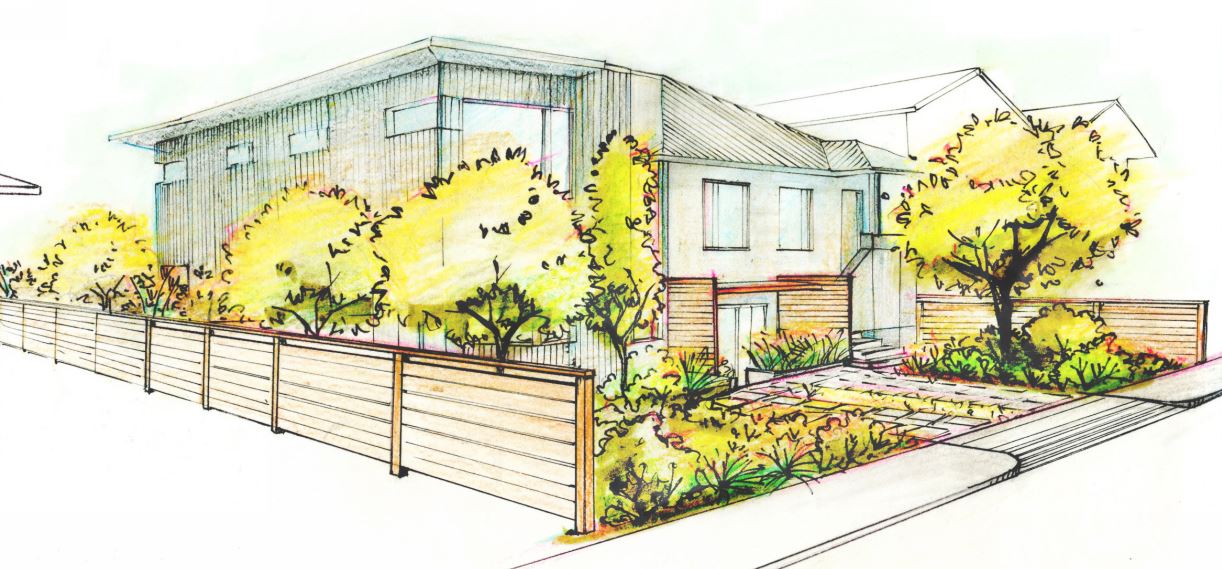
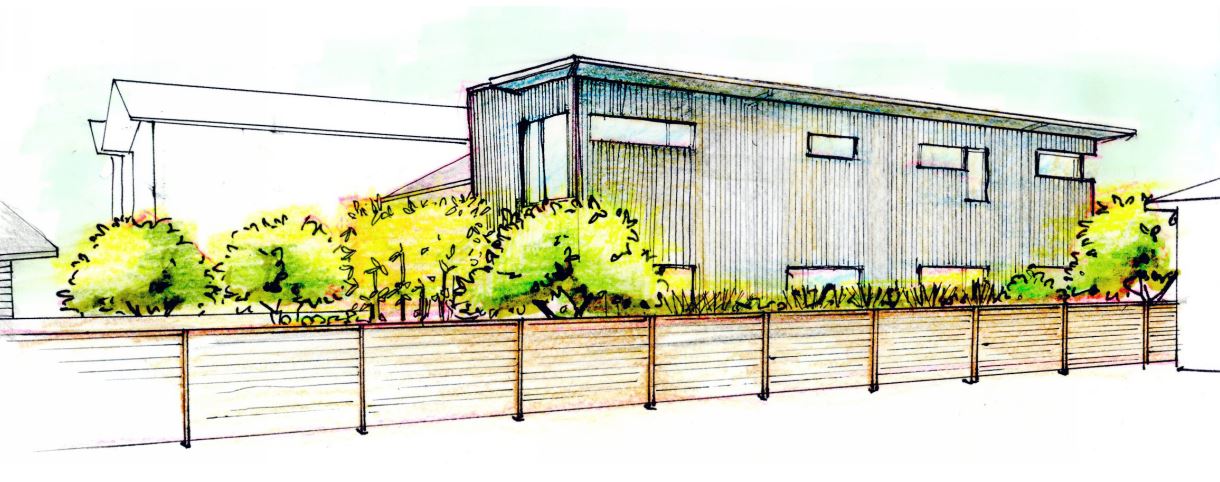
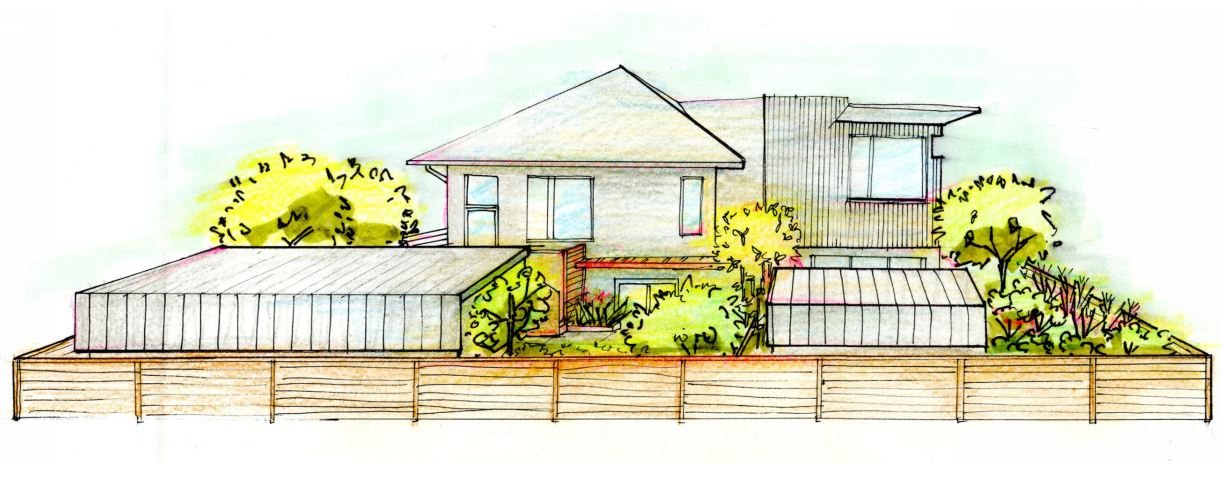
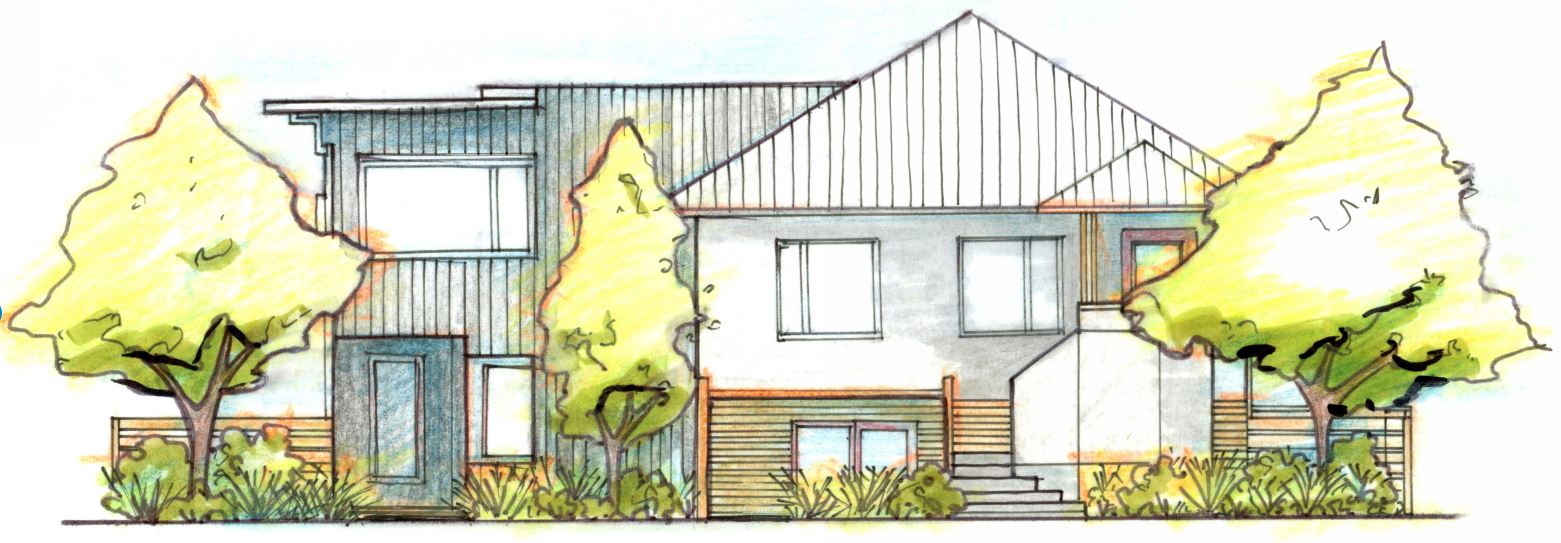
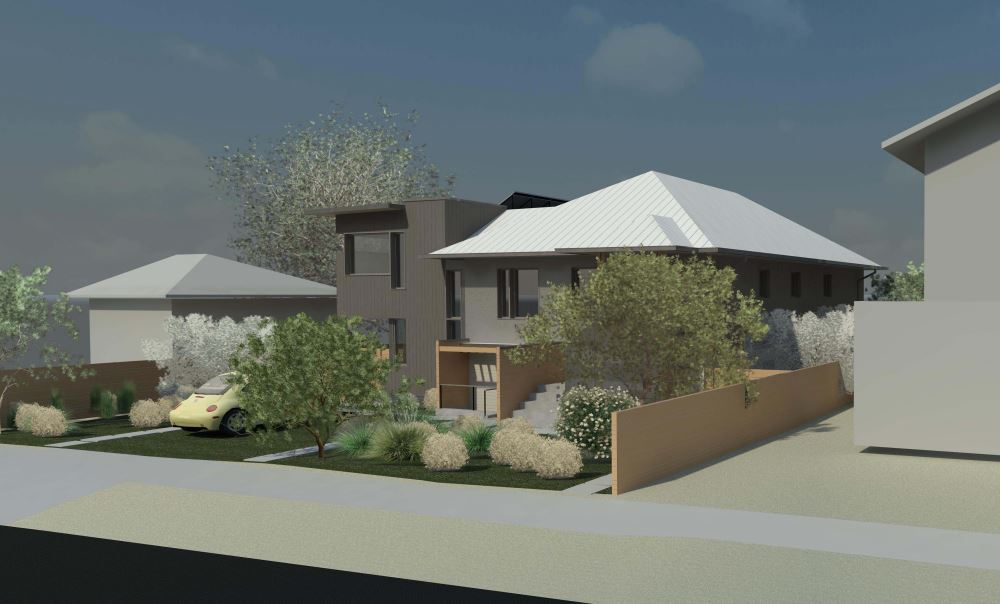
Here is the design that we presented at the community meeting last Thursday. We’re pretty excited by what Mark A and Kate have come up with.

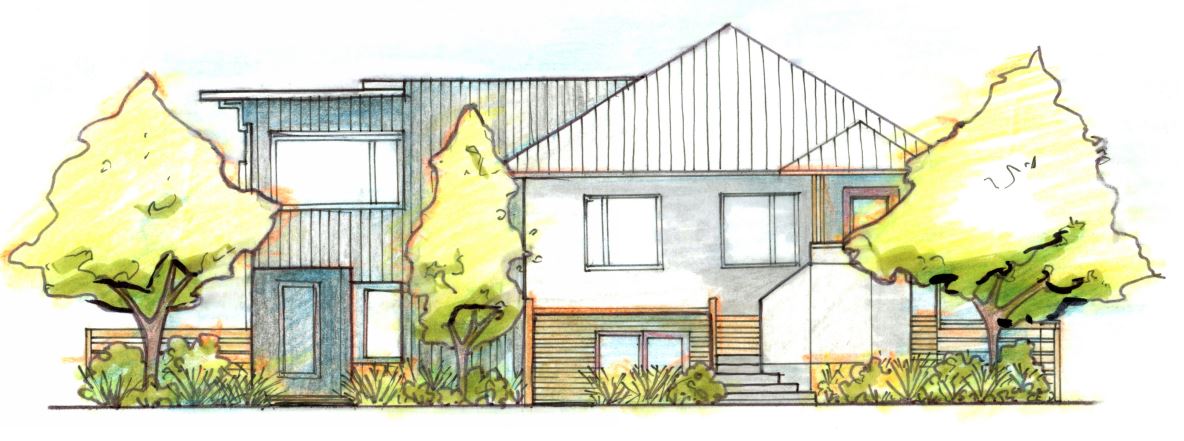
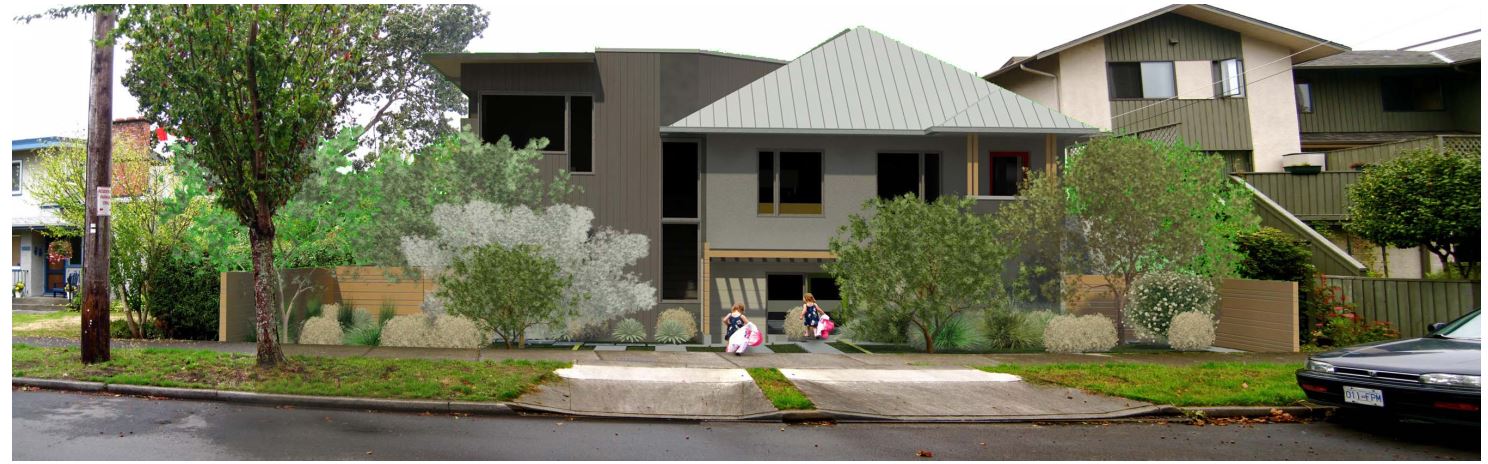
The renovation of the existing house respects and maintains the original form and roof line, while the addition is intentionally contemporary, simple and contrasting. This design strategy highlights the relationship between old and new.

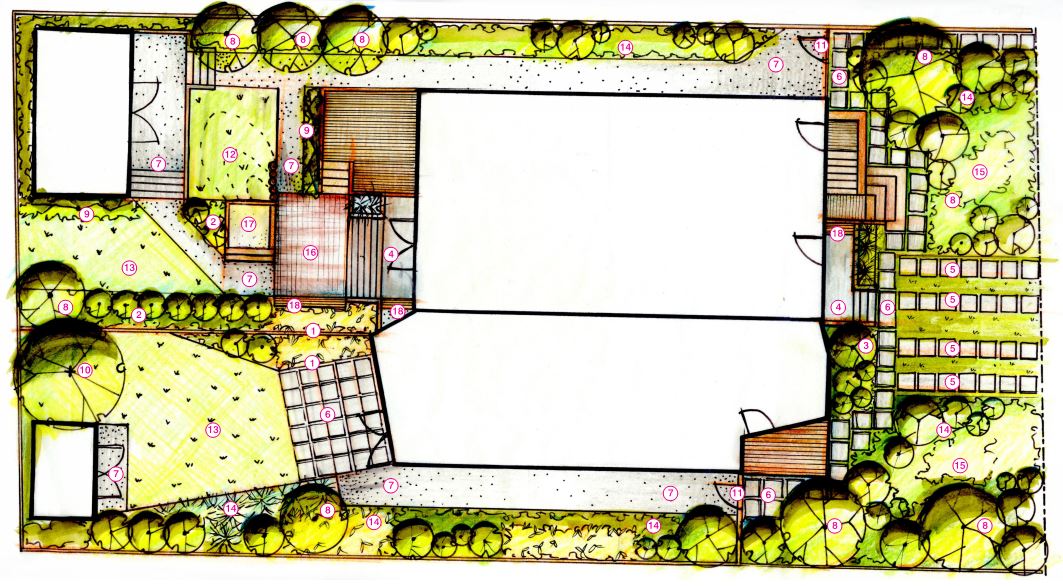
We are using traditional materials, including cedar siding and stucco, that are common throughout the neighbourhood. Deep window reveals introduced by the thicker Passive House walls add visual interest and depth to the facade. The landscaping ties everything together.


Front elevation, sketch by Kate Stefiuk

Front elevation, sketches by Kate Stefiuk


Front yard view, sketch Kate Stefiuk

Front yard, side view


Side yard from the south

Side yard from our south neighbour’s back yard

Back yard with sunken workshop

Back yard with sunken workshop


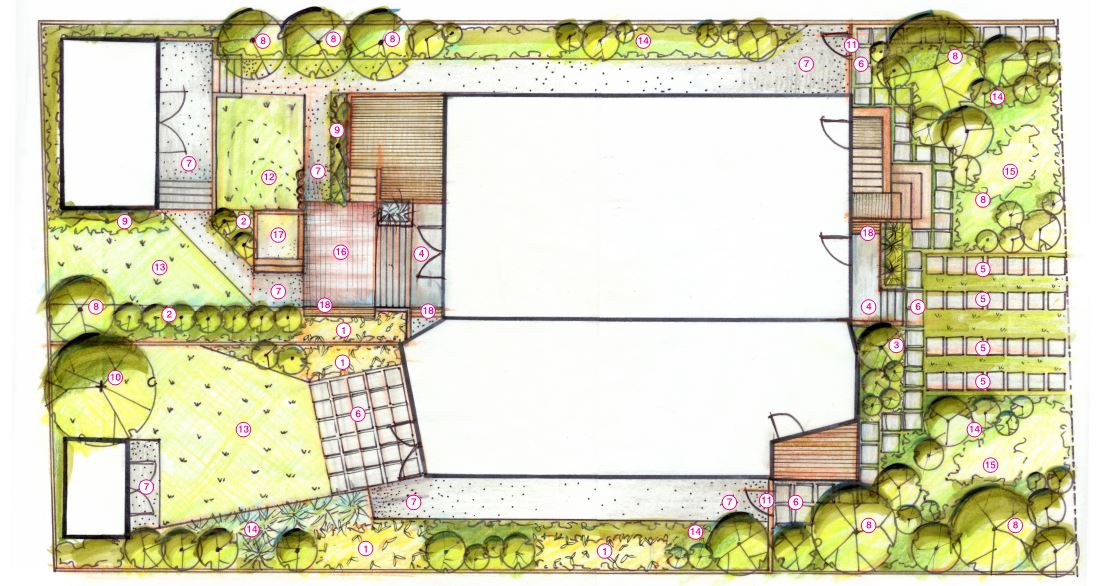
Landscape plan by Kate Stefiuk

Landscape plan by Kate Stefiuk


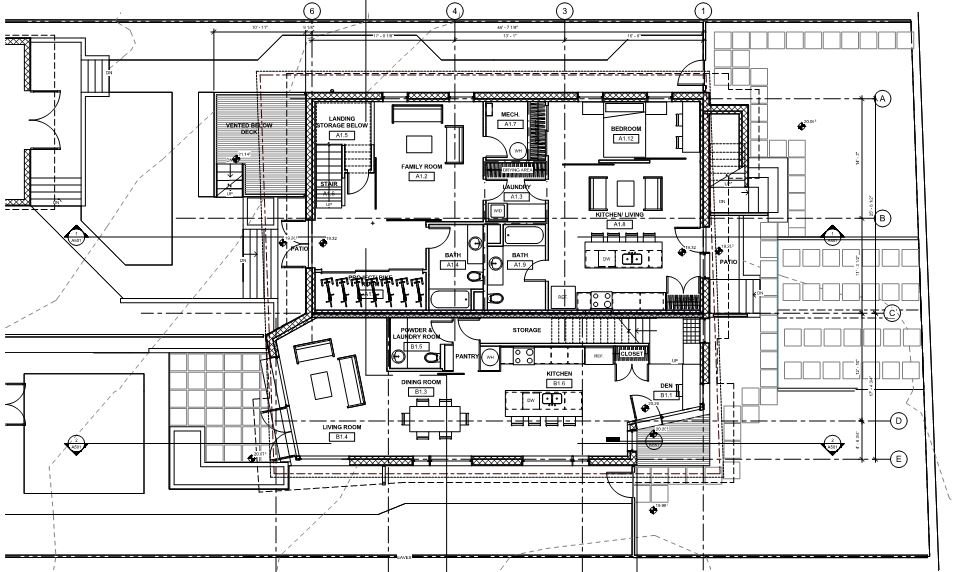
Lower floor plans, by Mark Ashby Architecture

Lower floor plan, by Mark Ashby Architecture


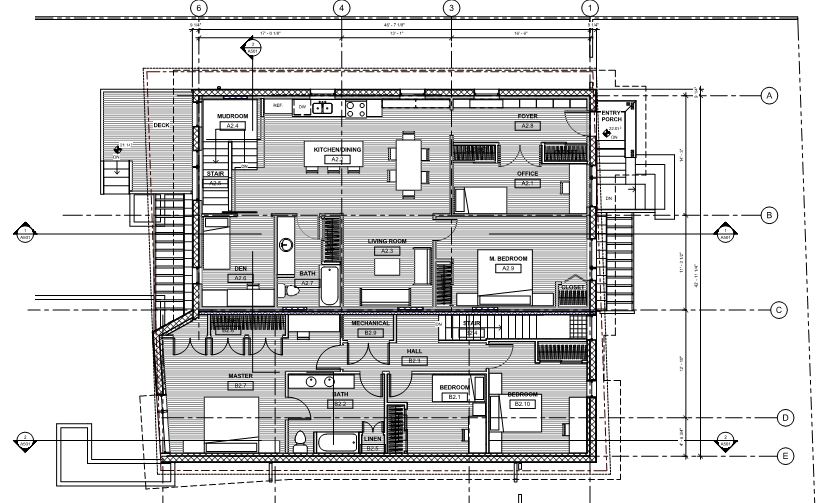
Upper floor plans

Upper floor plan


Streetscape, by Mark Ashby Architecture

Streetscape, by Mark Ashby Architecture


Filed Under: Design, Featured Tagged With: design, duplex, energy efficient design, low energy design, net zero, ultra low energy

The Path to Decarbonization and Net Zero Energy

October 13, 2016 by clove Leave a Comment

We’re targeting net-zero energy consumption and zero carbon emissions in the operation of our post-project home. Say what?

Net zero energy means that, on an annual basis, we generate as much energy as we use. So unless we have an oil well on our property, we are drastically reducing both our fossil fuel consumption and our utility grid dependence. Zero carbon emissions simply means that we don’t burn any fossil fuels to operate our home.

A home could use one or more different sources of site-generated renewable energy – solar photovoltaics or solar thermal, for example. I’m keeping things simple for the moment by assuming that we will only use solar photovoltaics to generate electricity. Unless we include battery storage, we will still be drawing electricity from the grid when the sun isn’t shining or when our demand is higher than our panels can provide. But in a place like BC that has a net-metering program, we will also be feeding back into the grid when we’re generating more than we need.

So can anyone just plunk a bunch of solar panels on the roof and viola: net zero energy? Not so fast. With the amount of energy most houses use today, you’d need a much bigger roof than you have. Allow me to demonstrate with our existing house.

In an earlier post, I estimated our current annual energy consumption to be about 13,270 kWh per year, or ~120 kWh/m2 of conditioned floor area, based on our first 6 months of utility bills. This is actually an ok number given that we have three chimneys, single pane windows, and all sorts of leaks and drafts. It’s about 45% lower than the average Canadian home and on par with the Germans. We turn things off when we aren’t using them, but we also shiver through the winter with an inadequate heating system.

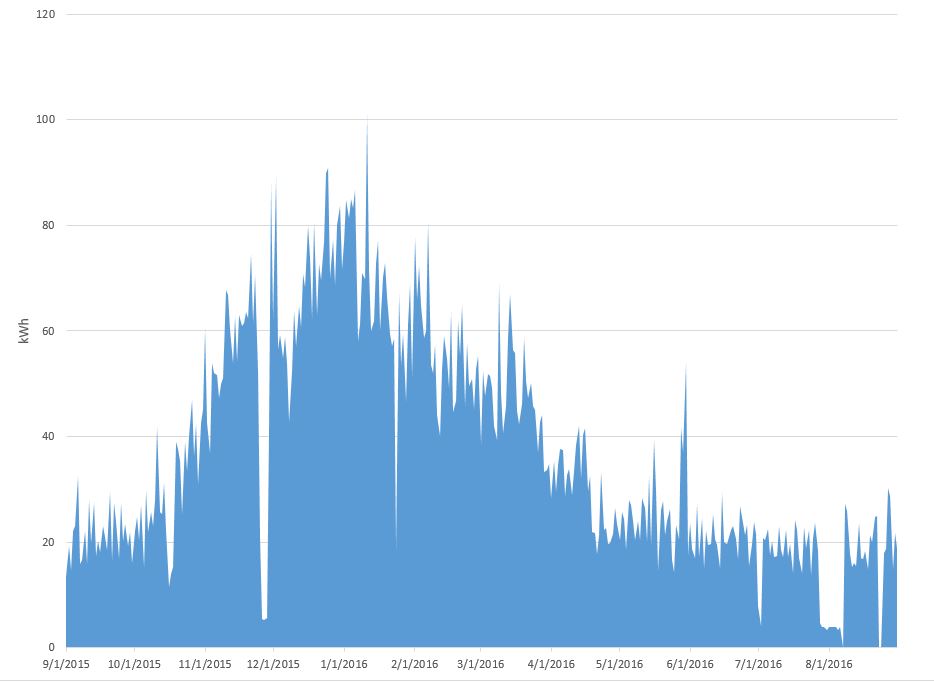
We now have a full year of electricity consumption data to update my earlier guestimate. Our actual one-year consumption was 13,700 kWh, or 123 kWh/m2/year. The daily consumption curve looks like this:

Full year of energy consumption for our existing house

Full year of energy consumption for our existing house

The ‘curved’ part is the energy we used for heating. If you drew a straight line across the flatter portion of the graph, the area below the line would roughly represent our non-heating energy use, which stays relatively constant throughout the year.

So that’s the energy demand side. Let’s now turn to the solar PV question.

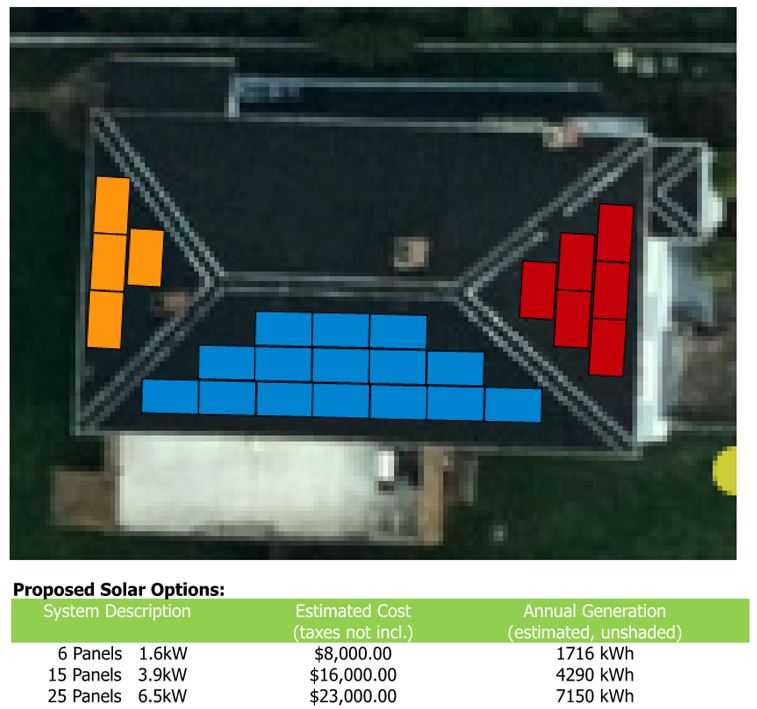
I called up Power to the People, who will do a free, high level evaluation of the solar potential of your house, based on a google earth analysis, some rules of thumb, and an assumption that your roof is not shaded. Here’s what their evaluation spat out for our existing house:

Power to the People Solar PV Analysis

Power to the People Solar PV Analysis

If we covered our south, east, and west roofs with panels, we could generate 7150 kWh annually. This is a little over half of our current consumption. We would have to reduce our consumption by nearly half to achieve our next zero energy vision using only solar PV.

Is this even possible? The Passive House approach promises a 90% reduction in heating demand by focusing primarily on the design of the building envelope. According to my rough estimate, about 50% of our current consumption is for heating.  So it would be doable if we both dramatically reduced our heating demand by improving the envelope and found some additional ways to save. I predict, for instance, that my long hot shower habit will be curbed when our house feels warm and comfortable in the winter. We’ve also heard that people who live in passive houses do not use dryers because the heat recovery ventilator helps clothes dry so quickly.

So we think it’s challenging but doable, and our example illustrates two things:

  1. The first step must be to reduce demand through passive strategies, like extra insulation, increased air tightness, and better windows.
  2. The way you live in your house matters too! Turning off lights and electronics, limiting long hot showers and dryer use etc. The lower you can get your energy demand, the more likely you can meet your annual average with site-generated energy.

One of the most exciting prospects about following the passive house approach is that we can reach our goal while feeling WAY more comfortable and having WAY better air quality. Win win!


Filed Under: Featured, Performance Tagged With: energy consumption, energy efficient design, passive house, performance, ultra low energy

CALUC, Here We Come!

October 10, 2016 by clove Leave a Comment

We are presenting our duplex proposal at the Fairfield Gonzales Community Association Land Use Committee (CALUC) on October 20! The Association’s political struggles have sufficiently abated that the Committee has resumed its activities.

Everyone who lives or runs a business within 100m of our property will receive a letter inviting them to the meeting, and anyone can attend. We present our plans; neighbours ask questions and provide comments, and the CALUC records those and submits them to the city. Depending on the comments received, we may make some revisions before submitting our official rezoning application. Then the 6-8 month clock starts ticking as our application wends its way through the various city engineering and planning departments.  If all that goes well, we present at a Public Hearing, at which City council votes yay or nay to approve our application.

Then we apply for our building permit and then we can put shovels to the ground – phew! With a little luck, we’ll get rolling with construction early next summer.

We are still tweaking a few things, but here’s how the design is shaping up.

Front Elevation, sketch Kate Stefiuk

Front Elevation, sketch by Kate Stefiuk

Landscape plan, sketch Kate Stefiuk

Landscape plan, sketch by Kate Stefiuk


Filed Under: Featured, Rezoning Tagged With: community engagement, neighbourhood engagement, rezoning

Attached Duplex Design is a Go!

July 17, 2016 by clove 2 Comments

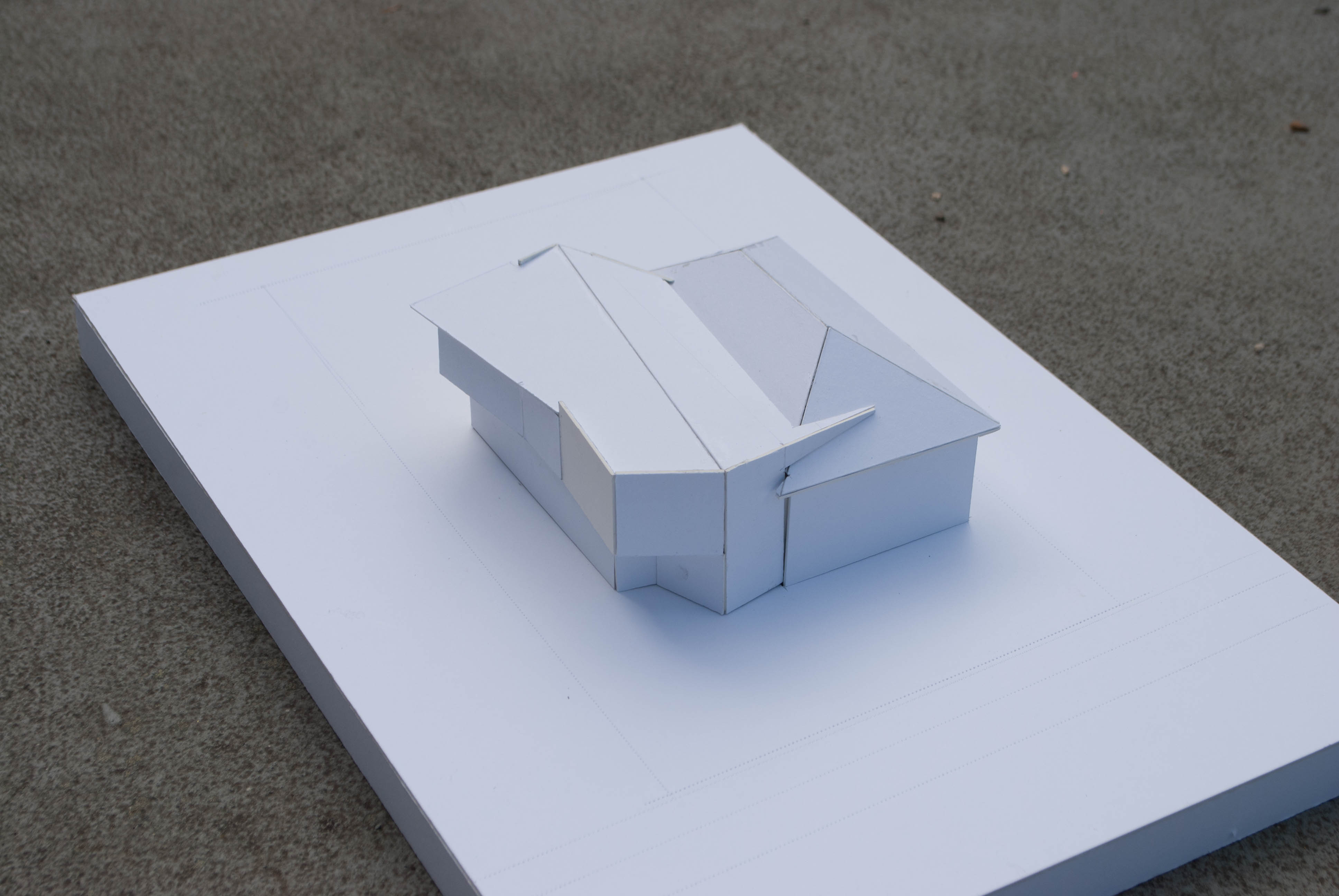
Attached model experiments by Mark Ashby

Attached model experiments by Mark Ashby

We’re going ahead with a new attached duplex design! Here’s why:

  • The attached option addresses some neighbours’ concern that the small lot house would have been too close to our neighbours. The attached option creates more space on the sides and fits better on our lot.
  • The attached option provides more distance to the large Garry oak in the adjacent yard to the south – better for its roots and less shade for our rooftop solar photovoltaics.
  • I’ve identified at least a couple of lending options that are viable for the attached option.
  • The massing is better for energy performance (less exterior walls = less energy lost through the envelope).
  • The approval process is simpler – we can meet the two-family zoning regulations with fewer variances and no longer need to collect petition signatures.
  • The city fees for the rezoning application are lower and we eliminate city subdivision fees (which amounts to savings of $5,000-$8000).

If we were set on the small lot subdivision option and were willing to wait a while, we might have been able to get it through. But the attached option does meet our needs and we do want to get the project going, so it felt like the best solution given the circumstances.

The design in now in progress and we’ll share renderings soon. One of the debates we’ve had is how to design an addition to an old existing house. Do we blend the design so that it looks like one unified whole? I think if we were designing from scratch we would do that. But to make the structure look like a unified whole, we actually would have to change the form of the existing house dramatically – particularly the roof.

We believe that the best way to honour the existing home and to retain as much of its existing structure as possible is to create a marked distinction between new and old. Mark A is taking a sculptural approach to the addition to contrast with the existing form and work with the existing roofline. Not an easy task, and we’re thankful we have an architect like Mark working out the details.

I had hoped to present the design at the mid-August Fairfield Gonzales Community Association Land Use Committee (CALUC), but discovered that the committee has been disbanded. Well, temporarily at least, as the group reconciles its status as a charity organization with its role in land use development issues. I am attending a community meeting to learn more. Stay tuned and in the meantime, enjoy the sun!


Filed Under: Design, Featured, Rezoning Tagged With: design, energy efficient design, rezoning, ultra low energy

Checking in with the City

June 10, 2016 by clove 2 Comments

I met with the City Planner responsible for rezoning applications for a second time. I’d met with him much earlier in the process to present our small lot subdivision concept. This second meeting was to update him on our progress and to establish whether the planning department had a preference for the small lot subdivision or the attached duplex path. I had already poured over the respective rezoning requirements for both options, but I found that the duplex design guidelines were much less detailed than the small lot design guidelines.

The planner confirmed that, in terms of design, a small lot subdivision and duplex application are evaluated similarly. In neither case does his department judge a project based on whether it is a contemporary or a traditional design. They look more at elements like scale, form, variation in materials, and landscaping that reference dominant features in the neighbourhood. So that was good news.

I also followed up with calls to other city departments that will be reviewing our application. Here’s what I learned:

  • For the small lot subdivision, we can either add two curb cuts or one larger curb cut to serve both properties. The city has a slight preference for a single larger curb cut because it takes up less overall street parking space. An attached duplex will need two curb cuts spaced a minimum distance apart. We’ll want to have these details worked out before we submit to minimize redesign work.
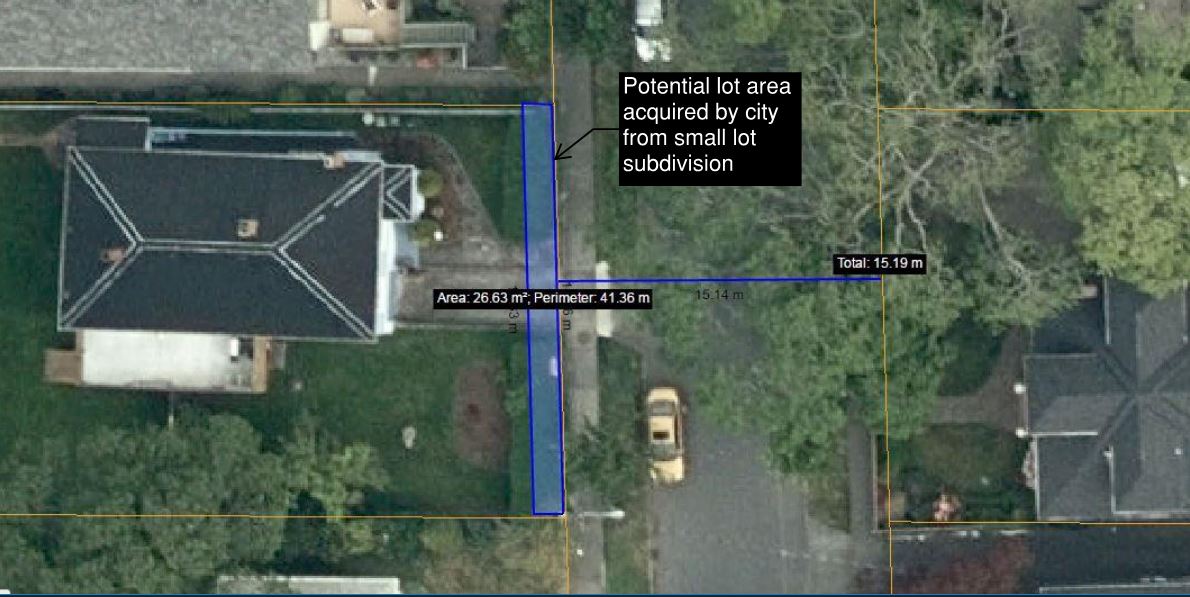
  • Here’s an interesting one: For the small lot subdivision, the city will ask for up to 1.5 meters of the depth of our lot as a dedication for widening the street. This is because our street is only 15 m wide and their standard is 18 m. So the city uses the subdivision as an opportunity to gain back up to half the missing road width, which they can then use to widen the boulevard or plant additional street trees. Here’s roughly what that would look like:

Small Lot Right of Way

  • The takeaway: make sure the small lot meets the minimum 300 sq m area with a 1.5 m swathe removed from it. With the current proposed property line location, one lot would dip below the minimum with that strip removed, and could potentially be rejected.
  • For the attached duplex option, this would not be a requirement. Score one for Plan B.

I hope that I will soon reach a point when I stop learning surprising new things every time I talk with someone about how to make our project happen. What I will say about working with the City of Victoria is that, while the rezoning process is an onerous one, its staff are available and willing to provide guidance. It’s easy to set up a meeting and if I call someone, they call me back within a couple of days. The trick is to figure out what questions you need to ask.

As we find answers and continue to hear input from others, Matt and I are solidifying our plan and feeling confident in our path forward. More to come soon!


Filed Under: Featured, Rezoning Tagged With: duplex, rezoning, small lot subdivision

  • « Previous Page
  • 1
  • …
  • 3
  • 4
  • 5
  • 6
  • 7
  • Next Page »

Who is Stretch Developer?

Stretch Developer is written by Christy Love. In partnership with my husband Matt, we are challenging ourselves to create the kind of homes we want to live in and see more of in our community. Home is the incredible Victoria, BC, Canada.

Sign up!

Sign up to receive email notifications of new posts.

Recent Posts

  • New Uses for Old Wood Part 2 September 26, 2021
  • Ongoing Preparations for the Apocalypse August 13, 2021
  • Things We’ve Noticed – Energy Edition May 29, 2021
  • Passive House Suite for Rent April 17, 2021
  • Things We’ve Noticed – Comfort Edition March 14, 2021

Blogs We Like

Green Building Advisor Blogs

Musings of an Energy Nerd

Treehugger

Talk to ARYZE

Recent Posts

  • New Uses for Old Wood Part 2
  • Ongoing Preparations for the Apocalypse
  • Things We’ve Noticed – Energy Edition
  • Passive House Suite for Rent
  • Things We’ve Noticed – Comfort Edition
  • New Uses for Old Wood Part 1

Tags

budget building permit cabinet construction climate action climate change community engagement construction deep energy retrofit design design progress development permit duplex duplex + suite energy consumption energy efficient design financing financing passive house finding land food security home inspections infill low energy design neighbourhood engagement net zero passive house Passive House comfort Passive House construction Passive House construction costs passive house for sale Passive House performance Passive House performance; Sanden CO2 heat pump Passive House rental Passive House systems passive house testing performance pro forma property search tips reclaimed wood reclaimed wood construction rezoning roof row house small lot development small lot subdivision ultra low energy

Copyright © 2026 · Metro Pro Theme on Genesis Framework · WordPress · Log in


Loading Comments...