Stretch Developer

Taking urban development into our own hands

  • Home
  • About
  • The Project
    • Finding a Property
    • Design
    • Approvals
    • Financing
    • Construction
    • Performance
  • Blog
  • Contact
  • Rental Suite

Community Meeting: Success!

November 20, 2016 by clove Leave a Comment

Our community meeting was a success! (At least it felt that way for a while.)

The intent of this meeting, hosted by the local Community Association Land Use Committee (CALUC), is to gather comments from neighbours that will be submitted as part of your rezoning application. The comments may also lead to design changes. While this is the official opportunity to gather community input, you’d be foolish not have at least introduced the project to your neighbours well in advance. In our case, we are over a year into the conversation.

I had sat in on several meetings for other projects, so I knew the general format. Still, I felt a lot of uncertainty before our meeting because I didn’t know who would be there besides our neighbour who had vocally opposed our small lot subdivision proposal.

The meeting started at 7 PM. There were four projects on the agenda, and we were #2. The room was packed and stuffy. I knew a handful of people.

The first project was a proposed 4-storey condo building to replace two single family homes across from Beacon Hill Park. The presentation went for an hour and a half, with a lot of discussion around scale, height, parking, privacy, views, and south-facing light – very typical discussion points from what I’ve seen.

After much of the room cleared out, we taped up our drawings and presented to about 15 people plus 5 members of the CALUC. At least 8 people were there for our project; many but not all were familiar faces.

We heard the full range of comments, from ‘everything about it is brilliant’ to ‘everything about it is horrible’. No kidding! On the whole, though, the feedback was very positive, and we had a thoughtful conversation about how to do creative infill in our city. I hesitate to represent the comments of others, so I will just say that those who supported the project seemed aligned with what we were aiming for, while the ‘horrible’ comment was too vague to draw any constructive criticism from. Our neighbours who were strongly opposed to the small lot subdivision focused on the details – plantings between our properties, the design of the roof line etc, which I took as an encouraging sign.

To get to this point feels like an accomplishment, even though we still face many more steps before we can break ground.

We originally chose this property because it is in a fabulous location and well suited to a small infill project. Early on, I heard a lot of stories from neighbours who had fought off various developments over the years. I wondered whether we had chosen the wrong neighbourhood. And yet we persisted through comments like ‘You’re ruining the neighbourhood’, ‘I’ll fight this to the death’ and ‘We’ll have to sue you’. We clung to the encouragement of those who liked what we were doing, and in talking to as many people as we could, we discovered that opposition was very localized; a minority talking like a majority. Still, we listened. We changed our design. And here we are, ready to submit our rezoning application.

And I actually believe even more strongly now that this is the perfect neighbourhood for our project. The way it has evolved reflects not only our vision and values, but also those we share with our neighbours. It reflects the eclectic and thoughtful character of and characters in our community.

POSTSCRIPT: I since received an email from a neighbour who attended the meeting that was very negative and attacking on our character. Two steps forward…

A friend told me before we started on this path that someone will always hate your project, no matter what you do. Fair enough, but I could do without the personal attacks. Needing a lift, I went for a long walk and checked out a couple of Passive House project tours that were happening around town (the 5th Street Passive House currently under construction and the North Park Passive House, which has been occupied for over a year). I got a few new ideas and my spirit was buoyed by the conversations I had with people who are committed to improving our environment, enthusiastic about learning, open about making mistakes, and hopeful for the future.

To all of you: Namaste!
 

Filed Under: Rezoning Tagged With: community engagement, energy efficient design, infill, neighbourhood engagement, rezoning, ultra low energy

CALUC, Here We Come!

October 10, 2016 by clove Leave a Comment

We are presenting our duplex proposal at the Fairfield Gonzales Community Association Land Use Committee (CALUC) on October 20! The Association’s political struggles have sufficiently abated that the Committee has resumed its activities.

Everyone who lives or runs a business within 100m of our property will receive a letter inviting them to the meeting, and anyone can attend. We present our plans; neighbours ask questions and provide comments, and the CALUC records those and submits them to the city. Depending on the comments received, we may make some revisions before submitting our official rezoning application. Then the 6-8 month clock starts ticking as our application wends its way through the various city engineering and planning departments.  If all that goes well, we present at a Public Hearing, at which City council votes yay or nay to approve our application.

Then we apply for our building permit and then we can put shovels to the ground – phew! With a little luck, we’ll get rolling with construction early next summer.

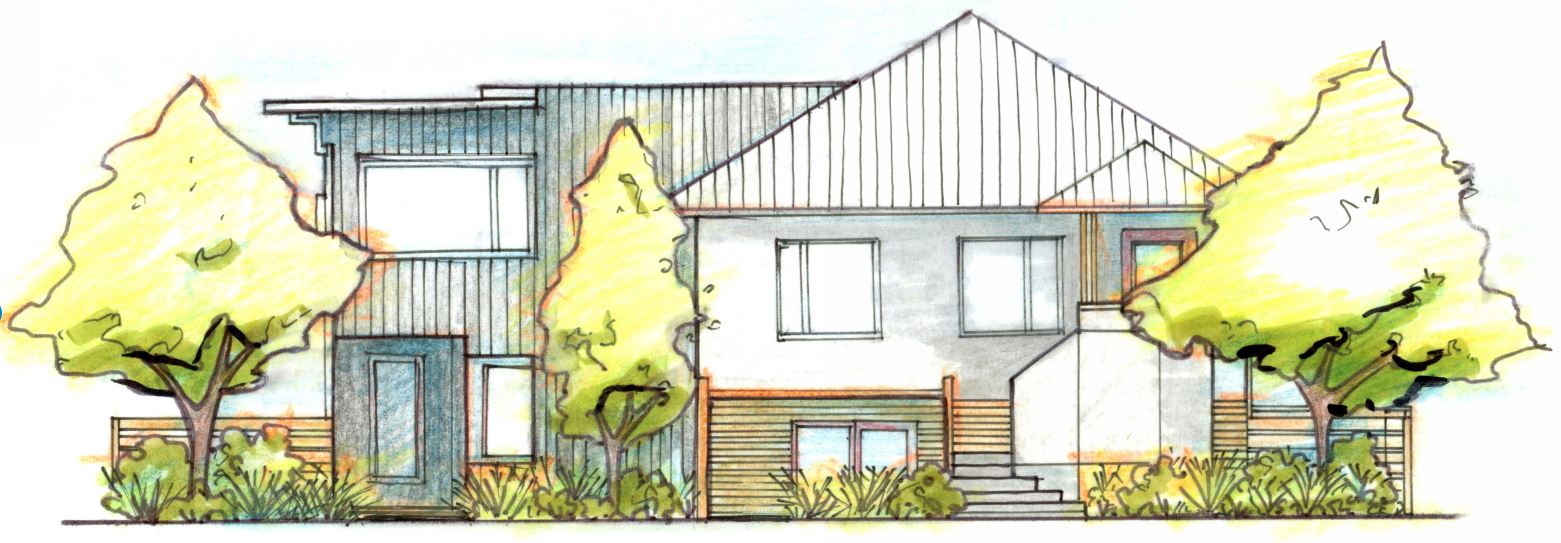
We are still tweaking a few things, but here’s how the design is shaping up.

Front Elevation, sketch Kate Stefiuk

Front Elevation, sketch by Kate Stefiuk

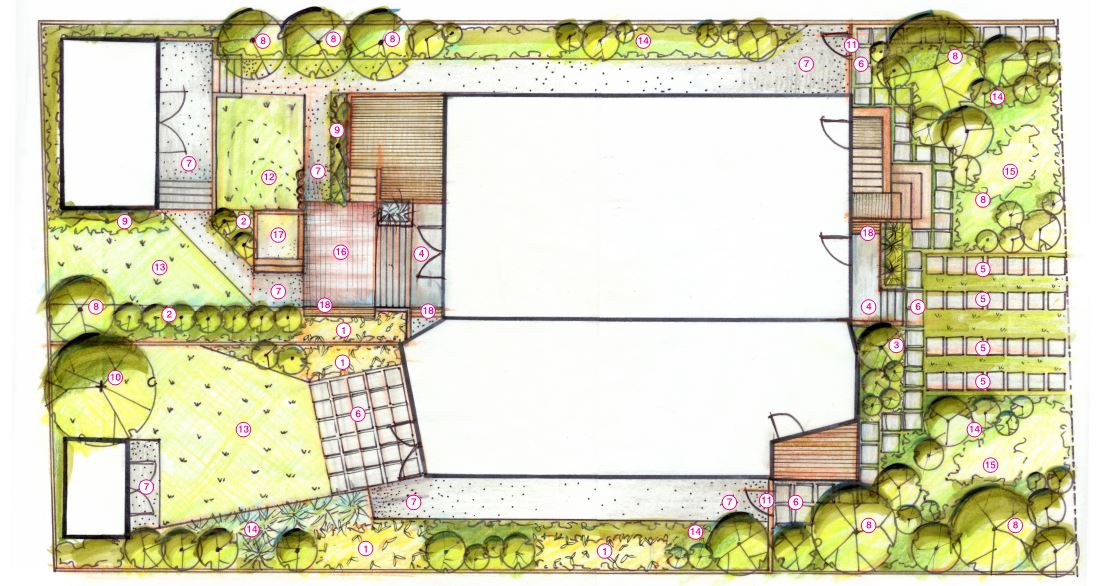
Landscape plan, sketch Kate Stefiuk

Landscape plan, sketch by Kate Stefiuk


Filed Under: Featured, Rezoning Tagged With: community engagement, neighbourhood engagement, rezoning

Attached Duplex Design is a Go!

July 17, 2016 by clove 2 Comments

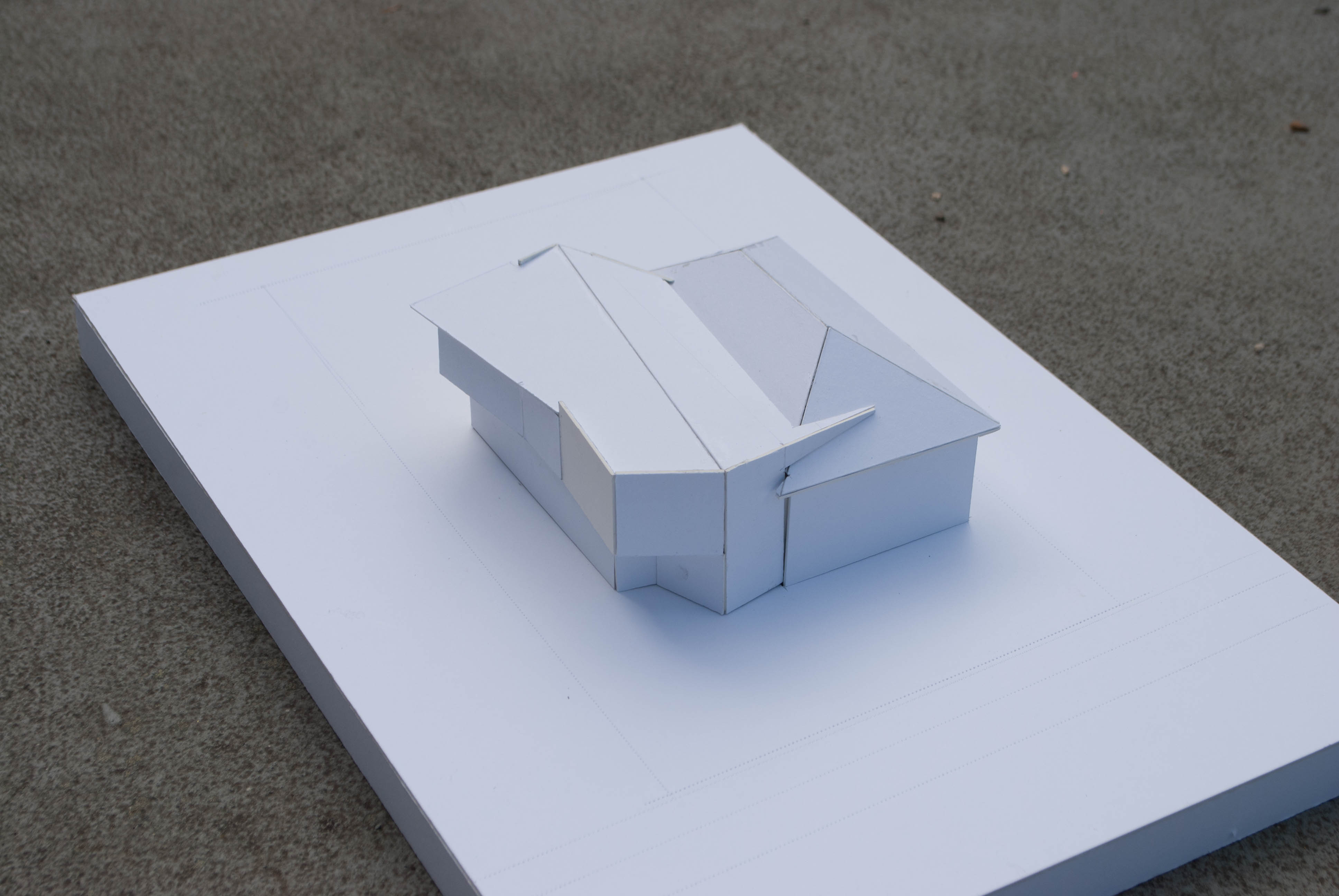
Attached model experiments by Mark Ashby

Attached model experiments by Mark Ashby

We’re going ahead with a new attached duplex design! Here’s why:

  • The attached option addresses some neighbours’ concern that the small lot house would have been too close to our neighbours. The attached option creates more space on the sides and fits better on our lot.
  • The attached option provides more distance to the large Garry oak in the adjacent yard to the south – better for its roots and less shade for our rooftop solar photovoltaics.
  • I’ve identified at least a couple of lending options that are viable for the attached option.
  • The massing is better for energy performance (less exterior walls = less energy lost through the envelope).
  • The approval process is simpler – we can meet the two-family zoning regulations with fewer variances and no longer need to collect petition signatures.
  • The city fees for the rezoning application are lower and we eliminate city subdivision fees (which amounts to savings of $5,000-$8000).

If we were set on the small lot subdivision option and were willing to wait a while, we might have been able to get it through. But the attached option does meet our needs and we do want to get the project going, so it felt like the best solution given the circumstances.

The design in now in progress and we’ll share renderings soon. One of the debates we’ve had is how to design an addition to an old existing house. Do we blend the design so that it looks like one unified whole? I think if we were designing from scratch we would do that. But to make the structure look like a unified whole, we actually would have to change the form of the existing house dramatically – particularly the roof.

We believe that the best way to honour the existing home and to retain as much of its existing structure as possible is to create a marked distinction between new and old. Mark A is taking a sculptural approach to the addition to contrast with the existing form and work with the existing roofline. Not an easy task, and we’re thankful we have an architect like Mark working out the details.

I had hoped to present the design at the mid-August Fairfield Gonzales Community Association Land Use Committee (CALUC), but discovered that the committee has been disbanded. Well, temporarily at least, as the group reconciles its status as a charity organization with its role in land use development issues. I am attending a community meeting to learn more. Stay tuned and in the meantime, enjoy the sun!


Filed Under: Design, Featured, Rezoning Tagged With: design, energy efficient design, rezoning, ultra low energy

Checking in with the City

June 10, 2016 by clove 2 Comments

I met with the City Planner responsible for rezoning applications for a second time. I’d met with him much earlier in the process to present our small lot subdivision concept. This second meeting was to update him on our progress and to establish whether the planning department had a preference for the small lot subdivision or the attached duplex path. I had already poured over the respective rezoning requirements for both options, but I found that the duplex design guidelines were much less detailed than the small lot design guidelines.

The planner confirmed that, in terms of design, a small lot subdivision and duplex application are evaluated similarly. In neither case does his department judge a project based on whether it is a contemporary or a traditional design. They look more at elements like scale, form, variation in materials, and landscaping that reference dominant features in the neighbourhood. So that was good news.

I also followed up with calls to other city departments that will be reviewing our application. Here’s what I learned:

  • For the small lot subdivision, we can either add two curb cuts or one larger curb cut to serve both properties. The city has a slight preference for a single larger curb cut because it takes up less overall street parking space. An attached duplex will need two curb cuts spaced a minimum distance apart. We’ll want to have these details worked out before we submit to minimize redesign work.
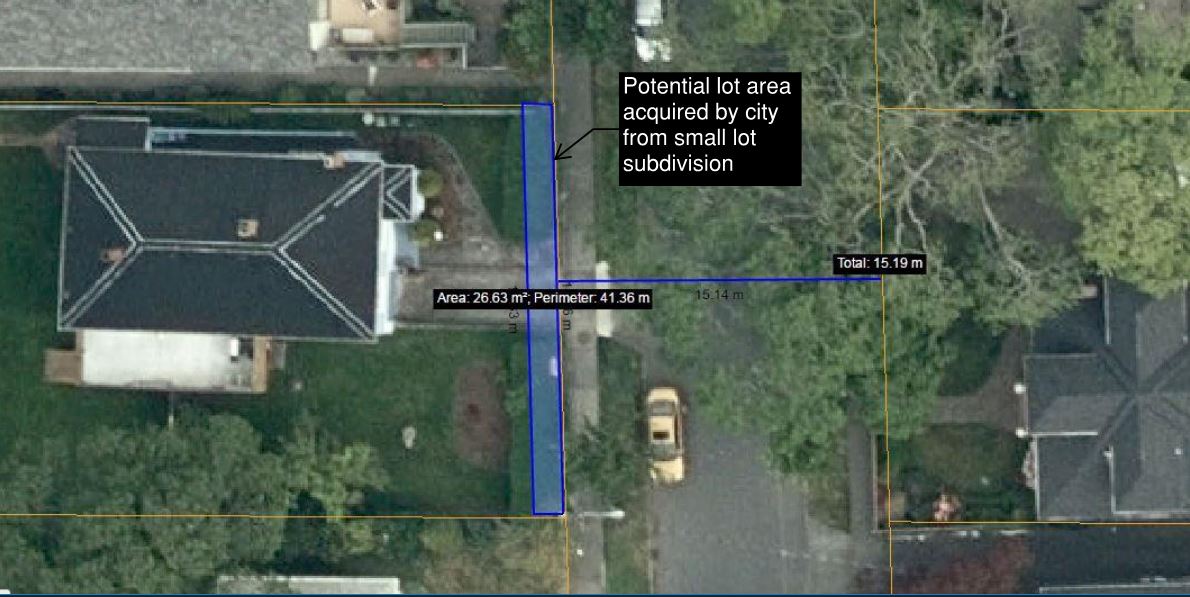
  • Here’s an interesting one: For the small lot subdivision, the city will ask for up to 1.5 meters of the depth of our lot as a dedication for widening the street. This is because our street is only 15 m wide and their standard is 18 m. So the city uses the subdivision as an opportunity to gain back up to half the missing road width, which they can then use to widen the boulevard or plant additional street trees. Here’s roughly what that would look like:

Small Lot Right of Way

  • The takeaway: make sure the small lot meets the minimum 300 sq m area with a 1.5 m swathe removed from it. With the current proposed property line location, one lot would dip below the minimum with that strip removed, and could potentially be rejected.
  • For the attached duplex option, this would not be a requirement. Score one for Plan B.

I hope that I will soon reach a point when I stop learning surprising new things every time I talk with someone about how to make our project happen. What I will say about working with the City of Victoria is that, while the rezoning process is an onerous one, its staff are available and willing to provide guidance. It’s easy to set up a meeting and if I call someone, they call me back within a couple of days. The trick is to figure out what questions you need to ask.

As we find answers and continue to hear input from others, Matt and I are solidifying our plan and feeling confident in our path forward. More to come soon!


Filed Under: Featured, Rezoning Tagged With: duplex, rezoning, small lot subdivision

Survey Says…(Talking with Our Neighbours Part 3)

May 27, 2016 by clove Leave a Comment

We’re approaching 11 months since we moved into our new (old blue) house, and about 9 months since we had our first early conversations about our small lot subdivision proposal. We’ve since talked with over 50 neighbours and left letters with a bunch more. We reached out to everyone on our block, plus many neighbours on adjoining blocks. Some neighbours we’ve met with numerous times; some only once; others we haven’t heard from at all.

This level of outreach may not be required for every project, but it felt right in our case for a few reasons:

  • The level of engagement in our community is very high. People care and want to be included.
  • We heard some strong opposition to our small lot proposal early on and needed to better understand how many people shared these views.
  • Because we intend to stay here for the foreseeable future, the effort to meet our neighbours has been worthwhile. We’ve heard so many interesting stories!

Here is our summary of what we’ve heard so far (you can view the current design here).

Of the immediate neighbours from whom we need written support (those with whom we share a property line), 73% who have responded are supportive and 27% are opposed. Several others have not responded or are remaining neutral. The key here is that to proceed with the current proposal, we would need at least 75% of neighbours to provide written support via petition. If someone doesn’t respond, his/her vote does not count.

Of ALL the neighbours we have heard from, 84% are in support or neutral, and 16% have stated opposition.

Here is what we heard people say they like about our current design (generally including comments we heard from more than one person):

  • They like the scale of the small lot house
  • They like that we are adding modest density
  • They like that we are keeping the existing house
  • They like the ultra-low energy design and environmental goals
  • They think density is needed to support Oak Bay Avenue businesses
  • They like the dedicated green space in back yard (moving parking to the front)

Here is what we heard people say they do not like about our current design:

  • They think the space is too tight for a second house
  • They are opposed to small lot subdivision
  • They don’t like the design and think it should more closely mimic character houses on the block
  • They think the proposed project will make parking issues worse
  • One doesn’t like parking in the front

Other comments, suggestions and ideas that were offered:

  • Consider the attached option, as it will leave more space between adjoining side properties.
  • Many are concerned about impacts to our neighbours most immediately affected due to their strong relationships and their current health issues. Consider waiting.
  • Confirm that there will be enough distance to the Garry Oak to the south to not damage it.
  • Partially bury workshop in the rear yard and/or change roof line to reduce height and minimize intrusion on properties to the west.
  • Remove back yard shed for new house to leave more rear yard green space.
  • Make the roof line of the new house more conventional.
  • Be more clear about material choices (i.e. show that we are using cedar or other natural siding material).
  • Include solar thermal for hot water pre-heating.

Next steps: If we go ahead with the small lot plan, we will incorporate as much of the constructive feedback as possible. We are also considering the attached duplex option. To confirm that this option is viable for us, we have a bunch of questions we need to answer around financing, costs, design requirements, and city expectations. This is what we are working on now.

Schedule: With either option, we have to apply for rezoning, which will take 6-12 months to get approved after we submit. Our current goal is to submit our application this summer with the hope of beginning construction next spring/summer.

Filed Under: Rezoning, Uncategorized

Remind Me Again Why We’re Doing This?

January 29, 2016 by clove 3 Comments

I’ve been learning through trial and error about how to communicate our project.

In my early conversations with our neighbours, I focused on sharing the basic information. What do we want to do and what does it look like? I knew I had to keep it short and not throw out too much information all at once. So I showed renderings, gave basic facts, and then somewhere in the muddle of it all, I practically whispered something about energy efficiency and my passion for sustainability – as if I was embarrassed to admit that this was the stuff that gets me up in the morning.

Then last week, I took a course in communication and leadership that convinced me I had it backwards. I need to lead with the vision and follow with the cool pictures and facts!

In other words, we must answer the question ‘why?’ at the very beginning of the conversation. If we answer the question later, it gets lost in the details. If we don’t answer it at all, we leave others to guess, and for many, ‘why’ is that we’re just another developer out to maximize profit.

So I tried it for myself, using the project narrative/letter to Council as my testing ground. Here’s the draft of the introduction:


This proposal is to modestly increase density in one of Victoria’s most walkable neighbourhoods, in a manner that exemplifies efficient design and construction practices, and respects the fabric of the existing established neighbourhood. The project is shaped by the following fundamental values (here comes the ‘why’):

  • We believe that we have the skills, materials, and available technologies – right now –  to build new homes that are significantly more energy and water efficient, comfortable, healthy and long-lasting than most of what is being built today.
  • We believe there is tremendous value in our existing homes and that there is much we can do to improve those as well.
  • We believe that environmental outcomes are at least as important as financial ones.
  • We believe that thoughtfully designed infill is critical to supporting a walking and biking culture.
  • We believe that sustainable design is compact design.
  • We believe that anyone can make a positive difference in their communities and this project is how we want to do it.

Starting with our vision – in a written narrative, a presentation, or an in-person conversation – reminds us what motivates us; what excites us; what pushes us out to knock on doors and jump through seemingly endless hoops. The fact that we have this opportunity to manifest so many of our core values in a real, live, bricks and mortar project is frankly incredible! It makes me want to jump up and cheer. So why in the world would we not start by sharing this enthusiasm?

You may not agree with our vision, and that’s OK. But the beautiful thing about sharing it is that it opens the door to conversation. It leads to questions. It may lead to disagreement.  It may lead to new ideas.

And by being clear about what we care about and where we are coming from, we are opening ourselves to the possibility that others are there with us.

What do you think?

(For a different spin on the same theme, check out architect Steve Ramos’ 7 Essential Public Speaking Lessons I Learned the Hard Way.)

Filed Under: Rezoning Tagged With: community engagement, energy efficient design, infill, neighbourhood engagement, rezoning

Talking with Our Neighbours Part 2

December 6, 2015 by clove 5 Comments

On Remembrance Day and I found myself with the gift of a free afternoon – a rare window of time during the day when I wasn’t working or with our daughter.

Despite a low-level trepidation, I folded the plans under my arm, donned my boots, scarf and mittens and thrust myself into the bright chilly November afternoon.

I started at the south end of the 100m radius on our block. A neighbhour several doors down was out raking leaves. I introduced myself, told her we were planning a project and asked if she wanted to hear a bit more. As I got into some of the goals of the project, she became increasingly engaged. She knew about Passive House; recognized that we had a huge lot that was likely to be developed by someone if not us, and said she would like to see our project happen. What a great (and relieving!) first conversation!

I talked with 5 more neighbhours that afternoon, including three who share a property line with us. 5 of the 6 people I talked with were either neutral or supportive. The 6th thought that the new lot and house seemed very narrow, but he also commended our ambitious plan.

So far so good!


I’ve now spent five afternoons door knocking and have had conversations with over 20 different neighbours. Each time, I have started with uncertainty and finished feeling buoyed by the largely positive response.

Here is a summary of the generally positive and constructive comments I have heard so far:

  • Most are either neutral or supportive of the project proposal
  • Many were supportive of adding modest density to the area
  • Most are either neutral or supportive of adding the suite to the existing house, citing the need to increase density and the diversity of housing options in the area
  • Neighbours sharing back yard boundaries want to ensure that their privacy is considered in the house and landscape design
  • One architect neighbour with a long history in the area suggested we move the parking back to the front of the property (see early design post). No other houses on the block with adjoining back yards on Chamberlain and Clare Streets have parking in the rear, which results in a large ‘park’ space that many of the residents value highly. There are even gates connecting many of the backyards.
  • Many expressed interest in and support for the energy efficiency/low energy approach to the design

Filed Under: Rezoning Tagged With: community engagement, neighbourhood engagement, rezoning, small lot subdivision

OK but HOW do we Talk with Our Neighbhours?

November 13, 2015 by clove Leave a Comment

I’ve described our project to neighbours we’ve gotten to know since moving in this summer. I need to broaden the circle to include neighbhours we haven’t yet met. But I’d been reluctant to take the next step and realized that I didn’t quite know how to initiate those conversations. I saw myself become the door-to-door solicitor that everyone avoids. I don’t want to impose myself and I don’t want to presume that everyone is interested or has the time to talk.

Deeper within my psyche lies the fear of launching our creation out into the universe and inviting feedback. It’s entirely possible that this project into which we have poured many hours of research and creative energy, could be hated. We are making ourselves vulnerable, and that is a little scary.

And yet – if we want to realize our project, it has to be done and the sooner the better. It’s even highly possible that we will learn something that will make our project even better. We’re early enough in the process that we can bend with the prevailing wind of community opinion.

Acknowledging the root of my reluctance, I turned off the timid voices in my head and converged on a plan of action. Yes, I will go door to door. But the purpose of my door knocking is simply to introduce the project; to ask if people want to learn more and then to arrange follow-up that meets their needs. This is a plan I can work with.


Filed Under: Rezoning Tagged With: community engagement, neighbourhood engagement, rezoning

The Radius of Neighbhourhood Consultation

October 31, 2015 by clove Leave a Comment

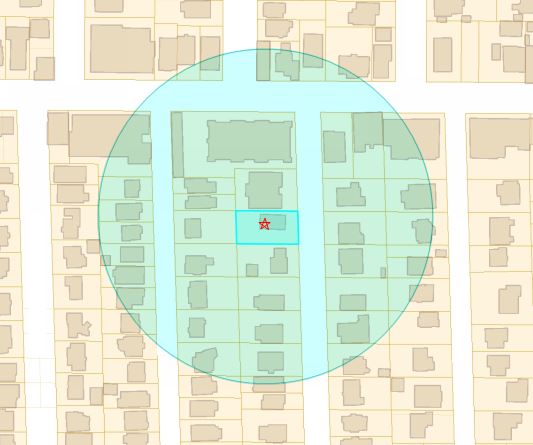
When our design is essentially complete, we will apply to present our project to a meeting of the Gonzales Neighbhourhood Community Association Land Use Committee (CALUC). The city mails notices of the meeting to all residents within a 100m radius of our property.

Here’s what that radius looks like (our house is the starred one in the middle):

notification radius for community mtg

The job of the CALUC is to record the general sentiment and specific comments of both the committee and any neighbhours in attendance. They submit these comments to the city and they are considered during the evaluation of our application.

As part of our application – and ideally before the CALUC meeting, we also have to petition all voting-age owners and renters of all properties sharing a property line or with a property line within 10m of ours. The properties outlined in red within the 100m radius shown in the image are the ones we are required to petition:

 signature radius for petition

The petition asks residents to indicate whether “I support the application” or “I am opposed to the application” and includes a space for comments. We tally up the “yeses” and the neutral non-responders and these have to represent a minimum of 75% of the total petitioned.

So my goal is to knock on as many of these doors as possible while we are still developing the design and can incorporate feedback.

Filed Under: Featured, Rezoning Tagged With: community engagement, neighbourhood engagement, rezoning

Early Meeting with the City Planner

October 9, 2015 by clove 1 Comment

Yesterday I met with the City of Victoria planner responsible for small lot subdivisions in our area. The purpose of this early meeting was to get a sense for any real or perceived barriers to approving our project from the planning department’s perspective. After we go through the community consultation process and submit our official rezoning application, it works its way through various engineering and planning departments and the planning department ultimately makes a recommendation for Council’s consideration.

When it comes to giving guidance around rezoning, planning staff are tasked with communicating what is allowed by already established zoning classes. They are unlikely to express support for a custom zoning proposal. A lot of work has gone into the creation and evolution of existing zoning and to have every developer come along and create something new would defeat the whole purpose of zoning regulations. The purpose of this early meeting was therefore to read between the lines and to get a sense for openness to our proposal.

The first thing the planner said, having given the schematic drawings a quick glance, was “this looks challenging.”

He felt that the biggest challenge was the addition of a suite to a small lot property (which is what the existing house would become after subdivision). It isn’t allowed in the existing small lot zoning, which is already very well established. It even has its own Design Guidelines.

There was plenty of nuance in our in-person conversation, including an acknowledgement of the importance of neighbourhood opinion. The nuance was absent from his follow-up email, which encouraged us to rework the project to meet existing zoning (i.e. no suite).

Although it feels like a rejection, I would be a fool to be surprised by this response. We already know that adding a suite in a small lot house is unprecedented. We also know that we need to creatively add housing in the most walkable neighbhourhoods of our city; to increase affordable housing and options for aging-in-place, and to reduce the impact of our buildings and lifestyles.

I debriefed with our planning guru Ian Scott and he said that he was expecting the planning department to say no, and that there was also a strong possibility that planning would recommend against the project in their report to council. The prospect that our project’s approval could come down to a final face-off between City staff and Council feels risky.  

However, Ian also said that none of the current zoning regulations has been updated to reflect the goals of the Official Community Plan (read post). So what it comes down to is whether we want – or can afford– to stick out our necks.

We would love to set a new precedent and to show what is possible with good design. And yet…are we willing to take the risk – the potential added expense and time to redesign and resubmit after a rejected application- in order to be the first to do something new? 

I was anxious to get going on our detailed design, but I still don’t know what many of our neighbhours think – particularly about the suite question. Our next logical step, then, is to talk with our neighbours about more of the specifics – show the renderings and gather their opinions about adding the suite, and then see how everything sits.

I think that if we can get a consensus that the project is very likely to get approved by both our neighbhours and city planning if we exclude the suite, then we would move toward that option.

Filed Under: Rezoning Tagged With: neighbourhood engagement, rezoning, small lot subdivision

  • « Previous Page
  • 1
  • 2
  • 3
  • Next Page »

Who is Stretch Developer?

Stretch Developer is written by Christy Love. In partnership with my husband Matt, we are challenging ourselves to create the kind of homes we want to live in and see more of in our community. Home is the incredible Victoria, BC, Canada.

Sign up!

Sign up to receive email notifications of new posts.

Recent Posts

  • New Uses for Old Wood Part 2 September 26, 2021
  • Ongoing Preparations for the Apocalypse August 13, 2021
  • Things We’ve Noticed – Energy Edition May 29, 2021
  • Passive House Suite for Rent April 17, 2021
  • Things We’ve Noticed – Comfort Edition March 14, 2021

Blogs We Like

Green Building Advisor Blogs

Musings of an Energy Nerd

Treehugger

Talk to ARYZE

Recent Posts

  • New Uses for Old Wood Part 2
  • Ongoing Preparations for the Apocalypse
  • Things We’ve Noticed – Energy Edition
  • Passive House Suite for Rent
  • Things We’ve Noticed – Comfort Edition
  • New Uses for Old Wood Part 1

Tags

budget building permit cabinet construction climate action climate change community engagement construction deep energy retrofit design design progress development permit duplex duplex + suite energy consumption energy efficient design financing financing passive house finding land food security home inspections infill low energy design neighbourhood engagement net zero passive house Passive House comfort Passive House construction Passive House construction costs passive house for sale Passive House performance Passive House performance; Sanden CO2 heat pump Passive House rental Passive House systems passive house testing performance pro forma property search tips reclaimed wood reclaimed wood construction rezoning roof row house small lot development small lot subdivision ultra low energy

Copyright © 2026 · Metro Pro Theme on Genesis Framework · WordPress · Log in


Loading Comments...